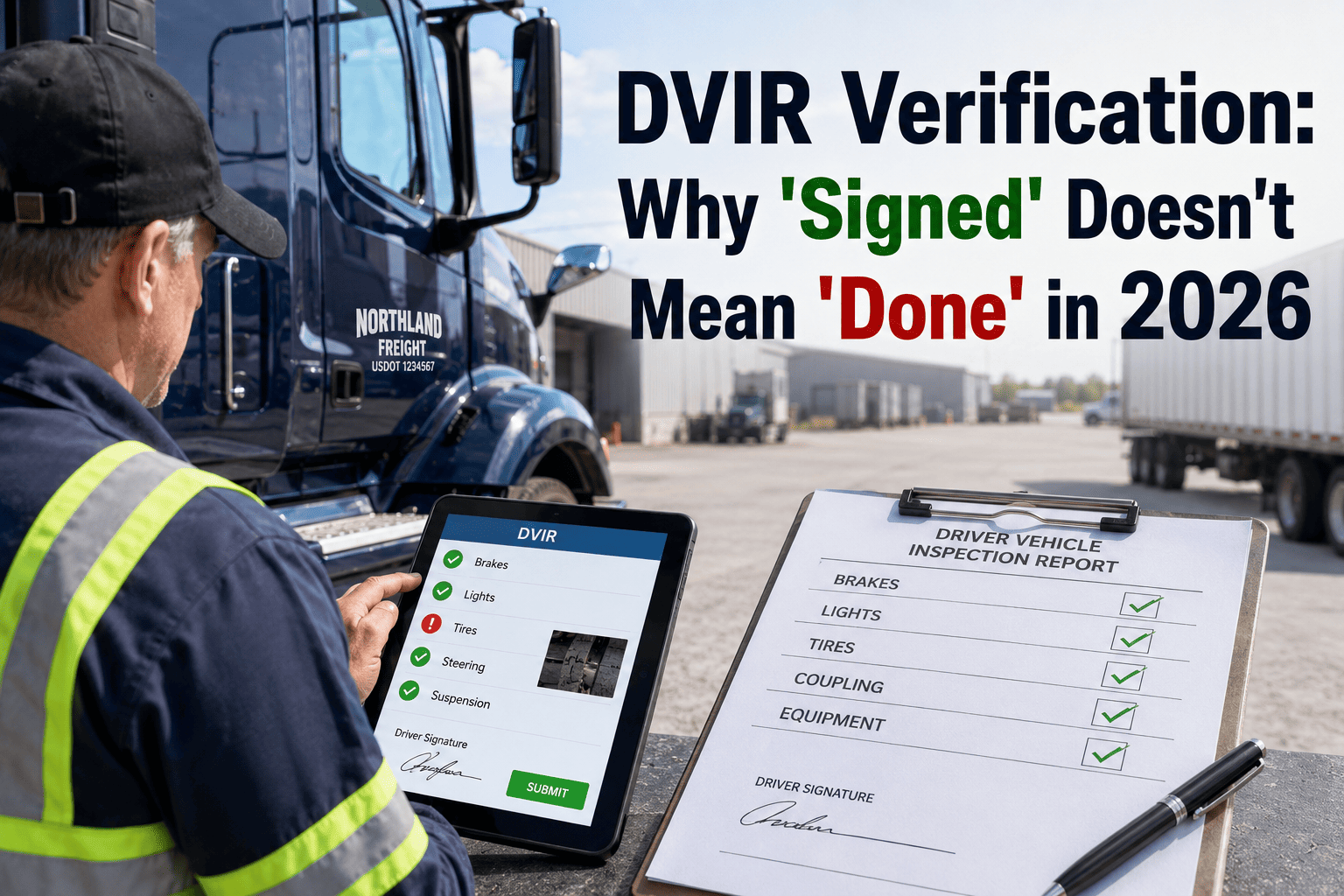
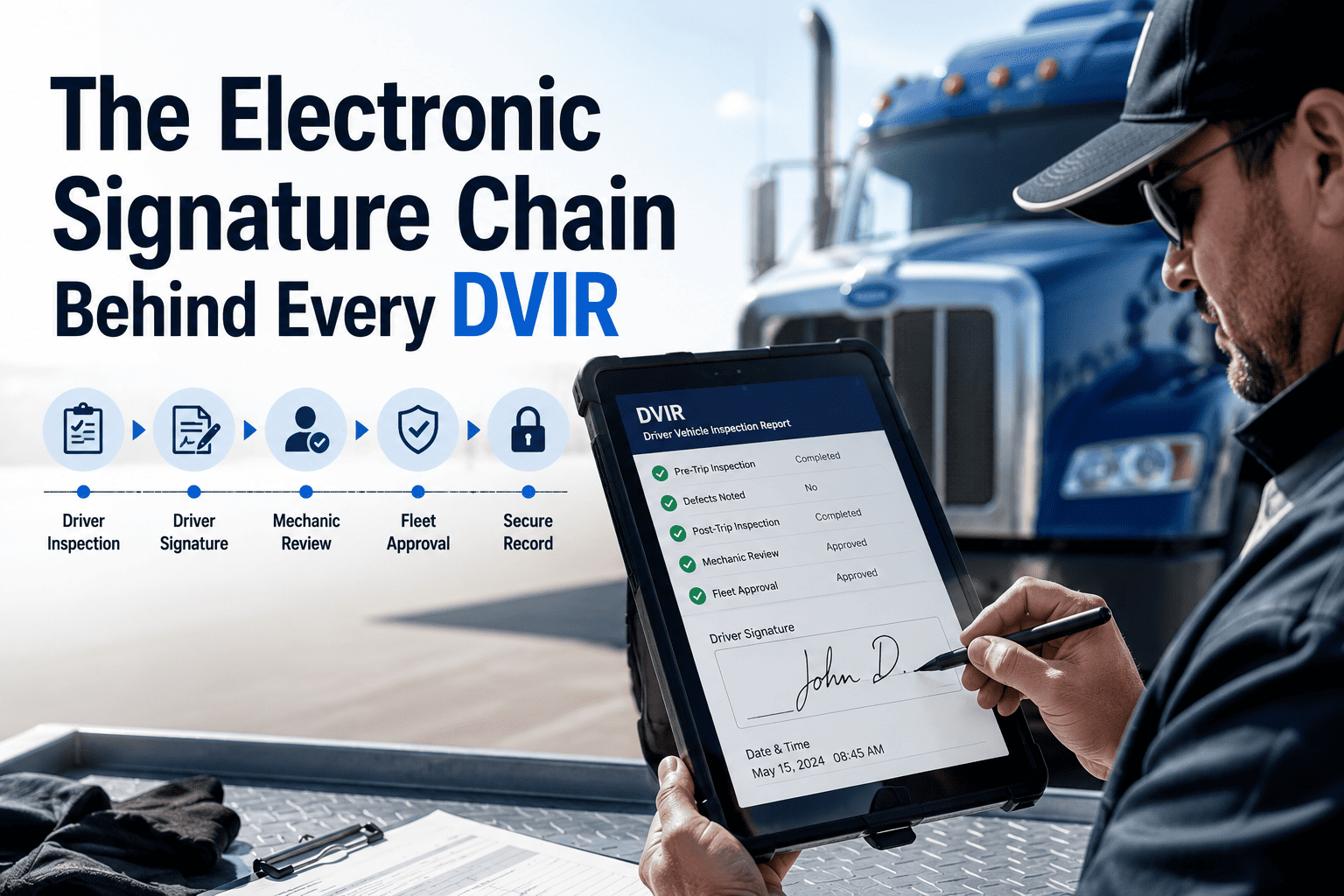
A 45-truck carrier in Ohio failed a DOT compliance review last spring after an auditor pulled fifteen DVIRs and found six missing one specific signature — not the driver's, not the next driver's, but the mechanic's certification that a reported defect had actually been repaired. One of those trucks had left the yard with an open steering defect because nobody had certified the fix before the keys were handed over. Under 49 CFR 396.11, that middle signature is not paperwork — it is the only proof that a defect report ever became a completed repair. See how Oxmaint locks that signature into every DVIR before a truck can be dispatched again.
DVIR Compliance / Repair Certification / 2026 Fleet Guide
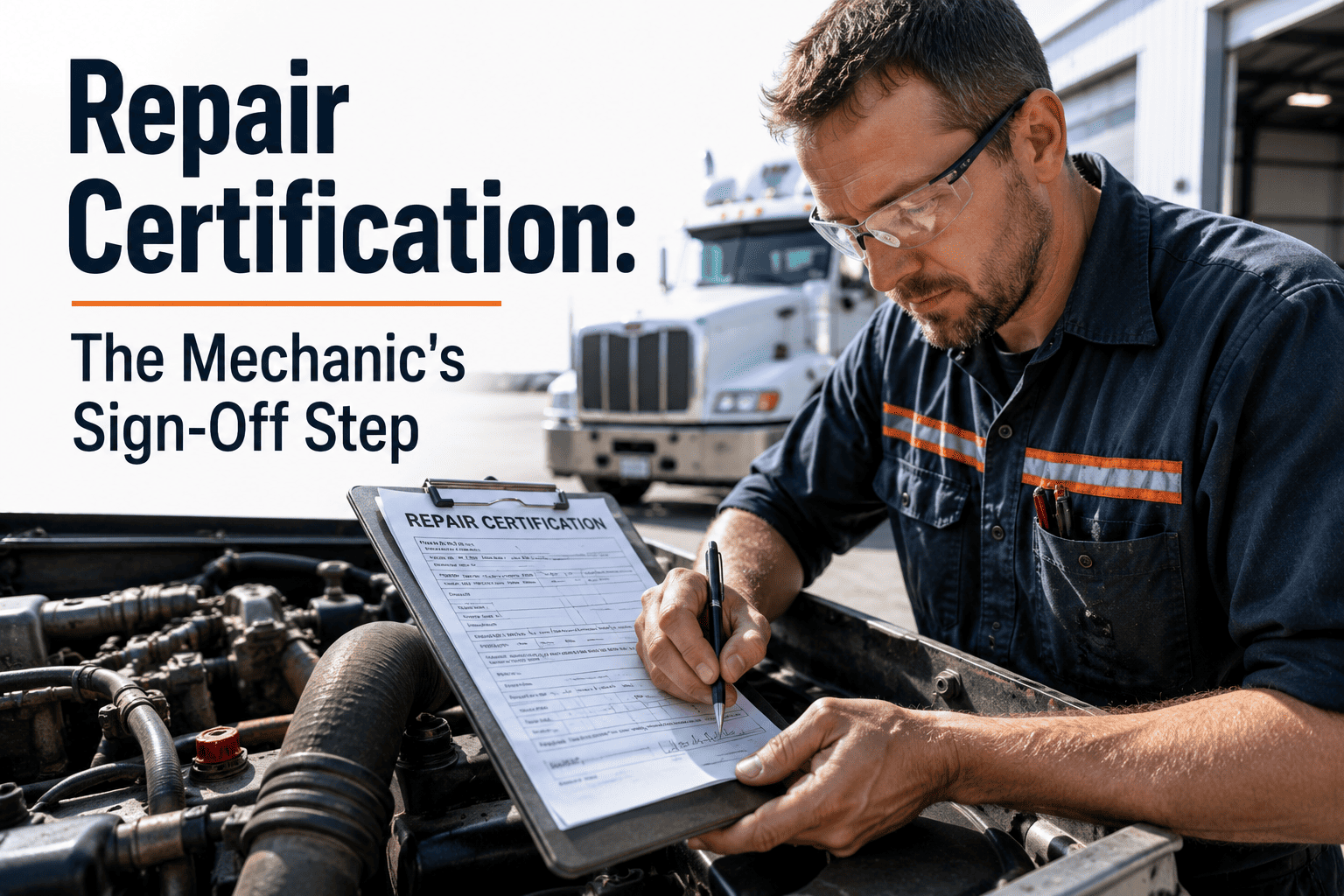
Repair Certification: The Mechanic's Sign-Off Step Most Fleets Get Wrong
A defect report is only half a compliance record. The mechanic's certification is the signature that proves the truck was actually fixed — and it is the single most cited gap in FMCSA audits. Here is exactly what it requires, why it gets missed, and how to close it for good.
89%
Of FMCSA compliance reviews pull DVIR records as a primary audit item
7%
Of motor carriers pass a focused DVIR review without a single citation
3
Signatures required in the DVIR chain — driver, mechanic, next driver
90 days
Minimum retention period for the DVIR and its repair certification
Digital Repair Certification
Make the Mechanic's Sign-Off Impossible to Skip
Oxmaint routes every reported defect straight to the shop, requires a certified sign-off before dispatch unlocks, and timestamps the whole chain automatically — so an auditor never finds a gap.
The Three-Signature Chain — and Why the Middle Link Breaks
Every DVIR under 49 CFR 396.11 is built on a chain of three separate signatures, and the chain is only as strong as its weakest link. The driver who finds a defect signs the report at the end of the shift. The next driver reviews that same report and signs before taking the wheel. Between those two moments sits the signature almost nobody talks about — the mechanic or carrier official who certifies that the defect was actually repaired, or that repair was not required for safe operation. That certification has to land on the original DVIR before the truck moves again, and it is the step auditors flag most often because it depends on a piece of paper or a status update surviving a shift change, a shop handoff, and sometimes a different terminal entirely.
What a Compliant Repair Certification Must Actually Include
01
Certification Statement
A clear statement that the defect was either repaired or that repair was determined unnecessary for safe operation — vague notes like "checked" or "ok" do not satisfy the regulation.
02
Repair Detail
What was actually done to the vehicle — the part replaced, adjusted, or inspected — recorded with enough detail that a second technician could verify the work without guessing.
03
Signature on the Original DVIR
The certification must appear on the same report the driver originally filed, not a separate work order that never gets attached back to the DVIR record.
04
Date and Time Stamp
A date tied to the repair, so the record shows the defect was closed before the vehicle went back into service rather than certified after the fact.
05
Qualified Signer
A mechanic or carrier official with the authority to certify the repair — the regulation does not require an ASE credential, but the signer must be someone the carrier has designated for this role.
06
Dispatch Lock Until Signed
No copy of the vehicle should go back on the road until the certification is complete — the regulation gives no grace period for safety-affecting defects.
From Defect to Dispatch: How the Certification Chain Runs
1
Driver Reports
At the end of the shift, the driver documents any defect affecting safe operation and signs the DVIR.
2
Mechanic Certifies
The shop repairs the defect — or documents why repair was unnecessary — and signs the certification on the original DVIR. This is the step this guide is about.
3
Next Driver Acknowledges
The following driver reviews the certified DVIR and signs before operating the vehicle, closing the loop.
Miss any one of these three signatures and the record is incomplete — but the middle one is the hardest to protect on paper, because it depends on a work order finding its way back to a DVIR that may already be sitting in a different truck's cab. Talk to Oxmaint about closing that gap across every terminal your fleet runs.
Paper vs. Basic Digital vs. Oxmaint Certification
| Certification Step |
Paper DVIR |
Basic Digital Log |
Oxmaint |
| Defect routes to shop |
Manual handoff — often delayed a shift |
Emailed or messaged to shop manually |
Auto-routed to the shop the moment it's logged |
| Certification location |
Written on the same paper copy — if it's found |
Separate work order, rarely linked back |
Certified directly on the original digital DVIR |
| Dispatch lock |
No system enforcement — relies on memory |
No automatic block on dispatch |
Vehicle stays locked until certification is signed |
| Audit retrieval |
Manual filing search — hours or days |
Searchable but scattered across tools |
Full 3-signature chain pulled in seconds |
| Retention compliance |
Depends on someone remembering to file it |
Stored, but repair record often separate |
DVIR and repair record retained together automatically |
What Happens When the Certification Signature Goes Missing
01
Out-of-Service Orders
If a roadside inspector finds a critical safety defect without a certified repair, the vehicle can be placed out of service on the spot — stranding the load until a certified mechanic reaches the site.
02
Citable Audit Findings
A missing certification signature is one of the most frequently cited findings in DOT compliance reviews, and it counts against the carrier even when the repair was actually completed.
03
Civil Penalties
Dispatching a vehicle with an unrepaired, uncertified safety defect carries some of the steepest per-violation fines in the FMCSRs, and penalties compound across every vehicle in the sample.
04
Litigation Exposure
After an accident, an uncertified defect on record is one of the first things a plaintiff attorney looks for — it turns a mechanical failure into a documented carrier oversight.
Close the Compliance Gap
Give Every Repair a Signature That Actually Sticks
Oxmaint keeps the defect, the repair, and the certification on one record from the moment it's reported to the moment the next driver signs off.
How Oxmaint Closes the Certification Gap
01
Instant Defect Routing
The moment a driver logs a defect, it lands directly on the assigned mechanic's queue — no waiting for a shift handoff or a printed copy to reach the shop.
02
Certification Tied to the Original Record
The mechanic's sign-off is captured directly on the same digital DVIR the driver filed — never a separate work order that has to be reconciled later.
03
Dispatch Lock Until Signed
A vehicle with an open safety defect cannot be dispatched in Oxmaint until the repair certification is complete — the rule enforces itself instead of relying on memory.
04
Audit-Ready in Seconds
Every DVIR, certification, and next-driver acknowledgment is retained together and searchable, so a compliance review request is answered in minutes instead of days.
Frequently Asked Questions
Does the mechanic have to be a certified technician to sign the DVIR?+
No specific credential is required by the regulation. The signer needs to be a mechanic or carrier official the carrier has designated with authority to certify repairs, and the certification must appear on the original DVIR.
What if the defect doesn't actually need a repair?+
The mechanic can certify that repair was unnecessary for safe operation, but that reasoning still has to be documented on the DVIR — an unexplained blank is treated the same as a missing signature.
How long does the repair certification record need to be kept?+
The DVIR itself must be retained at least 90 days, but the repair record it triggers generally needs to be kept for as long as the vehicle is under the carrier's control, plus twelve months after.
See how Oxmaint retains both together automatically.
Is an electronic mechanic sign-off legally valid?+
Yes. A 2026 FMCSA final rule explicitly added electronic DVIR authorization to the governing regulations, confirming that digital signatures, mobile submission, and cloud storage satisfy the written-report requirement.
What happens in drop-and-hook or slip-seat operations where multiple drivers share a truck?+
The chain still applies in full — whichever driver next operates the vehicle must review and acknowledge the certified DVIR, even if days passed and a different terminal handled the repair.
Book a demo to see how Oxmaint tracks the chain across terminals.
DVIR Compliance — Oxmaint
Every Defect Reported. Every Repair Certified. Every Truck Dispatched Clean.
Instant defect routing, certification tied to the original DVIR, dispatch locked until signed off, and a full audit trail ready in seconds — no more chasing a signature after the truck has already left.