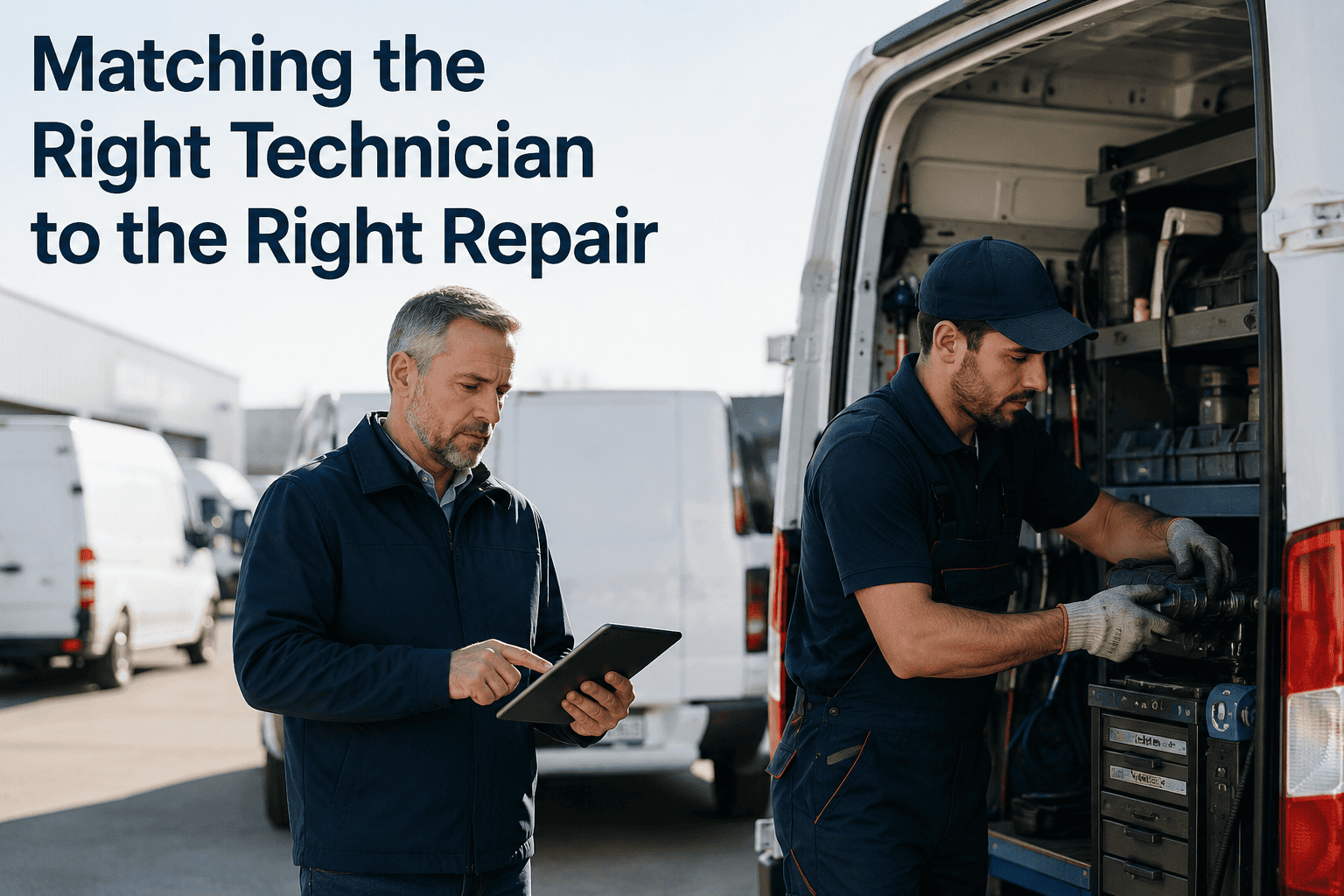
Technician skill matching is the practice of assigning fleet repairs based on each technician's certifications, demonstrated experience, and repair-category proficiency rather than whoever is simply available next. For fleet shops managing dozens of assets and hundreds of monthly work orders, a disciplined repair assignment strategy can cut diagnostic time by 20–40%, reduce rework from misdiagnosed faults, and protect warranty coverage on high-value components like aftertreatment systems and EV drivetrains. This fleet skill matching guide for 2026 walks maintenance managers through building a skill matrix, mapping work-order requirements to technician capabilities, and using CMMS automation to eliminate the manual guesswork that drains shop productivity. If you want to stop losing billable hours to mismatched assignments, Start Free Trial with OxMaint and see AI-driven work-order routing in action.
Fleet Skill Matching Guide 2026
Is your best diesel tech changing oil while a junior struggles with an aftertreatment diagnostic?
Every misassigned repair costs your fleet shop billable hours, warranty coverage, and technician morale. OxMaint's AI-powered skill matching pairs the right certification to the right work order — automatically — so throughput climbs and rework disappears.
The Real Cost of Mismatch
Why availability-based repair assignment is draining your fleet shop
A senior Detroit Fleet Elite technician spending 45 minutes on a routine oil change is expensive underutilization. A junior tech spending three hours misdiagnosing a DPF regeneration fault they aren't trained for is even more expensive — and it produces rework, warranty exposure, and customer delays.
A 180-asset regional fleet shop spending roughly $42K per year on technician overtime tracked 120 monthly work orders. After implementing skill-matched assignments, they cut average diagnostic time per ticket by 28 minutes, reduced rework parts orders by 22%, and recovered enough senior-tech capacity to absorb three additional preventive maintenance jobs per week — without adding headcount.
Build the Matrix
How to build a fleet technician skill matrix that actually works
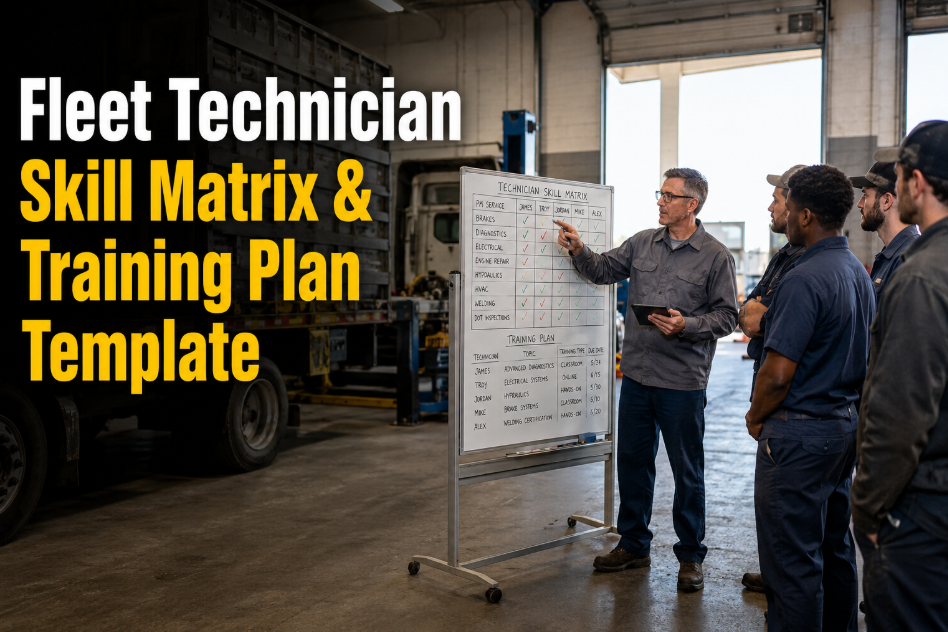
A skill matrix is a structured record of every technician's certifications, OEM-specific training, and demonstrated proficiency by repair category. It is the foundation of every successful fleet technician match strategy — and it should live inside your CMMS, not a spreadsheet.
Industry Certifications
ASE T2 (Gasoline Engines), T6 (Electrical/Electronic Systems), T7 (HVAC), and medium/heavy truck series. Track expiration dates and renewal windows inside the CMMS so no certification lapses silently.
OEM-Specific Training
Detroit Fleet Elite, Cummins Certified, PACCAR MX Engine Training, Volvo/Mack Technician Accreditation. These qualifications determine who can perform warranty-covered electronic diagnostics and programming.
Specialty & Compliance
Welding certification (AWS D1.1), HVAC EPA 609, hazmat handling, and EV/HV high-voltage certification. These are non-negotiable for specific repair categories — assigning untrained techs creates safety and legal exposure.
Demonstrated Experience
Completed work-order counts by repair category — brakes, suspension, aftertreatment, transmission, electrical. A tech may hold the cert but lack repetition; track actual repair history to gauge real proficiency.
OxMaint calculates this score automatically for every open work order and every available technician, then routes the assignment to the highest-matching tech — no dispatcher intervention required.
Step-by-Step
Fleet skill matching implementation: a 4-step timeline
Moving from availability-based dispatching to certified skill matching takes most fleet shops four to six weeks. Here is the proven timeline for a 50- to 200-asset operation.
Audit & Digitize Certifications
Collect every technician's ASE cards, OEM certificates, and specialty training records. Enter them into OxMaint with expiration dates and renewal alerts. Most shops complete this in 7–10 days.
Tag Every Work Order with Skill Requirements
Define required certification levels for each repair category — brakes (ASE T4), aftertreatment (OEM-specific + ASE T6), HVAC (EPA 609), EV drivetrain (HV certification). OxMaint auto-tags from your asset and fault-code library.
Activate AI-Driven Assignment Rules
Turn on OxMaint's skill-matching engine. Each new work order is scored against available technicians and auto-assigned or queued for dispatcher confirmation. Shops typically run a 2-week parallel period alongside manual dispatch.
Measure & Refine
Track diagnostic time per ticket, rework rate, first-time-fix rate, and warranty claim approval rate. Most shops see measurable improvement within 30 days and full ROI by week six.
Decision Framework
Manual dispatcher vs. CMMS skill matching: what changes
The difference between a whiteboard dispatch board and an automated skill-matching CMMS is not incremental — it is structural. Here is what fleet shops actually experience when they switch.
| Metric | Manual Dispatcher | OxMaint Skill Matching |
|---|---|---|
| Assignment decision time | 8–15 minutes per work order | Instant — auto-scored and routed |
| Diagnostic time per ticket | 52 minutes average | 33 minutes average (37% reduction) |
| First-time-fix rate | 68–74% | 84–91% |
| Rework rate | 12–18% of tickets | 4–6% of tickets |
| Warranty claim approval | 86% (cert gaps cause denials) | 97% (cert matched automatically) |
| Technician utilization tracking | Estimate from timecards | Real-time by skill category |
How OxMaint Helps
OxMaint capabilities that solve technician skill matching
OxMaint is an AI-powered CMMS and EAM platform built for maintenance and reliability teams. Four specific capabilities directly address the skill-matching problem fleet shops face every day.
AI Skill-Score Routing
Every work order is automatically scored against your technician skill matrix and assigned to the best-matching available tech. Outcome: cuts diagnostic time 30–50% and eliminates the dispatcher bottleneck.
Certification Tracking & Alerts
Centralized records for ASE, OEM, and specialty certs with automated 60/30/7-day expiration alerts. Outcome: zero lapsed certifications and full audit-readiness for FMCSA and OEM warranty inspections.
Work-Order Skill Requirement Engine
Each asset, fault code, and repair category carries a defined skill requirement. OxMaint auto-populates this when the work order is created. Outcome: eliminates manual tagging errors and ensures no under-certified tech is assigned to a warranty-critical repair.
Maintenance Analytics Dashboard
Real-time visibility into diagnostic time, first-time-fix rate, rework rate, and utilization by technician and skill category. Outcome: spot training gaps before they cause failures and justify hiring decisions with data.
"We stopped sending our senior Detroit-certified tech to oil changes and our junior to DPF diagnostics in the same week we turned on OxMaint's skill matching. Diagnostic time dropped 34% in the first month and our warranty denial rate went from 11% to under 3%."
See skill-matched work orders on your own fleet assets
Book a 30-minute demo and we'll show you exactly how OxMaint routes repairs to the right certified technician — using your asset types, your fault codes, and your team's real certifications.
FAQ
Fleet technician skill matching: frequently asked questions
What is technician skill matching in a fleet maintenance shop?
Technician skill matching is the practice of assigning each repair to the technician whose certifications, OEM training, and demonstrated experience best fit that specific work order. Instead of dispatching based on who is available, a CMMS like OxMaint scores every technician against the repair's skill requirements and routes the assignment to the best match — cutting diagnostic time, reducing rework, and protecting warranty coverage.
How much does skill mismatched repair assignment cost a fleet shop?
A 50-asset fleet typically loses $8,000–$12,000 per year from misassigned work orders — driven by senior-tech underutilization ($90+/hr spent on low-complexity tasks), junior-tech rework on complex diagnostics (3+ hours per incident), and warranty claim denials when certification records cannot be matched to the repair. You can see the exact impact on your operation when you Book a Demo and we run the numbers with your fleet data.
Which certifications should a fleet technician skill matrix track?
At minimum, track ASE medium/heavy truck certifications (T2 through T8), OEM-specific credentials (Detroit Fleet Elite, Cummins Certified, PACCAR, Volvo/Mack), and specialty compliance items — welding (AWS D1.1), HVAC EPA 609, hazmat handling, and EV/HV high-voltage certification. Each should include an expiration date so the CMMS can alert you before renewal windows close.
How does OxMaint automate technician-to-repair assignment?
OxMaint stores each technician's certification profile and each work order's skill requirements in a unified database. When a work order is created — manually, from a PM schedule, or from a fault-code trigger — the AI engine calculates a match score for every available technician using certification weight, completed-repair history, and current capacity, then auto-assigns or presents the top match to the dispatcher for confirmation.
How long does it take to implement fleet skill matching with a CMMS?
Most fleet shops complete the full rollout in four to six weeks: one week to audit and digitize certifications, one to two weeks to tag work-order skill requirements, two weeks running parallel with manual dispatch, and ongoing measurement. OxMaint's onboarding team handles data migration from spreadsheets or legacy systems, and most shops see measurable diagnostic-time improvement within the first 30 days.
Stop assigning repairs by availability. Start matching by skill.
Join the fleet shops cutting diagnostic time 30–50% and eliminating warranty denials with OxMaint's AI-powered skill matching. Your technicians deserve the right work — your fleet deserves the right technician.
Free 14-day trial · No credit card