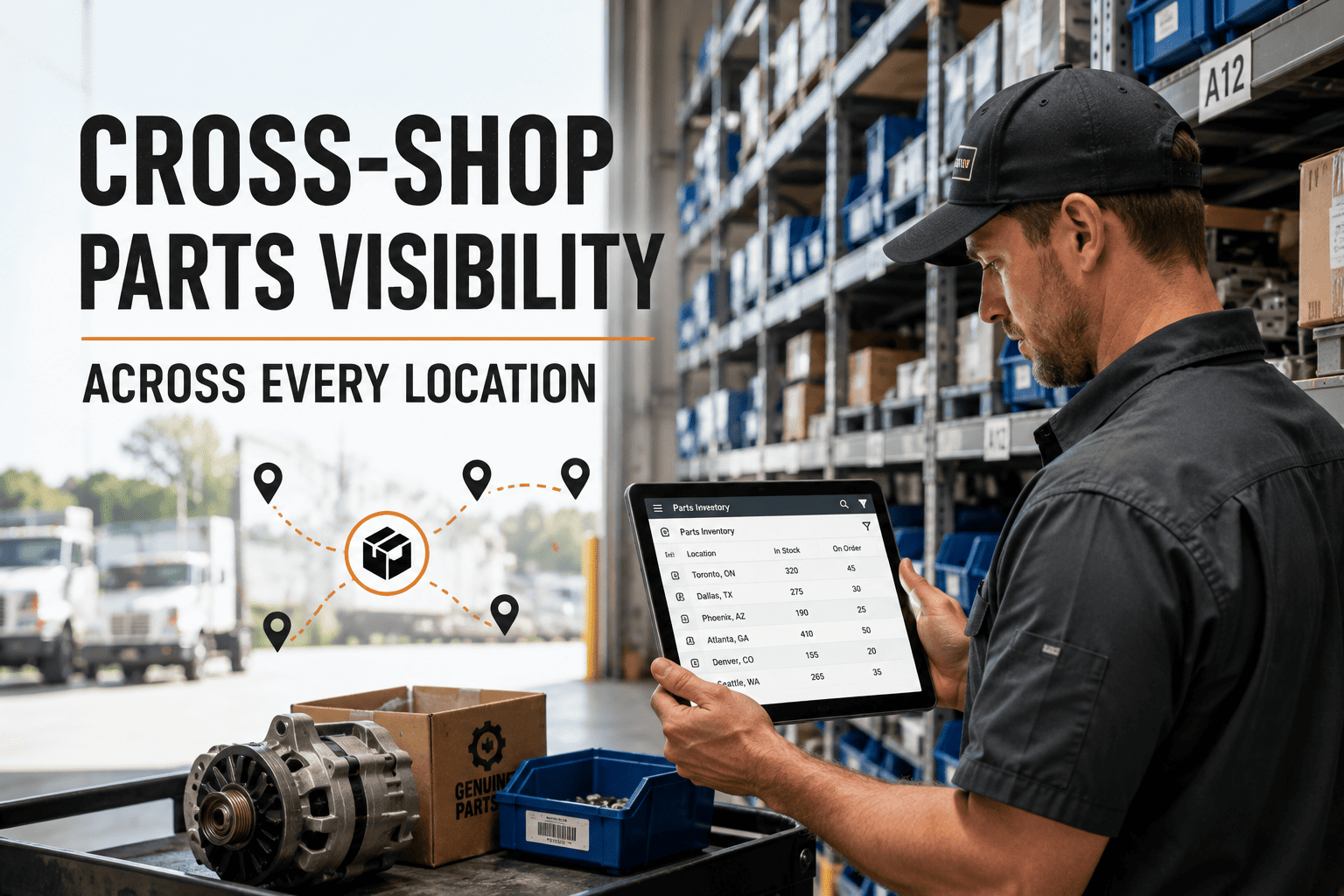
A brake job that takes 3 hours of wrench time can take 5 days of calendar time when the shop pulling the truck in doesn't know that the exact pads it needs are already sitting on a shelf at the sister shop 40 miles away. Cross-shop parts blindness is one of the most expensive problems in multi-location fleet operations — and one of the most invisible. Every shop stocks its own parts, tracks its own inventory, and calls other shops on the phone when something goes missing. The result is vehicles down for days waiting on parts that already exist inside the network, and a purchasing budget bloated by duplicate orders nobody can see. OxMaint gives every shop a single view of every part across every location, so a technician at shop A knows in three seconds whether shop B has what's needed. Start a free trial to see your parts network in one place.
Cross-Shop Parts Visibility · Fleet Guide · 2026
The Parts Are There. Nobody Knows Where.
Fleets with three or more shops sit on 20 to 30 percent duplicate inventory — while vehicles wait days for parts that already exist inside the network. OxMaint unifies every shop's inventory into one live view, so the closest available part gets to the vehicle that needs it fastest.
The 5-Day Brake Job
Where 3 Hours of Wrench Time Becomes 5 Days of Calendar Time
A single brake pad set stocked at the wrong shop is enough to strand a $200,000 truck for a full work week. The wrench time is unchanged. Everything around it stretches — and every hour of stretch shows up somewhere in the P&L.
Wrench Time
Actual technician labour on the job
Calendar Time
What the fleet manager actually reports
Where the 4 lost days go
Day 1
Truck arrives. Shop checks its own bin. Empty. Phone calls to two nearest shops go to voicemail.
Day 2
Purchasing raises an emergency PO at 3× standard cost. Vendor promises next-day delivery.
Day 3
Delivery slips. Truck sits. Meanwhile the pads are on shelf B7 at the shop across town.
Day 4
Part finally arrives. Wrong SKU. Cross-referenced by hand, reordered, another 24 hours added.
The Hidden Bleed
Three Ways Cross-Shop Blindness Quietly Drains the Budget
19 to 24%
of the parts budget lost to duplication and rush orders
The same filter gets ordered under three different SKUs across three garages. Rush shipping gets triggered for parts that already exist on a shelf 30 miles away. Neither cost shows up on a single line item — it hides across dozens of small POs.
14%
of total stock value sits as dead inventory across the network
Parts stocked for retired vehicle models. Emergency buys that never got used. Shop-specific overstock that could serve the whole fleet if anyone could see it. This is the single largest source of tied-up working capital in most multi-shop operations.
15 to 20 min
wasted per job hunting for parts that should exist but can't be found
Across a 20-technician operation running 40 jobs a day, that's 10 to 13 hours of paid labour every day spent searching instead of turning wrenches — the equivalent of one full technician who does nothing but look for things.
OxMaint Multi-Shop Inventory
OxMaint replaces the phone calls and spreadsheets with one live parts view across every shop, warehouse, and yard — so a technician can see network-wide stock, cost, and location before ever raising a PO.
One Network, One Inventory
Every Shop Sees Every Part — From One Dashboard
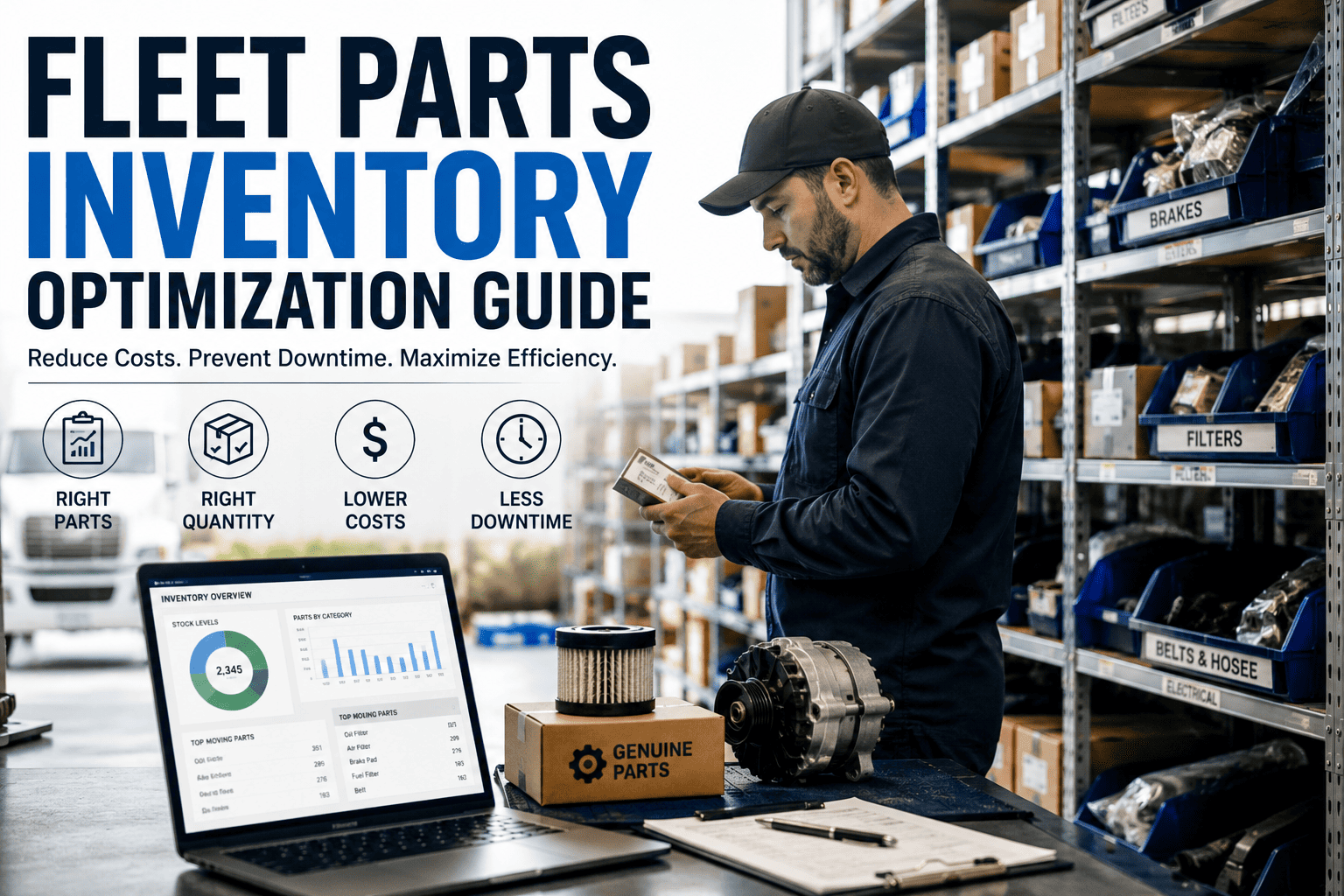
Instead of four separate inventory systems that quietly disagree with each other, OxMaint runs one unified inventory layer with per-shop bins underneath. Each location keeps its own stockroom, its own bin labels, and its own reorder points. What changes is that every technician, purchaser, and manager sees all of them at once.
OxMaint
Unified Inventory Layer
Shop A
1,240 SKUs · 12 bins
Central Warehouse
4,600 SKUs · 48 bins
One search bar. One SKU catalogue. One place to check availability across every physical location — with real-time updates every time a technician scans a part out.
Measured Impact
What Fleets Actually Get Back When Shops Stop Working Blind
47%
Fewer stockout events
A part that's out at one shop is almost always available somewhere else in the network. Real-time cross-shop lookups catch that before an emergency PO gets raised.
30 to 40%
Lower carrying costs
Shared visibility means shared safety stock. Duplicate SKUs across shops collapse into pooled inventory, and dead stock at one location can be reallocated instead of written off.
3 to 5×
Fewer emergency shipments
The 3× to 5× premium on rush shipping disappears when a part is one inter-shop transfer away instead of one emergency vendor call away.
15 to 20 min
Recovered per job
Technicians stop hunting. A scan on the OxMaint mobile app confirms location, bin, and quantity across every shop in the network in seconds.
Cross-Shop Workflow
How a Parts Request Actually Moves Across Shops in OxMaint
Step 1
Technician opens a work order
A truck rolls into Shop A with a failed brake caliper. The technician opens the work order in OxMaint and types the caliper part number.
Step 2
Network-wide availability check
OxMaint scans every shop, warehouse, and yard for that SKU and returns a ranked list — closest available first, with real-time on-hand counts.
Step 3
Inter-shop transfer, not a new PO
The caliper at Shop B is reserved for this work order. A transfer ticket is raised with a courier ETA — no purchase order, no rush shipping, no vendor call.
Step 4
Automatic reorder trigger
Once Shop B drops below its reorder point, OxMaint raises a standard PO at normal pricing — planned, not panicked, with the full audit trail attached.
Before and After
The Same Fleet, With and Without Cross-Shop Visibility
Common Questions
Cross-Shop Parts Visibility — What Fleet Managers Ask
Do all our shops need to run the same inventory setup for this to work?+
No. Each shop keeps its own bins, reorder points, and stocking strategy. OxMaint sits above them as a unified layer — so shop-level autonomy stays intact while network-wide visibility becomes instant.
Start a free trial to see a multi-shop setup.
How does the system know a part is really available and not already reserved?+
Every part is tied to a work order or transfer ticket the moment it's reserved. On-hand counts reflect true available stock, not just bin count — so no two shops can double-claim the same physical unit.
What happens when a transfer moves faster than the paperwork?+
A mobile scan at pickup and a second scan at delivery close the loop in real time. No paper transfer forms, no untracked movement, no in-transit blind window between shops.
Can we still keep some parts locked to a specific shop or route?+
Yes. Critical spares, warranty-restricted parts, and route-specific items can be pinned to a shop so they never show as transferable — while everything else remains fluid across the network.
Book a demo to see the pinning rules.
How long does it take to unify our existing shop inventories in OxMaint?+
Most multi-shop fleets import their existing SKUs, deduplicate cross-shop catalogues, and go live with unified visibility in one to two weeks — with technicians using the mobile scanner on day one.
OxMaint · Cross-Shop Parts Visibility
The Part You Already Own Shouldn't Cost a Week of Downtime to Find.
OxMaint gives multi-shop fleets one live view of every part in every location — turning phone calls and rush orders into three-second lookups and same-day inter-shop transfers. The parts you already have start doing the work you paid them to do.
.png)