A parts stockout is not just an inventory problem — it is a maintenance failure that compounds across every vehicle that needs service while the part is missing. When a fleet technician completes a brake inspection, flags the pads for replacement, and then discovers the warehouse has none in stock, that vehicle goes back on route with a known defect and a maintenance action that exists only as a note on a whiteboard. Across a multi-location fleet, these stockout gaps accumulate invisibly until a breakdown makes them visible. The average parts stockout costs a commercial fleet $1,800 in delayed repairs, emergency procurement, and extended vehicle downtime — per incident. Fleets that connect their inventory management directly to their maintenance scheduling through platforms like OxMaint eliminate this gap: when a part falls below minimum stock threshold, a purchase order fires before the next work order needs it. Book a demo to see the inventory-to-maintenance workflow live.
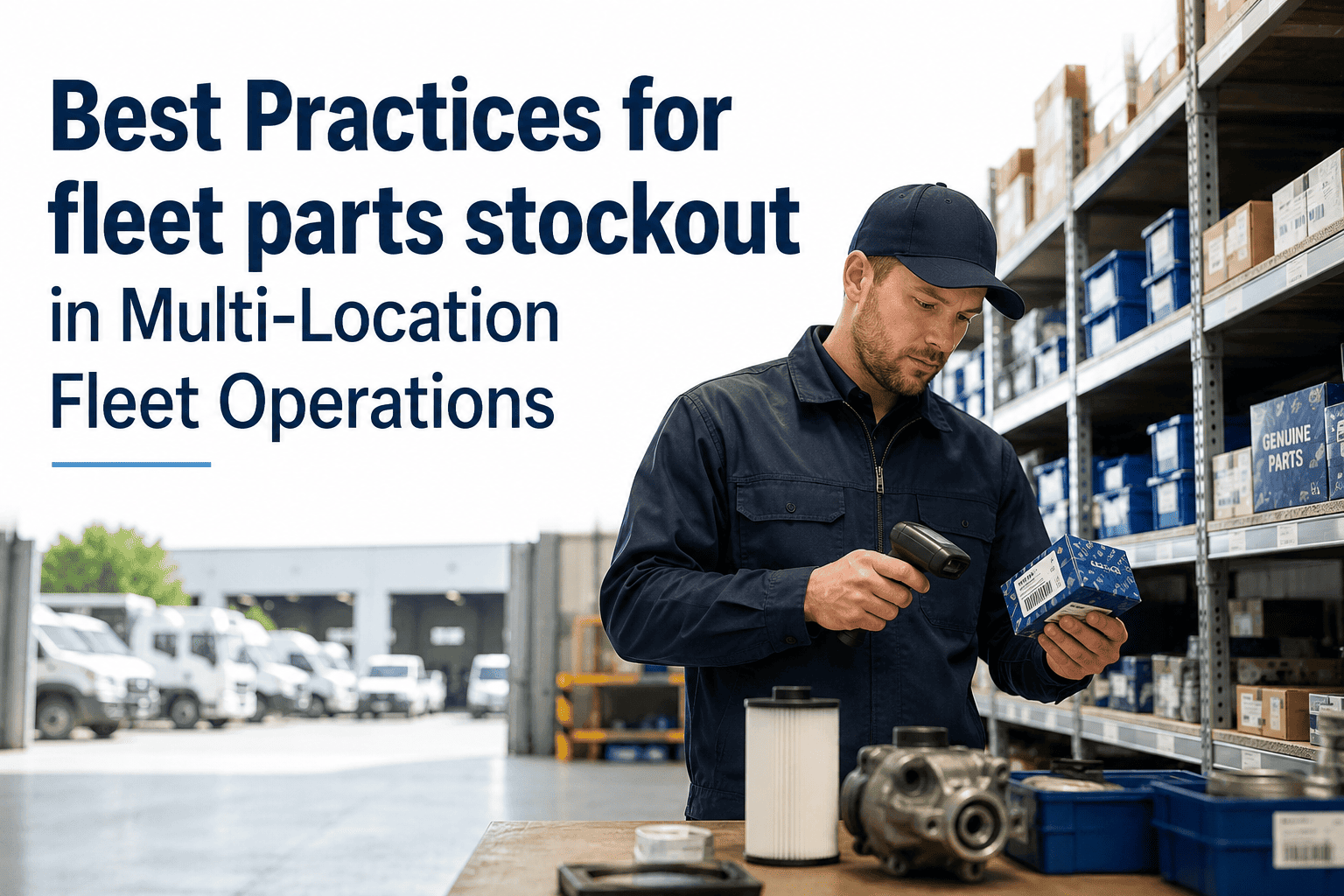
Best Practices for Fleet Parts Stockout in Multi-Location Fleet Operations
How to eliminate parts stockouts across distributed fleet maintenance operations — with inventory strategies, reorder automation, and demand forecasting that keep every workshop stocked for the maintenance work it is actually scheduled to do.
Why Multi-Location Fleets Face a Different Stockout Problem
A single-depot fleet with a competent stores manager can manage parts inventory manually. Multi-location fleet operations cannot — the inventory problem becomes an information and coordination problem that manual processes cannot solve at scale.
Location A has 12 brake pad sets sitting in a cage. Location B has zero and a vehicle waiting. Without a shared inventory system, the technician at B places an emergency order — or borrows from C — while A's stock sits idle. Across a 5-location fleet, this pattern costs an estimated $34,000 per year in unnecessary emergency orders alone.
Parts consumption at each location is driven by that location's maintenance schedule. When PM schedules are not connected to inventory systems, location managers reorder based on past gut feel rather than upcoming scheduled work. A location with four brake jobs scheduled next week needs brake pads now — not when the stock hits zero mid-job.
Each location carries its own safety stock buffer — independently set, independently managed, and almost always excessive for slow-moving parts. A fleet-wide view would consolidate this, reducing total inventory holding cost by 22–28% while maintaining or improving part availability across all locations.
Without a connection between the PM schedule and inventory planning, there is no way to predict what parts will be needed next month. Fleet maintenance has predictable demand patterns — brake pads needed at scheduled intervals, oil filters consumed at every service — but most inventory systems are not connected to the schedule that drives that demand.
6 Best Practices to Eliminate Parts Stockouts Across Multiple Locations
Reorder points based on past consumption always lag behind reality. The right trigger is upcoming scheduled work: if six oil changes are scheduled across three locations next week, the inventory system should confirm that six oil filters and the corresponding oil volume are in stock — today. OxMaint links every scheduled PM work order to an automatic parts check, flagging shortages 7–14 days before the work date so procurement can act before the gap becomes a delay.
Min-max reorder rules must be calibrated per location based on the number and type of vehicles that location services. A hub serving 40 vans needs different brake pad minimums than a depot serving 8. OxMaint's inventory module calculates recommended min-max levels per part per location based on the local fleet composition and service frequency — not fleet-wide averages that understock busy locations and overstock light ones.
Before placing an emergency external order, your system should check whether any other location has the part in surplus. A fleet-wide inventory view in OxMaint surfaces this automatically: when Location B hits its reorder point, the system checks all locations for available stock above their local minimum before flagging a purchase order. Inter-location transfers for high-value parts can be completed same-day, eliminating the emergency premium entirely.
Not all parts deserve the same management intensity. ABC classification focuses attention where it delivers the most value: Class A parts (high value, high usage — brake pads, filters, oil) deserve tight min-max controls and automated reordering. Class B parts (moderate value or usage) get periodic review. Class C parts (low value, slow moving — bulbs, fuses, fixings) can be managed with bulk orders and generous safety stock without significant cost impact.
Manual reordering for high-frequency parts fails in multi-location operations because it depends on location managers remembering to check stock levels, remembering minimum quantities, and initiating procurement through a manual approval chain. Each handoff is a delay risk. In OxMaint, Class A parts with defined min-max levels trigger automatic purchase orders when stock falls below minimum — sent directly to the preferred supplier with the correct quantity, requiring only a one-click approval from the fleet manager. Average time from stockout trigger to PO raised: under 4 minutes.
Parts demand is not uniform across the year. Brake pads, batteries, and wiper blades have predictably higher demand in winter. Tyre rotations and AC recharge consumables spike in summer. Predictive demand forecasting in OxMaint uses historical work order data and the upcoming PM schedule to project parts demand 4–8 weeks forward — allowing procurement to secure stock ahead of demand peaks rather than competing with every other fleet for emergency supply during the same seasonal rush.
Stop managing parts and maintenance in separate systems
OxMaint connects your PM schedule directly to inventory — so parts are checked before work is scheduled, reorders fire before stock runs out, and fleet-wide surpluses cover local shortages automatically. One platform, all locations, zero stockout surprises.
Reactive vs. Proactive Parts Management: The Cost Comparison
| Management Area | Reactive (Current State) | Proactive with OxMaint | Cost Impact |
|---|---|---|---|
| Reorder Trigger | Manual check when stock runs low | Automated min-max with PM schedule link | 91% fewer stockout events |
| Emergency Procurement | 2.7x premium on emergency orders | Planned orders at standard pricing | $34K+ saved annually (5-location fleet) |
| Inter-Location Visibility | Phone calls to check other depots | Fleet-wide stock visible in real time | Eliminates duplicate emergency orders |
| Safety Stock Levels | Each location sets independently | Fleet-optimized with central buffer | 22-28% lower total inventory cost |
| Demand Forecasting | Based on gut feel and last year | PM schedule-driven 8-week forecast | Parts available before demand peaks |
| Parts for Scheduled PM | Checked on the day of service | Checked and reserved 7-14 days ahead | Zero same-day stockout delays |
Frequently Asked Questions
How do we set the right minimum stock levels for each location?
Minimum stock levels should be set based on the number of vehicles serviced at that location, the average service frequency for each part, and the supplier lead time. OxMaint calculates recommended minimums based on your vehicle population and historical work order frequency. As a starting rule: minimum stock = (average weekly consumption x supplier lead time in weeks) + safety buffer of 20%. Start your trial to let OxMaint calculate this from your actual data.
What is the right safety stock level for high-value, low-frequency parts?
High-value, low-frequency parts (turbos, gearboxes, major electronic modules) should not carry high safety stock — the holding cost is too high. Instead, these parts should have a rapid-response supplier agreement or a shared regional stock arrangement across locations. OxMaint's inventory module supports supplier lead time tracking so you can model the risk of zero stock vs. the cost of holding one unit per location, and make a data-driven decision. Book a demo to walk through this for your specific parts profile.
How does OxMaint handle parts that are used across different vehicle types?
OxMaint's parts catalogue links each part to compatible vehicle makes and models. When a work order is created for a specific vehicle, the system automatically surfaces the correct part specification, checks stock for that SKU, and flags if a substitution-compatible alternative is available in stock. This prevents the common error of ordering the wrong specification under time pressure and having to re-order.
Can we track parts costs per vehicle to identify high-cost assets?
Every part consumed in a work order is costed and recorded against the vehicle asset record in OxMaint. This produces a lifetime parts cost per vehicle, a cost-per-mile figure, and a comparison against fleet averages — so vehicles consuming disproportionate parts spend are surfaced automatically for a repair-vs-replace analysis rather than continuing to absorb budget invisibly.
How do we manage parts for seasonal demand spikes without over-stocking?
OxMaint's predictive demand forecast uses the PM schedule and historical seasonal patterns to generate a rolling 8-week parts demand projection. This gives procurement 6-8 weeks of lead time before seasonal demand peaks — enough to order at standard pricing rather than emergency rates, and to stage stock across locations based on where the demand is concentrated. This typically reduces seasonal holding costs by 18-22% vs. location-level guesswork.
Every Stockout Is Predictable. With the Right System, None of Them Have to Happen.
OxMaint connects your maintenance schedule to your inventory — so parts are confirmed available before work is booked, reorders fire automatically, and your team spends time fixing vehicles instead of chasing parts. Start your free trial and run your first inventory health check across all locations today.