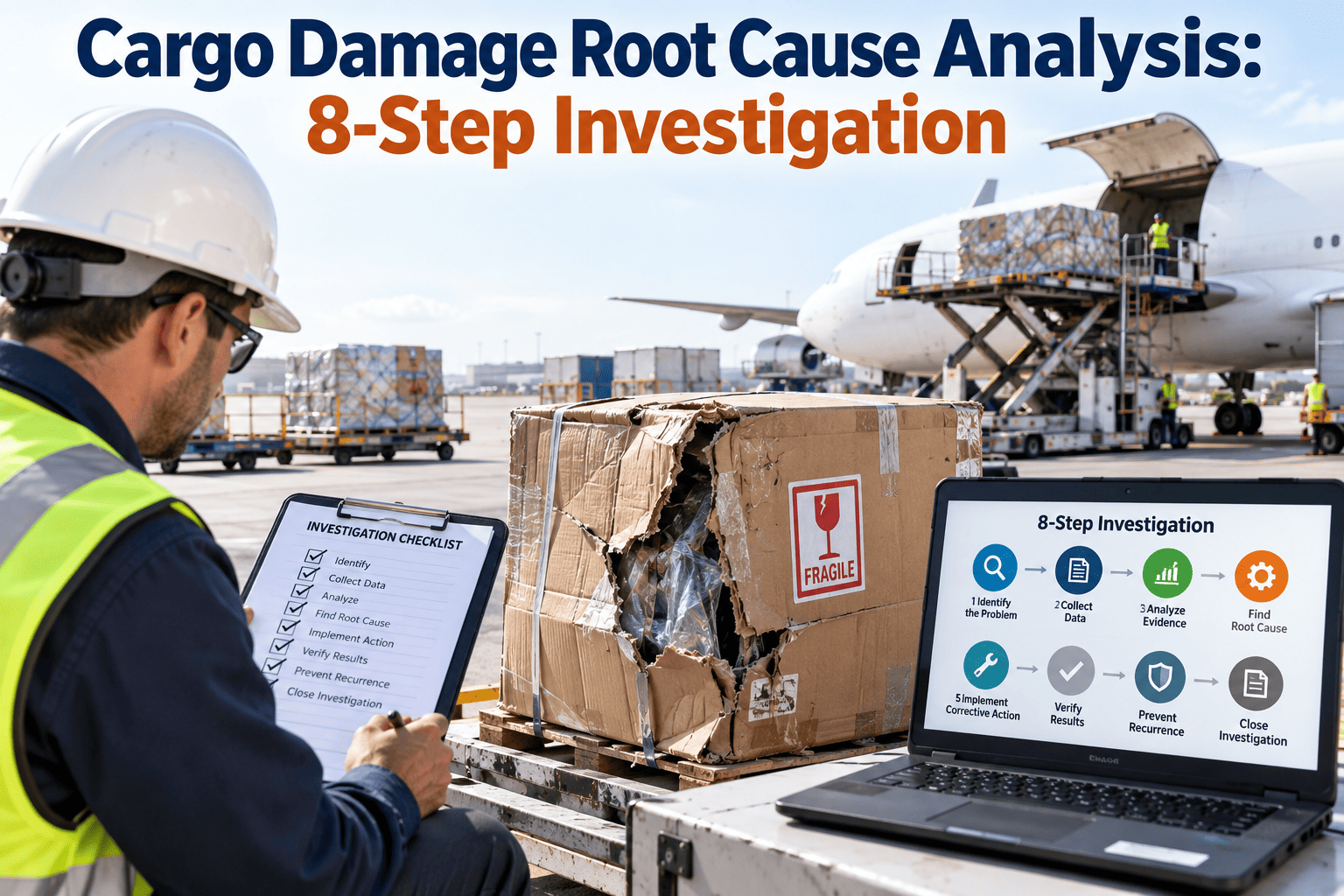
The same route keeps producing crushed corners on the same product line, month after month. Someone files a claim, someone repackages the load, and the next shipment goes out exactly the way the last one did — with nothing changed. That is not bad luck, it is a root cause that was never actually found. Most cargo damage investigations stop at "what happened" instead of pushing through to "why it keeps happening," and that shortcut is why the same failure shows up on next quarter's damage report too. A structured eight-step investigation changes that outcome by forcing every recurring pattern through the same disciplined process. OxMaint's inspection workflow captures the evidence that framework depends on, automatically.
Cargo Damage · Root Cause Analysis · 2026
Cargo Damage Root Cause Analysis: 8-Step Investigation
A free, structured investigation framework covering evidence collection, hypothesis testing, and corrective action, built to stop recurring damage patterns instead of just documenting them.
57%
Of cargo damage incidents repeat within 90 days without a formal RCA
8
Structured steps from first evidence to verified corrective action
3.4x
Lower recurrence rate for incidents that complete full RCA
72 hrs
Recommended window to complete an investigation while evidence is fresh
Why Investigations Stall
The Difference Between Documenting Damage and Solving It
Filing a claim closes the paperwork on an incident. It does nothing to prevent the next one. The gap between those two outcomes is a real investigation — and most operations skip it because nobody owns the process past the point of getting the claim paid.
No Ownership
Nobody Is Assigned to Dig Deeper
Once a claim is filed and paid, the incident is treated as closed, even though the actual cause was never identified or addressed in any way.
Evidence Decay
The Trail Goes Cold Fast
Photos, load logs, and witness memory all degrade quickly, and an investigation started weeks later is working with a fraction of the original evidence.
Surface Fixes
Symptoms Get Treated, Not Causes
Adding extra padding after a damage incident feels like a fix, but it treats the symptom while the actual handling or route problem stays untouched.
No Follow-Through
Corrective Actions Never Get Verified
Even when a cause is identified, few operations circle back to confirm the fix actually worked, so the same failure can quietly return months later.
The Framework
The 8-Step Cargo Damage Investigation Process
This is the sequence that turns a damage report into an actual answer. Skipping a step does not save time — it just moves the missing information further downstream, where it becomes harder to recover.
1
Secure the Scene and Evidence
Photograph the damage, the packaging, and the load position before anything is moved, repacked, or discarded.
2
Interview Everyone Involved
Talk to the driver, the loader, and the receiving inspector separately before accounts have a chance to align with each other.
3
Reconstruct the Timeline
Map every touchpoint the cargo passed through, from loading dock to final delivery, using telematics and inspection timestamps where available.
4
Generate Candidate Hypotheses
List every plausible cause — handling, route conditions, packaging design, vehicle suspension — without eliminating any of them prematurely.
5
Test Each Hypothesis Against Evidence
Match each candidate cause against the timeline and physical evidence, ruling out anything the facts do not support.
6
Confirm the Root Cause
Identify the single condition that, if removed, would have prevented the damage — not just a contributing factor along the way.
7
Assign and Implement Corrective Action
Define a specific, owned fix with a deadline, rather than a general instruction to "be more careful" that nobody can be held to.
8
Verify the Fix Actually Worked
Track the same failure mode for a defined period after the fix to confirm the recurrence rate actually dropped, not just assumed to have dropped.
Capture Evidence Automatically
A Root Cause Investigation Is Only as Good as the Evidence Behind It
OxMaint captures timestamped photos, load timelines, and inspection records automatically at every touchpoint, so step one of every investigation is already done before anyone opens a case file.
Root Cause Categories
The Six Places Cargo Damage Root Causes Usually Hide
Most root causes fall into a small number of recurring categories. Checking each one systematically prevents an investigation from fixating on the first plausible explanation and missing the actual cause.
| Category | What to Check | Typical Signal |
|---|
| Handling | Loading technique, stacking order, tie-down method | Damage concentrated at load edges |
| Route conditions | Road surface, elevation change, known hazard zones | Damage repeats on the same route |
| Packaging design | Cushioning adequacy, box strength, seal integrity | Same product line, different routes |
| Vehicle condition | Suspension wear, trailer floor condition, tire pressure | Damage repeats on the same vehicle |
| Environmental exposure | Temperature swings, humidity, transit duration | Damage type matches climate pattern |
| Human factors | Training gaps, fatigue, unclear procedures | Damage clusters around specific shifts |
Fishbone Method
Using a Fishbone Diagram to Organize the Investigation
When a single obvious cause is not apparent, mapping candidate causes against the six categories above in a fishbone structure keeps the investigation organized instead of following whichever theory comes up first in conversation.
01
Write the Effect at the Head of the Fish
State the damage outcome precisely — not "damaged goods" but the specific defect observed, so every branch of the analysis stays anchored to the same target.
02
Branch Into the Six Cause Categories
List handling, route, packaging, vehicle, environment, and human factors as the main bones, giving every category equal consideration before ruling any out.
03
Ask "Why" at Each Branch
For every candidate cause, ask why it might have occurred at least three more times, pushing past the first surface-level answer toward the underlying condition.
04
Cross-Check Against the Timeline
Eliminate any branch that the reconstructed timeline and physical evidence do not support, narrowing the diagram down to the causes that actually fit the facts.
Corrective Action Tracking
What Separates a Real Fix From a Well-Intentioned Note
An investigation that ends with "improve packaging" has not actually produced a corrective action. A real fix is specific enough that success or failure can be measured, and owned by someone who will be asked about it again.
Specific
Named, Not Vague
"Add 2-inch foam corner protectors to SKU-4471 shipments" is trackable. "Improve packaging" is not, and never gets closed out with confidence.
Owned
Assigned to One Person
A fix without a named owner tends to drift indefinitely, with everyone assuming someone else is handling it until the next incident proves otherwise.
Time-Bound
Deadline Attached
An open-ended corrective action rarely gets prioritized against the day's more urgent tasks, so a fix without a deadline is a fix that stalls.
Verified
Checked Against Results
The investigation is not actually closed until someone confirms the recurrence rate for that failure mode has genuinely dropped after the fix.
Fleet Manager Questions
Cargo Damage Root Cause Analysis — Common Questions
How soon after a damage incident should root cause analysis begin?+
Within 72 hours is ideal, before photos, memories, and load documentation start to degrade. Waiting longer means the investigation works with a weaker version of the same evidence.
Start a free trial to see evidence captured automatically at the point of inspection.
Does every cargo damage incident need a full 8-step investigation?+
Minor, isolated incidents with an obvious cause may only need a lighter review, but any recurring pattern or high-value loss deserves the full process.
Book a demo to see how OxMaint flags which incidents warrant full RCA.
What is the most commonly skipped step in cargo damage investigations?+
Verification of the corrective action is skipped far more often than any other step, because once a fix is proposed, most teams move on without confirming it actually reduced the recurrence rate over time.
How is a fishbone diagram different from a simple list of possible causes?+
A fishbone diagram forces equal consideration across every cause category instead of letting the investigation fixate on whichever explanation comes to mind first.
Try OxMaint free to see structured cause mapping in practice.
Can root cause data from past investigations prevent future damage?+
Yes. Aggregating confirmed root causes across past incidents reveals which categories — handling, route, packaging, or vehicle condition — drive the most recurring damage, which is where prevention budget should go first.
OxMaint · Cargo Damage RCA · Stop Repeat Losses
Turn Recurring Damage Into a Solved Problem, Not a Recurring Line Item
OxMaint captures the timestamped evidence every root cause investigation depends on automatically, so your team can move straight from incident to hypothesis to a verified fix, instead of starting each case from a blank page.