
Every unplanned fleet downtime event has a root cause that was visible in the data at least 3 to 6 weeks before the breakdown — and a maintenance record that either captured that signal or didn't. A van sitting idle at a customer site for 4 hours costs $700 in direct costs: driver idle time, recovery vehicle dispatch, customer satisfaction impact, and missed revenue. Multiply that by the 8 to 12 unplanned breakdowns the average 50-vehicle fleet experiences per month and the annual downtime cost runs $84,000 to $168,000 — almost entirely from vehicle failures that preventive maintenance, properly scheduled and completed, would have caught. Oxmaint's downtime analysis module tracks every breakdown event, maps it to its maintenance history, and identifies the PM gap or wear signal that preceded it — so the next one doesn't happen. Book a demo to see your fleet's downtime root cause analysis run against your actual breakdown history.
Oxmaint maps every breakdown to the maintenance signal that preceded it — missed PM interval, vibration trend, oil analysis result, or DTC history — and generates the specific corrective PM change that prevents recurrence. Fleets using Oxmaint downtime analysis report 60–74% reduction in unplanned breakdown events within 12 months.
Fleet downtime analysis is the systematic process of tracing each breakdown event back to its root cause — a missed PM interval, a wear signal that wasn't monitored, a DTC code that wasn't actioned, or an oil sample that showed metal particle trend — and using that root cause mapping to change the maintenance schedule or inspection protocol that allowed the failure to occur. Oxmaint automates this process: every breakdown triggers an automatic root cause investigation workflow that queries the vehicle's full maintenance history, telematics fault codes, PM completion record, and sensor trend data — then generates a prioritized corrective action that closes the gap. Over time, this builds a fleet-specific failure mode database that makes each PM schedule progressively more accurate at preventing the failures that actually occur in your operating environment.
The Seven Root Causes of Fleet Downtime — and How Oxmaint Catches Each One
Fleet breakdowns are not random. They fall into seven identifiable root cause categories — each with a specific detection method and a specific PM or operational change that eliminates future recurrence. Book a demo to see which of these seven categories drives the most downtime in your fleet.
The most common and most preventable root cause — an oil change interval exceeded by 2,400 miles, a brake inspection missed by 3 weeks, an air filter replacement deferred twice. Oxmaint prevents this by generating PM work orders before the interval is due and escalating automatically when completion is overdue.
Bearing vibration increasing over 8 weeks, brake pad thickness declining faster than expected, belt tension drifting below specification — wear trends that were present but not monitored against a baseline. Oxmaint connects to telematics sensors and vibration monitors, establishing per-vehicle baselines and alerting when any parameter's rate of change accelerates beyond a configured threshold.
A P0420 catalyst efficiency code cleared twice without investigation, a recurring ABS sensor fault dismissed as "intermittent" — DTC codes that appeared in the vehicle's history weeks before the failure that generated them but were not linked to a work order. Oxmaint's DTC integration flags recurring fault codes and requires a work order response within 48 hours for any code that has appeared more than twice on the same vehicle.
Harsh braking that accelerates brake pad wear by 40%, aggressive cornering that stresses suspension components beyond design limits, extended high-RPM operation that shortens engine life — driver behaviors that make standard PM intervals inadequate for that specific vehicle-driver combination. Oxmaint's driver scoring identifies vehicles where driver behavior requires accelerated PM intervals and adjusts the schedule automatically.
Quarterly oil analysis showing rising iron particle count — indicating bearing or cylinder wear — filed and not acted upon. Oil analysis is the most sensitive predictive signal available for internal engine and gearbox condition, providing a 60 to 90 day advance warning window. Oxmaint manages oil sampling schedules and routes analysis results directly to a work order when particle counts exceed the configured alert threshold.
A driver-reported defect on the pre-trip DVIR that was acknowledged but never assigned a work order — a brake pull reported Monday that became a brake failure Wednesday. Oxmaint's DVIR integration requires every defect item to receive a work order response within 24 hours, with escalation to the maintenance supervisor if not acknowledged. DVIR defects are the only downtime root cause category where the driver already told you about the problem before the breakdown.
The small number of vehicles past their economic life threshold that generate a disproportionate share of total downtime — each breakdown event taking longer and costing more to repair than earlier-lifecycle vehicles. Oxmaint's TCO tracking identifies vehicles past their replacement threshold and flags them as high-downtime-risk assets, enabling replacement planning before the cascade of failures that characterizes end-of-life vehicles begins.
Every Breakdown Has a Root Cause. Oxmaint Finds It — Then Prevents the Next One.
Automatic root cause investigation on every breakdown event — querying maintenance history, DTC records, PM completion, and sensor trends to identify the specific gap that allowed the failure and generate the corrective action that closes it. Book a demo to run root cause analysis on your fleet's last 12 months of breakdown events.
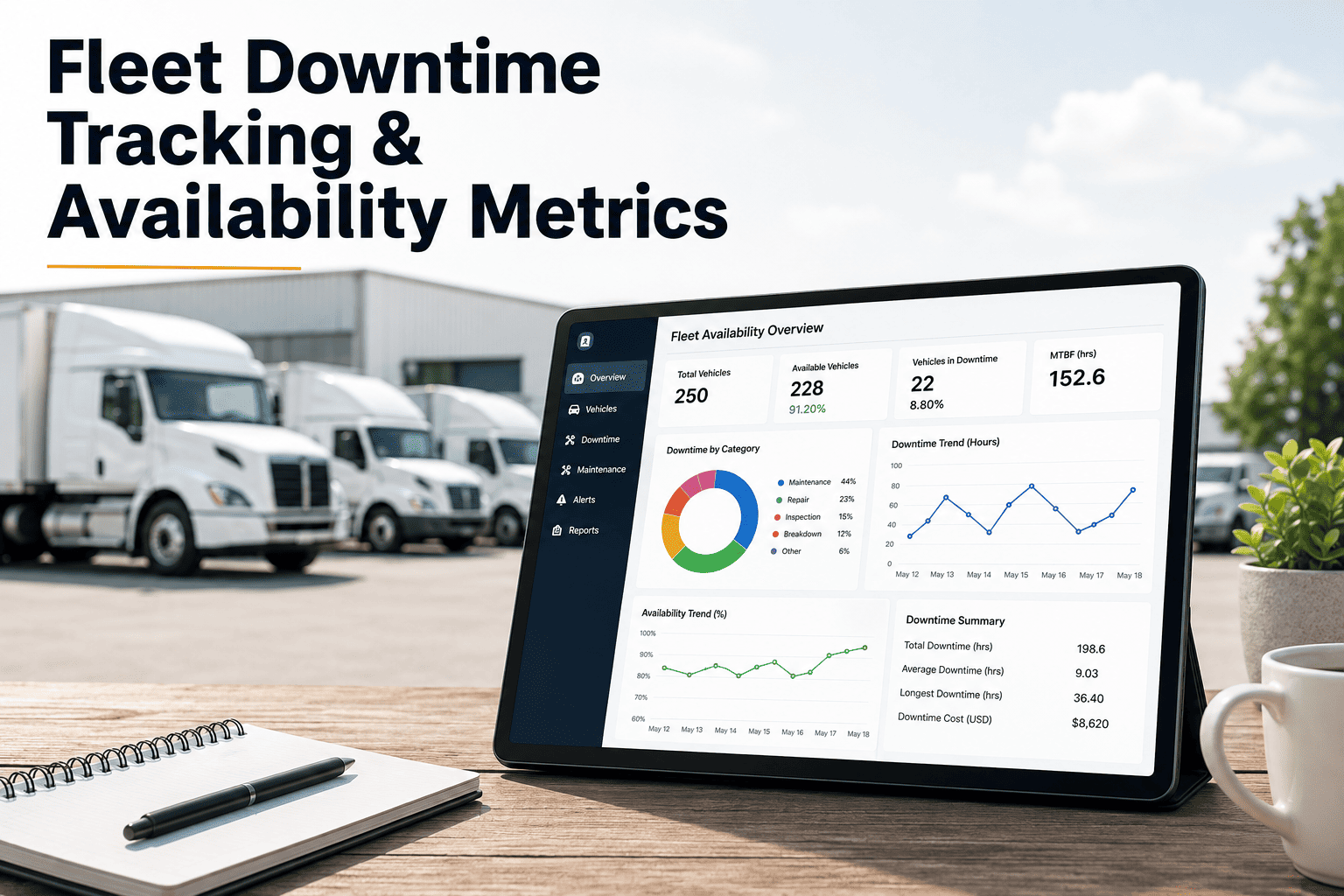
Downtime Analytics Dashboard — What Oxmaint Tracks
Six downtime metrics updated automatically — the numbers that separate fleets managing downtime reactively from those eliminating it systematically.
Downtime Pattern Detection — How Oxmaint Identifies Systemic Fleet Problems
Individual breakdown root cause analysis catches vehicle-level problems. Pattern detection catches fleet-level problems — issues affecting multiple vehicles that share a route, a vehicle spec, a maintenance shop, or a parts supplier.
If 4 vehicles assigned to the same regional route experience brake failures within 90 days, Oxmaint's pattern engine flags it — the route likely has a topography or loading pattern accelerating brake wear beyond what the standard PM interval assumes. Corrective action: shorten brake inspection interval for all vehicles on that route.
If all failure events of a specific type are concentrated in one vehicle model or powertrain configuration — a recurring alternator failure only on vehicles with a specific upfit package — Oxmaint's pattern detection flags the model-specific failure mode and generates a proactive inspection work order for all vehicles matching that spec before the next failure occurs.
If replacement parts from a specific supplier show significantly shorter service life than the fleet average for that component — brake pads lasting 60% of their rated mileage, belts failing at half the expected interval — Oxmaint's pattern detection flags the supplier quality issue before additional vehicles are affected by the same substandard part batch.
If vehicles serviced at a specific third-party shop show 3× the recurrence rate for a specific failure type, Oxmaint's pattern engine flags the shop — indicating a repair quality issue where the repair was completed but the root cause was not corrected. Fleet managers receive a shop performance flag before committing additional vehicles to that vendor.
We had 19 unplanned breakdowns in Q1 last year. After Oxmaint's root cause analysis identified that 12 of them traced to missed PM intervals and 4 to ignored recurring DTCs, we fixed the PM scheduling and made DTC response mandatory. Q1 this year: 6 breakdowns. $91,000 saved in recovery and idle costs. The patterns were there the whole time — we just had no system to see them.
Frequently Asked Questions
−67% Unplanned Breakdowns. +24 Days MTBF. $700 Per Event Saved — Starting Now.
Root cause analysis on every breakdown, pattern detection across the fleet, and predictive PM scheduling — all automated in Oxmaint. First analysis available within 48 hours of setup.



-(1).png)