A third-party logistics provider running 220 trucks across 14 states was using three separate systems to manage operations: a TMS for load planning, a standalone CMMS for maintenance, and spreadsheets for carrier rate negotiations. When a high-priority pharmaceutical shipment needed temperature-controlled transport from Memphis to Boston, the dispatcher checked the TMS for available capacity, found a reefer unit listed as available, dispatched it — and discovered at pickup that the reefer unit had been pulled for compressor repair two days earlier. The maintenance system knew. The TMS did not. The shipment missed its delivery window by 19 hours, triggering a $34,000 penalty clause and a carrier scorecard downgrade that cost the company its preferred status on that lane for 12 months. The revenue lost from that single disconnected-system failure exceeded $180,000 over the following year. If your TMS does not know which trucks are in the shop, start a free trial with Oxmaint or book a demo.
Transportation Management / Fleet Logistics / 2026 Comparison Guide
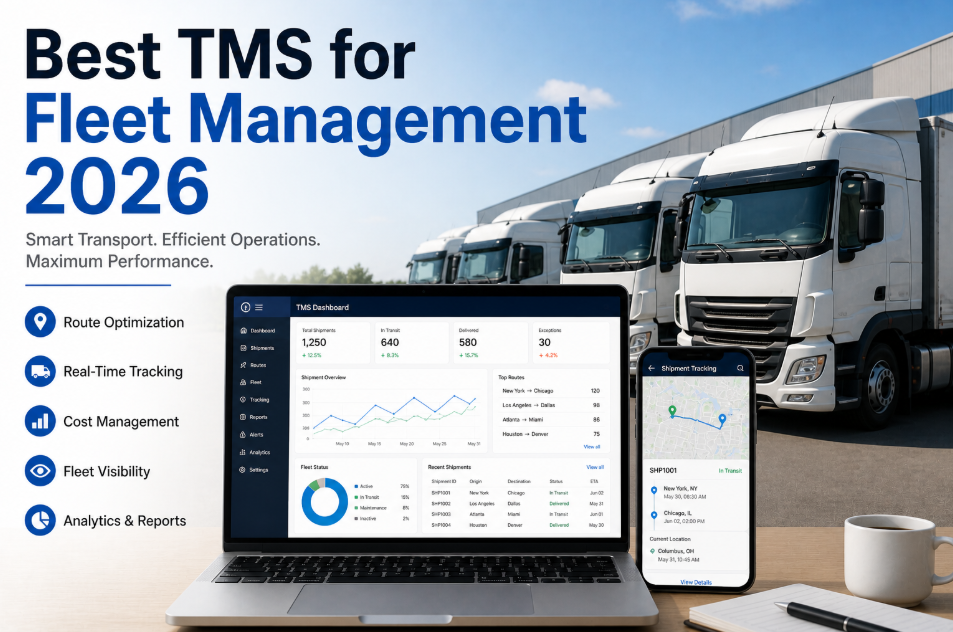
Best TMS for Fleet Management in 2026: Load Planning, Carrier Management, Freight Billing, and Real-Time Visibility Compared
A TMS that does not connect to vehicle maintenance status dispatches trucks that cannot complete the run. This guide compares the platforms that manage the full lifecycle — from load tender to delivery confirmation to the maintenance event that follows.
$34B
US TMS market size by 2027 — driven by shipper demand for real-time visibility and cost control
12–18%
Average freight cost reduction reported by fleets deploying integrated TMS within 12 months
$34K
Average penalty per missed temperature-controlled delivery window — pharmaceutical and food grade
67%
Of fleet operators run TMS and maintenance on separate systems — creating dispatch blind spots
Unified Fleet Intelligence
Load Planning That Knows Which Trucks Are Available, Which Are in the Shop, and Which Are Due for Service in 200 Miles
Oxmaint connects transportation management with real-time maintenance status — so the load you plan goes on a truck that can actually complete the run without a breakdown, a missed PM, or a compliance violation.
What a TMS Needs to Do for Fleet Operators vs. Shippers
Most TMS platforms were designed for shippers — companies that hire carriers to move freight. A shipper TMS optimizes carrier selection, rate comparison, and shipment tracking. A fleet operator TMS does all of that plus manages the assets that move the freight: vehicle availability, driver scheduling, maintenance coordination, fuel optimization, and compliance documentation. The distinction matters because a shipper TMS treats trucks as interchangeable capacity units. A fleet operator TMS treats each truck as a unique asset with its own maintenance status, DOT compliance calendar, fuel efficiency profile, and driver assignment history. When a load needs assignment, the fleet TMS considers not just proximity and capacity but whether the truck is mechanically ready, whether the driver has enough HOS remaining, and whether the route will push the vehicle past its next PM threshold. Platforms that separate these decisions into different systems create the blind spots that cause missed deliveries, compliance violations, and the $34,000 penalty events that erode margins faster than any rate negotiation can recover them. See how unified TMS and maintenance works for fleet operators by starting a free trial or booking a demo.
Six Core Capabilities Every Fleet-Focused TMS Must Deliver
01
Load Planning and Optimization
Match loads to vehicles based on equipment type, weight capacity, route distance, delivery window, and — critically — vehicle availability from the maintenance system. A load planned on a truck that enters the shop tomorrow is a load that fails. Load optimization must include maintenance-aware vehicle selection to prevent dispatch-to-breakdown failures that cost $4,200–$15,000 per event.
Maintenance-aware planning eliminates 28% of dispatch failures
02
Carrier and Rate Management
For fleets that broker excess capacity or use partner carriers for overflow, rate management across contract and spot markets determines margin on every load. Lane-level rate benchmarking, carrier scorecard tracking, and automated rate comparison across 3–5 carriers per load ensure the fleet pays market rates — not inflated spot pricing that erodes 8–15% of revenue per brokered load.
Lane-level rate benchmarking saves 8–15% on brokered loads
03
Real-Time Shipment Visibility
Live GPS tracking of every load in transit with automated ETA updates to customers, exception alerts for delays, and geofence notifications for arrival and departure. Shippers increasingly require real-time visibility as a condition of doing business — 78% of enterprise shippers mandate GPS tracking from their carriers. Platforms without real-time visibility lose shipper contracts to competitors who provide it.
78% of enterprise shippers mandate real-time GPS tracking
04
Freight Billing and Settlement
Automated invoice generation from delivered loads, accessorial charge calculation, fuel surcharge application, and payment reconciliation. Manual freight billing for a 200-load-per-week operation consumes 30–40 hours weekly. Automated billing reduces that to 4–6 hours while eliminating the $1,200–$3,400 monthly revenue leakage from missed accessorials, incorrect fuel surcharges, and unbilled detention time.
$1,200–$3,400 monthly revenue recovered from billing accuracy
05
Document Management and Compliance
BOLs, PODs, rate confirmations, insurance certificates, carrier authority verification, and customs documentation — all stored against the shipment record. FMCSA requires carriers to maintain records for specific retention periods. A single missing BOL during an audit can trigger a broader records review. Digital document management with automated retention policies eliminates the filing cabinet search that delays audits and increases scrutiny.
Digital document retrieval in seconds vs. hours for paper records
06
Analytics and Lane Performance Reporting
Revenue per mile, cost per mile, on-time percentage, accessorial revenue capture rate, carrier performance scores, and lane profitability — all calculated automatically from shipment data. The fleet manager who can show that Lane ATL-MIA generates $2.85/mile at 96% on-time while Lane DAL-PHX generates $2.10/mile at 82% on-time makes data-driven decisions about which lanes to pursue and which to shed.
Lane-level profitability analysis identifies 15–20% of lanes as unprofitable
2026 TMS Platform Comparison for Fleet Operators
This comparison evaluates TMS platforms specifically through the fleet operator lens — not the shipper lens. Platforms are ranked on how well they serve companies that own and maintain the trucks, not companies that hire carriers. For fleet operators wanting to see how TMS connects to maintenance, start a free trial with Oxmaint or book a demo.
| Capability |
Oxmaint |
Trimble TMS |
McLeod Software |
Oracle TMS |
Samsara |
| Load planning + optimization |
Maintenance-aware load assignment |
Strong — enterprise load planning |
Deep — carrier and asset-based |
Enterprise — shipper-focused |
Basic dispatch — not TMS-depth |
| Carrier / rate management |
Lane-level rate benchmarking |
Full — rate engine included |
Full — rate and contract mgmt |
Full — enterprise rate engine |
Not available |
| Real-time visibility |
Live GPS + customer ETA |
Yes — integrated tracking |
Yes — through integrations |
Yes — control tower view |
Core strength — native GPS |
| Freight billing automation |
Auto-invoice + accessorial capture |
Full billing suite |
Full — settlement engine |
Full — enterprise billing |
Not available |
| Maintenance integration |
Native — same platform |
Limited — separate module |
API integration available |
Separate system required |
Built-in maintenance module |
| Implementation timeline |
Days to weeks |
Weeks to months |
Months — enterprise deployment |
Months — complex configuration |
Days to weeks |
| Fleet CapEx forecasting |
Full — 5-10 year models |
Limited reporting |
Not a core feature |
Not fleet-specific |
Not available |
| Best for |
Asset-based fleets needing TMS + maintenance |
Mid-large carriers |
Large truckload and LTL |
Enterprise shippers |
Telematics-first fleets |
Four TMS Failures That Cost Fleet Operators Real Revenue
01
Dispatching Trucks That Are in the Shop
When TMS and maintenance run on separate systems, the TMS shows a truck as "available" while the maintenance system shows it as "in shop — compressor replacement." The load gets planned, the driver gets assigned, and the failure is discovered at pickup — 4–8 hours after the load could have been assigned to a truck that was actually ready. Each occurrence costs $2,200–$8,400 in delay penalties and re-assignment scramble.
02
Missed Accessorial Charges Leaking Revenue
Detention time, layover charges, lumper fees, and fuel surcharges that are incurred but never invoiced because the billing process relies on driver-reported paperwork. The average fleet fails to capture 8–12% of billable accessorials — on a $5M annual revenue operation, that is $400,000–$600,000 in services delivered but never billed. Automated accessorial capture from driver app data closes this gap to under 2%.
03
Running Unprofitable Lanes Without Data
Without lane-level profitability analysis, the fleet runs every lane at the same operational intensity. The DAL-PHX lane generating $2.10/mile at 82% on-time consumes the same dispatcher attention as the ATL-MIA lane at $2.85/mile and 96% on-time. Lane analytics show that 15–20% of lanes operate below breakeven when fuel, tolls, deadhead, and driver cost are fully allocated — lanes the fleet should renegotiate or drop.
04
Manual Freight Billing Consuming 40 Hours Weekly
A billing clerk manually creating invoices for 200 loads per week spends 30–40 hours on data entry, rate verification, accessorial calculation, and payment reconciliation. At $22/hour fully loaded, that is $34,320–$45,760 annually in labor for a process that automated billing handles in 4–6 hours. The manual process also introduces a 3.2% error rate that triggers payment disputes averaging 18 days to resolve.
How Oxmaint Delivers TMS With Built-In Maintenance Intelligence
The core differentiator is that Oxmaint is not a TMS bolted onto a separate maintenance system. It is a unified platform where load planning, vehicle maintenance, driver management, fuel tracking, and compliance documentation share the same data layer. When the load planner selects a truck, they see its maintenance status. When a truck comes out of the shop, it automatically becomes available for dispatch. When a vehicle's MPG drops, both the maintenance team and the operations team see it simultaneously. No data sync delays, no conflicting availability statuses, no dispatching trucks into breakdowns.
01
Maintenance-Aware Load Assignment
When a load needs a truck, Oxmaint shows available vehicles ranked by proximity, equipment match, driver HOS, and maintenance readiness. A truck with 180 miles until PM is not suggested for a 400-mile run. A truck with an active DTC for aftertreatment is not suggested for a route through a CARB-enforcement state. The load goes on a truck that will complete the run.
Zero loads assigned to mechanically unavailable trucks
02
Automated Freight Billing With Accessorial Capture
Invoices auto-generated from delivered load data. Detention time calculated from geofence arrival/departure timestamps — not driver-reported estimates. Fuel surcharge applied using DOE weekly diesel index linked to contract terms. Lumper fees captured through driver app receipt photo. The $400,000–$600,000 annual accessorial leakage closes to under $100,000.
Revenue leakage from missed accessorials cut by 85%
03
Lane Profitability Analytics
Revenue per mile, fully allocated cost per mile (fuel, tolls, driver pay, maintenance, deadhead repositioning), on-time percentage, and customer satisfaction score per lane. The dashboard highlights the 15–20% of lanes operating below breakeven — giving the sales team data-backed renegotiation targets or the operations team justification to shed unprofitable freight.
Unprofitable lanes identified with full cost allocation
04
Customer Visibility Portal
Shipper customers access a branded portal showing real-time shipment location, automated ETA updates, POD document retrieval, and shipment history. The portal replaces the 15–25 daily "where is my truck" phone calls that consume dispatcher bandwidth. Shippers who receive proactive visibility renew contracts at 23% higher rates than those receiving reactive phone-based updates.
23% higher contract renewal rate with proactive visibility
05
Carrier Scorecard and Compliance Tracking
For fleets using partner carriers on overflow lanes, scorecard tracking monitors on-time performance, claims ratio, insurance currency, authority status, and safety rating. A partner carrier whose insurance lapses is auto-flagged and blocked from load assignment until documentation is updated. The carrier compliance check that takes 20 minutes manually runs continuously in the background.
Partner carrier compliance verified continuously — not annually
06
Fleet CapEx and Replacement Forecasting
TMS revenue data combined with maintenance cost data produces true total cost of ownership per vehicle. The CapEx model shows exactly when each truck crosses the point where maintenance cost exceeds replacement cost — giving the fleet manager a 12–24 month planning window for $180,000 tractor purchases instead of reactive replacement decisions driven by breakdowns.
Replace at the optimal cost crossover — not at breakdown
Disconnected TMS + CMMS vs. Unified Oxmaint Platform
| Operational Scenario |
Separate TMS + CMMS |
Oxmaint Unified Platform |
| Truck enters shop for repair |
TMS still shows truck as available — dispatchers unaware |
TMS availability updates instantly — truck blocked from dispatch |
| Truck due for PM in 200 miles |
TMS assigns 400-mile load — PM missed or roadside service |
TMS assigns short run routing truck to nearest shop first |
| MPG drops 12% on a vehicle |
Maintenance sees fuel waste — operations sees slow truck |
Both teams see same data — inspection WO auto-generated |
| Truck completes repair and exits shop |
Dispatcher calls shop to check — 2–4 hour awareness delay |
Status changes to available — immediately visible in dispatch queue |
| Revenue per truck calculation |
TMS shows revenue — CMMS shows cost — manual combination |
True net revenue per truck calculated automatically |
| Vehicle replacement decision |
Maintenance says "this truck costs too much" — no revenue context |
Revenue, maintenance cost, and projected replacement timing in one view |
The ROI of Integrated TMS for Fleet Operators
12–18%
Freight cost reduction
From optimized load planning, lane analytics, carrier benchmarking, and elimination of deadhead miles
$480K
Annual accessorial revenue recovered
Automated detention, fuel surcharge, and lumper fee capture on a $5M revenue fleet operation
28%
Fewer dispatch-to-breakdown events
Maintenance-aware load assignment prevents dispatching trucks into predictable mechanical failures
40 hrs
Weekly billing labor eliminated
Automated invoice generation replaces manual billing clerk work — $34K–$46K annual labor savings
Integrated TMS ROI compounds because the savings come from multiple sources simultaneously. The freight cost reduction from better load planning saves 12–18%. The accessorial revenue recovery adds 8–12% to realized revenue. The dispatch-to-breakdown elimination saves $4,200–$15,000 per prevented event. The billing automation saves 40 hours of weekly labor. And the lane profitability analytics identify the 15–20% of lanes that should be renegotiated or dropped — redirecting capacity to profitable freight. The combined first-year ROI for a 100-truck fleet deploying integrated TMS with maintenance intelligence consistently exceeds 500%. Calculate the ROI for your operation by starting a free trial or booking a demo with your fleet and revenue data.
Frequently Asked Questions
Can Oxmaint TMS handle both asset-based and brokered freight?+
Yes. Oxmaint supports hybrid operations where the fleet runs owned trucks on primary lanes and brokers overflow freight to partner carriers. Asset-based loads use the maintenance-aware assignment engine. Brokered loads use the carrier management module with rate comparison, scorecard tracking, and compliance verification. Both load types flow through the same billing, visibility, and analytics systems — so the fleet manager sees total revenue and cost across owned and brokered capacity in one dashboard.
Start a free trial to configure hybrid asset and brokerage workflows.
How does Oxmaint TMS integrate with existing ELD and telematics?+
Direct API integrations with Samsara, Geotab, Motive, Verizon Connect, and OEM telematics provide real-time GPS position, driver HOS status, engine fault codes, and fuel consumption data. ELD data feeds the load assignment engine — a driver with 4 hours remaining will not be assigned a 6-hour run. GPS data feeds the customer visibility portal with live ETA. Fault code data feeds the maintenance system that updates truck availability in the TMS. All data flows are real-time, not batch-uploaded.
Book a demo to verify your telematics integration.
What size fleet benefits from a TMS?+
Fleets running 20+ trucks and managing 50+ loads per week see measurable ROI from TMS deployment. Below that threshold, the operational complexity can be managed with dispatch software and spreadsheets — though the revenue leakage from missed accessorials still exists. Above 50 trucks, TMS becomes essential because manual processes cannot scale — the billing clerk bottleneck, the lane analysis blind spot, and the dispatch-maintenance disconnect all grow proportionally with fleet size. The breakeven point for Oxmaint TMS typically occurs within the first 30 days of deployment for fleets above 30 trucks.
How long does TMS implementation take for a mid-size fleet?+
Oxmaint TMS deploys in days to weeks depending on fleet complexity — not the months-long enterprise implementations typical of legacy TMS platforms. Vehicle and driver data imports from CSV or telematics API. Lane and rate data configures during onboarding. Billing templates set up in the first week. Most fleets are dispatching through the TMS within 5–7 business days and running full billing automation within 14 days. No professional services engagement required. No six-figure implementation fee. A 150-truck fleet with 3 terminals completed full go-live in 11 business days including driver app deployment and customer portal activation.
Fleet TMS + Maintenance Intelligence — Oxmaint
Plan the Load. Know the Truck. Complete the Delivery. Bill It Accurately. Maintain the Asset. All in One Platform.
Load planning with maintenance awareness, automated freight billing with accessorial capture, lane profitability analytics, real-time customer visibility, carrier compliance management, and fleet CapEx forecasting — the complete transportation management platform that knows which trucks can actually run the loads you plan.
12–18%
Freight cost reduction
$480K
Accessorial revenue recovered
28%
Fewer dispatch failures
5–7 days
Fleet go-live timeline


.png)
