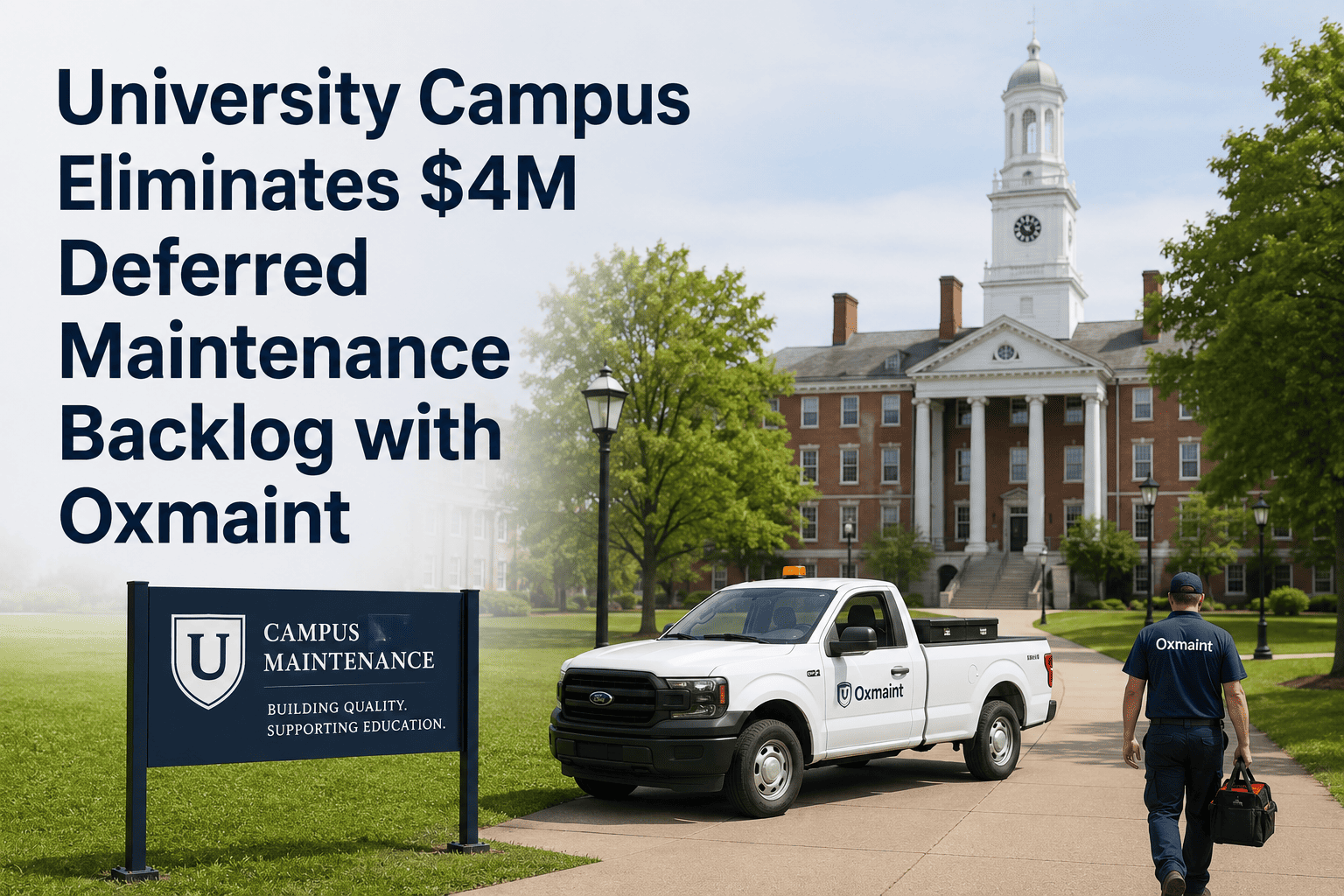
University Campus Eliminates $4M Deferred Maintenance Backlog with Oxmaint
By James Smith on May 15, 2026
A major state university managing 9.4 million square feet across 186 buildings had accumulated $4 million in deferred maintenance — a backlog driven by reactive-only work order management, a Facility Condition Index (FCI) score that had never been formally measured, and PM compliance rates sitting at 51%. The university deployed Oxmaint's asset lifecycle management platform and, over 24 months, eliminated the entire deferred maintenance backlog while raising PM compliance to 94% and reducing reactive work order share from 67% to 19%. Book a session to see how Oxmaint's FCI scoring works for campus facility portfolios.
$4M
Deferred Backlog Eliminated
51% → 94%
PM Compliance Improvement
24 mo
Full Backlog Clearance
186
Buildings Under Management
The Challenge
$4M in Deferred Maintenance and No Roadmap to Clear It
Universities face a structural deferred maintenance problem: aging infrastructure, constrained budgets, and competing capital priorities make it easy to push maintenance into future fiscal years until the backlog becomes unmanageable. This university's facilities team had no system for measuring asset condition, no FCI scoring to prioritize which buildings needed investment first, and no mechanism to ensure PM work orders were actually completed on schedule. The result was 1 in 3 work orders being reactive emergency responses, a facilities staff that felt perpetually behind, and a board-level capital planning process that had no reliable data foundation to work from.
Facility Condition Index Before Oxmaint
Good 0.00–0.10
Fair 0.10–0.30
Poor 0.30–0.60
Critical 0.60+ University: 0.71
FCI = Deferred Maintenance Cost / Current Replacement Value. Above 0.60 indicates critical infrastructure risk requiring immediate capital investment strategy.
The Approach
FCI-Driven Prioritization Across 186 Buildings
Rather than treating all deferred maintenance as equally urgent, Oxmaint's implementation team worked with the university's capital planning office to establish FCI scores for all 186 buildings using asset condition data imported from existing spreadsheets and physical condition surveys. Buildings were ranked by FCI, and a 24-month backlog elimination roadmap was generated automatically, sequencing work by criticality, available budget windows, and seasonal access constraints for occupied academic buildings.
01
Asset Condition Baseline
186 buildings inventoried and FCI-scored using imported maintenance history and physical condition assessments. Critical assets flagged for immediate PM priority escalation.
02
Backlog Sequencing
$4M deferred maintenance backlog broken into 24 monthly work packages, sequenced by FCI score, building occupancy schedule, and contractor availability windows.
03
PM Compliance Rebuild
All 2,400+ assets enrolled in Oxmaint's automated PM scheduling with criticality-based compliance alerts sent 30/14/7 days before due dates. Manual scheduling eliminated.
04
Capital Planning Integration
Oxmaint's lifecycle cost projections and FCI trend data were integrated into the university's 5-year capital plan, replacing spreadsheet estimates with CMMS-verified asset data.
24-Month Progress
Backlog Cleared. Compliance Rebuilt. Capital Plan Validated.
The university completed its 24-month backlog elimination roadmap on schedule and under budget. The FM department also documented a 34% reduction in labor overtime hours as reactive emergency responses were replaced with scheduled planned work — a direct productivity gain that partially offset the platform investment cost in year one.
Month 3
FCI scores established for all 186 buildings. Top 22 critical buildings identified. Emergency PM escalations configured for HVAC and roofing systems in buildings with FCI above 0.80.
Month 9
PM compliance reached 79% system-wide. Reactive work order share dropped from 67% to 41%. First $1.2M of deferred maintenance backlog cleared in critical HVAC and envelope systems.
Month 18
PM compliance at 91%. $3.1M of backlog cleared. University board approved a 5-year capital plan using Oxmaint FCI projections as the primary data source — first time in 12 years capital planning used verified asset condition data.
Month 24
Full $4M backlog eliminated. PM compliance at 94%. Reactive work orders at 19%. FCI portfolio average improved from 0.71 to 0.28 — from Critical to Fair. Estimated annual savings in emergency repair spend: $680,000.
Deferred Maintenance Doesn't Disappear — It Compounds
Oxmaint gives campus facility teams the FCI scoring, lifecycle prioritization, and PM automation needed to turn a growing backlog into a managed, funded, time-bound plan. See how it works for your campus.
What Higher Education FM Leaders Say About Deferred Maintenance
"Deferred maintenance in higher education is not a facilities problem — it is a data problem. When boards and CFOs cannot see a credible, asset-level cost projection for what it takes to maintain their physical plant, they default to deferral. CMMS-backed FCI scoring changes that conversation because it gives capital planners numbers they can defend."
Margaret Hoffmann
Associate VP Facilities, APPA Board Member, 22 Years in Higher Education FM
"A university that does not measure its Facility Condition Index is essentially flying blind on capital planning. The FCI is not a perfect metric, but it is the best universally comparable standard the industry has — and any institution running above 0.30 without a documented remediation plan is accumulating risk that will eventually show up as a structural failure or an accreditor finding."
Robert Caldwell, CFM
Certified Facility Manager, Former Director of Campus Operations — R1 Research University
Frequently Asked Questions
University Campus Deferred Maintenance and CMMS
Oxmaint calculates FCI using the standard APPA formula: deferred maintenance cost divided by current replacement value (CRV). Deferred maintenance values are pulled directly from open and overdue work orders in the CMMS, with asset replacement values entered during initial setup or imported from existing capital planning spreadsheets. FCI scores update dynamically as work is completed or new deferred items are logged. Start a free trial to explore FCI scoring configuration for your campus.
Yes. Oxmaint's capital planning reports export FCI scores by building, system, and portfolio with trend charts, deferred maintenance cost projections, and lifecycle replacement schedules. Reports are formatted specifically for board and CFO audiences — cost-focused, visual, and benchmarked against APPA's FCI standards. Multiple export formats include PDF, Excel, and data feed integrations with common capital planning platforms. Book a demo to review the capital planning report templates available.
Most campuses see PM compliance move from a manual baseline (typically 45–60%) to above 85% within 6 to 9 months of deployment. The rate of improvement depends on how completely assets are enrolled in automated scheduling in the first 90 days. Campuses that complete a full asset upload and PM schedule configuration in the first 30 days consistently show faster compliance gains than those doing phased asset entry. Sign up free to review the asset import and PM scheduling setup process.
Oxmaint supports full building-type classification with separate PM templates, compliance standards, and FCI benchmarks per building category. Residential halls, for example, have different inspection frequencies and compliance requirements than laboratory or athletic facilities. Work orders, asset records, and compliance reports can be filtered and exported by building type, allowing facilities directors to manage each category with appropriate standards while maintaining a unified portfolio view. Book a session to walk through multi-building-type configuration for your campus.
Your Campus Backlog Has a Number. Oxmaint Makes It a Plan.
FCI scoring, automated PM compliance, lifecycle cost projections, and board-ready capital planning reports — all from one platform managing every building on your campus. See how the university in this case study went from 0.71 FCI to 0.28 in 24 months.