A facility management plan is the difference between a maintenance team that responds to problems and one that prevents them. Without a documented plan covering asset inventory, PM schedules, vendor SLAs, budget frameworks, and emergency response protocols, every decision depends on whoever has the most experience in the room — and the day that person is unavailable, the facility pays for it. Start building your FM plan inside Oxmaint CMMS using our pre-built facility management templates, or book a 30-minute session with our facility planning specialists to review your current documentation structure and identify gaps.
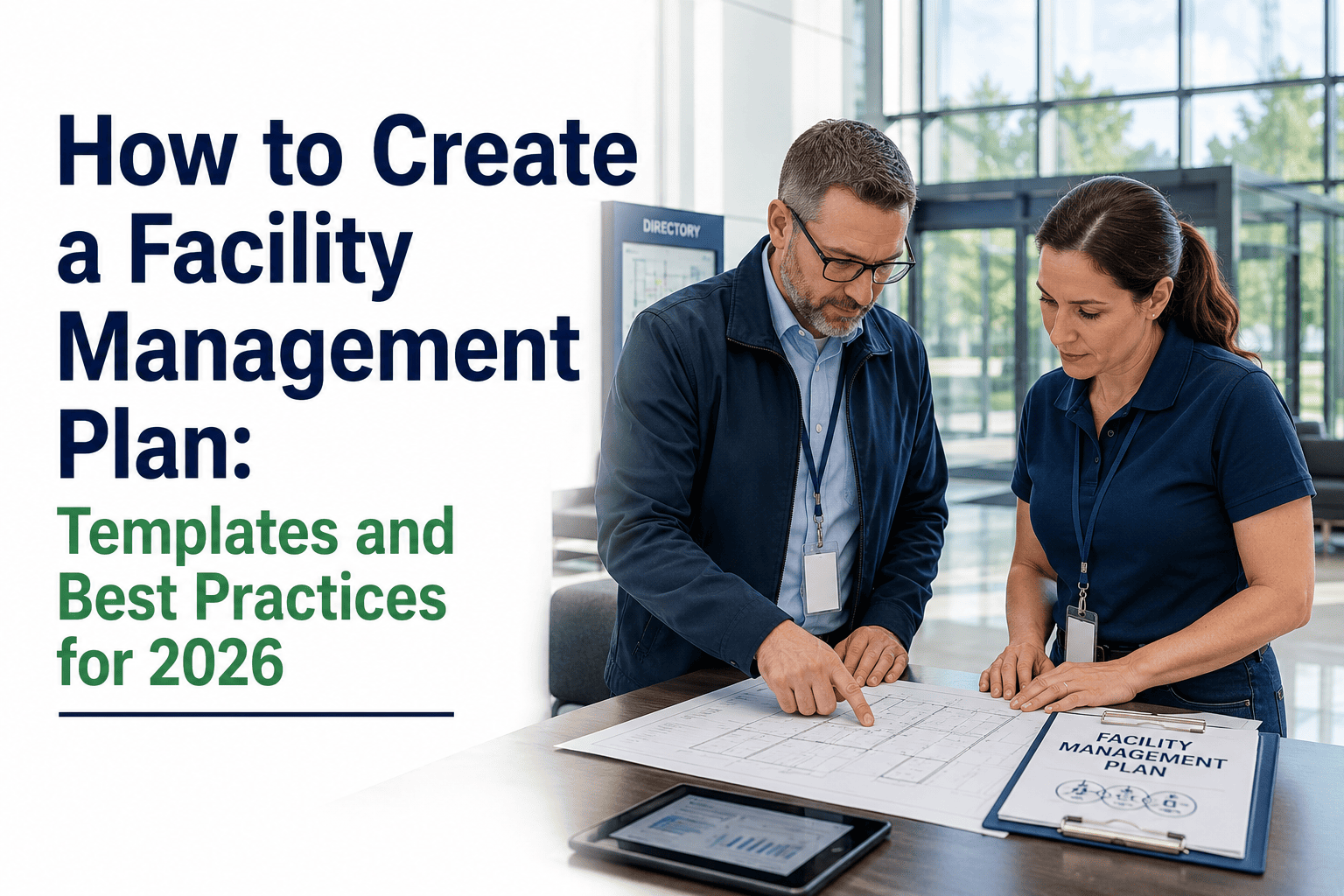
How to Create a Facility Management Plan: Templates and Best Practices for 2026
A practical, section-by-section guide to building a facility management plan that actually gets used — covering asset inventory, maintenance schedules, vendor contracts, budgets, and emergency response. Backed by IFMA standards and 2026 compliance requirements.
What a Facility Management Plan Is — and What It Is Not
A facility management plan is a living operational document that defines how a building or portfolio is maintained, managed, and improved over time. It is not a maintenance log, not a work order queue, and not an annual report. It is the strategic framework that connects your asset inventory to your maintenance activities, your budget to your compliance requirements, and your team's daily tasks to the organization's operational and financial goals.
The Six Sections Every FM Plan Must Include in 2026
IFMA's Facility Management Practice Standards and ISO 41001 both identify six core components of a functional facility management plan. The 2026 additions reflect new ESG reporting requirements, smart building integration standards, and hybrid occupancy management considerations that were not present in legacy FM plan frameworks.
A complete register of every maintainable asset — equipment tag, location, age, criticality classification, current condition rating (FCI), and OEM maintenance requirements. Without a clean asset inventory, every other section of the FM plan is built on an incomplete foundation. Assets not in the register do not get maintained.
PM schedules by asset class, with trigger types (calendar, runtime, condition), task scope, required parts, and estimated labor hours. Schedules should reference specific OEM manuals for each asset class and include a PM compliance target (IFMA world-class: 85–95% for critical systems). This section feeds directly into your CMMS work order engine.
A complete vendor register covering all service contractors — HVAC, electrical, elevator, fire protection, grounds — with contract terms, SLA response time commitments, insurance certificate status, and performance review schedule. For 2026, this section should include sustainability and ESG performance criteria for vendor selection and renewal.
Annual maintenance budget broken down by cost category — planned maintenance, reactive repair, capital replacement, utilities, and vendor contracts — with IFMA benchmark comparisons ($/sqft) by facility type. This section should include a 3-year CapEx forecast based on asset condition data and a deferred maintenance liability estimate for ownership reporting.
A calendar of all statutory, code, and certification-required inspections and tests — fire suppression, elevator, pressure vessels, electrical testing, environmental permits, and building certification renewals. Each item should specify the regulatory body, inspection frequency, documentation required, and responsible party. Missed items carry financial penalties and liability exposure.
Documented response protocols for critical system failures — HVAC, power, water, life safety — with escalation contacts, contractor emergency numbers, and temporary service arrangements. For 2026, this section should include cyber-physical system failure protocols for smart building and BMS-integrated facilities where a software or network fault can trigger building system failures.
2026 PM Frequency Reference Table — Key Building Systems
| System / Asset | PM Frequency | Trigger Type | Compliance Standard | World-Class Target |
|---|---|---|---|---|
| Chiller plant | Monthly + annual major | Calendar | ASHRAE 180 | 95% PM compliance |
| AHU — filter replacement | Per differential pressure | Condition (dP sensor) | ASHRAE 62.1 | 100% on condition trigger |
| Fire suppression system | Quarterly + annual | Calendar (statutory) | NFPA 25 | 100% — zero tolerance |
| Elevator | Monthly service + annual cert | Calendar (statutory) | ASME A17.1 | 100% — zero tolerance |
| Cooling tower (Legionella) | Monthly water treatment | Calendar + water test | ASHRAE 188 | 100% — health risk |
| Pumps and motors | Per OEM or 2,000–4,000 hrs | Runtime hours | OEM specification | 90%+ PM compliance |
| Electrical switchgear | Annual thermographic scan | Calendar | NFPA 70B | Annual without exception |
| Generator and UPS | Monthly load test + annual | Calendar | NFPA 110 | 100% monthly test log |
Oxmaint includes pre-configured asset register templates, PM schedule frameworks, and compliance calendars for 12 building types. Import your existing asset data, configure your PM schedules, and your FM plan is live in days — not months.
What Senior FM Practitioners Say About the 2026 FM Plan
The most common failure I see in facility management plan development is confusing completeness with quality. Teams spend months building comprehensive FM plans with beautifully formatted sections for every possible scenario — and then file them. A facility management plan only has value if it is connected to operational reality: if your asset inventory is in a CMMS that automatically generates PM work orders, if your compliance calendar sends alerts before deadlines, if your budget framework is fed by actual cost data from closed work orders rather than last year's estimates. The 2026 FM plan is not a document — it is a configuration. The best FM plans I have reviewed in recent years are one-page strategy documents with six hyperlinks — one to each section, all of which are live in the facility's CMMS. That is a plan that gets updated automatically as the facility operates, rather than a PDF that becomes obsolete the day after it is published.
Frequently Asked Questions
How long does it take to create a facility management plan from scratch?
With a CMMS providing the structural framework, most facility teams can build a functional first-version FM plan in 4–6 weeks: 1–2 weeks for asset inventory import and condition rating, 1–2 weeks for PM schedule configuration, and 1–2 weeks for vendor register entry and compliance calendar setup. The plan is never truly "complete" — it is a living document updated by every work order closure, vendor renewal, and compliance event. Facilities that attempt to build FM plans in standalone documents typically spend 3–6 months and produce a static file that is outdated on day one. Start your FM plan in Oxmaint today — templates pre-configured for your building type.
What is a Facility Condition Index and how does it fit into an FM plan?
The Facility Condition Index (FCI) is the industry standard metric for expressing the relative condition of a facility as a ratio of deferred maintenance cost to current replacement value. An FCI below 0.05 (5%) indicates a well-maintained facility; above 0.10 (10%) indicates significant deferred maintenance backlog requiring priority capital investment. FCI scoring should be performed on the major systems in your asset inventory annually and forms the quantitative basis for CapEx forecasting, budget justification to ownership, and long-range capital planning in Section 4 of your FM plan. Book a session to see how Oxmaint calculates FCI from your asset condition data.
Does an FM plan need to be different for each building in a multi-site portfolio?
The strategic framework and template structure should be consistent across a portfolio — enabling meaningful performance benchmarking between sites — but the operational content must be building-specific. PM schedules vary by asset mix. Compliance calendars vary by building age, use type, and jurisdiction. Vendor registers are site-specific. The best approach is a master FM plan framework at the portfolio level with building-specific appendices. In Oxmaint, this maps to a portfolio dashboard with building-level drill-down — one platform, multiple buildings, consistent KPI structure. Try Oxmaint's multi-site portfolio configuration free.
What 2026-specific requirements should be added to an existing FM plan?
Four additions distinguish a 2026 FM plan from legacy versions: an ESG reporting section covering energy intensity, refrigerant tracking, and carbon intensity by building; a smart building and BMS integration protocol covering cyber-physical system failure response; a hybrid occupancy management section addressing variable demand on HVAC, cleaning, and security systems; and an AI-assisted maintenance analytics section defining how predictive and condition-based maintenance data feeds into PM schedule optimization. Book a demo to review 2026 FM plan configuration options in Oxmaint.
Import your existing asset data, configure PM schedules from pre-built templates, and connect your compliance calendar — all in one platform that keeps your FM plan current automatically as your team closes work orders.