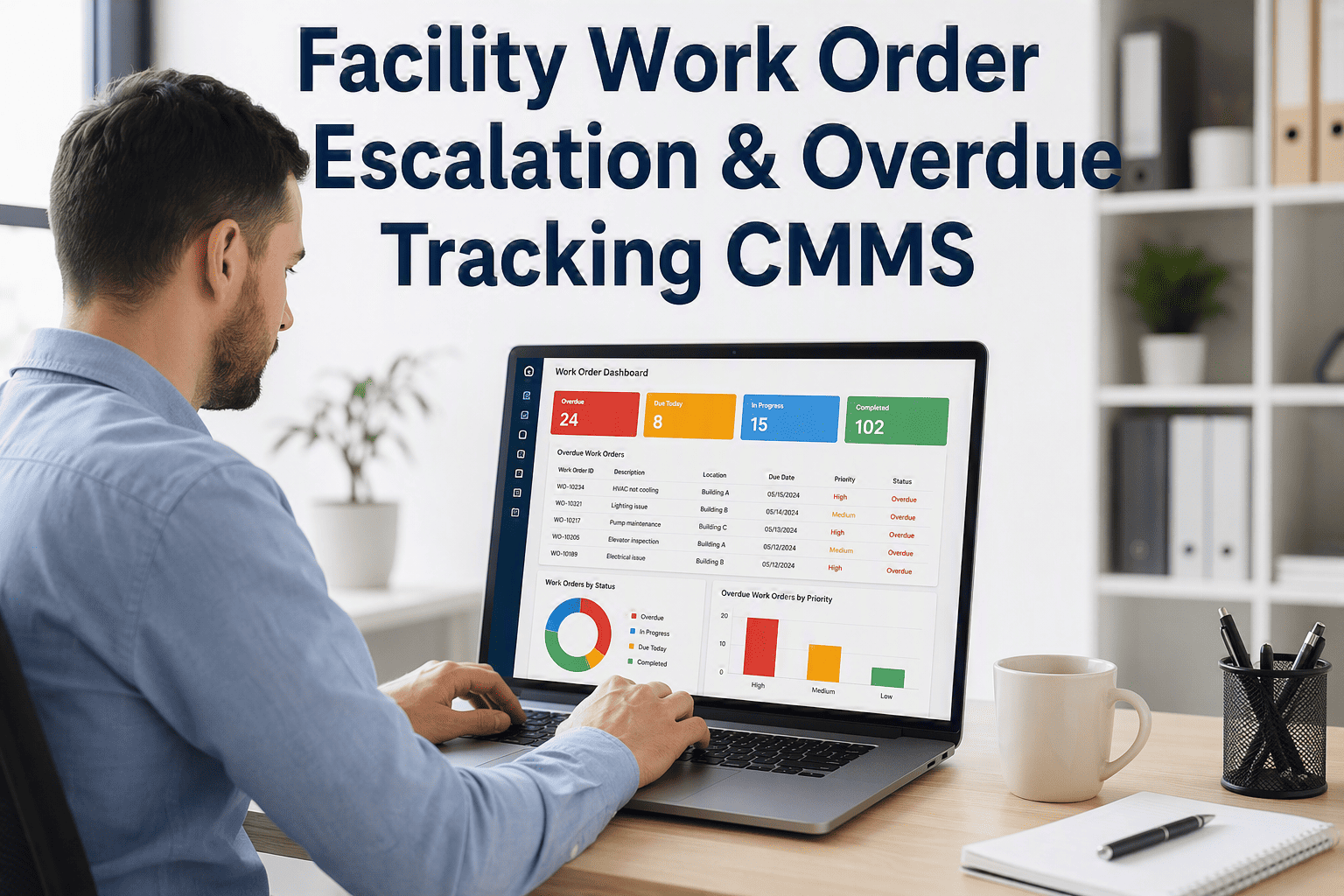
Every maintenance team hits the same wall: one work order comes in marked "urgent," then another, then five more before lunch, and by Friday nobody can say which one actually mattered. Facilities running without a documented priority framework end up burning nearly half of their technician hours on firefighting instead of prevention, while the preventive schedule quietly slips further behind. A structured, CMMS-enforced classification system fixes that by ranking every request on safety risk, asset criticality, and business impact instead of who asked the loudest. This guide walks through the four-tier priority model, the scoring factors behind it, the data fields that make scoring defensible, and how automated classification stops emergency work from swallowing your planned calendar. See how the scoring works against your own backlog with a quick walkthrough.
Work Order Automation · Priority Classification
Stop Guessing Which Work Order Comes First
A four-tier priority model, five scoring factors, and CMMS automation that ranks every request the same way, every shift, every technician, every building — so your team fixes what actually matters before a routine issue turns into an emergency.
45% → 15%
Reactive labor hours drop once a documented priority matrix replaces guesswork at intake
40%
Higher emergency repair rate carried by facilities sitting on a chronic four-to-six week backlog
35%
Faster emergency response once the right certified technician is auto-routed by skill match
90 sec
Time a CMMS needs to re-score and re-sequence the entire open backlog after a new emergency lands
The Framework
The Four-Tier Priority Model Maintenance Teams Actually Use
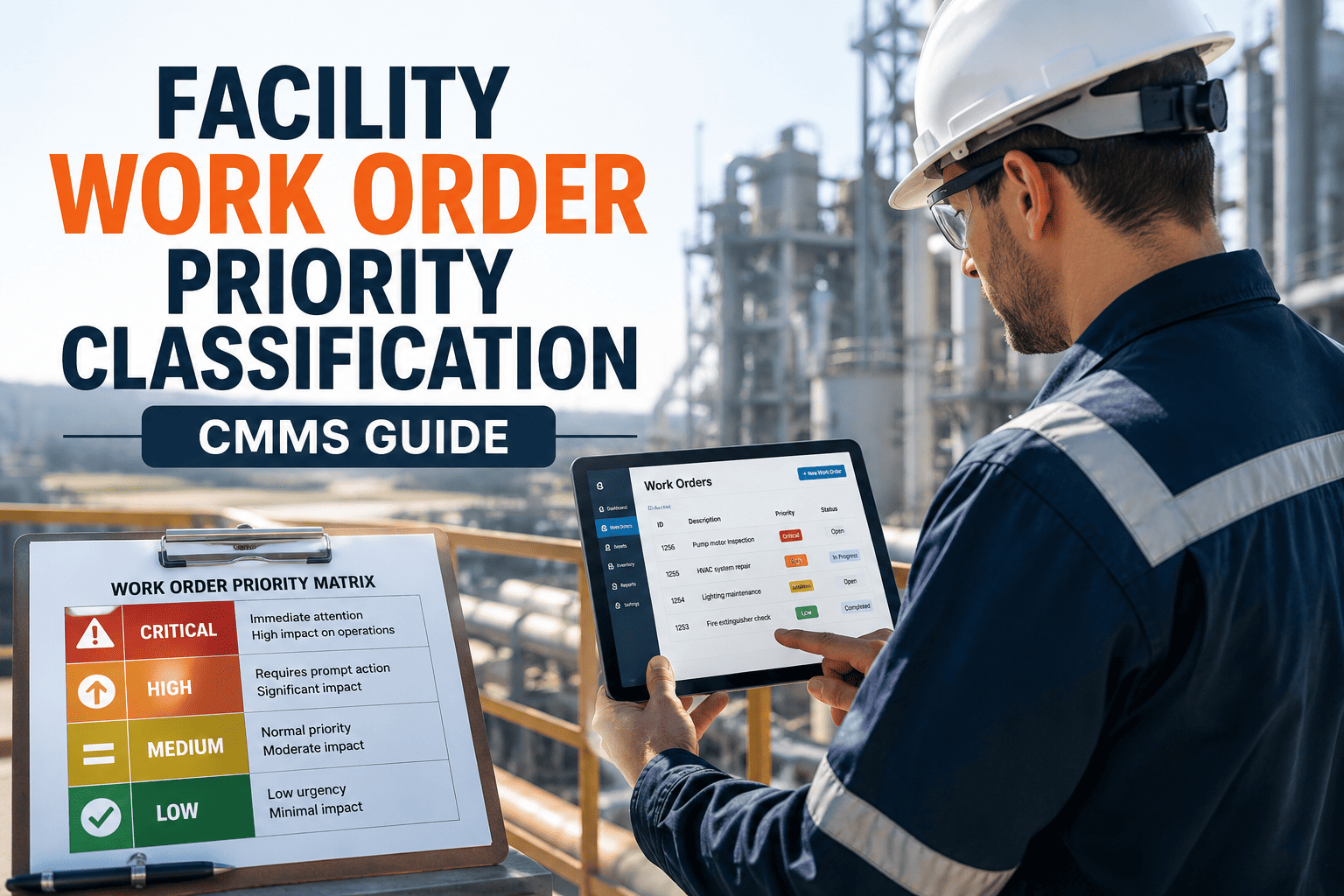
Four tiers cover the full range of work order requests without turning the process into another spreadsheet nobody follows. Each tier is defined by what happens operationally if the problem is left unresolved, not by how urgent the request sounds to the person who filed it, so the same ranking logic holds across every shift and every site.
P1 · Emergency
Respond within 1 hour
Immediate safety hazard, total production shutdown, or life-safety system failure. Bypasses normal approval routing and goes straight to the nearest certified technician with the required skill.
P2 · Urgent
Respond within 24 hours
Significant production impact, regulatory exposure, or environmental risk. Scheduled ahead of routine work and pulled forward automatically if it starts aging in the queue.
P3 · Routine
Schedule within 1 week
Minor operational impact — a slow leak, a flickering fixture, an intermittent sensor fault. Planned into the standard weekly technician route without displacing higher tiers.
P4 · Scheduled
Schedule within 30 days
Cosmetic, comfort, or low-impact requests batched into planned maintenance windows once critical and urgent work for the week is fully covered.
Why Subjective Priority Fails
Requestor Judgment vs Objective Scoring
When priority is a free-text field, everyone learns to type "urgent" to get seen faster, and the label stops carrying any real meaning within a few weeks. Scoring priority from asset data instead of adjectives keeps the queue honest and keeps preventive work from being pushed aside.
Manual, requestor-set priority
78% of requests get labeled "urgent" within the first week of a manual system
CMMS five-factor scoring
22% actually meet the objective criteria for emergency response
PM compliance, matrix-protected schedule
87% preventive maintenance compliance sustained even during emergency spikes
The Five Scoring Factors
Safety hazard flagged directly from the problem description
Asset criticality pulled straight from the asset registry
Production or occupancy impact if the issue is left unresolved
Compliance or regulatory deadline attached to the task
Technician certification and parts availability right now
Ranking work orders by memory doesn't scale past a handful of technicians.
Let the scoring matrix decide what's next, flag what's overdue, and re-sequence the backlog the moment something changes — across every building, every shift, without a supervisor rebuilding the priority list every single morning by hand.
Scoring In Practice
How Each Factor Turns Into a Priority Score
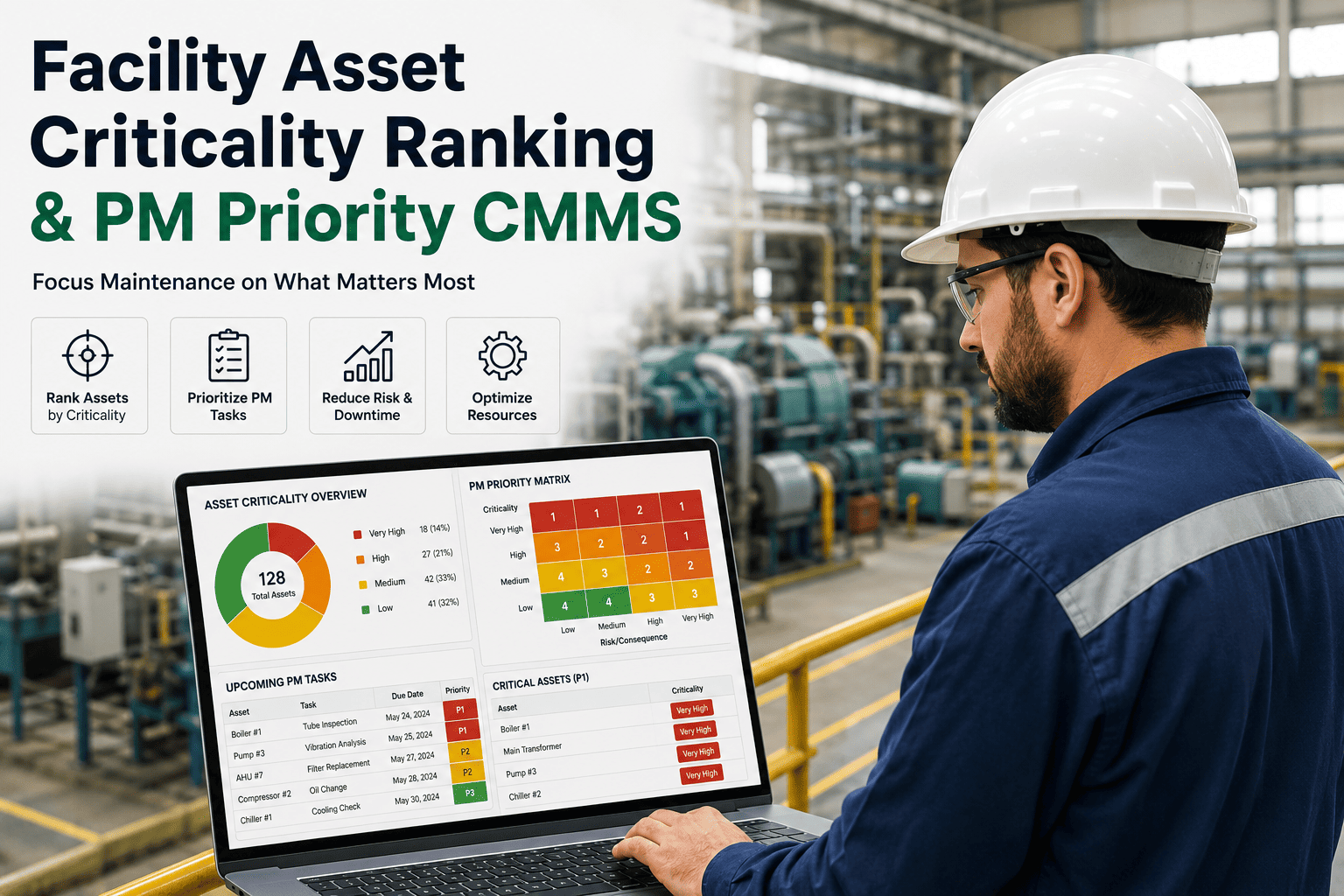
A CMMS combines these five factors into a single weighted score the moment a request is submitted, so the technician sees a ranked queue instead of a pile of unlabeled tickets waiting on a supervisor's judgment call.
| Scoring Factor |
What It Measures |
Typical Example |
| Safety Hazard |
Immediate risk to people from the reported issue |
Exposed wiring, gas smell, blocked fire exit |
| Asset Criticality |
Business dependence on the affected equipment |
Main chiller versus a break-room refrigerator |
| Operational Impact |
Downtime, occupancy, or output loss if delayed |
Line stoppage versus one unused workstation |
| Compliance Deadline |
Whether a regulatory inspection window applies |
Fire system test, pressure vessel inspection |
| Resource Availability |
Certified technician and parts on hand right now |
Skill match plus an in-stock replacement part |
Who This Helps
Built for Teams Buried in Mixed-Priority Requests
The same scoring logic adapts to very different operating environments, because it ranks consequence rather than industry-specific labels — which is why it works whether the request comes from a hospital wing or a factory floor.
Facilities and Corporate Real Estate
Portfolio teams juggling HVAC, electrical, and life-safety requests across multiple buildings need one ranking logic that holds no matter which site the request comes from, so a regional manager can trust the numbers without calling every building first.
Manufacturing and Plant Maintenance
Production-critical assets can't wait behind a request that simply arrived first. Criticality-based scoring keeps line-stopping failures ahead of cosmetic fixes automatically, and protects the PM calendar from being cannibalized every time a line goes down.
Healthcare and Education Campuses
Life-safety systems, lab equipment, and compliance-linked inspections carry different consequences than a classroom projector or office thermostat, and the matrix keeps that difference consistent across every building on campus, every day of the term.
Common Questions
Work Order Priority Classification — FAQs
How many priority tiers should a maintenance team actually use?
Four tiers — emergency, urgent, routine, and scheduled — cover nearly every request without becoming too complex for technicians to follow consistently on a busy shift. Oxmaint applies this structure automatically once your assets are loaded.
Start a free trial to configure your own tier definitions.
Can priority be assigned automatically instead of by the requestor?
Yes. The requestor describes the problem and location, and the system scores priority from asset criticality, safety keywords, and the compliance calendar. Nobody can inflate a request just by calling it urgent.
Book a demo to see the scoring run live on sample data.
What happens to preventive maintenance when emergencies pile up?
A protected PM tier means only lower-priority preventive tasks yield to a genuine emergency, while safety-critical and compliance-linked PMs stay locked on schedule. This is exactly what keeps PM compliance above 85% even during high-emergency weeks.
How does the system handle a senior stakeholder overriding the priority?
Every score is visible and defensible, so an override becomes a documented trade-off rather than a guess — the dashboard shows exactly what gets displaced and why before the change is confirmed and logged against the record.
Do I need clean asset data before setting up priority scoring?
No. Start with whatever asset list you already have and enrich criticality ratings as technicians work through each site. Most teams see accurate scoring within the first two weeks of onboarding through the
free trial.
CMMS Priority Classification · Oxmaint
Give Every Work Order a Score It Can't Argue With
Replace the daily guessing game with a scoring matrix that ranks safety, criticality, and compliance the same way every time, protects your preventive schedule from being cannibalized by reactive noise, and gives every supervisor a defensible answer when priorities get questioned.