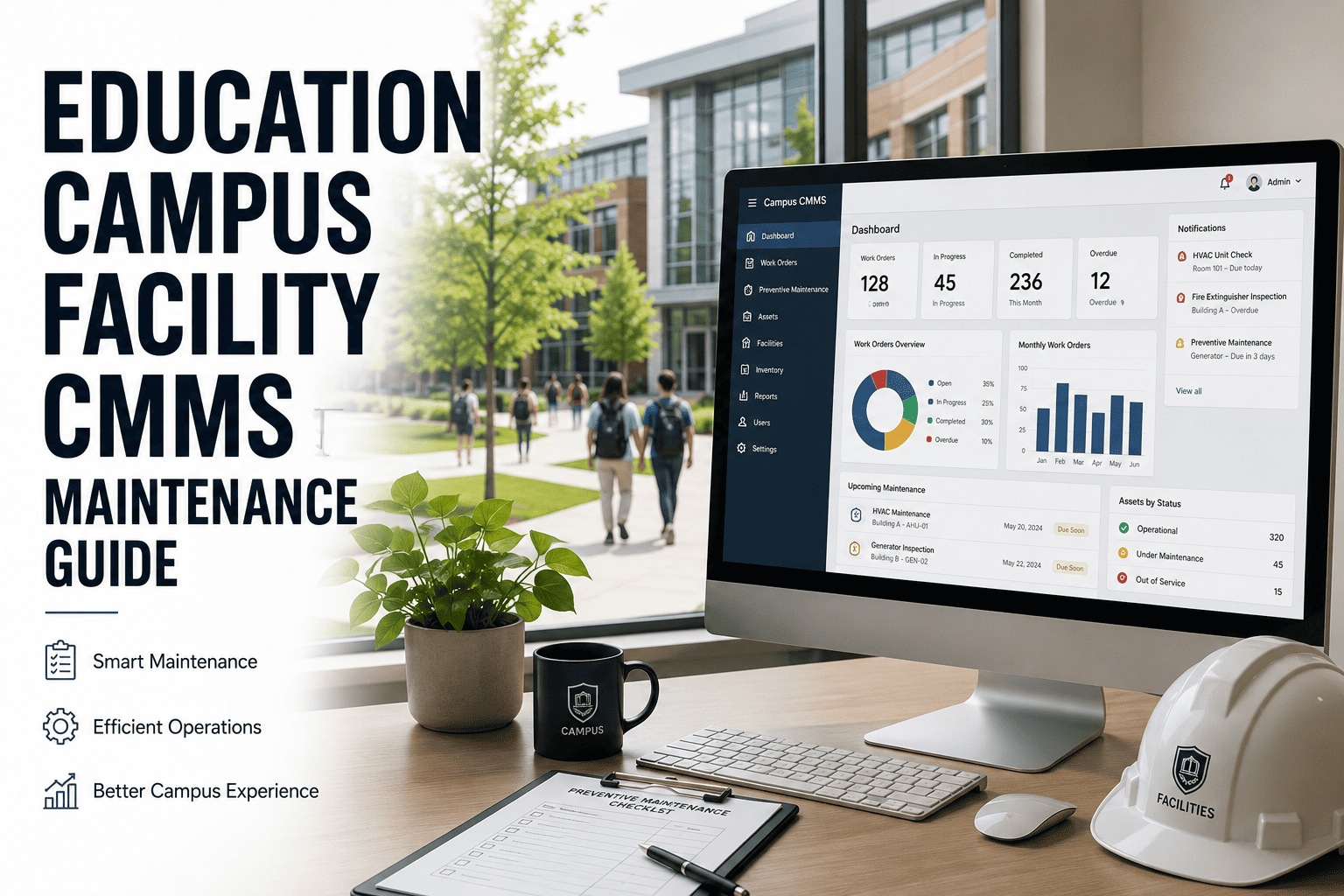
Education facility CMMS adoption is the single most effective way to reduce unplanned downtime across K-12 schools and higher education campuses, where maintenance teams routinely manage hundreds of HVAC units, lab systems, and building assets across multiple locations. A purpose-built campus CMMS guide helps facility directors transition from reactive, paper-based work orders to preventive and predictive maintenance that keeps classrooms safe and operational. Implementing a centralized university facility CMMS can cut emergency repair costs by 25-40% while extending equipment lifecycle by up to 50%. OxMaint brings AI-powered work order automation, asset tracking, and maintenance analytics into one platform built for multi-building campuses. Start Free Trial to modernize your campus maintenance operations today.
Education Facility CMMS Guide 2026
Is your campus still reacting to emergency maintenance instead of preventing it?
From K-12 districts to multi-campus universities, reactive maintenance costs 3-5x more than planned work and disrupts the learning environment. A unified education facility CMMS flips that ratio — scheduling preventive work, prioritizing classroom HVAC, and tracking every asset across every building in real time.
Implementation Roadmap
How to implement a campus CMMS in 5 phases
Most education facilities go live on a CMMS in 30-60 days when they follow a structured rollout. Here's the proven 5-phase timeline that minimizes disruption to academic operations.
Asset Inventory & Criticality Ranking
Catalog every asset across campus buildings — RTUs, boilers, chillers, elevators, lab equipment, doors. Assign criticality scores based on impact on instruction, safety, and research continuity. A typical 12-building campus has 800-2,500 trackable assets.
Preventive Maintenance Plan Setup
Build PM schedules for every critical asset. Prioritize classroom HVAC — ASHRAE Standard 62.1 requires minimum ventilation rates that directly impact student attendance and performance. Map filter changes, belt inspections, and coil cleaning to academic calendars.
Work Order Workflow Migration
Replace paper requests and email tickets with mobile work orders. Configure priority levels (emergency, urgent, routine, deferred), auto-assign by trade (HVAC tech, electrician, plumber), and set SLA response times by building type and classroom schedule.
Spare Parts & Inventory Linking
Connect PM triggers to parts availability. A classroom RTU down for 6 hours because the correct belt isn't in stock costs more than the belt itself. Set min/max levels for filters, belts, lamps, and actuators across campus storerooms.
Analytics, KPIs & Continuous Improvement
Launch dashboards tracking MTTR, PM compliance %, wrench time, and cost per asset. Compare buildings by downtime hours and identify the 20% of assets causing 80% of disruptions. Feed this data back into PM frequency tuning.
ROI & Cost Justification
What does a school facility CMMS cost vs. save?
A 15-building campus spending $480K annually on maintenance typically sees full CMMS payback within 4-7 months. Here's the math behind the savings.
Annual CMMS ROI Formula
[(Reactive repair savings) + (Extended asset life savings) + (Energy efficiency gains)] ÷ (Annual CMMS cost) × 100
| Metric | Before CMMS (Reactive) | After OxMaint (Preventive) | Annual Savings |
|---|---|---|---|
| Emergency work orders / month | 140 | 42 | $96K |
| Average MTTR (HVAC) | 9.2 hours | 3.1 hours | $34K |
| PM compliance rate | 31% | 92% | $28K |
| Asset lifecycle (rooftop units) | 12 years | 17 years | $54K |
| Overtime labor hours / month | 186 hrs | 52 hrs | $45K |
Worked Example
A regional community college with 11 academic buildings and 3 residence halls was spending $510K/year on maintenance with 60% reactive work order ratio. After deploying OxMaint as their campus CMMS, PM compliance hit 89% within 90 days, emergency calls dropped to 28% of volume, and overtime hours fell 64%. Total first-year savings: $207K. The college redirected $80K of that to deferred capital projects that had been stalled for three budget cycles.
Priority Framework
Classroom HVAC maintenance priority for schools
Indoor air quality and thermal comfort directly correlate with student attendance and test performance. A Harvard T.H. Chan School study found that classrooms with proper ventilation see 2-3% higher attendance. HVAC must be Priority 1 in any K-12 facility maintenance plan.
Daily & Weekly Checks
- Inspect classroom thermostats for tampering or dead batteries
- Check supply air temperature on top-floor RTUs during peak load
- Verify exhaust fans in restrooms and lab spaces are operational
- Log and triage hot/cold comfort complaints by room within 2 hours
Monthly PM Tasks
- Replace or clean air filters (MERV 13 minimum for classrooms per ASHRAE guidance)
- Inspect and tension belts on AHUs and RTUs
- Clean condensate drains and verify drain pan float switches
- Check CO2 sensors in densely occupied spaces (target <1000 ppm)
Seasonal & Annual
- Fall: combustion analysis and heat exchanger inspection before heating season
- Spring: cooling tower cleaning, chiller refrigerant charge, coil deep-clean
- Summer break (buildings unoccupied): major component replacements and retrofits
- Annual: ductwork inspection and airflow balancing verification
| Building Type | HVAC Priority Tier | Target PM Frequency | Acceptable Downtime Window |
|---|---|---|---|
| Classrooms (instructional hours) | Tier 1 - Critical | Every 30 days | < 2 hours during school day |
| Science labs & research spaces | Tier 1 - Critical | Every 21 days | 0 hours during active research |
| Residence halls | Tier 2 - High | Every 45 days | < 4 hours (notify residents) |
| Auditoriums & gymnasiums | Tier 2 - High | Every 60 days | Schedule around events |
| Storage & administrative | Tier 3 - Standard | Every 90 days | < 24 hours |
How OxMaint Helps
OxMaint capabilities built for education campus maintenance
OxMaint is an AI-powered CMMS and EAM platform engineered for multi-building campus operations. Here's how specific capabilities map directly to the challenges education facility teams face.
AI-Driven Preventive Maintenance Scheduling
OxMaint analyzes asset history, usage patterns, and failure data to auto-generate and continuously optimize PM schedules. Campus teams see 30-50% fewer unplanned HVAC failures within the first quarter.
Outcome: 40% reduction in unplanned downtimeMulti-Building Asset Tracking
Track every asset across every campus building with GPS mapping, QR code scanning, and complete service history. Know exactly which RTU in which building needs attention — and its full maintenance DNA.
Outcome: Eliminate phantom assets and lost service recordsPredictive Work Orders from Sensor Data
Connect IoT sensors on chillers, boilers, and RTUs to OxMaint. The AI detects vibration anomalies, temperature drift, and efficiency degradation — generating work orders before failure occurs.
Outcome: Catch 70% of failures 2-4 weeks earlyReal-Time Maintenance Analytics
Live dashboards show PM compliance, MTTR, wrench time, and cost-per-building. Compare buildings, identify chronic assets, and generate audit-ready reports for school boards and state compliance.
Outcome: Data-driven budget defense and audit readiness"We went from 60% reactive maintenance to 18% in one semester. OxMaint's PM scheduler alone saved us $140K in emergency HVAC repairs during peak winter. The school board now asks for our dashboard before budget meetings."
— Director of Facilities, 22-building public school district
See OxMaint on your campus assets — book a 30-min demo
Walk through a live CMMS configured for your building count, asset types, and academic calendar. See how preventive scheduling, mobile work orders, and predictive analytics work together on a real education campus.
Frequently Asked Questions
Education facility CMMS: common questions answered
What is the best CMMS for K-12 and higher education facilities?
The best education facility CMMS supports multi-building asset tracking, academic-calendar-aware PM scheduling, mobile work orders for field techs, and parent/staff request portals. OxMaint is purpose-built for campus environments with AI-driven preventive maintenance, real-time analytics, and spare-parts inventory linked directly to work orders — see it in action at Book a Demo.
How much does a campus CMMS cost for a school district?
Education facility CMMS pricing typically ranges from $3,000-$12,000/year depending on building count, user seats, and asset volume. With OxMaint, most 10-20 building campuses achieve full ROI within 4-7 months through reduced emergency repairs, overtime savings, and extended asset life. Annual savings commonly run 3-5x the software cost.
How long does it take to implement CMMS in a university or school?
A structured CMMS implementation for education facilities takes 30-60 days. Phase 1 (asset inventory) runs 1-2 weeks, PM plan setup 1 week, work order migration 1-2 weeks, and parts linking 1 week. OxMaint's onboarding team handles data import and configuration, so your technicians can start using mobile work orders by week 3.
Can a CMMS help with classroom HVAC priority and indoor air quality compliance?
Yes. A campus CMMS lets you tier buildings by criticality, schedule ASHRAE 62.1-compliant filter changes and ventilation inspections, and log every IAQ-related action for audit readiness. OxMaint's PM scheduler can auto-trigger filter replacements based on runtime hours and occupancy data, not just calendar dates.
How do I switch from paper work orders to a digital CMMS on campus?
Start by cataloging your top 20% of critical assets, migrating open paper tickets into the CMMS, and training technicians on the mobile app. OxMaint provides guided onboarding and data migration tools — most campuses eliminate paper work orders within 2-3 weeks of go-live. You can Start Free Trial and import your asset list on day one.
Stop reacting. Start preventing. Modernize your campus maintenance today.
Join education facilities using OxMaint to cut emergency repairs 40%, extend asset life 50%, and keep classrooms operational. Your data migrates in days — not months.
Free 14-day trial · No credit card