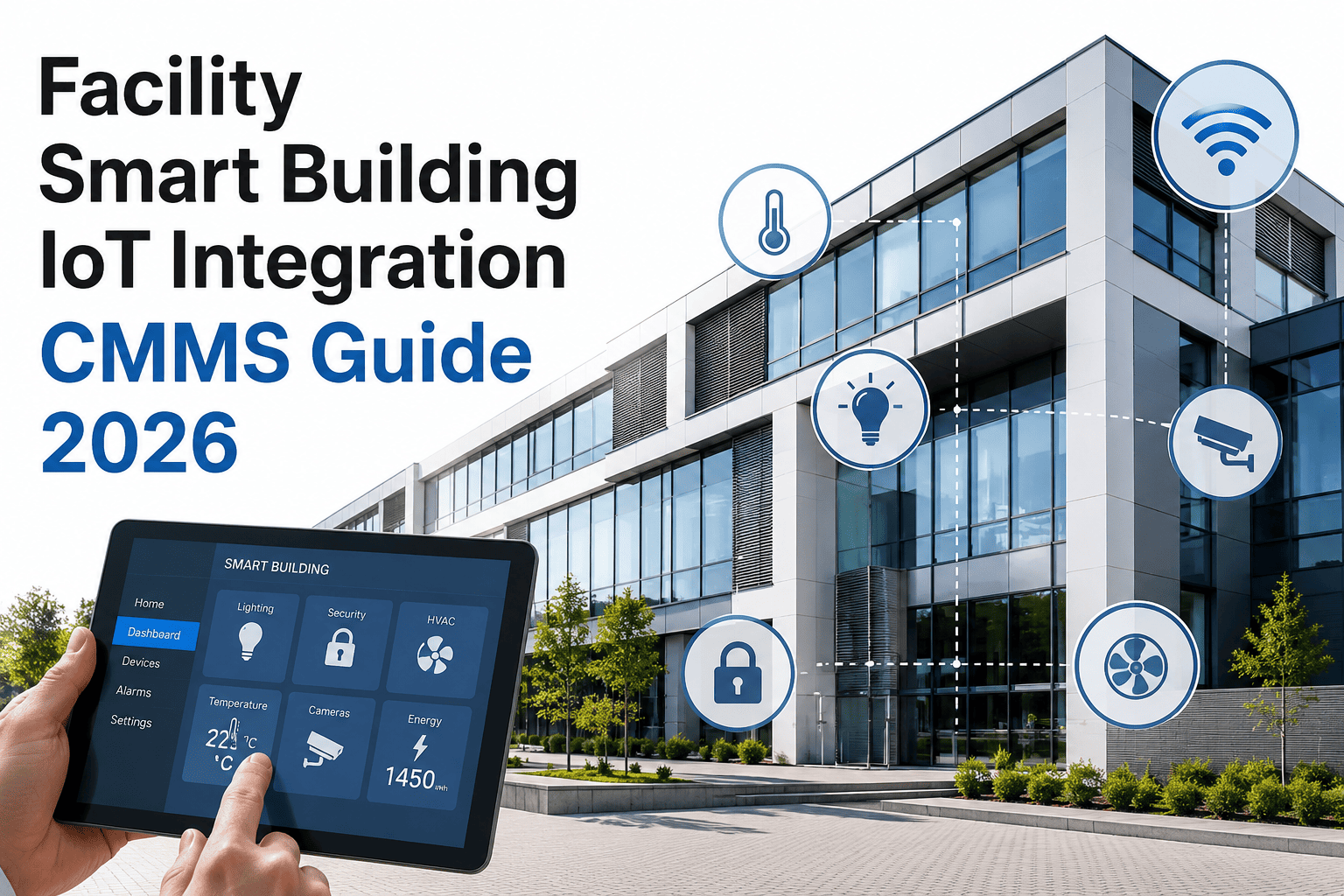
Facility smart building IoT integration is no longer experimental — by 2026, over 70% of large commercial and industrial facilities are expected to connect sensor networks directly to a CMMS, turning raw telemetry into automated work orders, predictive alerts and measurable downtime reduction. This facility smart building guide walks maintenance and reliability leaders through the architecture, ROI and implementation roadmap for connecting HVAC, energy, vibration and occupancy sensors to a centralized maintenance platform. Whether you manage a hospital campus, a manufacturing plant or a multi-site real-estate portfolio, pairing IoT data with an AI-powered system like OxMaint can cut unplanned downtime 30–50% and extend asset life by years. Ready to see it on your assets — Start Free Trial or read on for the full integration blueprint.
Can your maintenance team act on building sensor data in under 60 seconds?
A facility smart building without a CMMS is just expensive data. Connect your IoT sensor network to OxMaint and every anomaly becomes an auto-generated work order, every asset tells you before it fails, and every technician sees real-time condition data on their mobile device.
What a facility smart building IoT integration actually connects
A true facility IoT integration CMMS deployment links four sensor layers to one maintenance brain — OxMaint — so that data flows from physical equipment to technician dispatch without a single spreadsheet or phone call.
Environmental & HVAC sensors
Temperature, humidity, CO₂ and differential-pressure sensors across AHUs, chillers and cleanrooms. OxMaint ingests BACnet, Modbus and MQTT feeds, evaluates readings against asset-specific thresholds, and auto-creates a work order the moment a chiller approach temperature drifts 2°F beyond baseline.
Vibration & condition monitoring
Wireless tri-axial accelerometers on motors, pumps and fans stream FFT spectra to OxMaint's predictive analytics engine. A bearing-fault signature detected at 4 kHz triggers a priority work order with the exact fault frequency, severity score and recommended corrective action pre-filled.
Energy & power meters
Smart meters and power-quality monitors flag overcurrent, phase imbalance and energy waste. When a 75 kW motor draws 12% above its normative profile, OxMaint links the anomaly to the asset record, schedules a thermography inspection and alerts the reliability engineer — before a $18K rewind becomes necessary.
Occupancy & space utilization
PIR and CO₂ occupancy sensors feed demand-controlled ventilation logic and maintenance scheduling. Restrooms, lobbies and shared spaces receive cleaning and filter-change work orders based on actual usage count, not a fixed calendar — cutting unnecessary PM visits by 20–35%.
How to deploy CMMS facility IoT integration in 5 phases
Most facility teams can move from sensor selection to live automated work orders in 8–12 weeks. Here is the phased timeline OxMaint recommends for a typical 150–500 asset facility.
Asset criticality & sensor audit
Rank every asset by criticality (ABC analysis per ISO 55000). Identify the top 20% of assets — usually chillers, air handlers, pumps and compressors — that cause 80% of downtime. These become your first IoT targets. OxMaint's asset register import tool bulk-loads existing spreadsheets in under an hour.
Sensor selection & gateway setup
Choose wireless protocols (LoRaWAN for long-range, Wi-Fi/BLE for dense areas). Install edge gateways that translate BACnet, Modbus and OPC-UA into MQTT or REST payloads OxMaint can ingest. Typical sensor cost: $60–$350 per point; gateway: $400–$1,200.
CMMS integration & threshold mapping
Map each sensor stream to its parent asset in OxMaint. Configure condition-based triggers: if vibration velocity exceeds 0.28 in/s on a 1,800 RPM motor (ISO 10816 Zone C), auto-generate a work order with priority, assigned technician, spare-parts kit and safety checklist.
Predictive model training
Feed 30–60 days of baseline sensor data into OxMaint's AI engine. The system learns each asset's normal operating envelope and begins flagging anomalies — a bearing wear signature, a gradual efficiency decay, a refrigerant leak trend — 7–21 days before functional failure.
Scale, optimize & measure ROI
Expand sensor coverage to secondary assets. Review OxMaint analytics dashboards monthly: MTBF trend, PM compliance rate, energy cost per asset, and wrench-time percentage. Most facilities report full payback on sensor + CMMS investment within 9–14 months.
What does smart building CMMS integration cost and save?
A 180-asset facility spending $42K/yr on reactive repairs, overtime and premature replacements can expect to invest $25K–$45K in sensors, gateways and OxMaint licenses — and recover it in under a year through downtime avoidance, energy savings and labor efficiency.
| Cost / Savings Category | Without IoT + CMMS | With OxMaint IoT Integration | Annual Impact |
|---|---|---|---|
| Unplanned downtime (avg 14 hrs/mo) | $168,000 | $92,400 | −$75,600 |
| Energy waste (HVAC overcooling, motor drift) | $54,000 | $37,800 | −$16,200 |
| Reactive labor & overtime | $48,000 | $31,000 | −$17,000 |
| Premature asset replacement | $36,000 | $18,000 | −$18,000 |
| Sensor hardware (one-time, amortized Yr 1) | $0 | $18,000 | +$18,000 |
| OxMaint annual license (180 assets) | $0 | $14,400 | +$14,400 |
| Implementation & setup (one-time) | $0 | $8,500 | +$8,500 |
| Net Year-1 Benefit | — | — | +$51,100 |
How OxMaint turns facility smart building data into maintenance action
OxMaint is an AI-powered CMMS and EAM platform built to ingest IoT telemetry and convert it into work orders, predictive alerts and reliability analytics — without middleware, without spreadsheets, without delay.
Automated condition-based work orders
When a connected sensor breaches a threshold — vibration, temperature, amperage, pressure — OxMaint generates a fully populated work order in under 60 seconds: asset, fault type, priority, assigned technician, required parts and safety checklist. No dispatch phone calls, no lag.
AI predictive failure detection
OxMaint's ML engine learns each asset's baseline vibration, energy and thermal signature from 30+ days of sensor history. It detects bearing wear, imbalance, misalignment and refrigerant leakage 7–21 days before functional failure — with a confidence score and recommended intervention window.
Live asset intelligence dashboard
Every asset record in OxMaint displays its real-time sensor readings, trend charts, open work orders, PM history and spare-parts availability in a single pane. Reliability engineers see OEE, MTBF and PdM coverage at a glance — and can drill from a red KPI tile to the root sensor trace in two clicks.
Spare-parts auto-reservation
When a predictive alert fires, OxMaint automatically reserves the required spare part from inventory, checks stock level and generates a purchase request if quantity falls below the safety threshold. The technician arrives on-site with the right bearing, belt or filter — no second trip, no downtime extension.
Reactive maintenance vs facility smart building CMMS
The gap between a spreadsheet-driven maintenance program and a sensor-connected OxMaint deployment is not incremental — it is transformative. Here is what changes for the maintenance and reliability team.
| Dimension | Reactive / Spreadsheet Maintenance | OxMaint IoT-Connected CMMS |
|---|---|---|
| Fault detection | Technician or tenant reports failure after it happens | Sensor anomaly detected 7–21 days before failure; auto-work-order created |
| Work order creation | Manual entry, email or phone call; 2–8 hour lag | Auto-generated in <60 seconds with asset, fault, parts and checklist |
| PM scheduling | Calendar-based; 20–35% of visits unnecessary | Condition-based; PM fires only when sensor data warrants it |
| Spare parts readiness | Tech arrives on-site, finds part missing, waits or reorders | Parts auto-reserved at alert time; purchase order pre-generated if low |
| Compliance reporting | Days of manual spreadsheet assembly for audits | One-click ISO 55000 / FMCSA / Joint Commission report from live data |
| Downtime cost / month | $14,000 (avg 14 hrs unplanned at $1,000/hr) | $7,700 (avg 7.7 hrs unplanned — 45% reduction) |
| Asset useful life | Replacement at 8–10 years (run-to-failure pattern) | Extended to 11–13 years via early intervention and condition tracking |
See OxMaint turn your building sensor data into work orders — live
Book a 30-minute demo and we will connect a sample sensor feed to OxMaint, trigger an automated work order and show you the predictive dashboard on your screen in real time.
Facility smart building IoT integration CMMS — frequently asked questions
What is facility smart building IoT integration with a CMMS?
Facility smart building IoT integration with a CMMS connects physical building sensors — HVAC, vibration, energy, occupancy — to a Computerized Maintenance Management System so that sensor anomalies automatically generate work orders, predictive alerts and maintenance analytics without manual data entry. OxMaint supports BACnet, Modbus, OPC-UA, MQTT and REST integrations out of the box.
How much does it cost to integrate IoT sensors with a CMMS?
For a 180-asset facility, expect $18,000–$35,000 for wireless sensors and gateways, $8,000–$12,000 for implementation, and $12,000–$18,000 annually for an OxMaint license. Most facilities achieve full payback in 9–14 months through downtime avoidance, energy savings and labor efficiency. You can Start Free Trial to evaluate the platform with your own asset data before committing.
Which sensor protocols does OxMaint support for facility IoT integration?
OxMaint ingests data from BACnet, Modbus TCP/RTU, OPC-UA, MQTT, REST APIs and common LoRaWAN network servers. If your sensors push data to a gateway or cloud endpoint via any of these protocols, OxMaint can map the stream to an asset record and begin triggering condition-based work orders within days.
Can I keep my existing BMS and add CMMS smart building integration on top?
Yes. OxMaint sits alongside your Building Management System (BMS), pulling sensor telemetry via API or MQTT without replacing it. The BMS continues to control equipment; OxMaint handles the maintenance workflow — turning anomalies into work orders, tracking asset history and running predictive analytics on the same data your BMS already collects. Book a demo to see this architecture in action.
How long does it take to deploy a facility IoT smart building CMMS?
A typical 150–500 asset facility moves from sensor audit to live automated work orders in 8–12 weeks. Phase 1 (asset audit) takes 2–3 weeks, sensor installation 2–3 weeks, CMMS integration and threshold mapping 2–3 weeks, and AI model training requires 30–60 days of baseline data before predictive alerts are fully calibrated.
Stop reacting. Start predicting. Connect your facility smart building to OxMaint.
Join the maintenance teams who have cut unplanned downtime 30–50%, eliminated paper work orders and extended asset life by 2–3 years — all through IoT-connected CMMS intelligence.
Free 14-day trial · No credit card