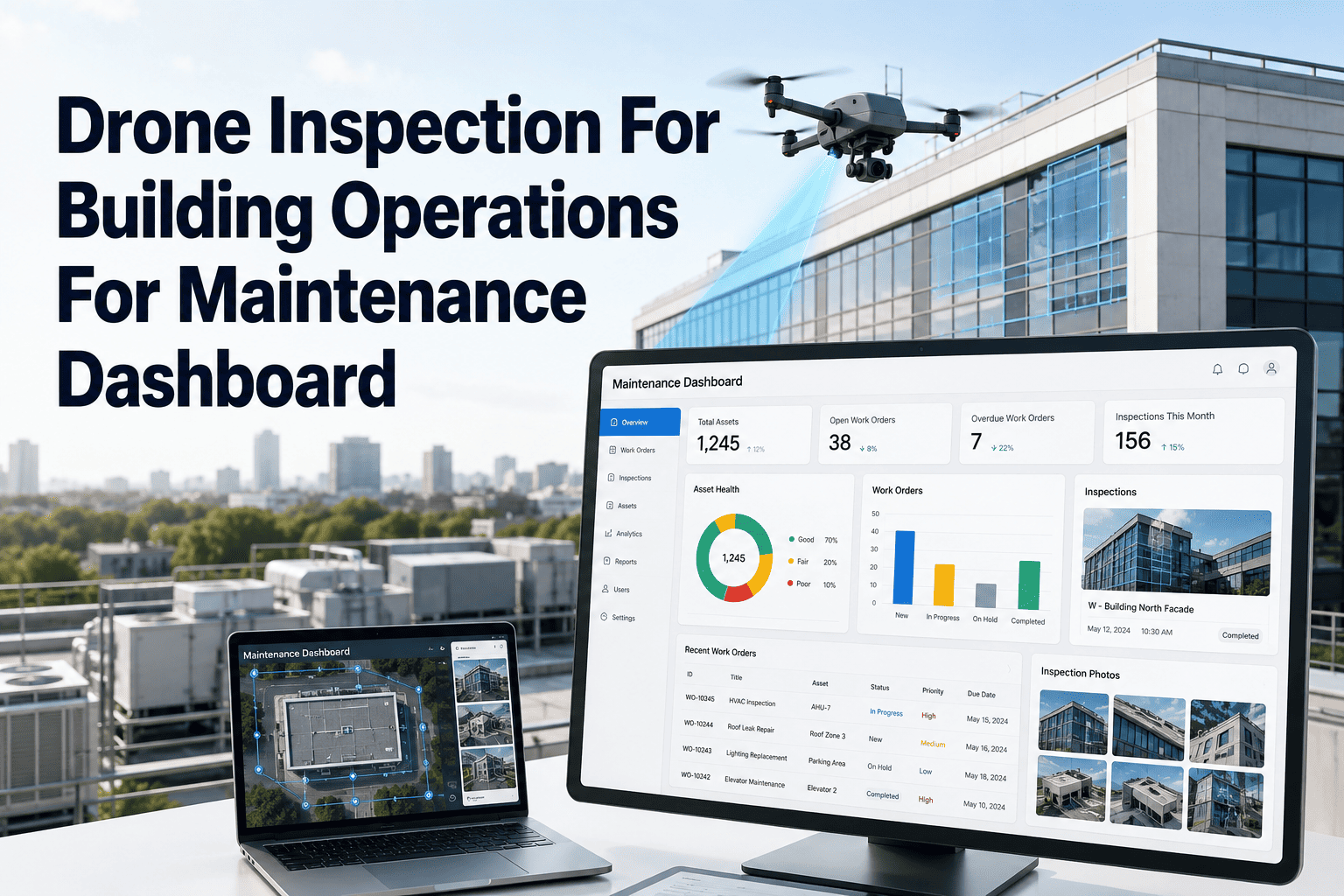
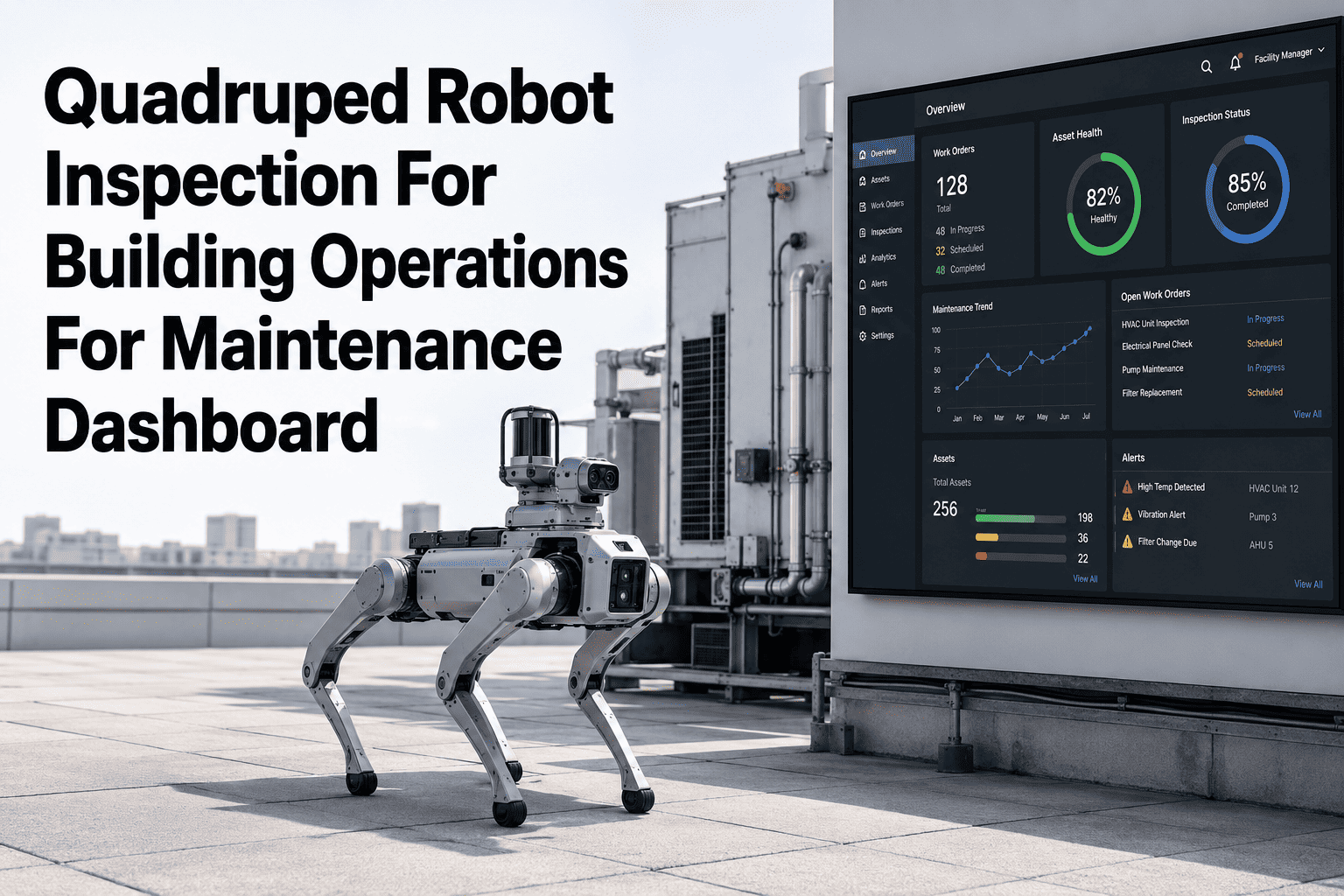
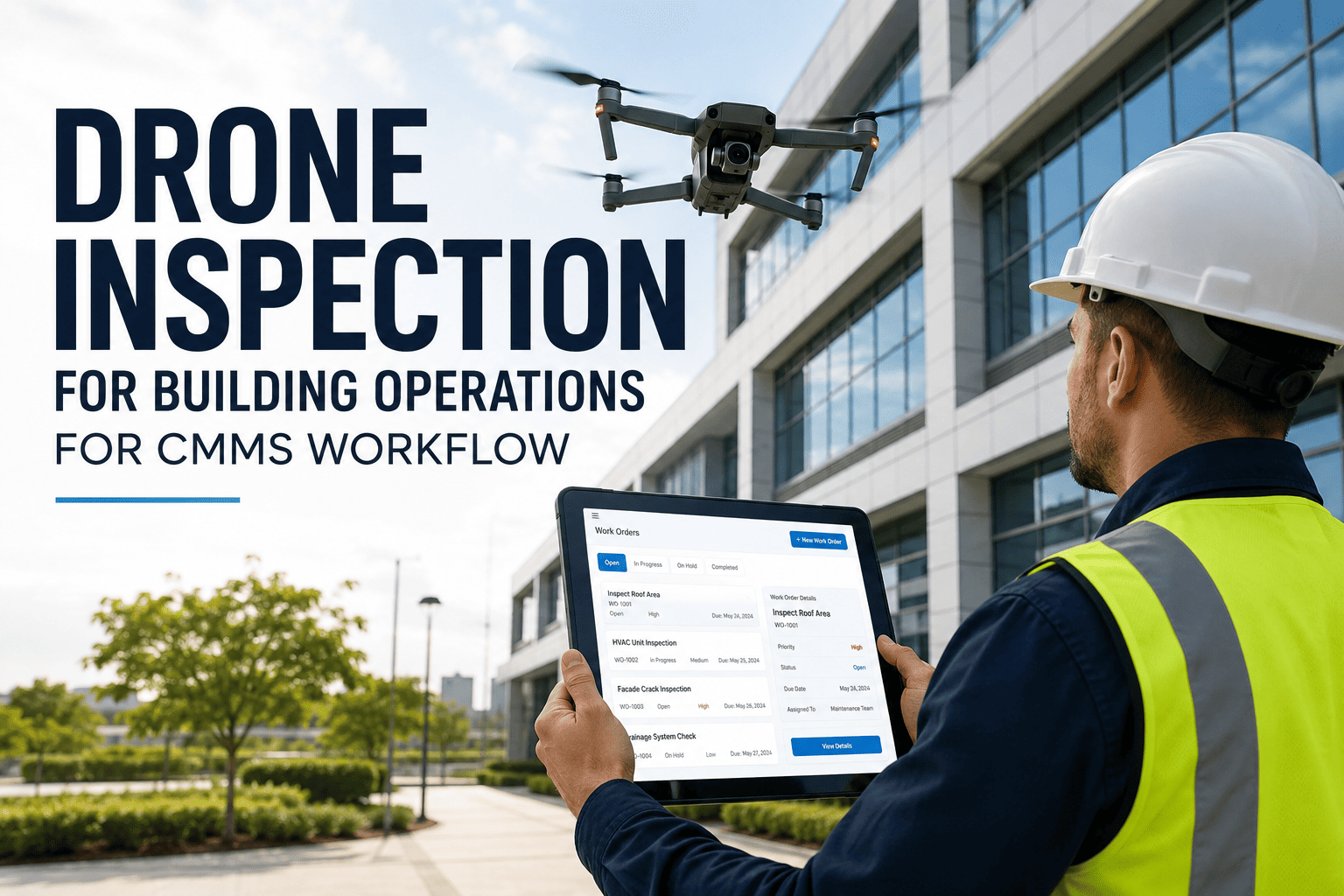
A traditional rope-access roof and facade inspection on a 200,000 square foot commercial building takes 4 to 6 days, costs $18,000 to $42,000, requires a permit pull and tenant notification, and still leaves blind spots wherever the rope team cannot safely reach. The same building can be flown by a single FAA Part 107 pilot in under 4 hours, at 40% lower cost, with 100% envelope coverage and 80% faster turnaround — and a 1°F-resolution thermal map that catches the wet insulation 12 months before it shows up as a stained ceiling tile on the floor below. The drone industry is not the new part of this story; building operations teams have flown roof inspections for five years. The missing piece is the moment the inspection lands. In most facilities today, a drone flight produces a thumb drive of orthomosaic maps, thermal JPEGs, and a PDF report — which then sits on a facility manager's desktop while the actual defects continue to age. The drone caught the parapet crack, but no one opened a work order. OxMaint's Drone Inspection Integration ingests orthomosaic maps, thermal image sets, and AI-flagged defect annotation files (GeoTIFF, GeoJSON, CSV) directly into your maintenance dashboard — geo-locating each defect on the building model, auto-creating a work order with the annotated image attached, and routing it to the right trade with severity-driven SLA timers. This article covers the building envelope coverage architecture, the data ingestion pipeline, the inspection method economics, and the annual cadence that determines whether your drone investment is a one-time consultant report or an ongoing maintenance asset — including how to set up a drone-data-to-CMMS work order automation workflow that converts every flagged anomaly into accountable maintenance work.
Drone Inspection · Building Operations · Maintenance Dashboard Integration
Drone Inspection Integration for Building Operations & Maintenance Dashboard
From a 4-hour drone flight to a closed work order with photo evidence — without the orthomosaic ever sitting on a thumb drive. The architecture below is what turns a one-time inspection consultant deliverable into a recurring maintenance program your asset team actually runs.
80%
Faster than traditional rope-access or scaffold inspections
40%
Lower cost than scaffold or rope-access inspections
100%
Envelope coverage — no blind spots or inaccessible areas
±1°F
Thermal accuracy — detects wet insulation 12 months before interior leak
14.4%
CAGR for global drone roof inspection market, 2025-2035 (Fact.MR analysis)
50%
Reduction in roof insulation R-value caused by just 1% moisture content
ASTM C1153
Standard practice for locating wet insulation using infrared imaging — drone-compatible since 1990
FAA Part 107
Remote Pilot Certificate required for all commercial building inspection operations in the US
What the Drone Actually Sees: Building Envelope Defect Map
The diagram below is what a single 4-hour drone mission produces on a typical 200,000 square foot flat-roof commercial building — overlaid as it appears in the OxMaint maintenance dashboard. Each marker is a geo-located defect; clicking opens the originating work order, the annotated image, and the recommended repair scope.
Zone A · Northwest Roof
Wet insulation · 12.4 m²
Membrane blister · 0.8 m²
Zone B · North HVAC Curb
RTU-3 flashing failure · active leak
Sealant degradation
Zone C · East Parapet
Coping stone displacement
Brick spalling · 4 units
Zone D · Southeast Roof
Ponding water signature
Drain debris accumulation
Zone E · South Facade
Hairline crack · 8.2 m vertical
Window seal thermal bridge
Zone F · West Roof & Drains
Gutter separation
Skylight gasket failure
Inspection Method Economics: Why Drones Replace Three Other Options
A facility director evaluating drone inspection is really running a 4-way comparison against scaffold, rope-access, and boom-lift methods. The matrix below compares the four standard approaches across the five dimensions that matter to a building operations budget — and shows why drone-based inspection now dominates the routine cycle across commercial building envelope inspection CMMS programs.
Method ▼ · Dimension ►
Cost
Duration
Coverage
Safety
Data Output
Drone (Part 107)
$3-6K
2-4 hrs
100% envelope
Ground-only crew
Geo-tagged orthomosaic + thermal + 3D
Rope Access
$18-42K
4-6 days
70-85%
High exposure
Photo log + notes
Scaffolding
$35-80K
10-14 days
80-90%
Moderate
Photo log + notes
Boom Lift
$12-25K
3-5 days
40-60% (perimeter only)
Moderate
Photo log + notes
From orthomosaic to closed work order
Your Drone Flight Should End in a Closed Work Order — Not a PDF
OxMaint ingests drone outputs in their native formats (GeoTIFF, GeoJSON, thermal JPG with embedded temperature data), geo-locates each defect on your building model, and auto-creates a CMMS work order with the annotated image attached. No re-keying. No second platform. No "where did I put that thumb drive."
The Drone-to-Work-Order Pipeline: Four Stages, Zero Re-Entry
The architecture that converts a 4-hour drone flight into closed maintenance work orders is what separates a one-time inspection deliverable from a recurring maintenance program. Each stage is automated; each handoff is geo-referenced; each finding lands in the same dashboard your engineering team already uses.
Stage 01
Raw Data Capture
DJI Matrice 4 Thermal or equivalent platform captures 20MP RGB stills + 4K video + thermal stack (±1°F). Pre-programmed flight path ensures repeatable coverage at every inspection interval. GPS-referenced and time-stamped.
Output: 3,000-8,000 images · 14-22 GB raw data
▼
Stage 02
AI Defect Detection
Processing platform stitches imagery into orthomosaic, runs AI classifier against trained defect library (cracks, blisters, ponding, thermal anomalies), and applies severity rating. Each defect tagged with confidence score and GPS coordinates.
Output: GeoTIFF orthomosaic · GeoJSON defect catalog · thermal overlay
▼
Stage 03
OxMaint Ingestion
OxMaint accepts drone output formats natively. Each defect is matched against the building asset hierarchy (Roof Zone, HVAC Curb, Parapet, Facade Bay), enriched with prior inspection history, and assigned a severity-driven SLA timer.
Output: Linked asset records · classified defect queue
▼
Stage 04
Work Order + Closure
Auto-WO created per defect with severity-routed priority. Roofing trade WOs go to roofing crew or contractor; thermal anomalies route to building envelope contractor; HVAC curb issues route to mechanical. Closure requires before/after photo evidence.
Output: Closed WOs with audit trail · feeds next-cycle comparison
Defect Severity Triage: How OxMaint Auto-Routes Each Finding
Not every roof anomaly is a 24-hour repair. The triage tiers below are how OxMaint classifies every drone-detected defect on intake — assigning the SLA, the routing logic, and the documentation requirement that matches the operational impact.
Tier 1 · Critical
SLA: 24 hours
Active leak or safety hazard
Active water intrusion · displaced coping or masonry · structural deformation · failed HVAC flashing with active leak. Routes to on-call roofing or facade contractor with duty-manager escalation at hour 18.
Examples: RTU flashing failure · displaced parapet stone · membrane tear with active leak
Tier 2 · Major
SLA: 7 days
Degradation requiring scheduled repair
Membrane blisters · vertical facade cracks >3 m · skylight gasket failure · brick spalling. Routes to standard maintenance schedule with parts procurement window.
Examples: 2 m² membrane blister · 8 m vertical hairline · skylight gasket separation
Tier 3 · Thermal
SLA: 30 days
Sub-surface anomaly · monitor and verify
Wet insulation signature · thermal bridging at windows · ponding water heat retention. Routes to building envelope contractor for moisture survey + confirmatory destructive testing before repair scope is finalised.
Examples: 12 m² wet insulation indication · window perimeter thermal bridge · ponding signature
Tier 4 · Minor
SLA: Next PM cycle
Cosmetic or trend-tracked
Surface staining · drain debris · gutter separation · sealant cosmetic degradation. Bundled into next quarterly PM work package. Trended for change vs prior inspection cycle.
Examples: drain leaf accumulation · gutter joint separation · efflorescence staining
Annual Drone Inspection Cadence: What Recurring Looks Like
A single drone flight is a one-time consultant report. A scheduled cadence is a maintenance program. The annual cycle below is what OxMaint pre-loads as the default drone inspection template for a typical commercial building portfolio — adjustable by asset age, climate, and prior inspection findings.
Spring · Q2
Full Building Envelope Drone Survey
Complete roof + facade + parapet + HVAC curb inspection. RGB orthomosaic + thermal capture. Establishes the baseline against which the rest of the year is measured. Schedules into shoulder season for optimal thermal differential between interior and exterior.
Output: ~12-20 defects logged · 2-4 WOs critical · 6-10 WOs major
Summer · Q3
HVAC Rooftop Thermal Survey
Focused thermal inspection of RTUs, chillers, electrical disconnects, and curb flashing during peak cooling load. Detects overworked compressors, refrigerant issues, and electrical hot-spots invisible during cooler months.
Output: HVAC asset condition update · PM schedule re-prioritisation
Fall · Q4
Pre-Winter Drainage & Envelope Verification
Aerial inspection of drains, downspouts, gutters, and parapet seals before winter ice loading. Verifies that summer repair work was completed and that prior Tier-1 defects have closed.
Output: Drainage clearance verification · seasonal readiness sign-off
Post-Storm · As Required
Rapid Damage Assessment Flight
Triggered automatically after hail events >1 inch, sustained winds >60 mph, or heavy rain >3 inches in 24 hours. Time-stamped imagery feeds insurance claims and rapid repair scoping within 48 hours of the weather event.
Output: Insurance-grade documentation · accelerated claim cycle
Annual · Q1
Year-over-Year Comparison & Capital Planning
Reviews the four prior flights against the original baseline. Identifies progressing defects, validated repair effectiveness, and capital projects required for the coming year. Feeds asset replacement forecasting into next-year capex.
Output: Capital planning brief · asset health scorecard · 12-month trend
Operational KPIs Your Facility Director Should Track
Target: 100%
Defect-to-Work-Order Conversion
Percentage of drone-flagged defects that became tracked work orders. Below 100% means flagged anomalies are aging without action — the same gap that traditional paper-based inspections create at scale.
Target: under 24 hr
Tier-1 Response Time
Mean elapsed time from drone-detected critical defect to contractor on-site. Active leaks and structural hazards have a 24-hour SLA; sustained breach signals a routing or escalation failure in the workflow.
Target: above 85%
Year-over-Year Defect Closure
Percentage of prior-year defects fully resolved before the next annual flight. Below 70% indicates the maintenance program is treating drone outputs as advisory rather than operational — and Tier-2 defects are progressing toward Tier-1.
Target: under 48 hr
Flight-to-Dashboard Latency
Mean elapsed time from drone landing to defects visible in the maintenance dashboard. Properly integrated systems hold this under 48 hours; manual report workflows often run 7-14 days, eroding the seasonal urgency the data was meant to capture.
Target: 100%
Photo-Evidence Closure Rate
Percentage of closed drone-originated work orders with attached before/after photo evidence. Insurance claims, capital planning, and contractor disputes all depend on this evidence chain being complete.
Target: under 5%
Repeat-Defect Recurrence Rate
Percentage of resolved defects that recur in the same building location within 12 months. High recurrence indicates the corrective scope addressed the symptom, not the underlying envelope failure — and the next inspection cycle will catch it again.
Expert Review
"
The building owners who still rely on annual walkthrough roof inspections are operating with roughly 80 percent less data than drone-enabled competitors — and the difference shows up in their reactive maintenance bill within 24 months. In 17 years inspecting commercial and industrial building envelopes across North America, I have watched the industry transition from rope access being the standard practice to drone-based inspection being the standard practice. But the technology was never the hard part. The hard part has always been what happens after the flight lands. I have audited drone inspection programs at facilities running $40 million in annual property maintenance spend where the orthomosaic deliverable was being filed in a SharePoint folder no maintenance technician ever opened. The drone caught the defects. Nobody fixed them. The defect ages, the leak develops, the interior damage costs ten times what the early repair would have. The fix here is not a better drone — it is a CMMS that ingests the drone's output as a primary intake channel, treats every flagged defect as a maintenance event with a routing decision and an SLA timer, and tracks closure with photo evidence. OxMaint's Drone Inspection Integration is the architecture I now recommend to facility directors as the operational backbone that makes drone investment actually pay back.
Caleb Morrison, CFM, IFMA Fellow
Director of Building Envelope Operations · 17 years commercial & industrial facility envelope inspection · Certified Facility Manager · International Facility Management Association Fellow · FAA Part 107 Certified Remote Pilot · Specialism in drone inspection program design for portfolio facility operators
Frequently Asked Questions
Q1
What drone output formats does OxMaint accept, and do we need a specific drone platform or processing software?
OxMaint accepts the
industry-standard drone deliverables regardless of the capture platform: orthomosaic maps in
GeoTIFF, thermal image sets in
JPG/PNG with embedded temperature metadata, defect annotation files in
GeoJSON or CSV, and 3D models or point clouds for portfolio comparisons. The platform is hardware-agnostic — DJI Matrice 4 Thermal, Skydio X10, Parrot Anafi, and Wingtra outputs all ingest the same way. Processing software like Pix4D, DroneDeploy, Propeller, and Anvil Labs all export to compatible formats.
Book a demo to test ingestion against your current drone vendor's deliverable format.
Q2
Do we need an in-house Part 107 pilot, or can we use a third-party drone service provider?
Both work, and most facility teams use both. In-house pilots make sense for portfolios above 8-10 buildings where the recurring flight cost amortises the certification, training, and aircraft investment. Third-party service providers are typically more economical below that threshold and provide their own pilot, aircraft, processing, and insurance. OxMaint's integration is identical either way — the drone vendor delivers the same output files into the OxMaint intake regardless of whether the pilot is W-2 or 1099. Many facility teams start with a third-party provider for two annual flights, then transition to in-house pilots for the post-storm and supplementary flights as the program matures.
Q3
How does OxMaint handle building envelope ordinance compliance — like NYC Local Law 11 or other facade inspection mandates?
Building envelope ordinances vary by jurisdiction, but the common pattern is a cyclical inspection requirement (NYC Local Law 11 / FISP runs on a 5-year cycle) with specific documentation deliverables. OxMaint stores the drone-captured inspection record against the building asset with the
ordinance cycle clock pre-set — generating an automatic work order 90 days before the next compliance deadline, tracking which inspection elements have been completed against the regulatory checklist, and exporting the inspection package in the format the local jurisdiction requires. Many jurisdictions now accept drone imagery as part of the visual inspection record provided it meets quality and coverage standards.
Read more on facade ordinance compliance in OxMaint.
Q4
How does the platform handle thermal imagery — is it just an image attachment or does it inform the work order severity?
Thermal images are not just attached — they are parsed for their embedded temperature data and used to calculate severity. A thermal anomaly with a 4°F differential from the surrounding membrane reads differently than one with a 12°F differential; the latter typically indicates active moisture, the former indicates a localised insulation gap. OxMaint applies a configurable temperature-differential threshold per asset class — roof membrane, facade window, RTU curb, electrical disconnect — and uses that threshold to drive severity tier assignment and routing logic. For energy auditing workflows, the platform also produces year-over-year thermal comparison overlays that quantify whether prior remediation reduced the thermal signature.
Q5
What is the typical implementation timeline and ROI window for drone inspection integration?
Implementation typically runs
3-6 weeks end-to-end: Week 1-2 covers asset hierarchy setup and building model registration; Week 3-4 covers drone vendor onboarding and ingestion format validation; Week 5-6 covers severity threshold tuning and routing rule configuration. ROI is typically realised on the first major flight: a single $4K drone flight that detects a wet-insulation signature 12 months before interior leak progression typically prevents $40K-$120K in downstream interior damage repairs — a 10:1 to 30:1 return on a single inspection. Across an annual program, facility directors typically see 35-50% reduction in reactive envelope repair spend within 18 months of program maturity.
Start an OxMaint free trial to import your current building portfolio and see the cadence template against your assets.
Stop discovering roof leaks through interior damage
Make Every Drone Flight End in a Closed Work Order
OxMaint ingests orthomosaic maps, thermal image sets, and AI-flagged defect catalogs directly into your maintenance dashboard — geo-locating each anomaly on your building model, auto-creating CMMS work orders with annotated images attached, and routing them to the right trade with severity-driven SLA timers. The architecture that turns drone inspection from a one-time consultant report into a recurring maintenance program.