Electrical faults are the leading cause of non-weather-related building fires on campus — and they give almost no warning before they become catastrophic. Arc faults develop over weeks as insulation degrades. Loose connections generate heat signatures that climb 2-5 degrees per day. Overloaded panels draw incrementally more current until a breaker fails or a conductor melts. By the time smoke is visible, the damage is already six figures. Universities and school districts managing aging electrical infrastructure across dozens of buildings face a compounding risk that manual inspections cannot keep pace with. Campuses deploying AI-powered anomaly detection through CMMS platforms like OxMaint with integrated IoT monitoring are detecting 87% of electrical faults before they cause outages or safety events — converting invisible risks into prioritized, auto-generated work orders that maintenance teams resolve during normal operations, not during emergencies. When a 40-year-old electrical panel serves a building with 800 students, the cost of not monitoring it is measured in lives, not just dollars.
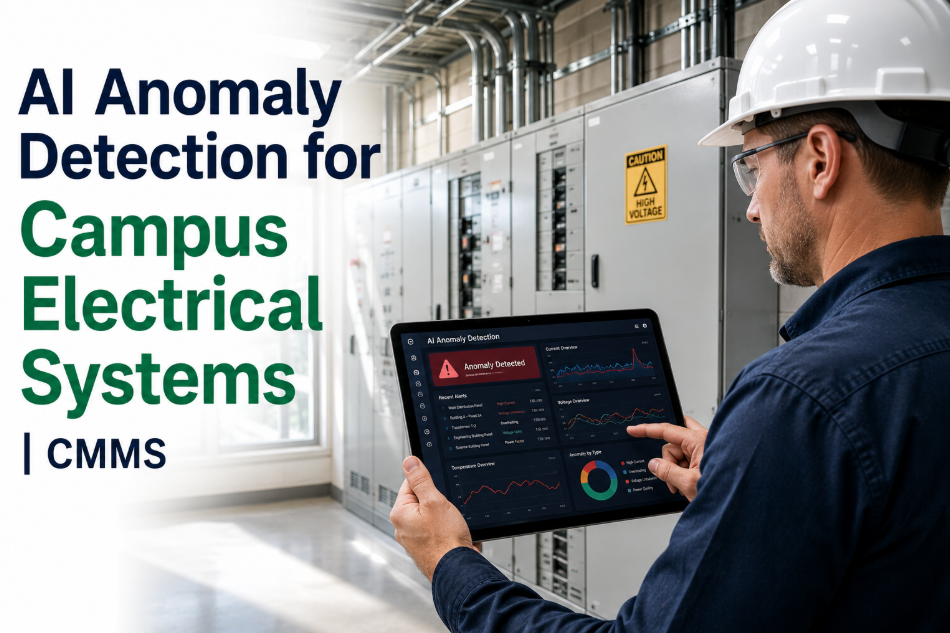
AI Anomaly Detection for Campus Electrical Systems
How AI-driven monitoring watches campus electrical panels 24/7, detects developing faults invisible to human inspection, and auto-triggers CMMS work orders before fires, outages, or equipment destruction occur.
What Is AI Anomaly Detection for Electrical Systems?
AI anomaly detection for campus electrical systems uses continuous sensor monitoring — current, voltage, temperature, harmonic distortion, and power factor — combined with machine learning algorithms that learn the normal operating signature of each electrical panel, transformer, and distribution circuit. When readings deviate from established baselines, the AI flags the anomaly, classifies the probable fault type, and triggers a prioritized work order directly in the CMMS.
This is fundamentally different from traditional electrical maintenance, which relies on annual thermographic scans, periodic breaker testing, and reactive response after tripped breakers or visible damage. AI monitoring watches every monitored circuit every minute of every day — catching the slow thermal creep of a loose lug connection or the harmonic signature of failing capacitors weeks before a human inspector would encounter them. OxMaint integrates this sensor data directly into its asset registry and work order engine, creating a closed loop from detection to resolution with full documentation. Campuses across the US, UK, and Australia are adopting this approach as electrical infrastructure ages and fire codes tighten. Ready to see how it applies to your campus? Start a free trial or book a demo to explore the IoT integration workflow.
The 6 Electrical Fault Patterns AI Catches Before Humans
Each fault type below develops gradually over days, weeks, or months. Manual inspection visits campuses too infrequently to catch them in time. AI monitoring sees them as they emerge — converting slow-developing risks into early-stage maintenance tasks instead of emergency calls.
Insulation degradation creates micro-arcing that generates distinctive high-frequency electrical signatures. AI detects these patterns 4-8 weeks before arc energy is sufficient to ignite surrounding materials. Annual thermographic scans miss 73% of developing arc faults between visits.
Loose lugs and terminations increase resistance, generating heat that climbs 2-5 degrees per day. AI temperature monitoring flags thermal rise at 10 degrees above baseline — long before the 80-degree rise that causes conductor failure. This single fault type causes 25% of all electrical panel fires.
Unbalanced loading across three-phase distribution causes overheating in the most-loaded phase while under-utilizing others. A 10% phase imbalance increases motor winding temperatures by 16% and reduces equipment life by 30%. AI detects imbalance drift at 5% — well before damage threshold.
Non-linear loads (LED drivers, VFDs, computers) generate harmonic currents that heat neutral conductors and transformers. AI monitors Total Harmonic Distortion and flags when THD exceeds 8% — the threshold where transformer derating and conductor overheating begin. Campus buildings with lab equipment are especially vulnerable.
Power factor correction capacitors degrade over 8-12 years, reducing power factor and increasing reactive power charges from utilities. AI detects falling power factor trends and increased capacitor ESR (equivalent series resistance) before total failure — which often involves capacitor rupture and arc flash risk.
Developing ground faults allow current to leak through unintended paths — creating shock hazards and wasting energy. AI monitors ground fault current continuously and flags leakage increases above 5mA baseline. Traditional testing catches this only during scheduled inspections, which occur once or twice per year on most campuses.
How the Detection-to-Resolution Loop Works
AI anomaly detection is only valuable if it connects directly to maintenance action. OxMaint creates a closed loop — from sensor detection through AI classification to auto-generated work order to verified resolution — with every step documented for compliance and audit purposes.
IoT sensors on electrical panels capture current, voltage, temperature, and power quality data every 60 seconds. Data streams directly to OxMaint via SCADA or cloud gateway integration. No manual readings required.
Machine learning algorithms establish normal operating patterns for each monitored circuit over a 14-21 day training period. The AI learns daily load cycles, seasonal patterns, and building-specific electrical signatures — then watches for deviations.
When sensor data deviates from established baselines, the AI classifies the anomaly type — thermal rise, harmonic distortion, phase imbalance, ground fault — and assigns a severity score. False positive rates drop below 5% after the first 30 days of operation.
Critical and high-severity anomalies automatically generate prioritized work orders in OxMaint, assigned to the appropriate electrical maintenance team. The work order includes anomaly type, sensor data snapshot, asset location, and recommended inspection procedure.
Electricians receive mobile notifications with full anomaly context. They inspect the flagged panel, perform corrective action, log findings with photos, and close the work order. The repair is linked to the specific asset and anomaly record permanently.
After repair completion, the AI monitors the same circuit to confirm the anomaly signature has resolved. If readings return to baseline, the fault is marked resolved. If the anomaly persists or worsens, a follow-up work order is auto-generated — ensuring no incomplete repair goes undetected.
Traditional Electrical Maintenance vs AI-Driven Monitoring
The gap between periodic manual inspection and continuous AI monitoring is not incremental — it is the difference between discovering problems and preventing them. Every row below represents a real operational scenario where AI changes the outcome from reactive damage control to proactive risk elimination.
| Capability | Traditional Manual Approach | AI Anomaly Detection + OxMaint |
|---|---|---|
| Monitoring Frequency | Annual thermographic scan + quarterly visual | Every 60 seconds, 24/7/365 |
| Fault Detection Window | Found at next scheduled inspection (months) | Flagged within minutes of anomaly onset |
| Arc Fault Detection | Visible damage or tripped breaker (too late) | High-frequency signature detected 30-60 days early |
| Documentation | Paper reports filed after inspection visits | Continuous digital record with timestamps and sensor data |
| False Positive Rate | Not applicable (reactive only) | Below 5% after 30-day training period |
| Work Order Generation | Manual creation after inspection findings | Auto-generated with anomaly classification and severity |
OxMaint integrates with existing IoT sensors, SCADA systems, and building automation platforms to bring AI-powered electrical monitoring into your CMMS workflow. No rip-and-replace. No complex IT projects. Most campuses are receiving their first AI-generated anomaly alerts within 30 days of sensor deployment. Walk through the full integration in a live demo.
Where to Deploy AI Monitoring First: Priority Matrix
Not every panel on campus needs AI monitoring on day one. The highest ROI comes from prioritizing circuits where failure consequences are most severe and where equipment age creates the greatest risk. This matrix shows the deployment priority ranking used by campus facility teams implementing AI electrical monitoring. Use this as your starting framework — then expand coverage based on the anomalies the system uncovers in the first 90 days. If you want help mapping this to your specific campus infrastructure, book a demo or start a free trial to begin building your asset registry.
Single point of failure for entire buildings. MDP failure causes complete building outage affecting hundreds of occupants. Average age on US campuses: 35+ years. Monitor all three phases, neutral, and ground plus panel temperature.
Fire alarm panels, emergency lighting, elevator power, and exit sign circuits. Failure creates immediate life safety risk and code violations. NFPA 70B recommends continuous monitoring for all life safety electrical systems.
Campus IT infrastructure depends on clean, reliable power. Harmonic distortion, voltage sags, and ground faults cause data loss and equipment damage. A single server room outage can cost $25,000-$100,000 in recovery and lost productivity.
Sensitive research equipment, chemical storage refrigeration, and fume hood motors require stable power quality. Power quality events can destroy months of research data. Harmonic monitoring is especially critical in buildings with high VFD density.
Chiller, boiler, and AHU motor circuits consume 40-60% of campus electrical load. Phase imbalance and voltage deviation monitoring prevents motor winding failures that cost $8,000-$25,000 per incident and cause multi-day building comfort disruptions.
Parking structure lighting, EV charging stations, and exterior distribution are exposed to weather and ground movement. Ground fault monitoring prevents shock hazards in wet environments. Increasingly critical as campus EV charging loads grow 30-40% annually.
ROI of AI Electrical Monitoring on Campus
The financial case for AI anomaly detection on campus electrical systems is built on three pillars: avoided catastrophic failures, reduced unplanned outages, and extended equipment lifespan. Each metric below is documented from campus implementations where continuous monitoring replaced periodic manual inspection.
Frequently Asked Questions
Does AI electrical monitoring require replacing our existing panels or switchgear?
How does the AI avoid generating false alarms that overwhelm the maintenance team?
Can OxMaint integrate with our existing building automation or SCADA system?
What compliance documentation does AI monitoring provide for NFPA 70B and insurance audits?
Your Electrical Panels Are Talking — Your Maintenance System Should Be Listening
Every campus has electrical panels that are developing faults right now — loose connections heating up, phase imbalances stressing motors, harmonic currents overloading neutrals. The only question is whether you find them during a planned inspection or during an emergency evacuation. OxMaint connects AI anomaly detection directly to your maintenance workflow, turning invisible electrical risks into documented, resolved work orders. See how continuous monitoring works for your campus infrastructure.
.png)