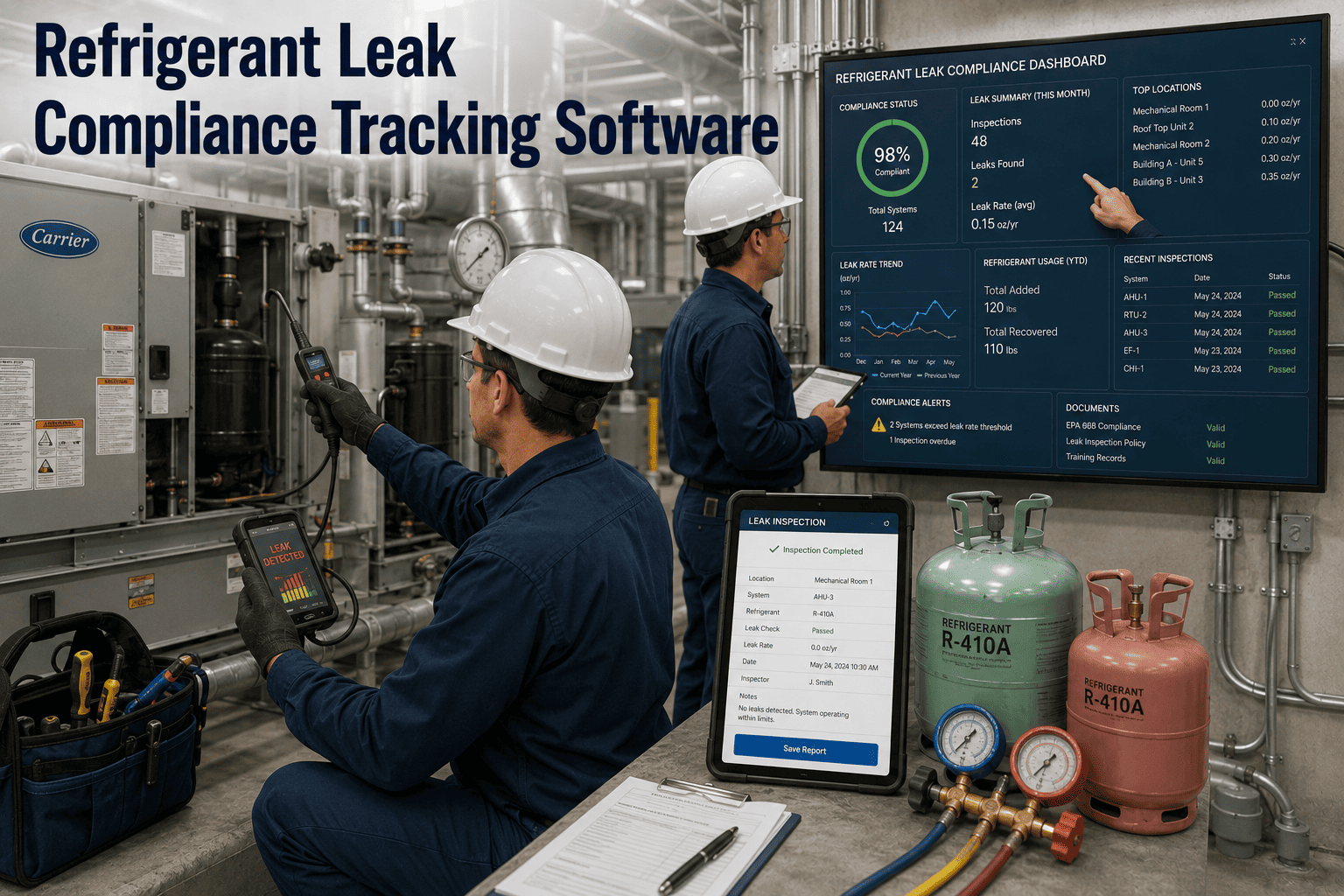
EPA Section 608 enforcement actions against HVAC operators reached a 10-year high in 2023 — with fines exceeding $44,000 per violation, per day. For facility managers and HVAC directors overseeing large commercial or industrial portfolios, refrigerant leak compliance is no longer a paperwork exercise. It is a material financial risk that requires real-time tracking of leak rates, usage logs, disposal records, and technician certification status — documented in a format that survives an EPA audit without a week of manual record reconstruction. Start a free trial to see how Oxmaint structures refrigerant compliance tracking across your entire HVAC portfolio, or book a demo and we will walk through your specific compliance exposure.
See how much compliance risk you can eliminate from your HVAC refrigerant management program.
- Real-time refrigerant leak rate tracking with EPA threshold alerting
- Automated usage logs, disposal records, and technician certification tracking
- Audit-ready compliance reports exportable in minutes, not days
No heavy implementation required · Works across multi-site portfolios · Live in days, not months
What is Refrigerant Leak Compliance Tracking?
Refrigerant leak compliance tracking is the systematic documentation and monitoring of refrigerant charge levels, leak test results, repair records, usage logs, and disposal documentation for every HVAC system containing regulated refrigerants — maintained in a format that satisfies EPA Section 608, state environmental regulations, and increasingly, ESG reporting requirements.
Federal regulations require that any appliance containing 50 or more pounds of refrigerant that exceeds defined annual leak rate thresholds must have the leak repaired, documented, and reported. For commercial and industrial HVAC portfolios — where a single building may contain dozens of chillers, RTUs, and split systems each holding 100–500+ pounds of refrigerant — manual tracking creates a compliance exposure that paper logs and spreadsheets cannot adequately manage.
A purpose-built compliance tracking system links refrigerant charge records to work orders, calculates leak rates automatically, alerts on threshold approaches, and produces audit-ready reports without manual data assembly. Start a free trial and see how Oxmaint builds refrigerant compliance into your normal HVAC maintenance workflow.
Key Components of a Compliant Refrigerant Tracking Program
Industry Pain Points in Refrigerant Compliance Management
These six compliance failures appear consistently in EPA enforcement actions and facility audit findings across commercial and industrial HVAC operations. Book a demo to see exactly where your current refrigerant compliance program has gaps.
| Operational Failure | Cost / Impact |
|---|---|
| Disconnected Service Records | Refrigerant additions recorded on paper service reports that never reach a central system — making annual leak rate calculation impossible without manual reconstruction of every service record per appliance per year. |
| Threshold Breaches Discovered Late | Without real-time leak rate tracking, facilities only discover they have exceeded EPA thresholds during annual reviews — long after mandatory repair and re-inspection obligations should have been triggered. |
| Contractor Service Gap | Third-party contractors record refrigerant usage in their own systems. Facility managers receive paper invoices with no direct link to the appliance compliance record — creating documentation gaps that cannot be closed retrospectively. |
| Uncertified Technician Exposure | EPA Section 608 certification expiry is often undiscovered until an audit reveals that refrigerant work was performed by a technician whose certification lapsed — creating employer liability for every service event in the uncertified period. |
| Audit Preparation Crisis | EPA inspectors give short notice. Facilities using paper records and spreadsheets spend 3–7 days assembling documentation — often failing to produce complete records that would have been sufficient if organised in a single system. |
| ESG Reporting Complexity | Investors and tenants increasingly require Scope 1 emissions disclosure including refrigerant leakage. Facilities without per-appliance refrigerant usage logs cannot produce the granular data that ESG reporting now demands. |
How Oxmaint Powers Refrigerant Compliance Tracking
Oxmaint integrates refrigerant compliance documentation directly into HVAC work order workflows — so every service event automatically contributes to the compliance record without separate data entry.
Reactive vs. Compliant: Refrigerant Management Comparison
|
| ||
|---|---|---|
| Compliance Area | Reactive / Paper-Based | Proactive with Oxmaint |
| Leak Rate Monitoring | Manual annual calculation — breaches discovered retrospectively | Real-time calculation — threshold alerts before obligations trigger |
| Service Record Linkage | Paper service reports — manual extraction required for compliance | Auto-linked to appliance asset record via work order workflow |
| Follow-Up Inspections | Calendar reminders or verbal — frequently missed | Automatic work order generation at 30-day and 120-day deadlines |
| Audit Preparation | 3–7 days of manual record assembly — incomplete coverage likely | One-click export — complete compliance record in minutes |
| ESG Reporting | Estimated totals only — no per-appliance granularity | Per-appliance refrigerant quantity data — Scope 1 reportable |
| Technician Certification | Expiry tracked in HR — maintenance team often unaware | Certification status in CMMS — expiry alerts linked to technician profiles |
| Regulatory Fine Exposure | High — documentation gaps and late detection are common | Minimised — complete records and proactive threshold management |
ROI: What Structured Refrigerant Compliance Tracking Delivers
The financial return on refrigerant compliance software is asymmetric — the cost of a single EPA enforcement action typically exceeds years of software subscription costs. Start a free trial and eliminate your refrigerant compliance exposure from day one.
Frequently Asked Questions
What refrigerant types and regulations does Oxmaint's compliance tracking support?
Oxmaint supports all refrigerant types regulated under EPA Section 608 — including HFCs (R-410A, R-32, R-134a), HCFCs (R-22), and blends — as well as Class I and Class II ozone-depleting substances. For international operations, the system accommodates UK F-Gas, EU F-Gas, and Australian OPSGGM requirements. Compliance configurations are set per site to reflect the applicable regulatory framework.
How does Oxmaint track refrigerant usage when work is performed by third-party contractors?
Facility managers can enter contractor refrigerant data from the service report when received, or contractors can be given limited mobile access to record additions directly in the field. Both approaches ensure contractor service data enters the central appliance compliance record without paper reconciliation. Most facilities use direct entry for regular contractors and manager entry for occasional service providers.
What triggers the EPA's mandatory repair requirements and how does Oxmaint track them?
Appliances containing 50+ pounds of refrigerant trigger mandatory repair when annual leak rates exceed 10% (comfort cooling) or 20% (industrial process refrigeration). Once exceeded, operators have 30 days to repair, or 120 days with an approved retrofit plan. Oxmaint creates a 30-day repair work order immediately upon threshold breach and schedules a 120-day verification work order automatically — with escalating alerts if deadlines are approaching unresolved.
Can Oxmaint support refrigerant compliance reporting for ESG and sustainability disclosures?
Yes. Oxmaint's per-appliance, per-year refrigerant addition data supports Scope 1 greenhouse gas emissions calculation under GHG Protocol, CDP, SEC climate disclosure, and EU CSRD reporting obligations. Data exports by refrigerant type, appliance, site, and reporting period feed directly into sustainability reporting templates — eliminating the annual manual data collection exercise that currently makes Scope 1 refrigerant disclosure a reconciliation project.
Stop Carrying Refrigerant Compliance Risk You Cannot See
Turn every refrigerant service event into a documented, tracked, audit-ready compliance record with Oxmaint. Real-time leak rate monitoring. Automatic deadline tracking. One-click EPA audit export.
- Real-time leak rate tracking and EPA threshold alerting
- Automated 30-day and 120-day follow-up work order creation
- Portfolio-wide compliance visibility across all appliances and sites
Limited onboarding slots available this quarter · Measurable results in the first 30 days
No heavy implementation required · Works across multi-site portfolios · Live in days, not months