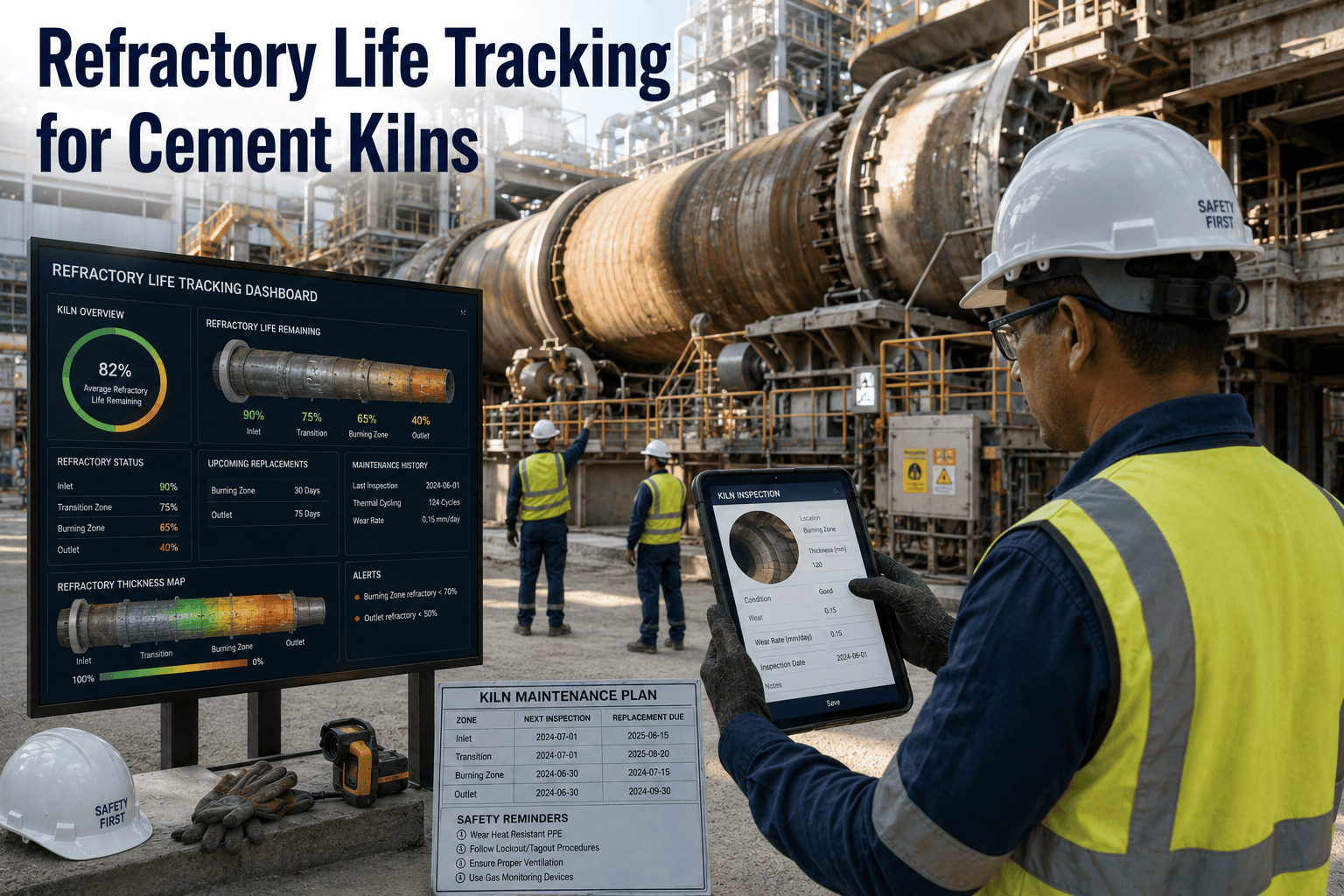
Cement kiln refractories are the most maintenance-critical asset class in any cement plant — yet most plants manage them through instinct, visual inspection, and manual logs that cannot predict failure before it costs hundreds of thousands in emergency downtime. A single unplanned kiln shutdown due to refractory failure costs a typical cement plant 3–7 days of production and $200,000–$800,000 in lost throughput, emergency labor, and expedited material costs. The shift from reactive refractory management to structured life-tracking is one of the highest-ROI maintenance investments available in cement manufacturing. Start a free trial to see how Oxmaint tracks refractory life across every kiln zone, or book a demo and we will walk through your specific kiln asset structure.
See how much cost you can eliminate from unplanned refractory failures in your cement plant.
- Real-time refractory zone condition scoring across every kiln
- Predictive replacement scheduling backed by 5–10 year CapEx models
- Full kiln refractory asset history — zone by zone, campaign by campaign
No heavy implementation required · Works across multi-site portfolios · Live in days, not months
What is Refractory Life Tracking?
Refractory life tracking is the systematic monitoring, documentation, and predictive management of refractory brick and castable lining condition across every zone of a cement kiln — from the inlet to the burning zone to the outlet. It replaces periodic visual inspection and tribal knowledge with structured asset records, condition scoring, thermal data integration, and replacement forecasting tied to actual measured wear rates.
A complete refractory life tracking system records installation dates, lining thickness at commissioning, inspection findings at each campaign, zone-level condition scores, repair histories, and remaining life estimates. When integrated with kiln shell temperature scanning data, it enables condition-based replacement planning months in advance — converting what was historically a surprise failure into a scheduled, budgeted maintenance event.
For cement plants managing multiple kilns across one or several sites, refractory life tracking provides the asset history and CapEx forecasting backbone that plant managers, maintenance directors, and operations VPs need to defend capital budgets and prevent the production losses that dominate maintenance P&L exposure. Start a free trial to see how Oxmaint structures refractory asset records for your kiln fleet.
Key Concepts in Refractory Life Management
Industry Pain Points in Refractory Management
The same six failure modes appear in cement plants worldwide — regardless of kiln size, age, or production volume. Most trace directly to the absence of structured refractory life tracking. Book a demo to see how Oxmaint eliminates each of these pain points in your plant.
| Operational Failure | Cost / Impact |
|---|---|
| Surprise Refractory Failures | Without condition scoring and wear trend data, lining failures arrive without warning — triggering emergency shutdowns that cost 4.8× more than planned replacements and disrupt production schedules for weeks. |
| No Asset History Continuity | When maintenance personnel change, refractory knowledge leaves with them. Paper records and spreadsheets leave replacement decision-making disconnected from actual asset history. |
| Inaccurate CapEx Budgeting | Without campaign life data and wear rate trends, refractory CapEx requests are built on estimates — leading to budget surprises that damage credibility with ownership and finance teams. |
| Premature Replacement Waste | Without condition data, conservative managers replace refractory earlier than necessary — wasting 15–30% of serviceable lining life and spending capital that tracking would defer by months. |
| Shell Damage from Late Detection | Hot spots detected too late cause irreversible kiln shell damage — turning a $150,000 reline into a $600,000+ repair involving shell section replacement and structural engineering assessment. |
| Procurement Lead Time Failures | Specialty burning-zone bricks carry 8–16 week lead times. Plants without forward-looking forecasts routinely face extended shutdowns waiting for materials that should have been ordered months earlier. |
How Oxmaint Solves Refractory Life Tracking
Oxmaint's asset management platform applies its hierarchy — Portfolio > Property > System > Asset > Component — directly to cement kiln refractory management, giving every zone its own condition-scored asset record with full lifecycle history.
Reactive vs. Planned: Refractory Management Comparison
|
| ||
|---|---|---|
| Dimension | Reactive Management | Planned with Oxmaint |
| Failure Detection | Shell hot spot or visible lining collapse — hours before shutdown | Condition score trending — weeks or months before threshold |
| Shutdown Duration | 7–21 days — material procurement delays and unplanned labour mobilisation | 4–7 days — pre-staged materials, scheduled crew, no delays |
| Replacement Cost | 4.8× planned cost including emergency premiums and lost production | Budgeted line item — no cost surprises at board level |
| CapEx Forecasting | Annual estimate based on last year's spend — no forward visibility | 5–10 year rolling forecast from measured wear rates |
| Material Selection | Repeat same specification regardless of performance data | Data-driven selection from multi-campaign material performance history |
| Knowledge Retention | Leaves with experienced technician on retirement or departure | Stored in asset registry — accessible to any authorised team member |
| Audit and Compliance | Manual record assembly — days of preparation per audit | Instant export — full inspection and replacement history by zone |
ROI and Results: What Structured Refractory Tracking Delivers
These outcomes are drawn from cement plant operations data and industry benchmarks. The financial case for structured refractory life tracking is consistent across plant sizes and geographies. Start a free trial to begin building your refractory asset records today and see measurable results within 30 days.
Frequently Asked Questions
How does Oxmaint handle refractory tracking across multiple kiln zones with different wear rates?
Each kiln zone is tracked as an independent asset — burning zone, transition zones, inlet, and outlet each carry their own condition score, inspection history, and material record. Wear rates differ dramatically between zones, so zone-level tracking is essential for accurate replacement planning. When a zone condition score reaches a defined threshold, Oxmaint triggers a work order and flags the replacement for the next CapEx review.
Can Oxmaint integrate kiln shell temperature scanner data with refractory condition records?
Yes. Oxmaint supports IoT and SCADA data integration, linking shell temperature scanner readings directly to the corresponding refractory zone asset records. A thermal anomaly can automatically trigger an inspection work order for that zone and update its condition flag — creating a closed loop from thermal detection to inspection scheduling to replacement forecasting, without manual data transfer between systems.
What data does a cement plant need to start refractory life tracking in Oxmaint?
The minimum starting point is last installation date and material specification per zone — data most plants have in some form. From that baseline, Oxmaint builds forward as technicians add inspection findings on mobile. Plants with richer historical records can upload previous campaign data to establish a multi-campaign baseline from day one. Most plants see improvement in replacement planning accuracy within the first six months of structured tracking.
How does refractory life tracking support CapEx planning in cement plant budgeting cycles?
Oxmaint's rolling 5–10 year CapEx model uses measured zone wear rates, campaign life history, and current condition scores to project when each zone will require replacement and at what cost. Every line in the CapEx forecast links to the zone condition data that justifies it — replacing estimate-based requests with asset-backed evidence that finance teams approve significantly faster.
Stop Losing Millions to Reactive Refractory Failures
Turn every kiln zone into a predictable, trackable asset with Oxmaint. Condition-based replacement planning. 5–10 year CapEx forecasting. Full campaign history — zone by zone.
- Real-time refractory zone condition visibility across every kiln
- Predictive failure alerts before hot spots become shutdowns
- 5–10 year CapEx forecasting from measured wear rates
Limited onboarding slots available this quarter · Measurable results in the first 30 days
No heavy implementation required · Works across multi-site portfolios · Live in days, not months