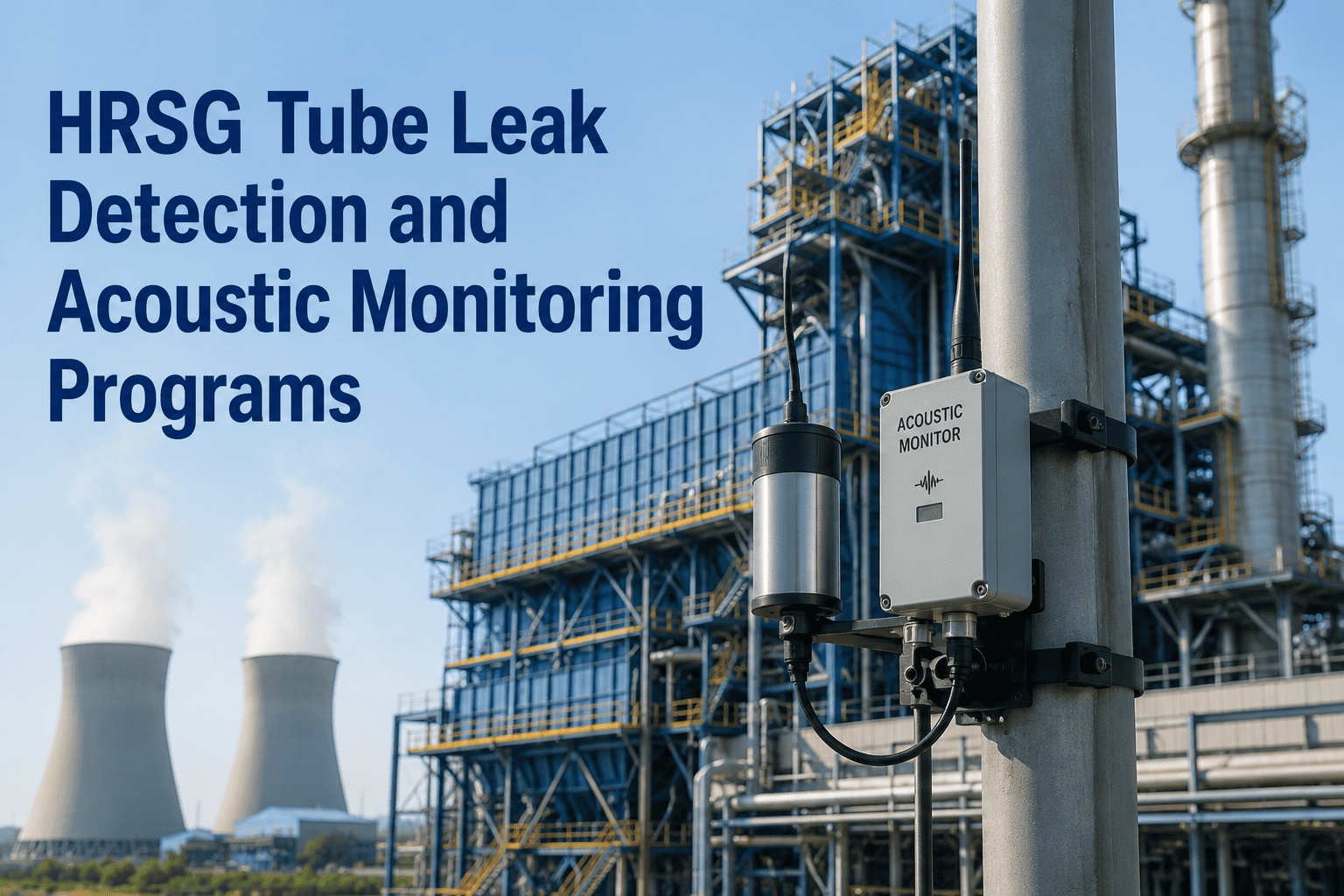
Boiler Tube Leak Detection in Power Plants | Techniques & Tools

By Jordan Blake on January 26, 2026

boiler-tube-leak-detection-power-plants

A single tube failure in a 500 MW boiler requires an average of 3.6 days to repair and costs more than $3 million in lost generation and maintenance expenses. Yet the leak itself often starts as something invisible—a pinhole defect producing ultrasonic frequencies your operators will never hear. The difference between plants that catch these failures early and those that don't comes down to detection technology. Modern acoustic, thermal, and AI-assisted systems can identify tube degradation weeks before catastrophic failure, transforming emergency shutdowns into scheduled maintenance windows.

Industry Data 2020-2024

The True Cost of Boiler Tube Failures

Why detection technology isn't optional—it's survival

60%
Of all boiler outages are caused by tube failures
54%
Of total power plant outages stem from tube leaks
$
$3M+
Average loss per single tube failure (500 MW unit)

Understanding Modern Detection Technologies

Boiler tube leak detection has evolved dramatically from the days of waiting for visible steam or audible hissing. Today's plants have access to three primary detection approaches, each with distinct strengths. The most effective programs combine multiple technologies to create layered protection—catching what one method might miss. Plants that sign up for integrated maintenance platforms can coordinate data from all these sources into unified dashboards that make early warning actionable.

Detection Methods

Three Technologies. One Goal: Zero Unplanned Outages

Most Widely Used
Acoustic Emission
Detects high-frequency sounds (1-10 kHz) from escaping steam before human hearing can perceive them
Detection Excellent
Location 3D Triangulation
Best For Early Leaks
Thermal Imaging
Identifies hot spots on boiler walls indicating insulation degradation or internal tube issues
Detection Good
Location Visual Pinpoint
Best For Wall Damage
Cutting Edge
AI-Assisted Analysis
Machine learning processes sensor data to predict failures before physical symptoms appear
Detection Predictive
Location Sensor-Based
Best For Prevention

How Acoustic Leak Detection Works

Acoustic emission monitoring represents the most mature and widely adopted early detection technology. When steam escapes through even a pinhole-sized defect, it creates ultrasonic waves that propagate through the boiler structure. Piezoelectric sensors mounted on the boiler convert these waves into electrical signals that can be analyzed in real-time. Systems monitor continuously—24 hours a day, 7 days a week—detecting leaks before they become audible or visible to operators.

The Acoustic Detection Pipeline

From invisible leak to actionable alert in milliseconds

1
Signal Generation
Steam escaping through tube defect creates high-frequency acoustic waves in the ultrasonic range
2
Sensor Capture
Piezoelectric sensors on boiler structure convert acoustic waves to measurable electrical voltage
3
Signal Processing
Voltage amplified, filtered, and processed to isolate leak signatures from operational noise
4
3D Triangulation
Multiple sensors calculate exact leak location using time-of-arrival analysis across the network
Alert & Action
System generates maintenance alert with precise location data for immediate response planning

The challenge with acoustic systems lies in distinguishing leak signals from operational noise—particularly during soot blower operation when background acoustic levels spike dramatically. Modern systems address this through sophisticated signal processing that filters out known interference patterns. For plants looking to integrate acoustic alerts with their maintenance workflow, book a free demo to see how CMMS integration automates the response.

AI and Machine Learning: The Detection Revolution

Artificial intelligence has transformed boiler tube leak detection from reactive monitoring to predictive analysis. Deep learning models—particularly convolutional neural networks (CNNs) and long short-term memory (LSTM) networks—can process temperature data from dozens of sensors simultaneously, identifying subtle patterns that precede failure by hours or even days. Research published in late 2024 demonstrated that hybrid CNN-SVM approaches achieve detection accuracy exceeding 99% while minimizing false positives.

AI Performance Metrics

What Machine Learning Achieves

99.2%
Classification accuracy with deep neural networks on acoustic emission data
94%
Specificity rate for detecting tube leakages of varying sizes
25 hrs
Advance prediction time using PCA-based detection methods
82-99%
Detection range validated across 9 years of operational data
The Key Advantage: AI systems learn from your specific boiler's normal operating patterns, becoming increasingly accurate over time at distinguishing genuine anomalies from routine operational variations.

The practical implementation challenge is integrating AI insights with maintenance operations. An algorithm that predicts a leak in 25 hours provides no value if that prediction sits in a database instead of triggering a work order. Plants using maintenance management systems with AI integration—sign up free to explore can automatically convert detection events into prioritized maintenance tasks with all relevant diagnostic data attached.

Stop Reacting to Failures—Start Predicting Them

See how integrated detection systems connect with automated maintenance workflows. Our specialists can show you the complete sensor-to-work-order pipeline for your specific boiler configuration.

Common Tube Failure Mechanisms

Effective detection requires understanding what you're detecting. Boiler tubes fail through several distinct mechanisms, each producing different warning signatures that detection systems must recognize.

Primary Failure Mechanisms

Understanding root causes enables targeted detection strategies

Corrosion
Water chemistry upsets, low pH, oxygen pitting
Thermal Imaging Wall Monitoring
Weeks to months warning
Erosion
Fly ash impact, soot blower damage, flow patterns
Acoustic Emission Thermal Hotspots
Days to weeks warning
Creep
Long-term high temperature exposure under stress
AI Analysis Temp Trending
Months (predictable)
Thermal Fatigue
Repeated heating/cooling cycles, startup stress
Strain Monitor Cycle Counting
Calculable by cycles

Expert Perspective: Building an Effective Detection Program

The plants achieving the best tube leak prevention results aren't relying on any single technology. They're combining acoustic monitoring for early leak detection, thermal imaging for wall condition assessment, and AI-driven analysis for failure prediction—all feeding into a unified maintenance management system that ensures no alert goes unaddressed.

01
Start with Critical Zones
Water wall tubes account for the majority of failures. Focus initial monitoring investment on waterwall sections, superheaters, and reheaters where failures cascade most severely.
02
Integrate Chemistry Data
Water chemistry excursions often precede tube failures by weeks. Connecting chemistry monitoring to your detection program creates earlier warning than physical sensors alone.
03
Close the Response Loop
Detection without action is just expensive data collection. Every alert must automatically generate a trackable maintenance task with clear ownership and response timeline.

The best-performing utilities have reduced tube failure frequency by implementing organized Boiler Tube Failure Reduction (BTFR) programs that combine detection technology with root cause analysis and aggressive replacement of damaged tubing. Ready to build or improve your detection program? Schedule a free consultation with our power plant specialists to assess your current capabilities and identify the highest-impact improvements.

Implementation: Your Path Forward

Moving from reactive tube failure response to predictive detection doesn't require replacing everything overnight. The most successful implementations follow a phased approach that builds capability while demonstrating ROI at each stage. Begin with acoustic monitoring on your highest-risk boiler sections, integrate that data with your maintenance management system, then expand coverage and add AI analytics as the foundation proves its value. Plants ready to take the first step can sign up for OXmaint free and start building their detection workflow immediately.

Turn Detection Into Prevention

Join power plants using OXmaint to connect tube leak detection systems with automated maintenance response. See exactly how sensor intelligence becomes scheduled repairs—before failures happen.
Frequently Asked Questions

How does acoustic leak detection differ from simply listening for leaks?
Acoustic emission systems detect ultrasonic frequencies (typically 1-10 kHz and above) that human hearing cannot perceive. By the time a leak produces audible sound, it has already grown significantly. Piezoelectric sensors can identify the high-frequency signatures of tiny steam escapes, providing detection capability weeks before traditional methods would notice anything wrong. Additionally, acoustic systems provide 3D triangulation to pinpoint exact leak locations, which manual listening cannot accomplish.
What detection accuracy can AI-based systems achieve?
Recent research demonstrates that hybrid deep learning approaches combining convolutional neural networks with support vector machine classifiers achieve detection accuracy exceeding 99% on acoustic emission data. Deep neural network models tested across 9 years of operational data showed accuracy ranges of 82.8% to 99.3% depending on hyperparameter optimization. The key advantage is that AI systems minimize false positives while catching subtle anomalies that rule-based systems miss.
How much advance warning can early detection provide?
Warning time varies by detection method and failure type. Acoustic systems can detect active leaks immediately, while pattern-based AI analysis using techniques like Principal Component Analysis has demonstrated prediction times of 25 hours or more before failure symptoms become obvious through conventional monitoring. For slow-developing mechanisms like creep, thermal trending can provide weeks or months of warning when properly calibrated to your specific boiler's operating history.
Can detection systems distinguish between leak signals and normal operational noise?
This is the core challenge that modern systems address through sophisticated signal processing. Soot blower operation, in particular, creates background acoustic levels that can mask leak signatures. Advanced systems use filtering algorithms trained on your specific boiler's noise patterns, and AI-based approaches learn to distinguish normal operational variations from genuine anomalies. Bidirectional LSTM neural networks have proven particularly effective at separating leak signals from soot blower interference.
What's the ROI timeline for implementing leak detection systems?
Given that a single tube failure in a 500 MW unit can exceed $3 million in combined repair costs and lost generation, preventing even one unplanned outage typically justifies the investment in detection technology. Most plants see positive ROI within the first year, often from a single avoided emergency shutdown. Beyond direct cost avoidance, early detection enables scheduled repairs during planned outages, reduces secondary damage to adjacent tubes, and extends overall boiler life through better condition management.

Share This Story, Choose Your Platform!