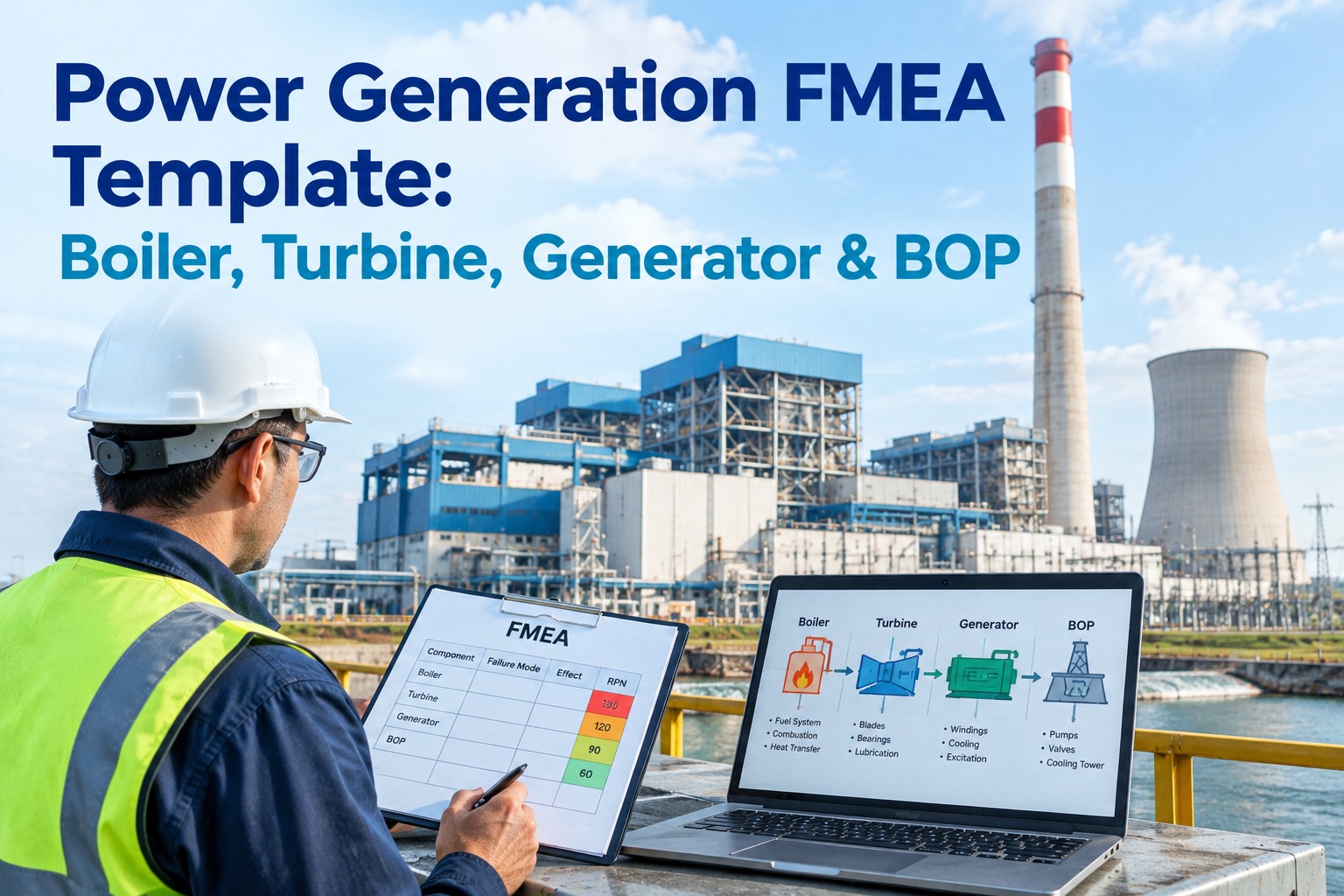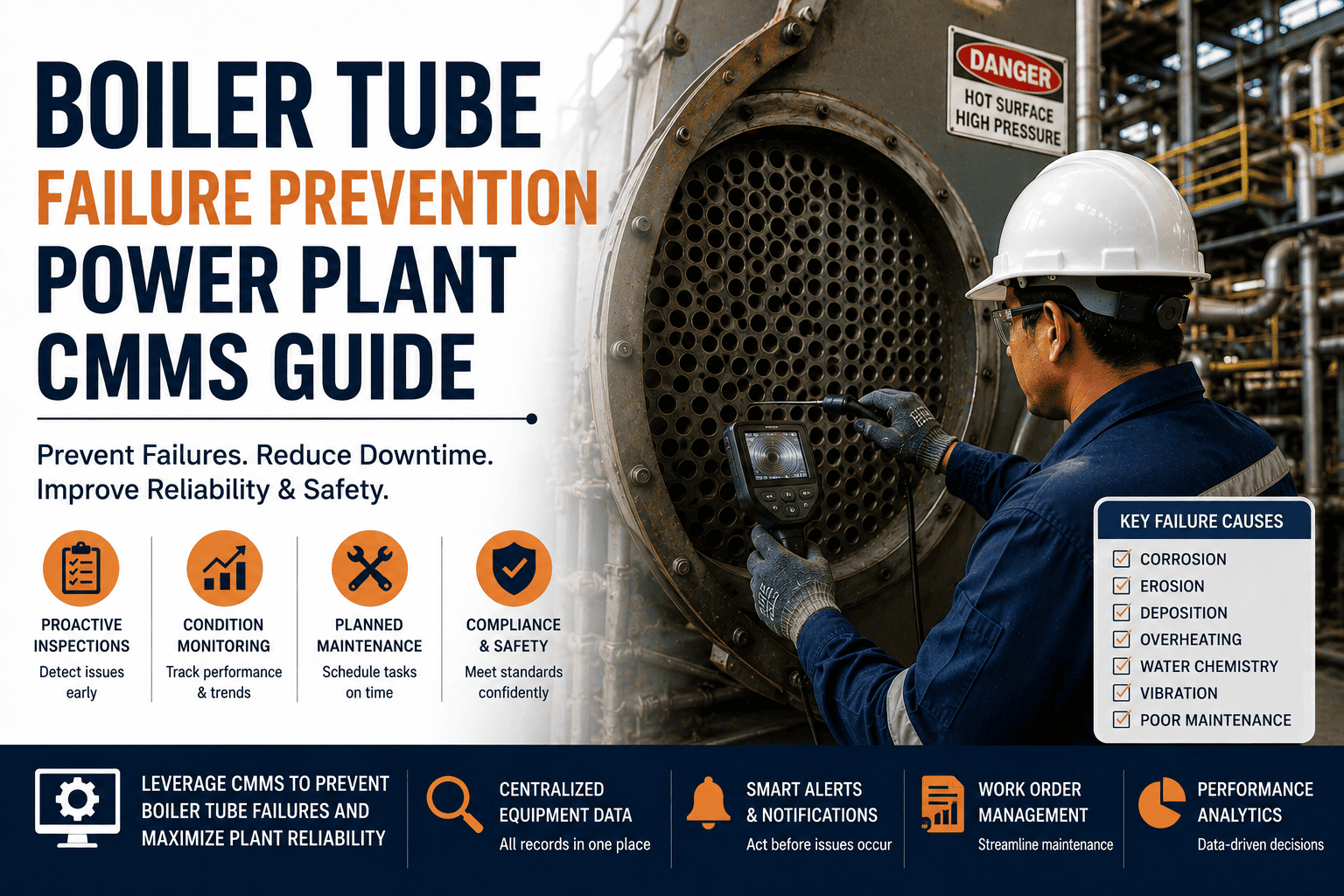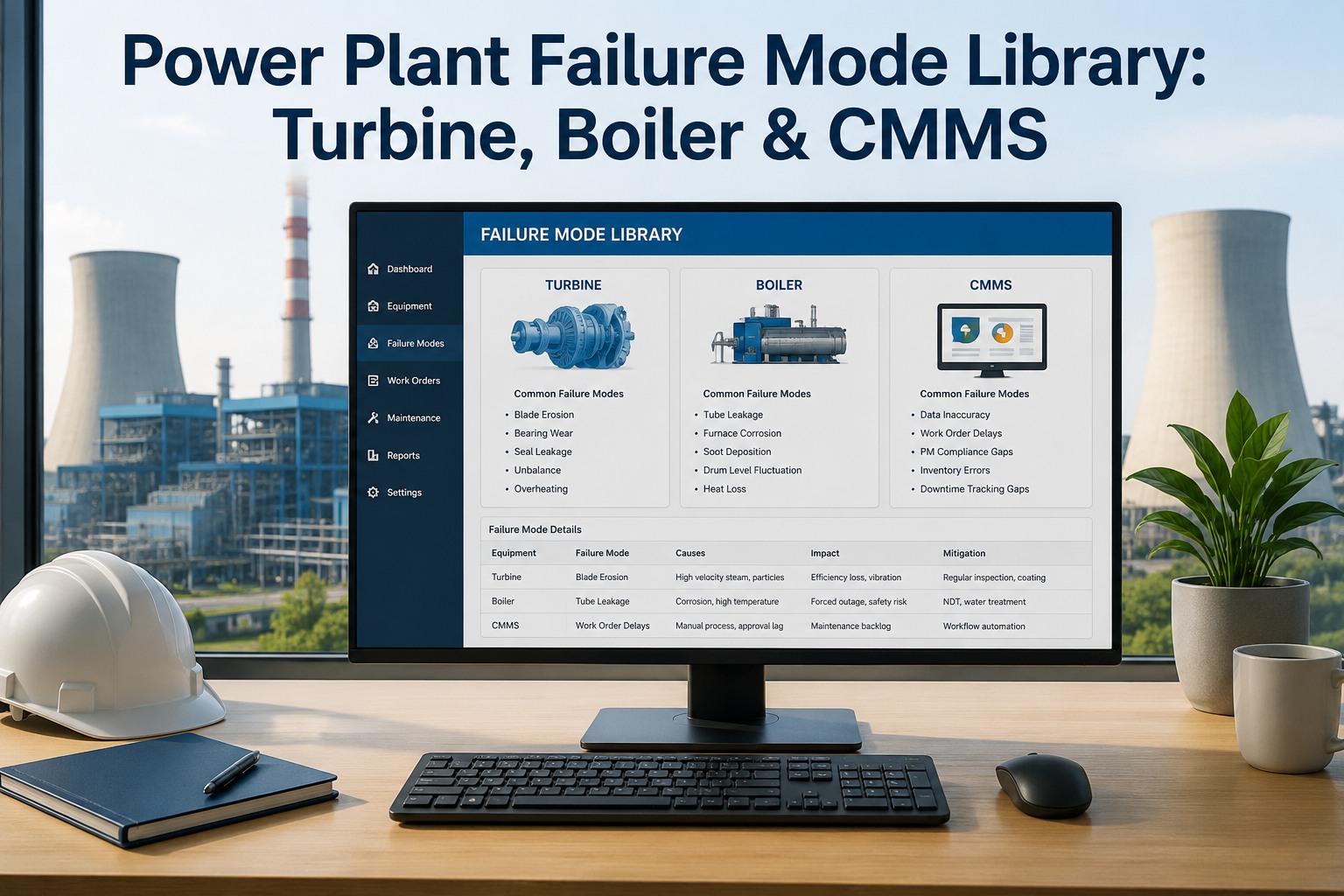
FMEA (Failure Mode and Effects Analysis) for boiler and HRSG power plant systems is a structured, step-by-step method for identifying equipment failure modes, assessing their severity and likelihood, and prioritizing preventive maintenance tasks before costly outages occur. A well-executed boiler FMEA analysis helps reliability engineers quantify risk priority numbers (RPN) for critical assets like economizers, superheaters, and feedwater pumps, transforming reactive firefighting into predictable, data-driven maintenance. By integrating power plant FMEA outputs directly into an AI-powered CMMS like OxMaint, teams can automate PM scheduling, track defect elimination, and prevent forced outages that cost upwards of $10,000 per megawatt day. Ready to turn your HRSG FMEA findings into automated work orders? Start Free Trial and centralize your boiler reliability program today.
Boiler & HRSG Reliability
Is your power plant one tube leak away from a forced outage?
Boiler and HRSG failures account for over 40% of unplanned power plant downtime. A structured FMEA identifies your highest-risk failure modes and turns them into targeted PM tasks before they trigger costly outages. OxMaint operationalizes that analysis—closing the loop between risk identification and automated maintenance execution.
Step-by-Step Guide
How to Conduct an FMEA for Boiler and HRSG Systems
A power plant FMEA is most effective when executed sequentially across critical asset boundaries. The goal is to move from functional decomposition to quantified risk—and finally to a specific maintenance task that mitigates that risk within your CMMS.
Define System Boundaries & Functions
Map the boiler or HRSG into functional blocks (e.g., economizer, evaporator, superheater, reheater, duct burner, drum). Document the primary function of each block—such as "raise feedwater temperature to 600°F"—so failure modes are tied to lost function, not just broken parts.
Identify Failure Modes & Effects
For each block, list how it can fail (e.g., tube fouling, caustic gouging, short-term overheating, creep rupture) and the effect on plant operation. A boiler failure mode analysis must capture both local effects (leak) and system effects (forced derate, trip, safety hazard).
Assign Severity, Occurrence & Detection Scores
Score each parameter from 1 to 10. A tube rupture causing a unit trip might score Severity = 9. Calculate the Risk Priority Number (RPN = S × O × D). Any HRSG FMEA item with an RPN above 200 typically demands immediate mitigation or a design change.
Select Maintenance Tasks & Export to CMMS
Map high-RPN failure modes to specific tasks: condition monitoring (NDT thickness checks), time-based PM (descaling, sootblowing), or predictive maintenance (vibration, thermography). Finally, push these tasks into OxMaint as scheduled PM triggers so they execute automatically.
FMEA RPN Calculation
Calculating RPN for Power Plant Failure Analysis
The Risk Priority Number (RPN) is the mathematical backbone of any FMEA boiler power plant evaluation. It quantifies risk so maintenance managers can justify resource allocation and PM frequency to plant leadership.
Risk Priority Number Formula
RPN = Severity (S) × Occurrence (O) × Detection (D)
Worked Example
Consider a 500MW combined-cycle plant conducting an HRSG FMEA. The superheater tubes have a history of creep rupture due to short-term overheating (S=9, O=5, D=6, RPN=270). By implementing continuous tube-wall temperature monitoring via OxMaint's predictive analytics, Detection improves to D=2, dropping the RPN to 90. The plant avoids a mid-cycle outage that would have cost an estimated $500,000 in lost generation and emergency repair.
Risk Priority Matrix
Boiler & HRSG FMEA RPN Reference Table
Below is a snapshot of common high-risk failure modes identified during a typical boiler FMEA guide evaluation, along with recommended maintenance actions to load into your CMMS.
| Asset / Component | Failure Mode | Effect | RPN | Recommended CMMS Task |
|---|---|---|---|---|
| Superheater Tubes | Creep rupture / overheating | Forced outage, steam leak | 270 | Quarterly NDT thickness + real-time temp monitoring |
| Economizer | External corrosion / fly-ash erosion | Feedwater leak, derate | 210 | Annual ultrasonic testing + targeted sootblowing PM |
| HRSG Drum | Caustic gouging / waterline corrosion | Catastrophic rupture risk | 240 | Monthly water chemistry audit + internal inspection |
| Boiler Feed Pump | Bearing wear / cavitation | Loss of feedwater, unit trip | 180 | Monthly vibration analysis + oil sampling |
| Duct Burner | Nozzle coking / flame instability | Incomplete combustion, NOx spike | 120 | Semi-annual burner inspection & cleaning PM |
OxMaint Integration
How OxMaint Operationalizes Your FMEA Boiler CMMS Strategy
An FMEA is only valuable if its outputs drive daily maintenance execution. OxMaint bridges the gap between boiler reliability FMEA analysis and automated work order management, ensuring high-RPN modes are actively monitored and mitigated.
Automated PM Trigger Creation
Import your FMEA RPN power plant tasks directly as time-based or condition-based PMs. OxMaint auto-generates work orders based on operating hours, calendar dates, or sensor thresholds—reducing manual scheduling time by 80%.
Predictive Analytics Integration
Connect IoT vibration and temperature sensors to OxMaint to lower your Detection (D) scores. AI-driven alerts predict HRSG reliability issues weeks before failure, cutting unplanned downtime by 30-50%.
Defect Elimination Tracking
Track recurring boiler failure modes across closed work orders. OxMaint's analytics dashboard highlights persistent RPN drivers so reliability engineers can prioritize capital projects or design modifications over band-aid repairs.
Audit-Ready Compliance Logs
Every PM triggered by your FMEA maintenance power strategy is digitally logged with timestamps, technician notes, and parts consumption. Pass ISO 55000 and insurance audits with zero paperwork.
Turn Your FMEA Findings Into Automated Maintenance
Stop leaving boiler reliability insights trapped in spreadsheets. Book a 30-minute demo and see how OxMaint converts your HRSG FMEA risk scores into living, breathing PM schedules.
Frequently Asked Questions
Boiler & HRSG FMEA Essentials
What is FMEA in a power plant boiler context?
FMEA (Failure Mode and Effects Analysis) is a proactive reliability tool used to identify how boiler and HRSG components can fail, the impact of those failures, and the likelihood of occurrence. By assigning severity, occurrence, and detection scores, power plants can calculate a Risk Priority Number (RPN) to prioritize maintenance tasks and prevent forced outages.
How is RPN calculated in HRSG FMEA analysis?
The Risk Priority Number is calculated by multiplying three factors: Severity (S), Occurrence (O), and Detection (D), each scored on a 1-10 scale. The formula is RPN = S × O × D. An RPN above 200 generally indicates a high-risk failure mode in an HRSG system that requires immediate mitigating action or a change in maintenance strategy.
How does a CMMS support FMEA maintenance for power plants?
A CMMS like OxMaint operationalizes FMEA findings by converting high-RPN failure modes into automated preventive maintenance (PM) schedules, condition-based triggers, and digital work orders. This ensures that the corrective actions identified during the analysis are actually executed, tracked, and audited over time, rather than sitting dormant in a spreadsheet.
What are the most common failure modes in boiler FMEA?
The most common boiler failure modes include tube ruptures from short-term overheating, creep rupture in superheaters, caustic gouging in waterwall tubes, economizer fly-ash erosion, and drum waterline corrosion. Identifying these through a structured FMEA boiler power plant analysis allows teams to implement targeted NDT inspections and water chemistry controls.
How often should a power plant update its boiler FMEA?
A boiler reliability FMEA should be reviewed annually and updated whenever a major failure occurs, a design modification is made, or operating conditions change significantly. To easily maintain and action your living FMEA, you can Start Free Trial of OxMaint and link risk scores directly to your evolving PM schedules.
Ready to Eliminate Forced Outages?
Join the reliability teams using OxMaint to predict boiler failures, automate PMs, and keep their HRSGs running at peak efficiency. See the platform on your assets today.
Free 14-day trial · No credit card