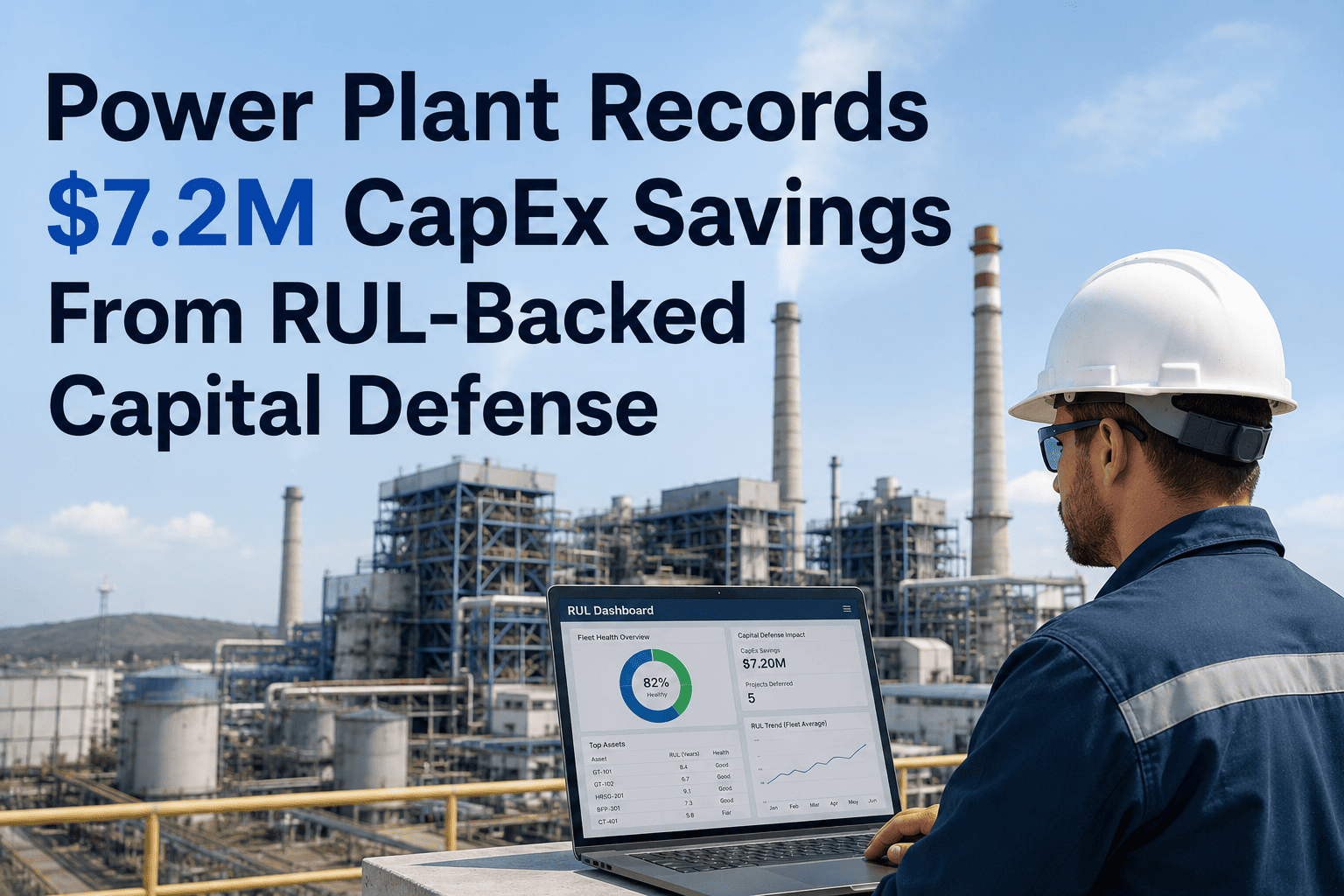
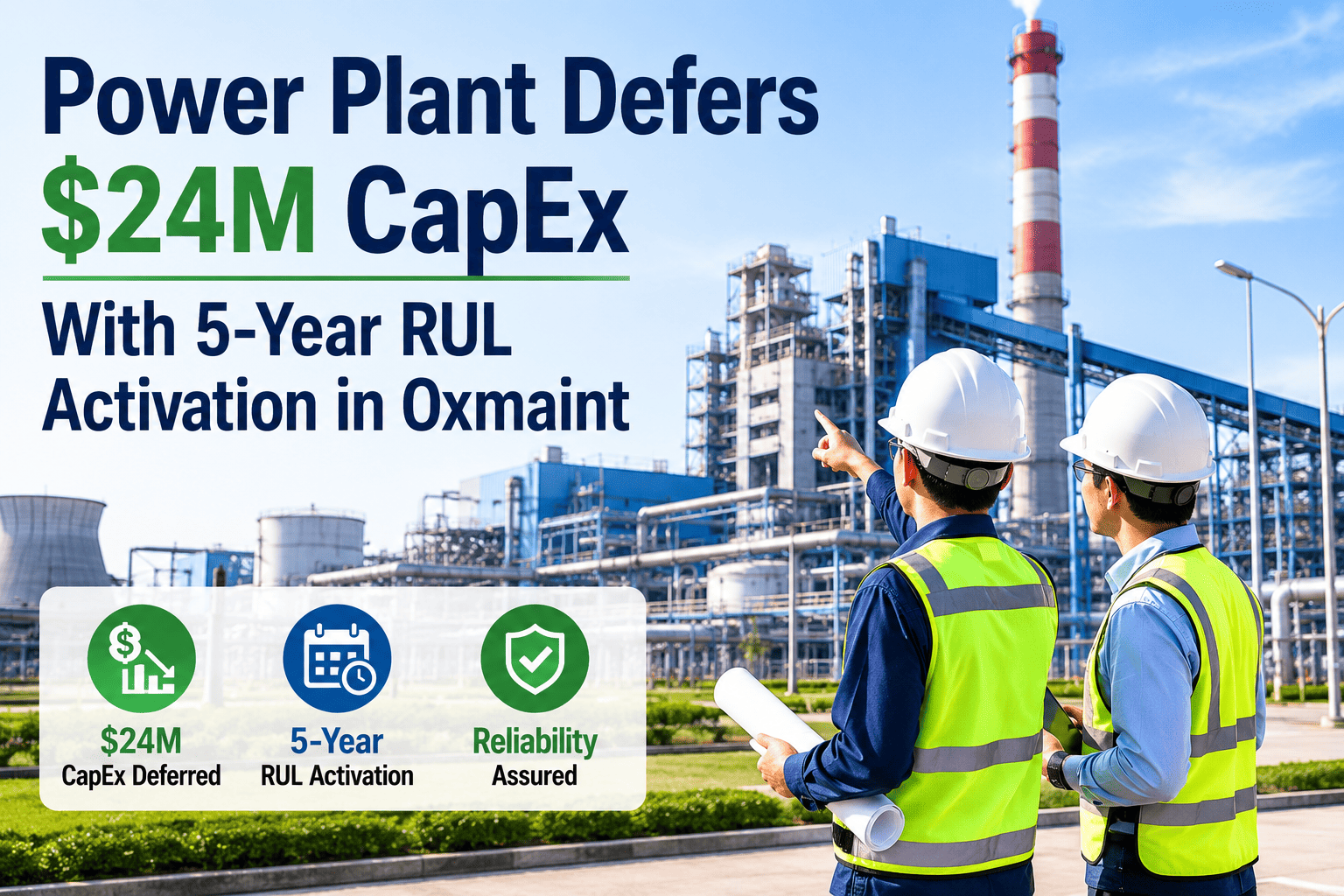
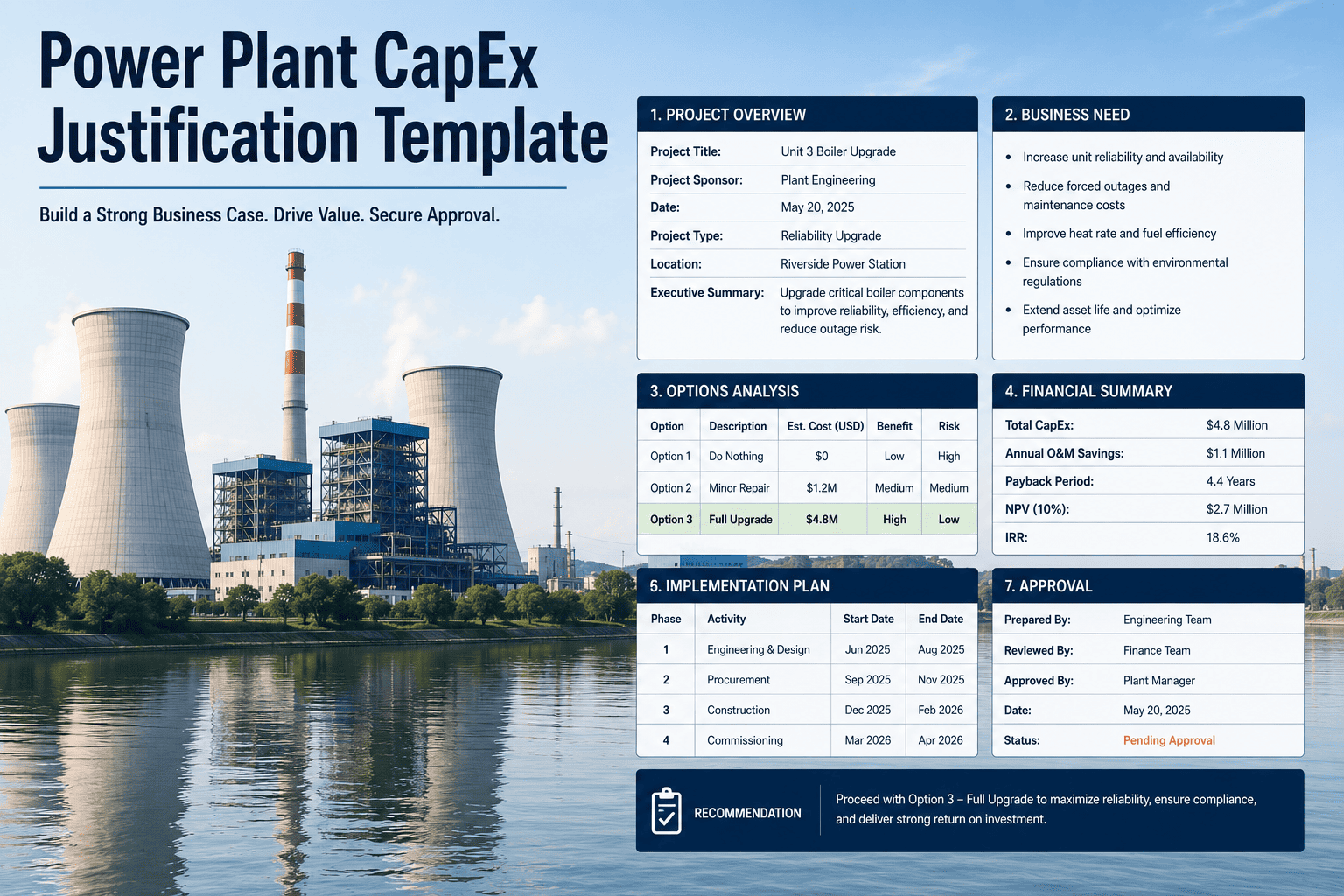
Capital expenditure decisions in power plant asset management are rarely made in a data vacuum — but they are frequently made in a data poverty environment that is just as dangerous. A budget committee reviewing a $4M boiler replacement request cannot independently verify whether the asset genuinely needs replacement or whether another 6 to 8 years of managed operation remains available. Without a documented remaining useful life model backed by years of condition trending, inspection findings, and failure mode analysis, the team requesting capital must argue from authority rather than from evidence — and a CFO facing competing demands for the same capital will defer or cut that request more often than not. The power plant in this case study changed that dynamic permanently by deploying OxMaint's RUL-backed capital defense framework across four major asset classes: two boilers, three pulverizing mills, two forced draft blowers, and a station service transformer. The result was $7.2M in documented CapEx savings over 36 months — not through deferring necessary investment, but by demonstrating, with data, that specific assets had serviceable life remaining that the organization's intuition had underestimated.
What RUL-Backed Capital Defense Actually Means
Remaining Useful Life (RUL) estimation is the quantitative process of projecting how much operating life an asset has remaining under current degradation rates and operating conditions. Capital defense means using that projection — supported by documented inspection findings and performance trending — to make a formal, data-backed case to budget committees that a requested capital replacement is either premature or genuinely necessary. Most capital requests in power generation fail the capital defense test because the supporting evidence is anecdotal: the asset is old, someone experienced says it needs replacing, and the maintenance team cannot prove otherwise. OxMaint provides the data architecture to build and defend the evidence that turns that conversation around.
Capital Defense (Deferring Premature CapEx)
Budget committee approves a $1.8M boiler pressure part replacement request. OxMaint RUL model, backed by 4 years of creep measurement trending and ultrasonic thickness data, demonstrates 8.5 additional operating years remain within design limits.
Outcome: Replacement deferred 7 years. $1.8M preserved for priority capital needs. Accelerated monitoring program implemented as the risk management control.
Capital Preserved: $1.8M
Capital Justification (Accelerating Necessary CapEx)
Finance team questions a $620K mill replacement request, citing recent overhaul. OxMaint grinding element wear trending shows 94% wear consumption in 14 months — 6 months ahead of historical rate — driven by a documented change in coal quality.
Outcome: Replacement approved in the same budget cycle. Coal quality correlation documented as a planning factor for future mill life projections at this plant.
Failure Cost Avoided: $1.4M
The Four Asset Classes: How OxMaint Tracked RUL Across Each
RUL Data Sources
Ultrasonic wall thickness, creep measurement, oxide scale thickness, tube sample analysis
Trending Period
4 years of inspection data across 3 annual outage cycles
CapEx Request Challenged
Full superheater and reheater bundle replacement — $3.1M total
OxMaint RUL Finding
Degradation rate consistent with 7–9 additional years at current operating parameters. Spot replacement of 14 flagged tubes recommended instead.
Approved action: Spot tube replacement at $84K. Next full assessment in 3 years. $3.1M deferred.
RUL Data Sources
Grinding element wear measurement, classifier performance, coal fineness testing, power draw trending
Key Finding
Mill A and Mill C had 40%+ grinding element life remaining despite being on the same replacement schedule as Mill B (which was genuinely end-of-life)
OxMaint Action
Replaced Mill B on schedule ($620K justified). Deferred Mill A and Mill C replacement 18 months. Differential operating conditions documented.
$1.2M of the $1.8M in mill CapEx deferred based on individual RUL evidence, not fleet-average scheduling.
RUL Data Sources
Vibration trending, impeller wear measurement, bearing temperature history, flow coefficient trending
CapEx Request Challenged
Full impeller replacement on both blowers — $1.6M — based on elapsed operating hours
OxMaint RUL Finding
FD Blower 1: impeller at 34% wear — replacement not justified. FD Blower 2: impeller at 87% wear — replacement confirmed necessary.
FD Blower 2 replaced ($780K). FD Blower 1 deferred 24 months ($820K saved). Vibration monitoring intensity increased on Blower 1.
Capital Requests Without RUL Evidence Lose. Capital Requests With RUL Evidence Win.
OxMaint builds the condition trending, inspection records, and RUL projections that let your maintenance team defend every capital request — and challenge every premature one. Start building that evidence base today.
The RUL Evidence Pyramid: What Goes Into a Defensible Capital Case
01
NPV Decision Model
Lifecycle cost model comparing continued operation, rehabilitation, and replacement — with risk-adjusted cash flow projections at 3, 5, and 10-year horizons.
02
RUL Projection with Confidence Interval
Statistical RUL estimate based on degradation rate, failure mode library, and operating condition history — with explicit confidence bounds tied to data depth.
03
Multi-Year Condition Trending
Longitudinal degradation data across multiple inspection cycles — wall thickness, vibration amplitude, wear rates, temperature profiles — showing rate-of-change over time.
04
Inspection Findings & Maintenance History
Complete inspection records, work order history, parts replacement log, and failure event documentation — the foundation that makes every layer above it credible.
Frequently Asked Questions
How does OxMaint calculate RUL for assets with irregular inspection intervals and data gaps?
OxMaint's RUL engine uses Bayesian updating — weighting recent condition data more heavily when historical records are sparse, and widening the confidence interval to reflect uncertainty. Missing inspection periods are flagged explicitly in the RUL report, and the system presents confidence-bounded projections rather than point estimates.
Sign up free to see how incomplete records are handled during onboarding.
Can OxMaint generate the capital defense documentation in a format suitable for budget committee presentation?
Yes. The platform generates a structured Capital Defense Report that includes the RUL projection with confidence intervals, the condition trend data supporting the estimate, a comparison of action alternatives (continue, rehabilitate, replace) with NPV analysis, and an explicit risk statement. The report is exportable as a PDF and is designed to be presented to finance and executive audiences without translation.
Book a demo to see an example report.
What happens when OxMaint's RUL model indicates that an asset genuinely does need immediate replacement?
The same data rigor that defers premature replacements also accelerates justified ones. When degradation trending and failure mode analysis indicate imminent end-of-life, OxMaint generates an expedited capital justification package with the same evidence base — giving the maintenance team an equally strong case for urgent approval, which is often the harder argument to make without documented data.
Does OxMaint support RUL tracking for rotating equipment alongside static pressure parts and structural assets?
Yes. The platform manages RUL tracking for rotating equipment (pumps, fans, compressors, mills) using vibration, oil analysis, and performance data; static pressure parts (boiler tubes, headers, piping) using thickness and creep measurement data; and electrical assets (transformers, switchgear) using DGA, insulation, and thermal data — all within the same asset hierarchy and capital planning dashboard.
Condition Trending
→
RUL Model Built
→
Capital Defense Ready
→
$7.2M Preserved
Turn Your Inspection Data Into Capital-Grade Evidence — Starting Today
OxMaint's RUL-backed capital defense framework is built for maintenance engineers who know their assets better than any spreadsheet — and need a platform that lets them prove it to the people who control the budget. Every inspection you log is a data point in your next capital case.