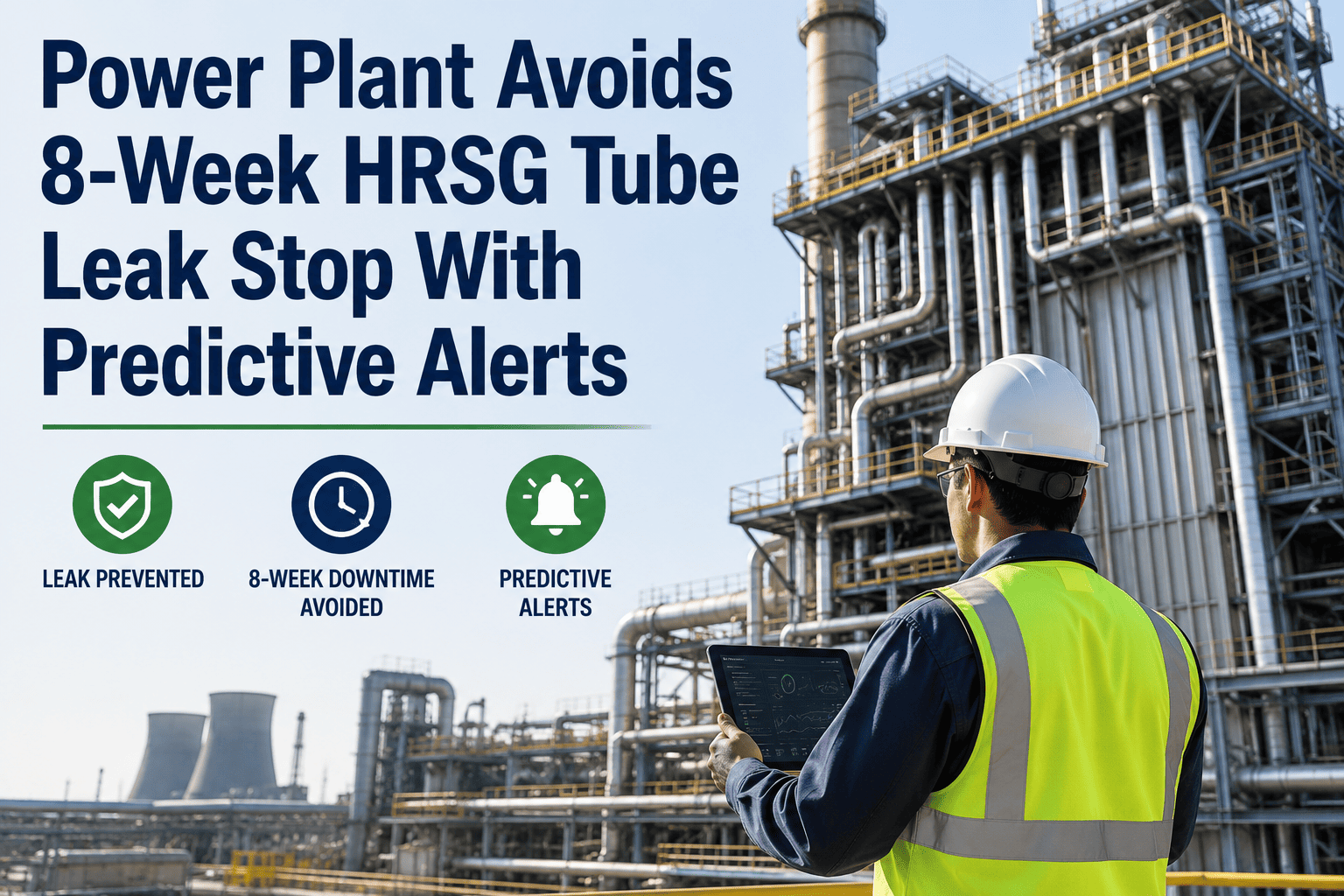
An HRSG tube leak that reaches forced outage isn't just an 8-week shutdown — it's a complete dismantling of your operations, revenue, and contractual commitments. Refractory removal, tube access, replacement, hydro testing, and recommissioning of a heat recovery steam generator can run $3.5 million to $8 million in direct costs, plus the tolling or capacity revenue lost during the outage window. At one power plant, an Oxmaint-monitored HRSG generated a sodium tracking alert and an acoustic leak detection signal 15 days before a tube leak would have triggered a forced outage. The plant scheduled a targeted inspection, confirmed the leak location, and completed a planned repair during a 72-hour window — avoiding the 8-week forced outage that their maintenance team estimated was otherwise two weeks away. Start your free Oxmaint trial and activate acoustic and chemistry-based HRSG monitoring today.
15 days
Advance Warning Before Forced Outage
72 hrs
Planned Repair vs 8-Week Forced Outage
$6.2M
Estimated Outage Cost Avoided
2 signals
Acoustic + Sodium — Confirmed Together
WHY HRSG TUBE LEAKS ARE SO DANGEROUS
The 8-Week Forced Outage Nobody Sees Coming Until It's Too Late
HRSG tube leaks are insidious failures. They begin as microscopic defects — pitting, stress corrosion cracking, or flow-accelerated corrosion — that develop over months before reaching a threshold that causes measurable steam loss. By the time a tube leak becomes audible to maintenance personnel or visible on steam flow balance calculations, it has often progressed far enough that the heat recovery steam generator must be taken offline for full-scope investigation. The cost cascade that follows is devastating: gas turbine derates, replacement power procurement, tube access scaffolding, refractory removal, replacement tube procurement, welding certification, hydrostatic testing, and full recommissioning. Oxmaint provides the early warning signals that interrupt this cascade before it starts. Book a demo to see how Oxmaint HRSG monitoring integrates with your plant's existing chemistry and acoustic instrumentation.
THE TWO DETECTION SIGNALS — HOW THEY WORK TOGETHER
Acoustic Leak Detection and Sodium Tracking: Why One Signal Isn't Enough
Neither acoustic leak detection nor sodium tracking alone provides sufficient confidence to justify a planned outage for tube inspection. Acoustic sensors can generate false positives from valve noise or flow turbulence. Sodium spikes can have chemical feed causes unrelated to tube leaks. Oxmaint's value is in correlating both signals together — when acoustic anomalies and sodium chemistry deviations occur simultaneously, the combined confidence level is high enough to support a targeted inspection decision.
How It Works
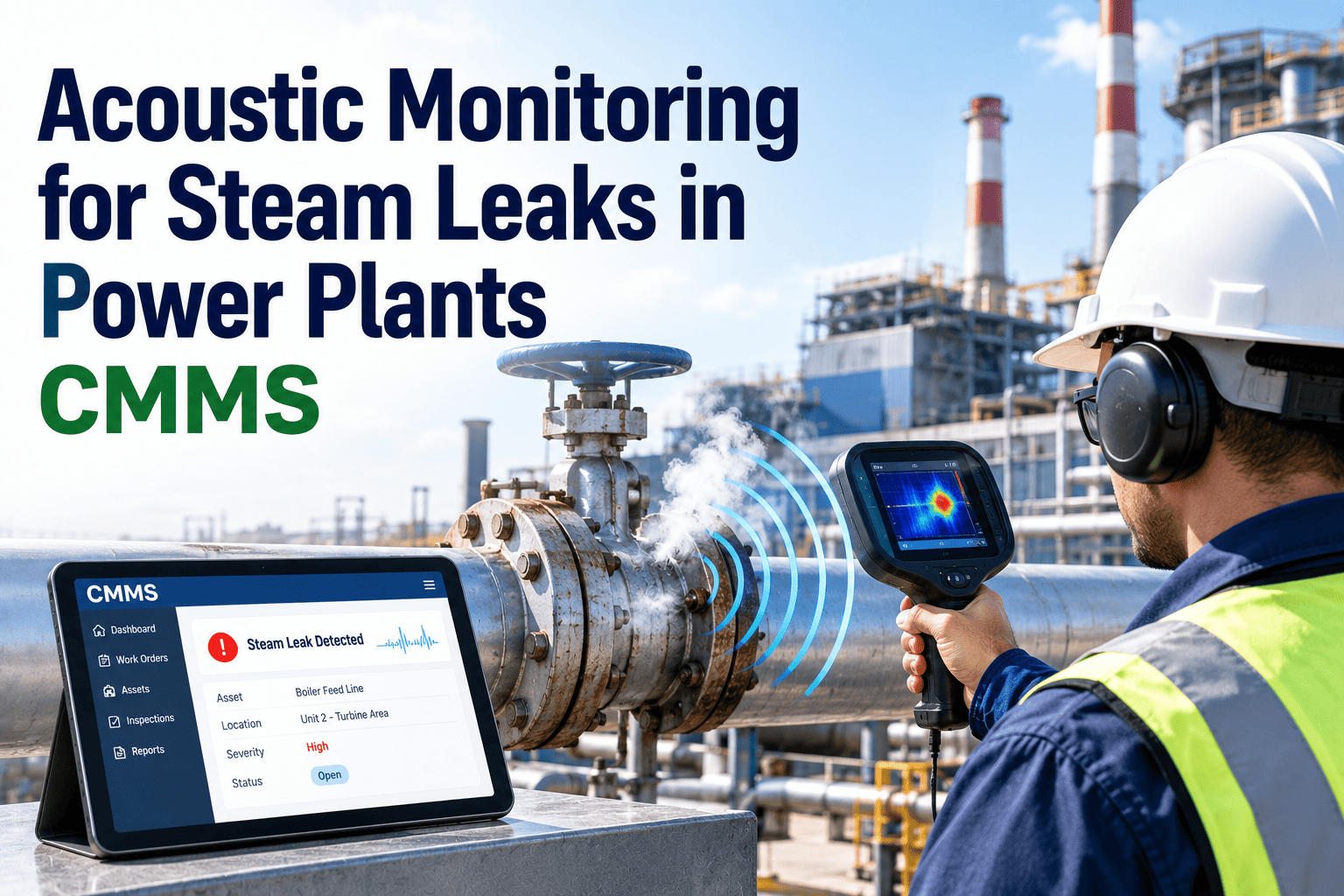
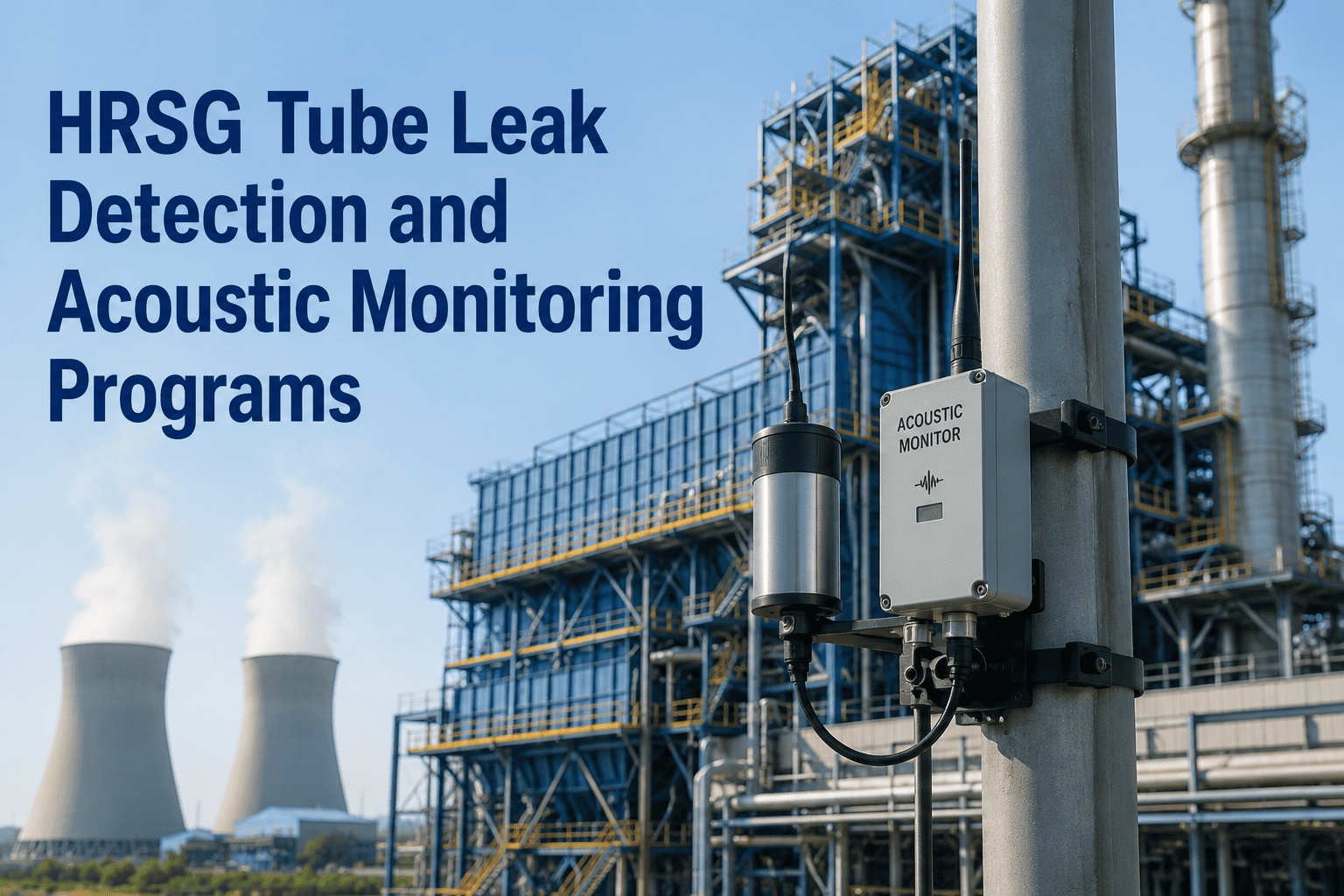
Acoustic sensors detect the characteristic broadband noise signature of steam escaping through a tube defect — distinguishable from background mechanical noise through frequency pattern analysis in the Oxmaint signal processor.
What Oxmaint Tracks
Signal amplitude trend above baseline, frequency signature matching tube leak pattern, spatial location estimate from multi-sensor triangulation, rate of amplitude increase over time.
In this case: Acoustic signal appeared Day 1 of the 15-day window, rising steadily at a rate consistent with active leak propagation.
How It Works
Sodium ingress from a tube leak appears as elevated sodium concentration in the steam drum, turbine steam, or condensate return. Oxmaint tracks sodium against baseline chemistry profiles and flags deviations that exceed control limits over multiple consecutive readings.
What Oxmaint Tracks
Sodium concentration trend in multiple sample points, correlation between sodium rise and chemical feed events (to rule out false positives), rate of sodium increase relative to expected leak propagation rates.
In this case: Sodium reading rose above control limit on Day 4 and continued climbing — correlating with the acoustic signal to confirm an active tube defect.
THE 15-DAY EVENT SEQUENCE
From First Oxmaint Alert to Successful Planned Repair: Day by Day
Acoustic Watch Alert Generated
Oxmaint ALDS sensor network detects broadband noise increase in HRSG module 2. Signal classified as Watch level — monitoring interval tightened to 15-minute readings. Chemistry team alerted to increase sodium sampling frequency.
Sodium Deviation Confirmed
Steam drum sodium rises above the Oxmaint control limit for the third consecutive reading — ruling out a chemical feed event. Oxmaint generates a dual-signal correlation alert: acoustic + chemistry deviation, classified as Warning. Maintenance supervisor and plant manager notified automatically.
Action Level — Inspection Planning Begins
Both signals continue rising. Oxmaint escalates to Action level. Engineering team convenes to plan targeted inspection scope. Acoustic triangulation data narrows probable leak location to a 4-row section of module 2 superheater. Scaffold and access planning begins. Planned outage window identified for Day 15.
Preparation and Confirmation
Replacement tube sections procured. Welding crew scheduled. Signals continue rising at a rate confirming the leak is active and progressing. Oxmaint projected time-to-forced-outage estimate: 10 to 18 days from Day 7, validating the planned outage timing.
Planned Repair Completed — 72 Hours
HRSG taken offline at planned time. Leak confirmed in acoustic triangulation target zone. Two tube sections replaced. Hydrostatic test passed. Unit returned to service 72 hours later. No forced outage. No cascade damage. No missed power delivery obligations.
Avoided: 8-week forced outage, $6.2M estimated cost, 3 months of capacity performance penalty exposure
An HRSG Tube Leak Gave 15 Days of Warning. Most Plants Never Hear It.
Oxmaint acoustic leak detection and sodium tracking — correlating chemistry and acoustic signals so your engineering team gets actionable advance warning, not a forced outage.
THE COST COMPARISON
Planned Repair vs Forced Outage: What This One Alert Was Worth
Forced Outage — 8 Weeks
Tube replacement and weld repair: $280K
Scaffold, access, and refractory: $420K
Cascade damage — downstream tube rows: $890K
Replacement power procurement (8 weeks): $2.1M
Capacity performance penalty (3 months): $680K
Emergency labor premium (unplanned): $340K
Lost tolling revenue (8 weeks): $1.5M
Total Estimated: $6.2M+
72-Hour Planned Outage
Targeted tube replacement: $95K
Pre-staged scaffold and access: $48K
No cascade damage — early intervention
Replacement power: 72 hours only — $63K
No capacity performance penalty
Standard labor rates — planned scheduling
72-hour revenue impact only — $38K
Total Actual Cost: $244K
FREQUENTLY ASKED QUESTIONS
What Plant Engineering Teams Ask About Oxmaint HRSG Leak Detection
How does Oxmaint distinguish an HRSG tube leak acoustic signal from normal valve noise or flow turbulence?
Oxmaint's acoustic processing uses frequency domain analysis to identify the broadband signature characteristic of steam escaping through a tube defect, compared against the plant-specific noise baseline established during initial deployment. Valve noise and flow turbulence have distinct frequency signatures that Oxmaint filters out after baseline learning. The system also uses multi-sensor amplitude comparison to localize the signal — directional noise sources like valves register differently than distributed tube leak signals.
Start your Oxmaint trial to configure HRSG acoustic baseline learning for your unit.
Does Oxmaint sodium tracking work if the plant already has an online sodium analyzer installed?
Yes. Oxmaint integrates with existing online sodium analyzers via standard data historian connections (OPC-UA, Modbus, PI). If the plant already has sodium monitoring at the steam drum, turbine steam, or condensate return, Oxmaint ingests that data stream and applies trending and anomaly detection logic on top of it — adding intelligence to instrumentation you already have.
Book a demo to discuss your existing chemistry instrumentation and integration options.
How accurate is Oxmaint's acoustic triangulation for locating a tube leak within the HRSG?
Acoustic triangulation accuracy depends on sensor placement density and the HRSG module geometry. In the case study above, the leak was narrowed to a 4-row section of one superheater module, significantly reducing the inspection scope from a full HRSG entry to a targeted access point. Typical triangulation accuracy for a multi-sensor ALDS deployment is within one to two module sections, which translates to a 60 to 80% reduction in inspection scope compared to a full unit entry.
How many ALDS sensors does an HRSG require for effective Oxmaint coverage?
Sensor quantity depends on HRSG module count and physical dimensions. A typical 2-pressure HRSG with 4 to 6 modules is effectively covered by 8 to 14 acoustic sensors placed at casing penetration points per module. Oxmaint's deployment team provides a sensor placement plan based on your HRSG isometric drawings before installation begins — minimizing sensor count while maximizing coverage and triangulation accuracy.
Can Oxmaint HRSG monitoring provide early warning for other tube failure modes beyond pinhole leaks?
Yes. In addition to active tube leaks detected acoustically, Oxmaint tracks chemistry parameters associated with tube wall degradation prior to leakage — including dissolved oxygen trends, cation conductivity, and pH excursions that indicate corrosion activity. Tube metal temperature trending from thermocouple data can also flag flow-accelerated corrosion risk zones before wall loss reaches leak threshold.
See the full Oxmaint HRSG monitoring parameter library in your free trial.
15 Days of Warning Turned an 8-Week Outage Into a 72-Hour Repair.
Oxmaint acoustic leak detection and sodium chemistry tracking — correlating the signals that catch HRSG tube failures before they force your plant offline. Free trial, live in under a week.