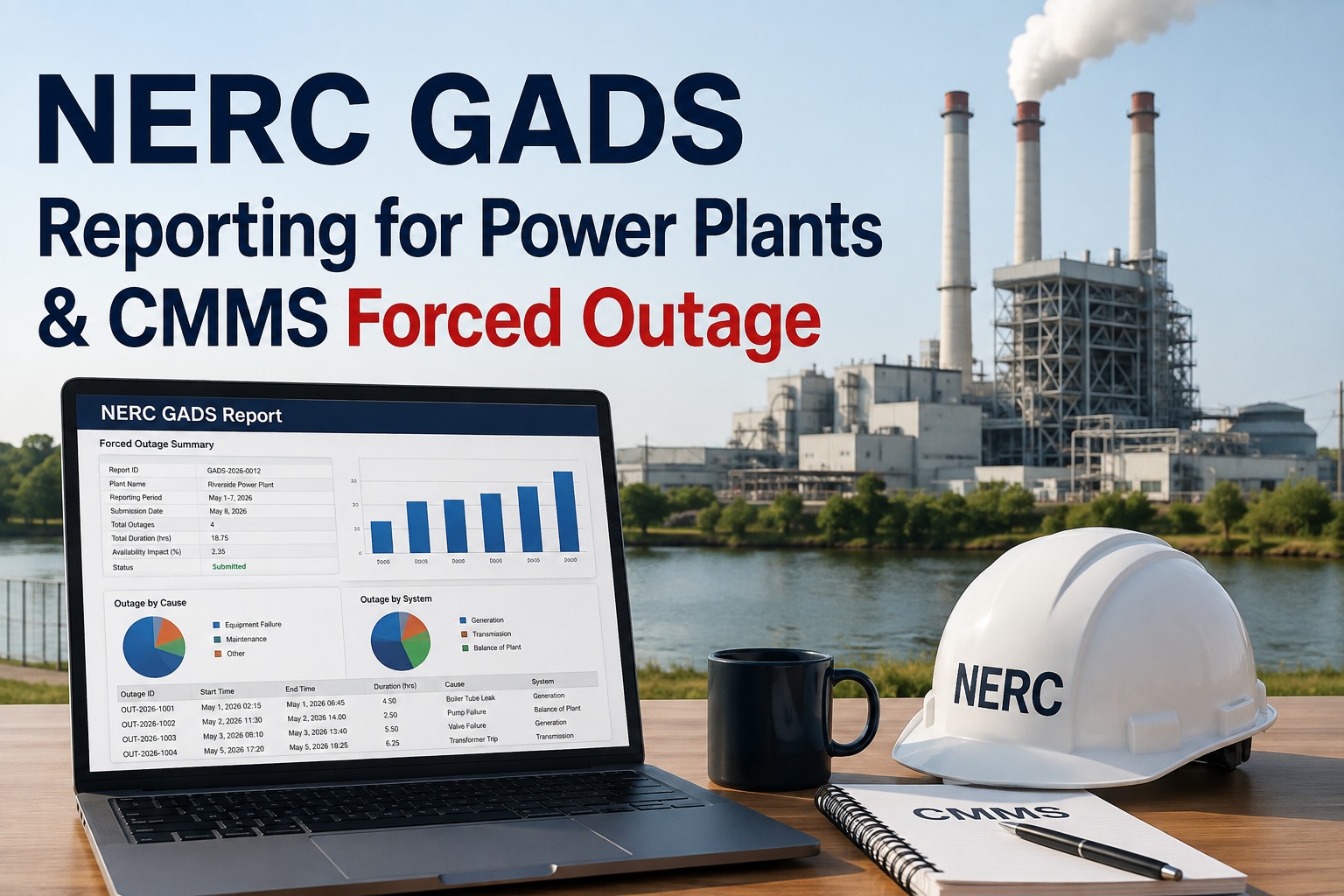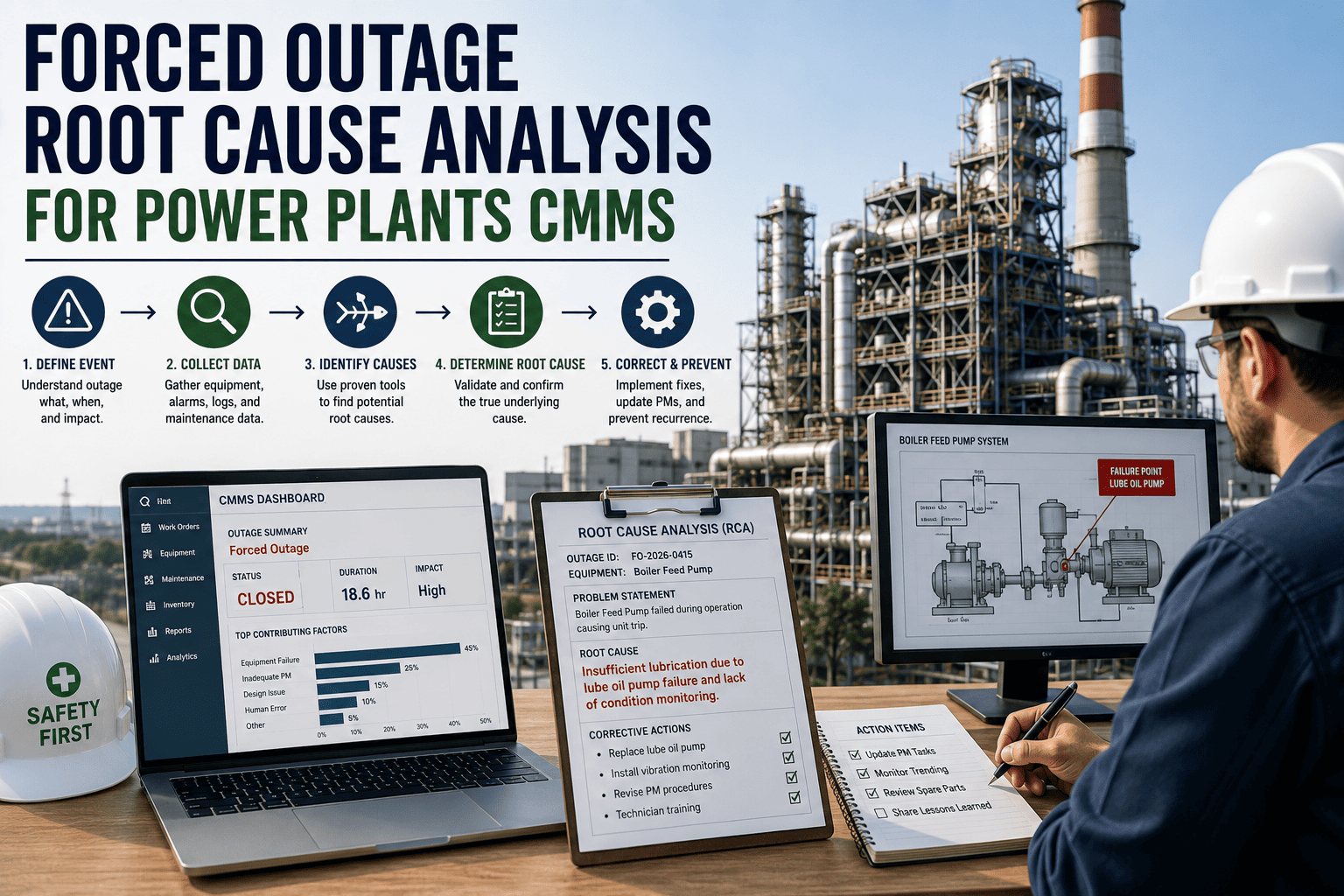
Forced outage root cause analysis for power plants is the structured investigation process that identifies why a turbine trip, boiler tube leak, or generator failure occurred — and, more critically, what corrective actions will prevent it from happening again. A single forced outage at a 500 MW coal or combined-cycle facility can cost $250,000 to $1.2 million per day in lost generation, replacement power, and emergency repair labor, making a rigorous power plant RCA process essential for grid reliability and margin protection. When maintenance teams rely on paper logs, disconnected spreadsheets, or tribal memory, outage cause analysis stalls for weeks and corrective actions slip through the cracks — exactly the gap an AI-powered CMMS like OxMaint closes by codifying the investigation workflow from fault to fix. You can Start Free Trial to digitize your outage RCA workflow today, or read on for the complete implementation guide.
Power Plant Reliability · Outage Investigation
How many forced outages will your plant survive this year without a structured RCA process?
The average fossil plant experiences 3–7 forced outages annually, each costing $250K–$1.2M per day in lost generation. Without a codified power plant RCA process embedded in your CMMS, root causes go undocumented in 60% of cases — and the same failure recurs within 18 months.
The 5-Phase Outage Investigation Timeline
Forced outage RCA timeline: from turbine trip to closed corrective action
A defensible turbine trip RCA follows a strict sequence — typically completed within 30–90 days depending on complexity. Skipping phases or delaying data collection is the #1 reason outage cause analysis fails to identify the true root cause.
Data Preservation & Evidence Lockdown
Freeze DCS trends, vibration historian data, alarm logs, and operator logs within hours of the trip. OxMaint automatically snapshots the asset's work-order history, PM compliance record, and last inspection results into a sealed RCA case file — eliminating the evidence-loss gap that plagues manual investigations.
Fault Tree Analysis & 5-Why Mapping
Map the sequence of events using fault tree analysis (FTA) and the 5-Why method to drill from the symptom (e.g., "turbine tripped on high vibration") to the physical, human, and latent root causes. OxMaint's structured RCA templates guide teams through each branch and attach evidence directly to the fault tree node.
Root Cause Confirmation & Testing
Validate the suspected root cause through metallurgical lab analysis, borescope inspection, or component testing. A robust power plant failure RCA must distinguish between physical cause (bearing failure), human cause (wrong lubricant applied), and latent cause (PM interval not updated after vendor bulletin).
Corrective Action Assignment & Tracking
Each identified root cause generates one or more corrective actions — design changes, PM interval updates, training, or procedure revisions — assigned with owners and due dates inside the CMMS. OxMaint tracks every action to closure with automated escalation alerts, closing the recurrence-prevention loop.
Recurrence Verification & Knowledge Capture
Monitor the affected asset and similar equipment for 90+ days to confirm the fix holds. OxMaint's analytics engine flags any precursor trend (vibration, temperature, oil degradation) on the asset family, verifying the corrective action is effective before the RCA case is formally closed.
RCA Methods Compared
Which RCA method should power plants use for forced outage investigation?
Different failure modes demand different analytical tools. Most high-performing reliability teams use 2–3 methods in combination — here is how the four core approaches stack up for power plant failure RCA.
| RCA Method | Best For | Time Required | Depth | CMMS Integration |
|---|---|---|---|---|
| 5-Why Analysis | Simple, single-cause failures (e.g., a tripped breaker from a loose connection) | 1–2 hours | Basic | Built-in template, auto-linked to work order |
| Fault Tree Analysis (FTA) | Complex turbine trips and generator failures with multiple contributing factors | 1–3 days | Advanced | Visual tree builder with evidence attachments |
| Fishbone (Ishikawa) | Systematic brainstorming across Man, Machine, Method, Material categories | 2–4 hours | Intermediate | Categorized root-cause codes in dropdown |
| FMEA-Based RCA | Proactive RCA for recurring failure modes on critical asset families | 3–5 days | Advanced | RPN scoring, auto-synced with PM strategy |
A world-class power plant RCA process scores above 0.85 — meaning 85%+ of corrective actions close on time AND the failure does not recur within a year. Plants without CMMS-tracked RCA typically score 0.30–0.45, losing millions to repeat outages.
Real-World Scenario
Turbine trip RCA: a worked example at a 500 MW combined-cycle plant
Steam turbine trip on high bearing vibration — $340K lost in 38 hours
Siemens SST-5000, 280 MW steam turbine, Bearing #2
Trip at 02:14 on high vibration (14.2 mm/s, alarm at 11.2 mm/s)
38 hours, $340K in lost generation + $28K emergency labor
5-Why chain built inside OxMaint's RCA module:
Why did the turbine trip? — Bearing #2 vibration exceeded trip setpoint.
Why was vibration high? — Babbitt bearing surface degraded, oil film compromised.
Why did the bearing degrade? — Lubrication oil ISO cleanliness at 22/19 vs. target 16/13.
Why was oil contaminated? — Duplex filter auto-switchover failed; filter ran to collapse.
Why did switchover fail? — Differential-pressure switch last calibrated 14 months ago; PM overdue by 62 days. Root cause: PM compliance gap in CMMS — filter DP switch not on a calibration PM with automated due-date escalation.
Corrective actions tracked in OxMaint: (1) Replace Bearing #2 — completed at +34h. (2) Create calibration PM for DP switch on all 6 turbine filter skids — 7-day due date. (3) Add oil-cleanliness trend alert at ISO 18/15 — auto-triggered from predictive analytics. (4) Review all similar PMs plant-wide for overdue status — generated 23 PM corrections. Projected outcome: zero recurrence, $340K/outage avoided, payback on CMMS investment in <4 months.
How OxMaint Helps
How OxMaint's CMMS powers forced outage RCA for power plants
OxMaint turns outage investigation from a paper-chase into a closed-loop digital workflow — from evidence capture to corrective action verification. Here is how four specific capabilities map to the RCA challenges reliability teams face.
Structured RCA Templates
Built-in 5-Why, Fishbone, and FTA templates auto-populate the asset's work-order history, PM compliance, and failure codes — cutting investigation setup time by 70% and ensuring no evidence is lost.
Cuts investigation cycle time from 45 days to 14Corrective Action Tracking
Every root cause generates tracked actions with owners, due dates, and automated escalation emails. Dashboards show closure rates and overdue actions in real time — no more actions buried in meeting minutes.
93% on-time closure vs. industry avg of 48%Predictive Failure Detection
AI-driven analytics on vibration, temperature, and oil-analysis trends flag the precursor signatures of the exact failure mode your RCA identified — across all similar assets — before the next trip happens.
Prevents 30–50% of forced outages before they occurAudit-Ready Documentation
Every RCA case, evidence file, corrective action, and verification result is permanently linked to the asset record — producing NERC, ISO 55000, and internal-audit-ready reports with one click.
Cuts audit prep from 2 weeks to 2 hoursBook a 30-minute demo — see OxMaint prevent your next forced outage
Walk through a real turbine-trip RCA workflow on your own asset data. See how corrective actions, predictive alerts, and audit-ready documentation come together in one platform.
FAQ
Forced outage RCA for power plants — frequently asked questions
What is a forced outage root cause analysis in a power plant?
Forced outage RCA is the structured investigation of an unplanned generation loss — such as a turbine trip or boiler tube leak — to identify the physical, human, and latent root causes and implement corrective actions that prevent recurrence. It typically combines evidence preservation (DCS trends, alarm logs), analytical methods like 5-Why or fault tree analysis, and CMMS-tracked corrective actions with verified closure.
How long should a power plant RCA take after a forced outage?
A thorough forced outage investigation should be completed within 30–90 days. Evidence preservation happens in the first 24 hours, fault tree analysis and 5-Why mapping within 1–7 days, root cause confirmation via lab testing within 7–30 days, and corrective action closure within 30–60 days. Plants using a CMMS with built-in RCA templates like OxMaint typically compress this to 14–21 days — you can Book a Demo to see the workflow.
What is the difference between a physical root cause and a latent root cause?
The physical root cause is the direct failure mechanism — for example, a bearing's Babbitt surface degraded due to contaminated oil. The latent root cause is the organizational or systemic gap that allowed it: the PM for the filter DP-switch calibration was overdue by 62 days with no escalation. Effective power plant failure RCA identifies and addresses both layers, or the outage will recur.
How does a CMMS improve outage cause analysis?
A CMMS like OxMaint improves outage cause analysis by auto-populating the asset's complete maintenance history (work orders, PM compliance, failure codes, past RCAs) into the investigation, providing structured RCA templates so no analytical step is skipped, tracking every corrective action to closure with automated escalations, and verifying the fix held by monitoring precursor trends on the asset family — closing the loop that spreadsheets and paper logs leave open.
What are the most common causes of forced outages in power plants?
The most common causes are boiler tube leaks (accounting for roughly 40% of fossil-plant forced outages), turbine bearing and blade failures, generator winding failures, condenser tube leaks, and boiler feed-pump failures. In over 60% of cases, the underlying root cause is a preventive maintenance gap — overdue PMs, missing condition-monitoring alerts, or incorrect PM intervals — which is why RCA-driven PM strategy updates are the highest-ROI corrective action a plant can take.
Stop recurring outages. Start your OxMaint trial today.
Join the reliability teams using OxMaint to cut forced outages 30–50%, close 93% of corrective actions on time, and make every RCA audit-ready.
Free 14-day trial · No credit card