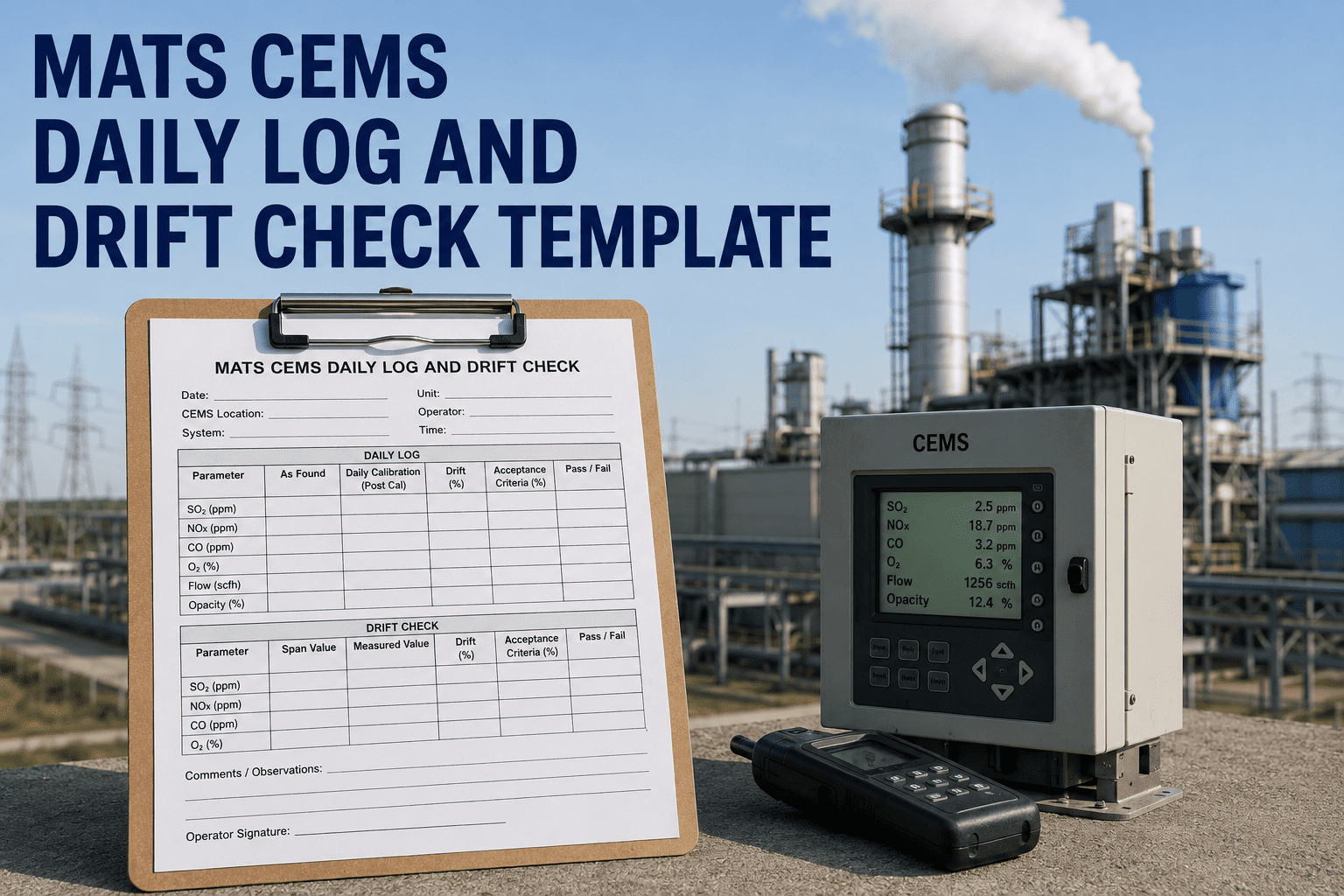
EPA MATS requires continuous emissions monitoring systems to demonstrate accuracy every single operating day — not quarterly, not annually, but daily. Zero and span drift checks, mercury monitor calibrations, calibration gas verifications, and out-of-control period documentation must be recorded, retained for five years, and producible on demand during a stack test review or enforcement inspection. Facilities that receive MATS NOVs do not typically fail because their CEMS malfunctioned. They fail because their daily logs were incomplete, their drift calculations were undocumented, or their out-of-control periods were not formally recorded with corrective action evidence. If your CEMS logs live in operator shift books and disconnected spreadsheets, the compliance exposure is already present. Start your OxMaint free trial and bring your MATS CEMS documentation into a single, audit-ready system.
EPA MATS · CEMS · 40 CFR Part 75 · Daily Drift Logs
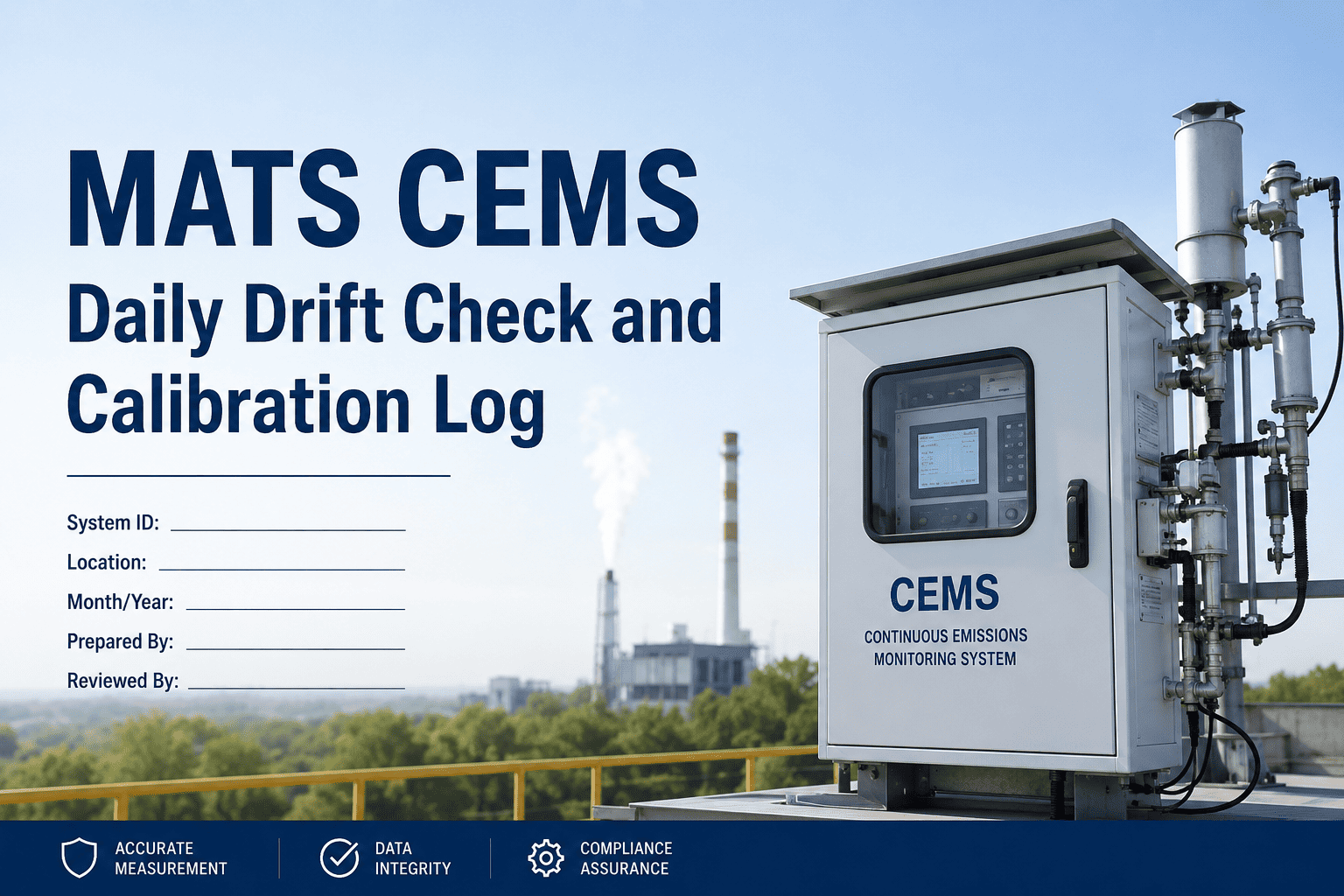
Free MATS CEMS Daily Log and Drift Check Template — Zero/Span, Mercury, Calibration Gas, and Out-of-Control Records
A field-ready CEMS daily log template covering zero and span drift checks, mercury CEMS calibration, calibration gas cylinder records, and out-of-control period documentation — structured for MATS Subpart UUUUU compliance. Download the template, then see how OxMaint automates the daily workflow and keeps every record audit-ready without manual assembly.
CEMS Daily Status — Unit 2
Today · 06:00 Shift Log
SO₂ Monitor — Zero Drift
0.3%
Pass
SO₂ Monitor — Span Drift
1.1%
Pass
Mercury CEMS — Cal Gas
2.4%
Monitor
NOₓ Monitor — Span Drift
6.8%
Out-of-Control
Flow Monitor — Zero Check
0.8%
Pass
Why MATS CEMS Logs Fail Audits
The Six Documentation Failures That Produce MATS NOVs — Even When the Equipment Is Working
Drift
Drift Values Recorded Without Pass/Fail Determination
MATS requires the facility to determine and record whether each drift check passes the applicable criteria (2% of span for zero, 10% of span for span drift under Part 75 Appendix B). Recording the raw reading without the pass/fail evaluation leaves an incomplete log entry that auditors treat as a missing record.
OOC
Out-of-Control Periods Not Formally Opened
When a drift check exceeds the applicable criterion, an out-of-control period must be formally initiated, the affected data flagged as invalid, and corrective action documented. Facilities that correct the monitor and resume logging without formally recording the OOC period and its resolution create a gap that is frequently cited during enforcement reviews.
Cal Gas
Calibration Gas Cylinder Records Incomplete
MATS requires that calibration gas cylinders be certified and traceable. Cylinder ID, concentration, certification date, expiration date, and the National Institute of Standards and Technology (NIST) traceability statement must all be on file. Expired or untraceable calibration gases — even those that produce passing drift readings — invalidate the check and the monitoring data associated with it.
Mercury
Mercury CEMS Calibration Gaps Between QA Events
Sorbent trap monitoring systems and mercury CEMS have specific calibration requirements under MATS. Facilities that track mercury QA events in a separate log from their primary CEMS records routinely produce incomplete documentation when auditors request a unified compliance record for a specific monitoring period or stack test window.
Substitute
Substitute Data Not Applied During OOC Periods
During an out-of-control period, actual monitor readings cannot be used as valid emissions data — substitute data values must be applied per the applicable Part 75 provisions. Facilities that continue reporting actual readings during undocumented OOC periods face both data integrity findings and potential emissions underreporting citations on audit review.
Retention
Five-Year Record Retention Not Verifiable
MATS requires retention of CEMS records for five years. Facilities that maintain logs in operator shift books, local spreadsheet files, or archived network drives cannot quickly demonstrate that a continuous, unbroken five-year record exists for every monitoring parameter on every operating unit — the exact demonstration an EPA inspection requires.
The Template — Log Structure
MATS CEMS Daily Log Template — Every Required Field, Every Monitoring Parameter
The template is structured as a daily log with separate sections for each monitoring parameter. Every section includes the required measurement fields, pass/fail criteria reference, out-of-control initiation fields, and calibration gas traceability records aligned with 40 CFR Part 75 Appendix B requirements.
SO₂ / NOₓ / CO₂ Monitor — Daily Drift Check
Zero Drift Check
Expected zero value (%)
Measured zero reading (%)
Zero drift calculation (%)
Criterion: ≤ 2.0% of span
Pass / Fail determination
Span Drift Check
Expected span value (%)
Measured span reading (%)
Span drift calculation (%)
Criterion: ≤ 10.0% of span
Pass / Fail determination
Mercury CEMS — Daily Calibration and Drift Check
Low-Level Calibration Gas Check
Cylinder ID and concentration (µg/m³)
NIST traceability certification reference
Measured response value
Calibration error (%)
Pass / Fail — criterion ≤ 5%
Mid-Level / High-Level Check
Cylinder ID and certified concentration
Cylinder expiration date
Measured response and calibration error
Upscale check criterion reference
Pass / Fail determination
Out-of-Control Period Record
Affected monitor and parameter
_______________________
OOC period start — date and time
_______________________
Criterion exceeded — zero or span, value recorded
_______________________
Substitute data method applied
_______________________
Corrective action taken
_______________________
OOC period end — date, time, and re-certification check result
_______________________
Responsible technician and supervisor sign-off
_______________________
Calibration Gas Cylinder Register
| Cylinder ID |
Gas Type |
Certified Conc. |
Cert. Date |
Expiry Date |
NIST Ref. |
Status |
| CYL-001 |
SO₂ Zero |
0 ppm |
— Enter — |
— Enter — |
— Enter — |
Valid |
| CYL-002 |
SO₂ Span |
— ppm |
— Enter — |
— Enter — |
— Enter — |
Valid |
| CYL-003 |
NOₓ Span |
— ppm |
— Enter — |
— Enter — |
— Enter — |
Check |
| CYL-004 |
Hg Low |
— µg/m³ |
— Enter — |
— Enter — |
— Enter — |
Valid |
OxMaint · MATS CEMS · Daily Logs · Out-of-Control Tracking · Audit-Ready
Your CEMS Logs Should Be Complete, Consistent, and Retrievable Every Day. OxMaint Makes That Automatic.
OxMaint enforces required fields on every daily log, tracks out-of-control periods through to verified closure, and produces five-year retention records exportable in minutes. See the MATS CEMS workflow live in 30 minutes.
Quick Reference — Drift Criteria
MATS CEMS Drift Check Pass/Fail Criteria — 40 CFR Part 75 Appendix B at a Glance
SO₂ Monitor
Zero Drift
≤ 2.0% of span
Span Drift
≤ 10.0% of span
Combined (Zero + Span)
≤ 6.0% of span
OOC Trigger
Exceeds any criterion above
NOₓ Monitor
Zero Drift
≤ 2.0% of span
Span Drift
≤ 10.0% of span
Combined (Zero + Span)
≤ 6.0% of span
OOC Trigger
Exceeds any criterion above
Mercury CEMS
Low-Level Cal Error
≤ 5.0%
Mid/High-Level Cal Error
≤ 10.0%
System Integrity Check
≤ 5.0% bias
OOC Trigger
Any criterion exceeded
Flow Monitor
Zero Check
≤ 3.0% of span
Upscale Check
≤ 3.0% of span
Calibration Error
≤ 3.0% of reading
OOC Trigger
Exceeds any criterion above
OxMaint for MATS CEMS
How OxMaint Closes the Gap Between a Daily Log Template and Full MATS Compliance
01
Daily Log Auto-Generation
OxMaint generates a structured daily CEMS log work order for each operating unit at the start of every shift. Required fields — zero drift, span drift, pass/fail determination, calibration gas cylinder ID — cannot be skipped at closure. Every completed log is timestamped, attributed to the operator, and stored against the unit record permanently.
02
Automatic OOC Period Initiation
When a drift check result exceeds the applicable criterion, OxMaint automatically opens an out-of-control period record for the affected monitor. The system flags subsequent data as requiring substitute values, notifies the responsible engineer, and tracks the OOC period to formal closure — including the re-certification check result that confirms valid monitoring has resumed.
03
Calibration Gas Cylinder Register
Every calibration gas cylinder is registered in OxMaint with its certified concentration, NIST traceability reference, certification date, and expiration date. The system alerts the CEMS team when a cylinder approaches expiration — before an expired cylinder is used in a daily check that would invalidate the monitoring data and produce a retroactive compliance gap.
04
Five-Year Retention and Audit Export
Every MATS daily log, OOC period record, calibration gas register, and mercury CEMS calibration record is retained in OxMaint for the five-year period required by regulation. Filtering by unit, parameter, and date range produces a complete, timestamped export — covering any monitoring period an EPA inspector or stack test reviewer requests — in minutes rather than days.
Out-of-Control Period — Step by Step
What a Properly Documented MATS Out-of-Control Period Looks Like
1
Drift Check Exceeds Criterion
The daily drift check result exceeds the applicable Part 75 Appendix B criterion — zero drift above 2% of span, span drift above 10% of span, or combined drift above 6% of span. The pass/fail determination is recorded immediately with the actual value observed.
2
Out-of-Control Period Opened
The OOC period is formally opened with the start date, start time, affected monitor and parameter, and the criterion exceeded. In OxMaint, this step is required before the daily log can be closed when a failure is recorded — preventing the common failure mode of correcting the monitor without opening a formal OOC record.
3
Substitute Data Applied
During the OOC period, actual monitor readings cannot be used as valid MATS compliance data. The applicable substitute data method is identified, documented, and applied to the affected data period. The substitute data method reference and the data flagging action are recorded in the OOC period log.
4
Corrective Action and Re-Certification
The cause of the drift failure is identified and corrective action taken — calibration adjustment, sensor cleaning, component replacement, or calibration gas replacement. A re-certification check is performed to confirm the monitor now passes the applicable drift criterion before valid monitoring resumes.
5
OOC Period Formally Closed
The OOC period record is closed with the end date, end time, re-certification check result, responsible technician, and supervisor sign-off. The complete record — from drift failure to verified resolution — is retained and linked to the affected unit and monitoring parameter for the five-year retention period.
OxMaint · MATS CEMS · Daily Logs · 5-Year Retention · Free to Start
Every CEMS Daily Log Complete. Every OOC Period Documented. Every Cylinder Tracked. Automatically.
OxMaint enforces complete MATS CEMS daily log fields, automatically initiates out-of-control period records on drift failures, tracks calibration gas cylinder expiration, and retains five years of records exportable on demand. Go live across your full unit fleet in days — no IT overhead, no lengthy rollout.
Frequently Asked Questions
MATS CEMS Daily Log and Drift Check — Common Questions
What are the daily drift check criteria under MATS and 40 CFR Part 75?
For SO₂ and NOₓ monitors: zero drift must not exceed 2.0% of span and span drift must not exceed 10.0% of span. The combined zero and span drift must not exceed 6.0% of span. For mercury CEMS, calibration error must not exceed 5% at the low level and 10% at mid and high levels. Exceeding any criterion initiates an out-of-control period requiring formal documentation.
Set up your drift criteria in OxMaint free.
Does OxMaint automatically open an out-of-control period when a drift check fails?
Yes. When a drift check result is entered that exceeds the configured criterion, OxMaint requires the operator to open an OOC period record before closing the daily log entry. The OOC record captures the start time, affected parameter, criterion exceeded, substitute data method applied, corrective action, and re-certification result — producing the complete documentation trail that MATS enforcement reviewers expect.
See the OOC workflow in a live demo.
How does OxMaint handle calibration gas cylinder expiration tracking?
Each calibration gas cylinder is registered as an asset in OxMaint with its certified concentration, NIST traceability reference, and expiration date. The system generates an alert before expiration — giving the CEMS team time to order a replacement before the current cylinder expires and potentially invalidates a daily drift check. Expired cylinder use is one of the most common retroactive compliance gaps found during EPA audits.
Can OxMaint produce a five-year MATS CEMS record export for an EPA inspection?
Yes. Filtering by unit, monitoring parameter, and date range produces a complete export of daily log records, OOC periods, calibration gas registers, and mercury CEMS calibration records for any period within the five-year retention window — with timestamps, operator attribution, and pass/fail determinations included for every entry.
Start free and configure your first unit's CEMS log today.