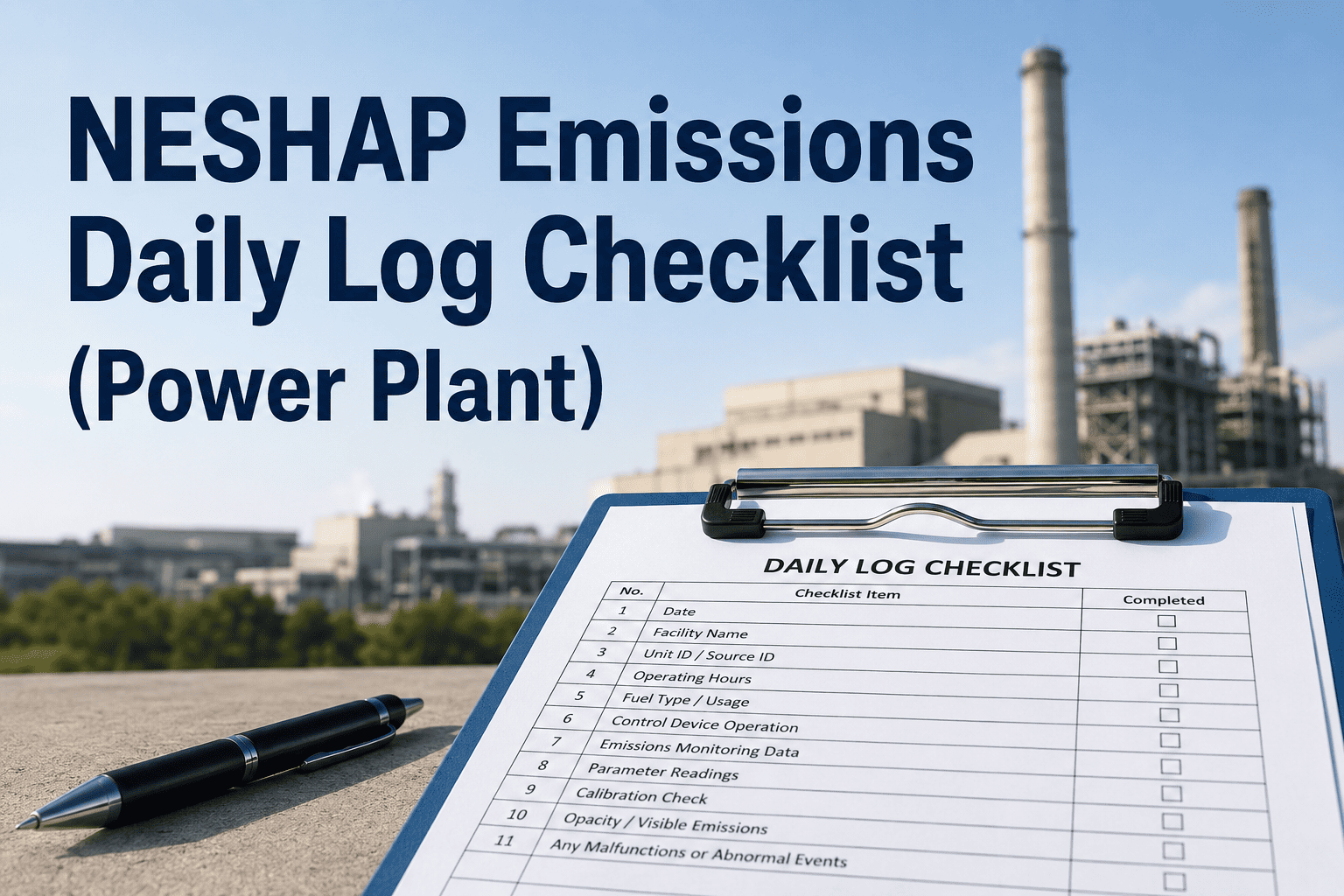
National Emissions Standards for Hazardous Air Pollutants (NESHAP) compliance at coal and gas-fired power plants requires daily monitoring, documentation, and exceedance response protocols under 40 CFR Part 63 Subpart UUUUU for coal units and Subpart KKKK for stationary combustion turbines. Power plant operators must record continuous emissions monitoring system (CEMS) readings for regulated pollutants including particulate matter, sulfur dioxide, nitrogen oxides, mercury, and acid gases on every operating day, flag any exceedance events that breach emission limits, verify CEMS calibration status, and initiate immediate corrective action when monitoring equipment malfunctions or emission limits are exceeded. A single day of missing NESHAP emissions data or undocumented exceedance events can trigger EPA enforcement actions, civil penalties exceeding $50,000 per day of violation, and mandatory corrective action plans that persist for years. This NESHAP emissions daily log checklist covers CEMS reading documentation, exceedance identification protocols, calibration verification procedures, corrective action workflows, and CMMS-integrated recordkeeping strategies that power plant environmental teams use to maintain continuous NESHAP compliance across all operating units. Sign Up Free to digitize your NESHAP emissions daily log and automate exceedance alerts across every monitored pollutant in your power generation facility with Oxmaint.
NESHAP EMISSIONS COMPLIANCE
Missing One Day of NESHAP Emissions Documentation Can Cost Your Plant $50,000+ in EPA Penalties
Oxmaint centralizes power plant NESHAP daily logs, automatically flags exceedance events against emission limits, tracks CEMS calibration status in real-time, and generates EPA-ready compliance reports with complete audit trails for every operating day.
NESHAP Regulatory Framework for Power Plant Emissions Monitoring
The Clean Air Act established National Emission Standards for Hazardous Air Pollutants to control toxic air pollutant emissions from major sources including electric utility steam generating units and stationary combustion turbines. Power plants subject to NESHAP regulations must install and operate continuous emissions monitoring systems for regulated pollutants, maintain emissions below Maximum Achievable Control Technology (MACT) limits, and document daily compliance through electronic data logging systems that capture every hour of unit operation. NESHAP Subpart UUUUU applies to coal-fired electric utility boilers and requires monitoring of particulate matter, mercury, hydrogen chloride or sulfur dioxide as surrogates for acid gas emissions, and filterable particulate matter depending on unit size and control technology configuration.
Gas-fired combustion turbines fall under NESHAP Subpart KKKK which establishes emission limits for formaldehyde, carbon monoxide, and nitrogen oxides based on turbine design and fuel type. Both regulations mandate that power plants conduct daily review of CEMS data to identify any exceedance events, equipment malfunctions, or data quality issues that could affect compliance demonstration. Facilities must maintain permanent records of all CEMS readings, calibration verifications, and corrective actions for minimum five-year retention periods accessible for EPA inspection at any time. Book a Demo to see how Oxmaint automates NESHAP daily log workflows with built-in emission limit comparisons and automatic exceedance flagging across all monitored units and pollutants in your generation fleet.
Daily NESHAP Emissions Monitoring and Documentation Requirements
Power plant environmental staff or control room operators review CEMS data daily to verify that all required monitoring systems are operational, emissions remain below applicable limits, and no data gaps exist that would compromise compliance reporting. The daily log documents hourly average concentrations for each monitored pollutant, unit operating parameters including load and heat input, CEMS availability percentages, and any periods where monitoring systems were in calibration mode, maintenance downtime, or malfunction status. When hourly emissions exceed the applicable NESHAP emission limit, operators must flag the exceedance in the daily log, notify plant environmental management, and initiate investigation to determine whether the exceedance resulted from actual emissions increase, CEMS measurement error, or data processing anomaly.
CEMS Calibration Verification and Quality Assurance Integration
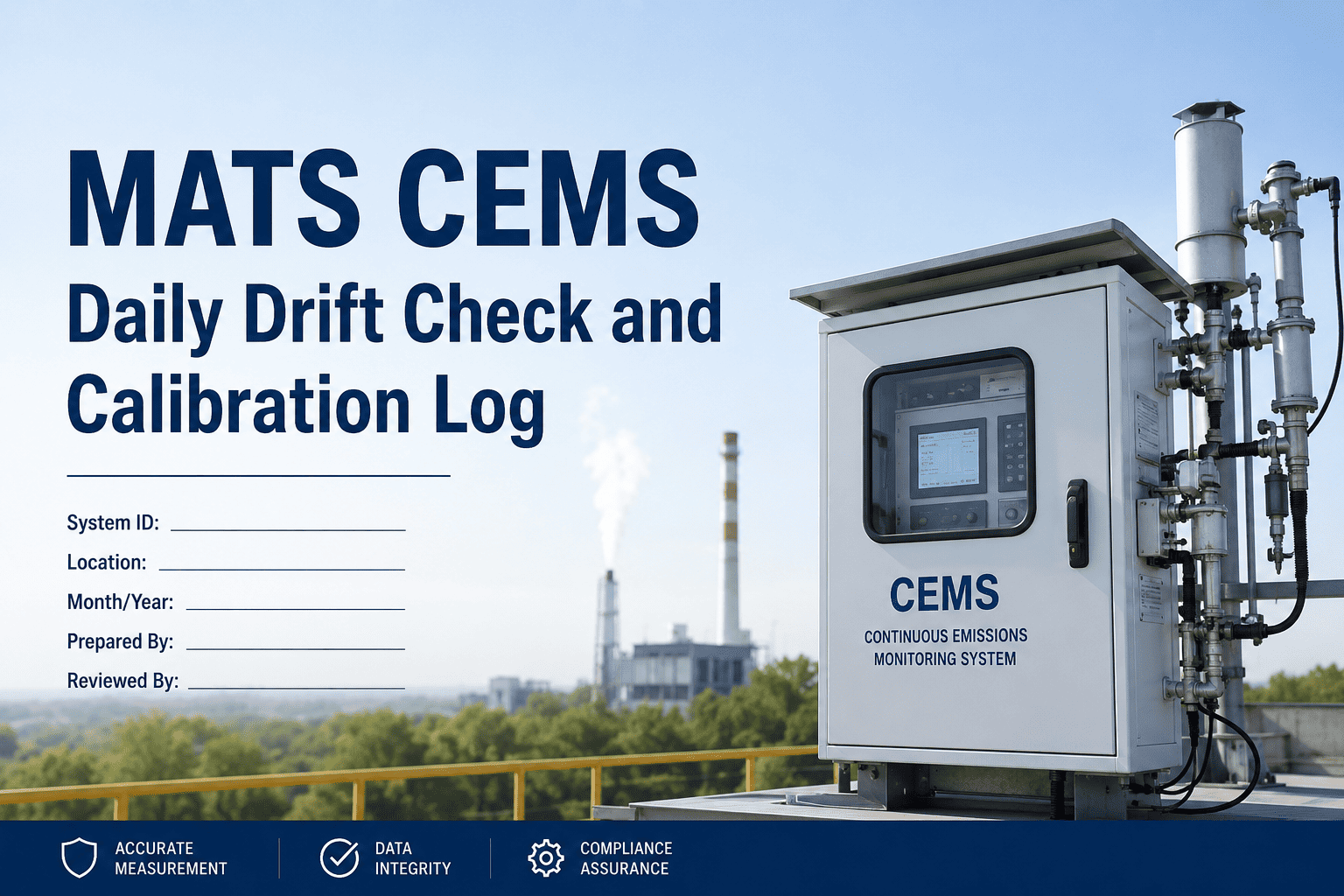
Daily NESHAP emissions logs must include verification that all CEMS analyzers successfully completed required calibration checks within the past 24 hours and that quality assurance procedures are current. This includes confirmation of daily zero and span drift checks, weekly cylinder gas audits where applicable, and quarterly Relative Accuracy Test Audits (RATA) certification status. CEMS systems that fail calibration checks or exceed drift tolerances require immediate corrective action and may need to be taken out of service until repairs restore measurement accuracy within acceptable limits. During CEMS downtime, facilities must use approved alternative monitoring methods or emissions estimation procedures specified in their site-specific monitoring plans to maintain continuous compliance documentation even when primary monitoring equipment is unavailable.
NESHAP Exceedance Response Workflow
Step 1
Exceedance Detection
CEMS data review identifies hourly emission reading exceeding applicable NESHAP limit. Operator flags exceedance in daily log and notifies environmental coordinator immediately per plant procedures.
Step 2
CEMS Verification
Environmental staff verifies CEMS calibration status and reviews recent QA/QC check results to rule out measurement error. Confirms exceedance represents actual emissions and not analyzer malfunction.
Step 3
Root Cause Investigation
Operations and environmental teams investigate unit operating parameters during exceedance period including load changes, fuel quality variations, control equipment performance, and process upsets that could explain elevated emissions.
Step 4
Corrective Action
Implement corrective measures such as combustion tuning, control equipment optimization, fuel switching, or unit derate to restore emissions below NESHAP limits. Document all actions in permanent compliance records.
Step 5
Compliance Assessment
Environmental manager evaluates whether exceedance constitutes NESHAP violation based on averaging period and emission limit structure. Determines if EPA notification or deviation report is required under 40 CFR Part 63 provisions.
AUTOMATED EXCEEDANCE RESPONSE
From Detection to Resolution — Oxmaint Manages Every NESHAP Exceedance Event With Complete Documentation
Oxmaint automatically flags emission limit exceedances in real-time, creates corrective action work orders with investigation tasks, tracks resolution through final compliance assessment, and maintains permanent EPA audit trails linking exceedances to root causes and corrective measures.
CMMS Integration for NESHAP Emissions Documentation
Advanced power plants integrate NESHAP emissions monitoring into their computerized maintenance management systems to centralize daily log documentation, automate exceedance detection algorithms, and link emissions events to specific equipment maintenance histories. CMMS-based NESHAP programs can import CEMS data directly from plant distributed control systems, eliminating manual transcription errors while providing real-time dashboards showing compliance status across all operating units. Integration with work order systems allows environmental staff to automatically generate investigation tasks when exceedances occur, track corrective action completion through electronic workflows, and maintain permanent records linking emissions events to equipment repairs, control system optimizations, or operational adjustments that resolved the non-compliance condition. Sign Up Free to implement automated NESHAP emissions tracking in Oxmaint with direct CEMS data integration, intelligent exceedance detection, and complete EPA recordkeeping compliance built into your existing maintenance platform.
Environmental Compliance Manager – 25 Years Coal & Gas Power Generation
The most critical aspect of NESHAP emissions compliance that plants consistently underestimate is the documentation burden during exceedance events. EPA auditors will request complete records showing exactly what investigation steps were taken, what unit operating data was reviewed, what corrective actions were implemented, and how effectiveness was verified after each action. Plants using paper-based daily logs or simple spreadsheet tracking systems struggle to reconstruct this level of detail months or years after an exceedance occurred. I strongly recommend that all NESHAP-subject facilities implement electronic compliance management systems that automatically capture timestamped investigation notes, link corrective action work orders to specific exceedance events, and preserve the complete decision-making record that EPA expects to see during enforcement reviews. The investment in compliance software is minimal compared to the penalties and corrective action plan costs that result from inadequate exceedance documentation during EPA inspections.
Expert Review
Dr. Sarah Mitchell, PhD
Senior Air Quality Engineer – Former EPA Office of Air Quality Planning and Standards
During my time at EPA headquarters working on NESHAP rule development and enforcement, I reviewed hundreds of power plant compliance files and observed a consistent pattern: facilities with robust daily emissions documentation programs rarely faced serious enforcement actions even when occasional exceedances occurred, while plants with poor recordkeeping practices received significant penalties even for relatively minor violations. The difference was entirely in the quality of documentation demonstrating good faith compliance efforts. Plants that could produce detailed investigation records, corrective action logs, and effectiveness verification data for every exceedance event typically received compliance assistance rather than enforcement escalation. My advice to power plant environmental managers is to invest heavily in your daily NESHAP logging systems and treat documentation quality as seriously as the emission control equipment itself. The regulatory value of excellent records cannot be overstated when your facility eventually undergoes EPA inspection or enforcement review.
Electronic Reporting and EPA Compliance Submissions
NESHAP regulations require power plants to submit semi-annual compliance reports to EPA documenting all emission monitoring data, exceedance events, CEMS quality assurance results, and corrective actions taken during the reporting period. Modern facilities use electronic data management systems that automatically compile daily log information into formatted compliance reports meeting EPA submission requirements under the Compliance and Emissions Data Reporting Interface (CEDRI) system. Automated report generation eliminates manual data aggregation errors and ensures that all required information elements are included in submissions filed through EPA's Central Data Exchange. Plants should conduct internal pre-submission reviews of compliance reports to verify data accuracy and completeness before filing, as erroneous submissions can trigger EPA follow-up requests or enforcement inquiries that consume significant staff time to resolve.
What immediate actions are required when a power plant exceeds a NESHAP emission limit?
Operators must immediately flag the exceedance in the daily emissions log and notify plant environmental management. The environmental team must verify that the exceedance represents actual emissions rather than CEMS measurement error by reviewing recent calibration data and analyzer performance. If confirmed as a real exceedance, the plant must investigate root causes including unit operating parameters, fuel quality, and emission control equipment performance during the exceedance period. Corrective actions such as combustion optimization, control system adjustments, or unit load reduction may be necessary to restore emissions below limits. All investigation findings and corrective actions must be documented in permanent compliance records. For violations of applicable emission limits based on averaging period calculations, the plant may need to submit a deviation report to EPA within specified timeframes per 40 CFR Part 63 General Provisions.
How long must power plants retain NESHAP emissions daily logs and supporting documentation?
EPA regulations require power plants to maintain all NESHAP compliance records including daily emissions logs, CEMS data, calibration records, and corrective action documentation for a minimum of five years from the date of creation. Records must be readily accessible for EPA inspection either on-site or through electronic data systems that can produce requested information within reasonable timeframes. Many facilities retain records beyond the five-year minimum to support long-term emission trending analysis, compliance demonstration during permit renewals, and defense against potential enforcement actions that may investigate historical compliance patterns. Electronic recordkeeping systems with secure cloud storage and automated backup procedures are strongly recommended to prevent data loss and ensure continuous audit readiness throughout the required retention period and beyond.
What happens if CEMS equipment fails and no emissions data is available for NESHAP reporting?
When primary CEMS analyzers are out of service due to malfunction, maintenance, or calibration activities, power plants must use EPA-approved alternative monitoring methods specified in their site-specific monitoring plans. Alternative methods may include backup CEMS analyzers, parametric monitoring of control equipment operating parameters, fuel analysis procedures, or emission factor calculations based on unit heat input and fuel characteristics. The daily log must document all CEMS downtime periods, identify the alternative monitoring method used, and explain why primary CEMS data was unavailable. Excessive CEMS downtime that exceeds quality assurance availability requirements may require makeup RATA testing or other corrective measures to restore data quality certification. Plants should prioritize CEMS maintenance and spare parts inventory to minimize downtime and maintain continuous compliance data under primary monitoring methods rather than relying on alternative procedures that may have greater uncertainty and limited EPA acceptance during enforcement reviews.
Do NESHAP emission limits apply during startup, shutdown, and malfunction periods?
EPA has eliminated the startup, shutdown, and malfunction (SSM) exemption from NESHAP emission limits for most source categories including power plants. Current regulations require facilities to comply with emission limits at all times including during startup, shutdown, and malfunction events. However, power plants may develop work practice standards or alternative emission limits specifically applicable during these periods if the standard limits are not achievable due to technical limitations of emission control equipment. Any such alternative standards must be approved by EPA as part of the facility's operating permit and must represent Maximum Achievable Control Technology considering the specific operational mode. Plants must document all startup, shutdown, and malfunction events in daily emissions logs with detailed narratives explaining the circumstances, emission levels during the event, and actions taken to minimize emissions and duration of the non-standard operating period.
Can Oxmaint integrate with existing power plant CEMS data systems for automated NESHAP logging?
Yes, Oxmaint can integrate with most power plant distributed control systems and CEMS data historians through standard industrial communication protocols including OPC, Modbus, and REST APIs. Integration allows automatic import of hourly emission readings from plant data systems into Oxmaint's NESHAP compliance module, eliminating manual data entry while maintaining complete traceability to source measurements. Oxmaint applies user-configured emission limit algorithms to automatically flag exceedances, calculate rolling averages for 30-day compliance demonstration, and generate corrective action work orders when thresholds are breached. The system maintains permanent audit trails linking all CEMS data, calibration verifications, and exceedance investigations in a single compliance management platform accessible to environmental staff, plant management, and EPA auditors. Integration projects typically complete within 4-6 weeks depending on plant data system architecture and the number of monitoring points to be connected.
COMPLETE NESHAP COMPLIANCE PLATFORM
Every Pollutant. Every Hour. Every Operating Day — Documented, Verified, and Ready for EPA Review
Oxmaint transforms NESHAP emissions compliance from a daily administrative burden into an automated program that prevents exceedances, documents corrective actions, and demonstrates exemplary environmental performance during EPA inspections and enforcement reviews.