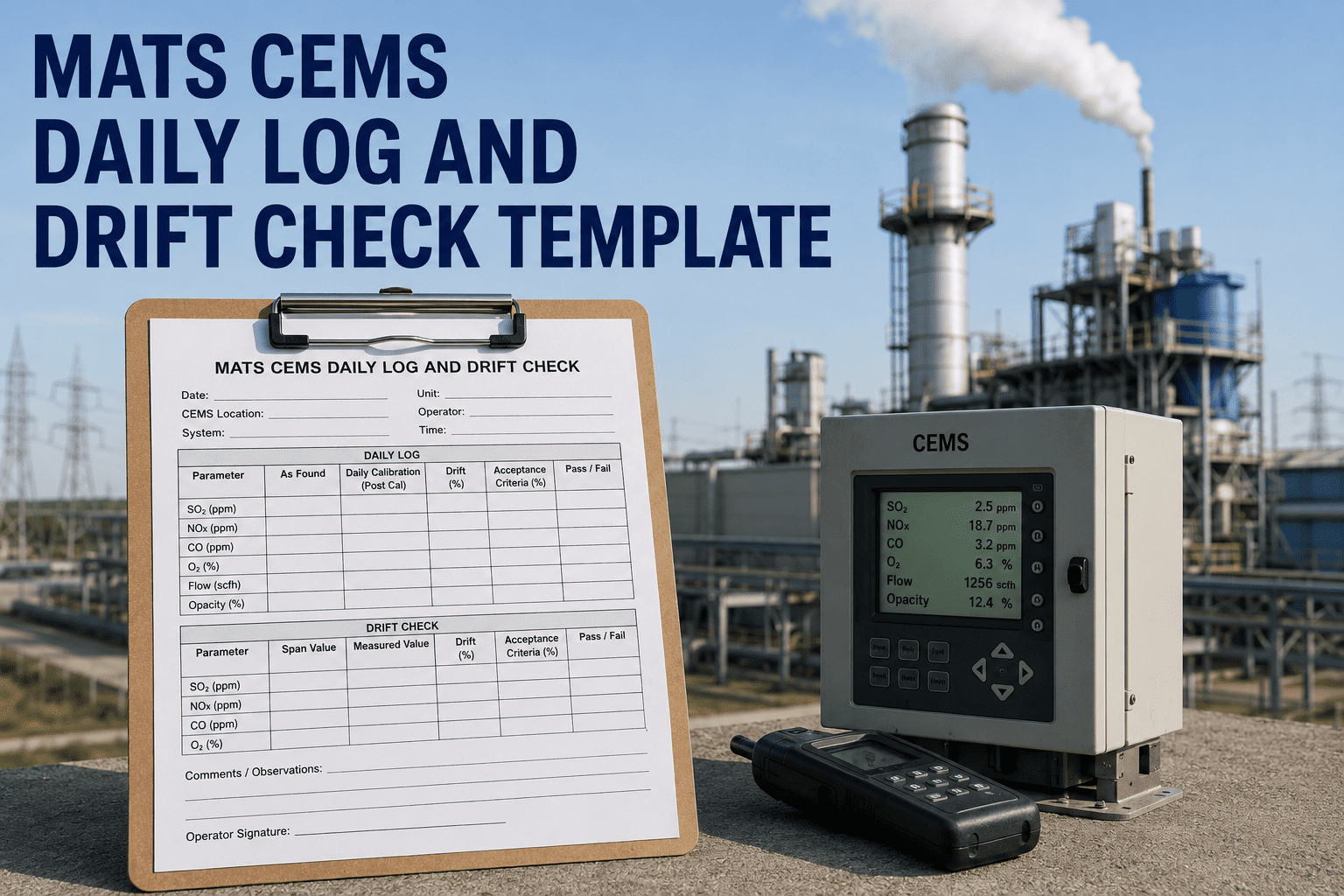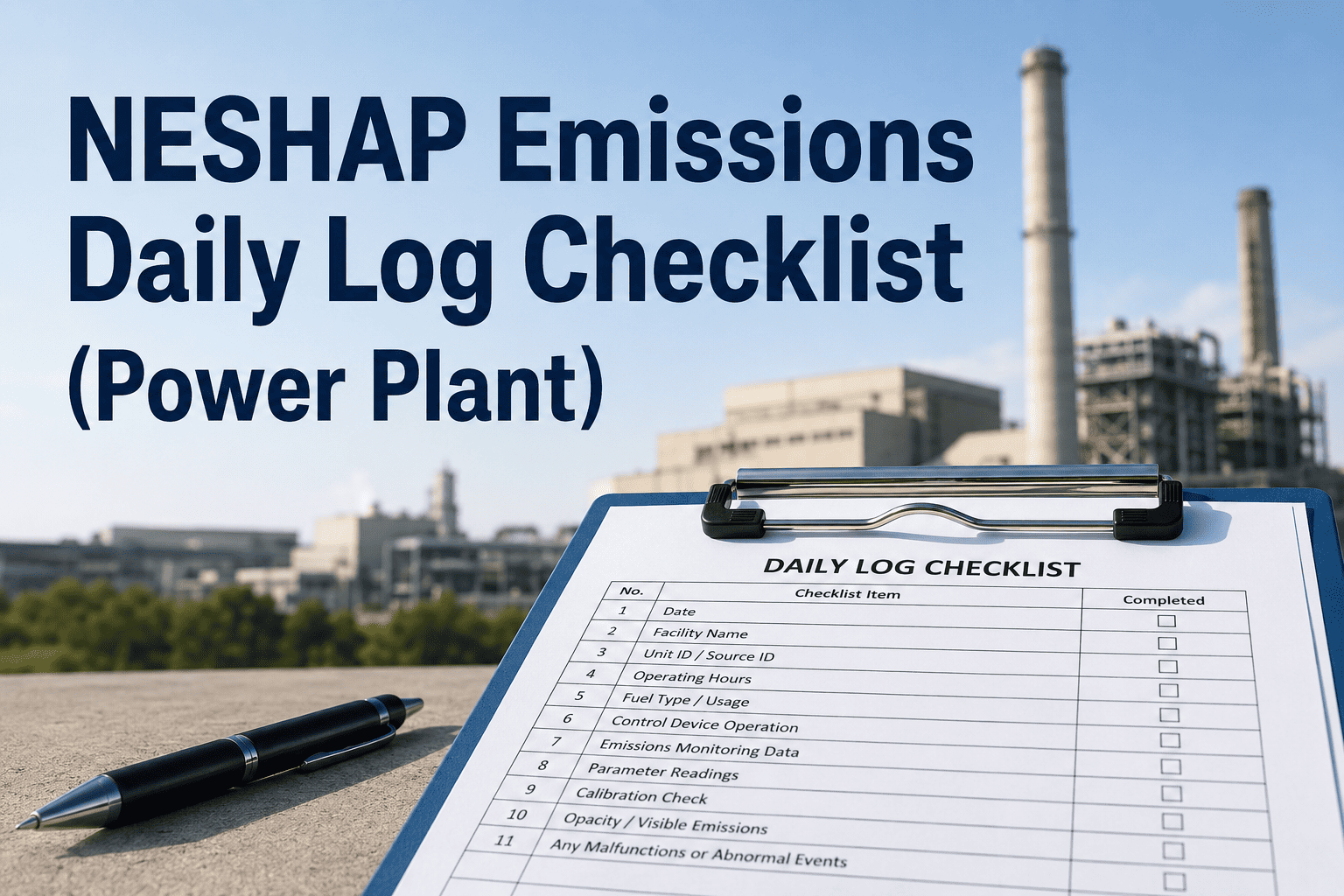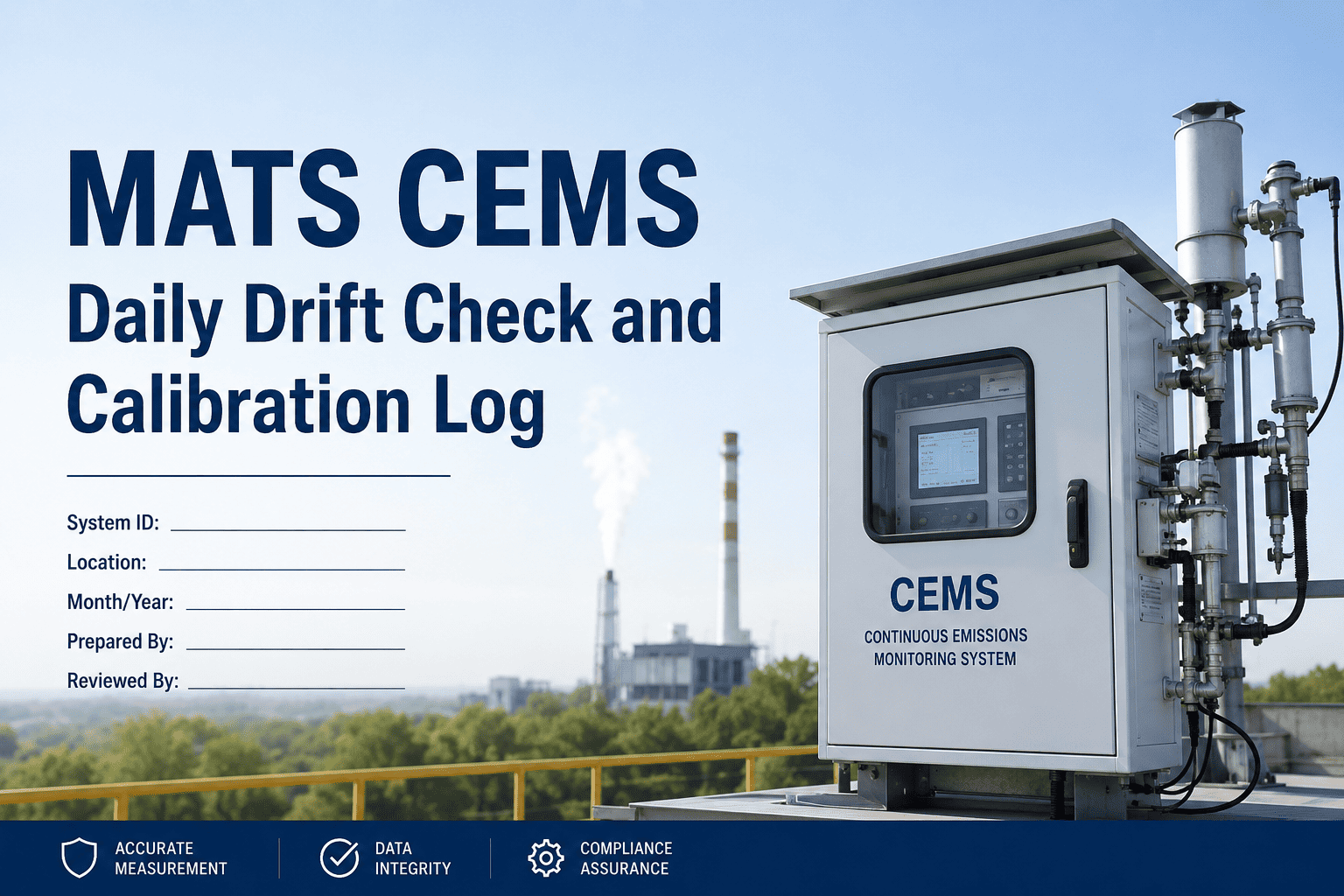
Mercury and Air Toxics Standards (MATS) continuous emissions monitoring systems at coal-fired power plants require daily drift verification procedures to demonstrate measurement accuracy and regulatory compliance under 40 CFR Part 75 and EPA MATS final rule provisions. Zero drift and span drift checks conducted each operating day validate that CEMS analyzers for mercury (Hg), hydrogen chloride (HCl), sulfur dioxide (SO2), and other regulated pollutants maintain calibration within allowable tolerances before emissions data is reported to EPA. A drift check failure exceeding Quality Assurance Quality Control (QA/QC) thresholds triggers immediate corrective action, analyzer recalibration, and potential data invalidation for the affected operating period. This MATS CEMS daily drift check and calibration log covers zero drift procedures, span gas verification, drift tolerance limits, corrective action protocols, and CMMS-linked documentation strategies that coal plant environmental compliance teams use to maintain continuous MATS emissions data quality. Sign Up Free to digitize your MATS CEMS drift check program and automate daily QA/QC documentation across every analyzer in your emissions monitoring system with Oxmaint.
One Failed Drift Check Without Documented Corrective Action Can Invalidate an Entire Day of Emissions Data
Oxmaint centralizes MATS CEMS daily drift logs, tracks zero and span drift trends by analyzer, triggers automatic alerts when drift approaches QA/QC limits, and links corrective actions to specific drift exceedances for complete EPA audit trails.
MATS CEMS Drift Check Requirements and Regulatory Framework
The EPA Mercury and Air Toxics Standards established stringent continuous emissions monitoring requirements for coal-fired electric generating units to track mercury, acid gases, and toxic metal emissions. Under 40 CFR Part 75 Appendix A and Appendix B specifications, CEMS analyzers must undergo daily drift assessments to verify that measurement accuracy has not degraded since the last calibration event. Zero drift checks introduce calibration gas at zero concentration to confirm the analyzer baseline has not shifted, while span drift checks use reference gas at a known high concentration to verify full-scale measurement accuracy. Both checks must be completed within 24 hours of the previous drift verification during unit operation, with results documented in permanent QA/QC records retained for EPA inspection.
MATS CEMS drift tolerances are specified as a percentage of span value for the monitored pollutant, with typical allowable limits of ±2.5% for zero drift and ±5.0% for span drift measured against the reference gas certified concentration. When drift exceeds these thresholds, the analyzer is considered out of calibration and all emissions data collected since the last successful drift check becomes suspect. Plant environmental staff must perform immediate corrective action including recalibration or analyzer maintenance, then conduct a passing drift check before emissions data can be considered valid for EPA reporting purposes. Book a Demo to see how Oxmaint tracks drift trends over time and provides early warning when analyzers approach drift tolerance limits before QA/QC failures occur.
Daily Drift Check Procedure and Documentation Protocol
Coal plant CEMS operators conduct daily drift checks during scheduled plant rounds, typically at the beginning of each operating shift to establish data quality for the upcoming 24-hour period. The procedure involves introducing certified calibration gas through the analyzer sample path, allowing the system to stabilize for the specified purge time, then recording the analyzer response compared to the certified gas concentration. Zero drift is calculated as the difference between the analyzer reading during zero gas introduction and the true zero value, expressed as a percentage of the analyzer span. Span drift is calculated as the difference between the analyzer reading during high-level calibration gas introduction and the certified gas concentration, also expressed as a percentage of span. Both values must fall within the QA/QC acceptance criteria specified in the plant Quality Assurance Project Plan.
MATS Analyzer Drift Tolerance Specifications
| Monitored Parameter | Span Value Range | Zero Drift Limit | Span Drift Limit | Check Frequency |
|---|---|---|---|---|
| Mercury (Hg) Total | 0-20 μg/m³ | ±2.5% of span | ±5.0% of span | Daily (24-hour) |
| Hydrogen Chloride (HCl) | 0-50 ppm | ±2.5% of span | ±5.0% of span | Daily (24-hour) |
| Hydrogen Fluoride (HF) | 0-20 ppm | ±2.5% of span | ±5.0% of span | Daily (24-hour) |
| Sulfur Dioxide (SO2) | 0-500 ppm | ±2.0% of span | ±5.0% of span | Daily (24-hour) |
| Nitrogen Oxides (NOx) | 0-400 ppm | ±2.0% of span | ±5.0% of span | Daily (24-hour) |
| Carbon Dioxide (CO2) | 0-20% volume | ±0.5% absolute | ±5.0% of span | Daily (24-hour) |
| Oxygen (O2) | 0-25% volume | ±0.5% absolute | ±5.0% of span | Daily (24-hour) |
Corrective Action Protocol for Failed Drift Checks
When a daily drift check exceeds QA/QC tolerance limits, MATS regulations require immediate corrective action before the analyzer can return to service for emissions data reporting. The first corrective step is typically an analyzer recalibration using the full calibration protocol specified in the manufacturer's quality control manual, which includes introducing multiple concentration levels of calibration gas and adjusting analyzer response to match certified values. If recalibration successfully brings the analyzer back within drift tolerances on a subsequent drift check, normal operation can resume with data validation restored. However, if recalibration fails to correct excessive drift, more extensive troubleshooting is required including sample system leak checks, analyzer component inspection, detector cleaning, and potential analyzer replacement if hardware degradation is identified.
All corrective actions taken in response to failed drift checks must be documented in the plant MATS compliance records with sufficient detail to demonstrate that the analyzer was restored to acceptable performance before emissions data was relied upon for regulatory reporting. This documentation typically includes the failed drift check results, specific corrective actions performed with date and time stamps, post-corrective-action drift check results confirming acceptable performance, and identification of personnel who performed the work. Plants should also track drift failure root causes in their environmental management systems to identify chronic analyzer issues that require more fundamental solutions such as analyzer upgrades, sample conditioning improvements, or changes to preventive maintenance frequency. Sign Up Free to implement automated drift failure workflows in Oxmaint that create corrective action work orders, track troubleshooting steps, and close the loop with verification drift checks all linked to the original QA/QC exceedance.
From Zero Drift to Span Verification — Oxmaint Closes Every QA/QC Loop in Your Emissions Monitoring Program
Oxmaint digitizes daily drift checks on mobile devices, automatically calculates drift percentages against span values, flags exceedances in real-time, and generates complete EPA audit trails linking every failed drift check to documented corrective actions and passing retest results.
CMMS Integration for CEMS Drift Check Documentation
Modern coal plants integrate MATS CEMS drift check procedures into their computerized maintenance management systems to centralize QA/QC documentation, automate drift calculation formulas, and link corrective actions to specific analyzer performance issues. CMMS-based drift check programs eliminate manual logbook transcription errors, provide real-time visibility into analyzer health trends across multiple monitoring locations, and generate automated compliance reports formatted for EPA electronic reporting requirements. Integration with plant distributed control systems can automatically pull analyzer readings during drift checks and populate CMMS records with timestamps and values, reducing manual data entry burden on CEMS operators while improving data accuracy and audit trail completeness.
The most common cause of MATS CEMS drift check failures in coal plants is inadequate calibration gas management. Expired gas cylinders, incorrect gas concentrations for analyzer span settings, and contaminated gas delivery systems account for approximately 60% of failed drift checks that result in data invalidation. Plants that maintain rigorous calibration gas inventory control, verify gas certification dates monthly, and implement preventive maintenance on gas delivery regulators and tubing experience drift check pass rates above 98%. I recommend treating calibration gases as critical spare parts with minimum on-hand quantities and reorder triggers based on cylinder pressure monitoring. The cost of maintaining fresh calibration gas inventory is trivial compared to the compliance risk of invalid emissions data during EPA reporting periods.
During EPA MATS compliance audits, we consistently found that plants with electronic drift check documentation systems had significantly fewer recordkeeping violations than plants using paper logbooks. The primary advantage of digital systems is automated calculation of drift percentages, which eliminates the most common source of QA/QC documentation errors. Paper-based systems also suffer from illegible handwriting, missing entries during shift coverage gaps, and lost logbooks during document retention periods. I strongly recommend that all coal plants transition to CMMS-integrated drift check procedures with automated drift calculations, electronic signatures, and permanent digital storage. The investment in digital systems pays for itself many times over through reduced compliance risk and improved audit performance during EPA inspections or enforcement actions.
Calibration Gas Management and Quality Control
Maintaining proper calibration gas inventory and quality is essential for successful MATS CEMS drift check programs. Calibration gases must be certified by an EPA Protocol 1 certified gas manufacturer with traceability to National Institute of Standards and Technology (NIST) reference standards. Gas certifications specify the exact concentration of each component in the gas mixture with stated uncertainty values, and these certifications expire after manufacturer-specified time periods typically ranging from 12 to 24 months. Plants must track calibration gas certification expiration dates and reorder replacement cylinders before current stocks expire to prevent drift check delays or the use of invalid calibration references.
Frequently Asked Questions — MATS CEMS Drift Checks
Every Drift Check. Every Analyzer. Every Shift — Documented, Verified, and EPA-Ready
Oxmaint delivers the MATS CEMS quality assurance platform coal plants need to maintain continuous data validity, eliminate manual documentation errors, and demonstrate exemplary compliance performance during EPA audits and enforcement reviews.