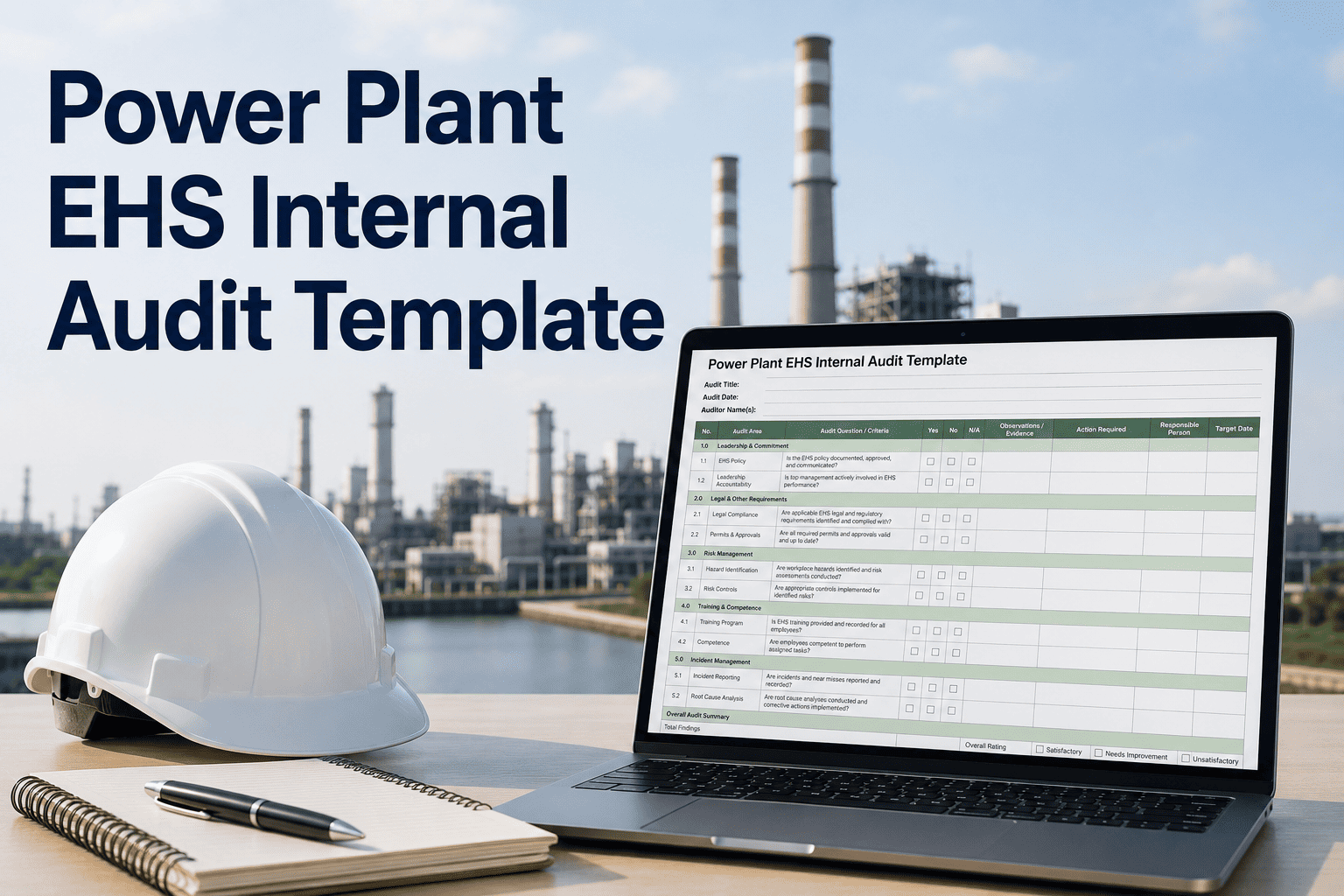
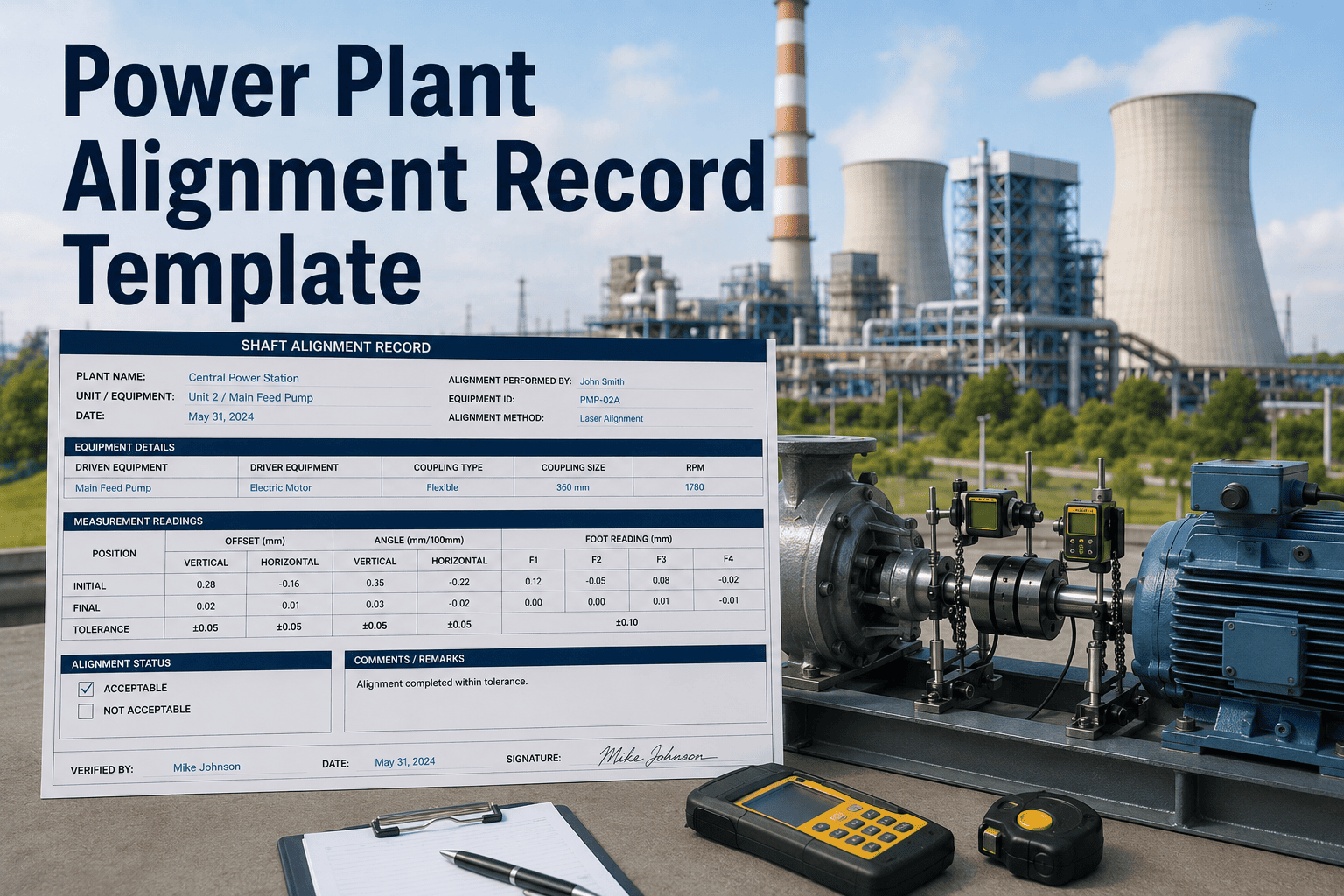
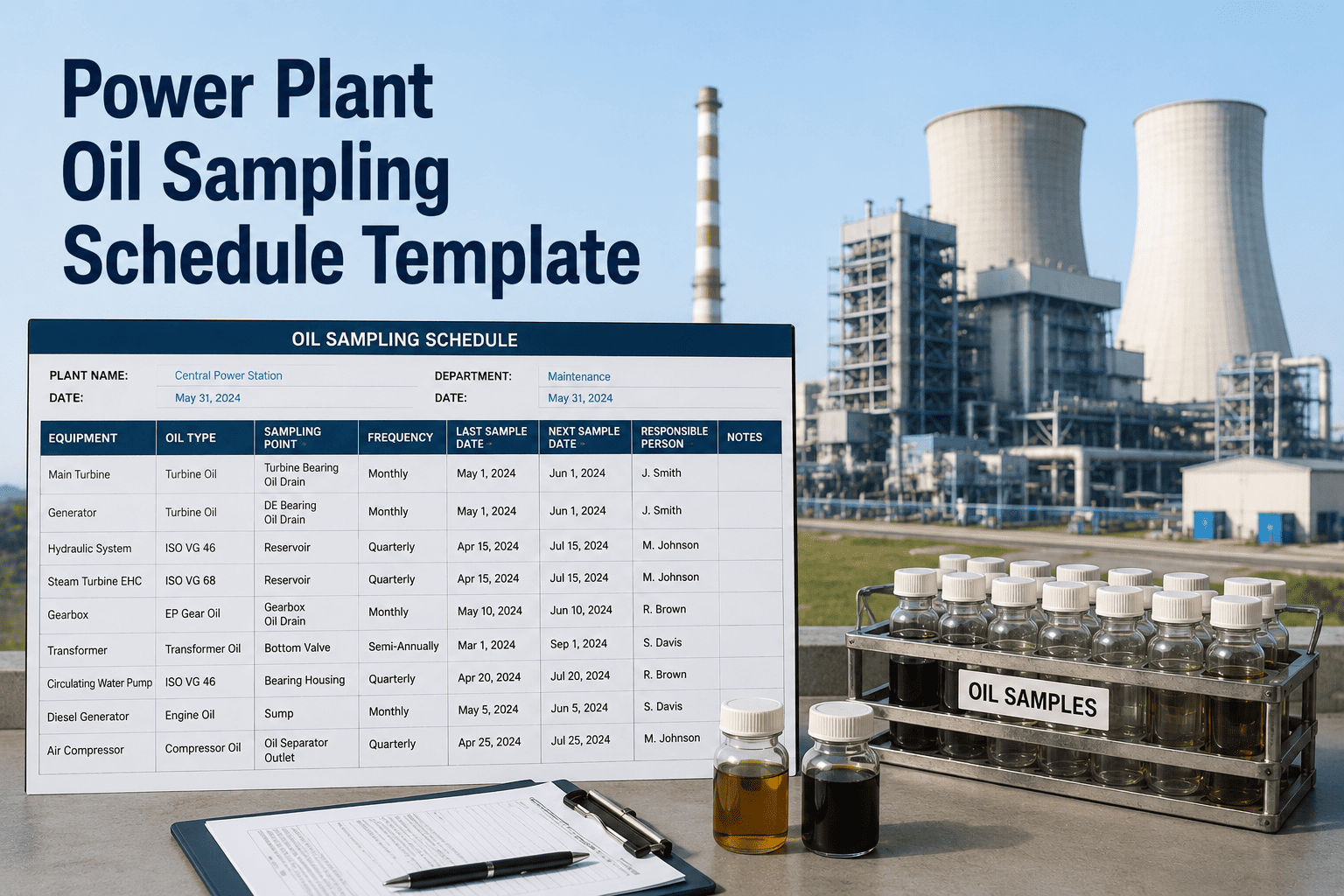
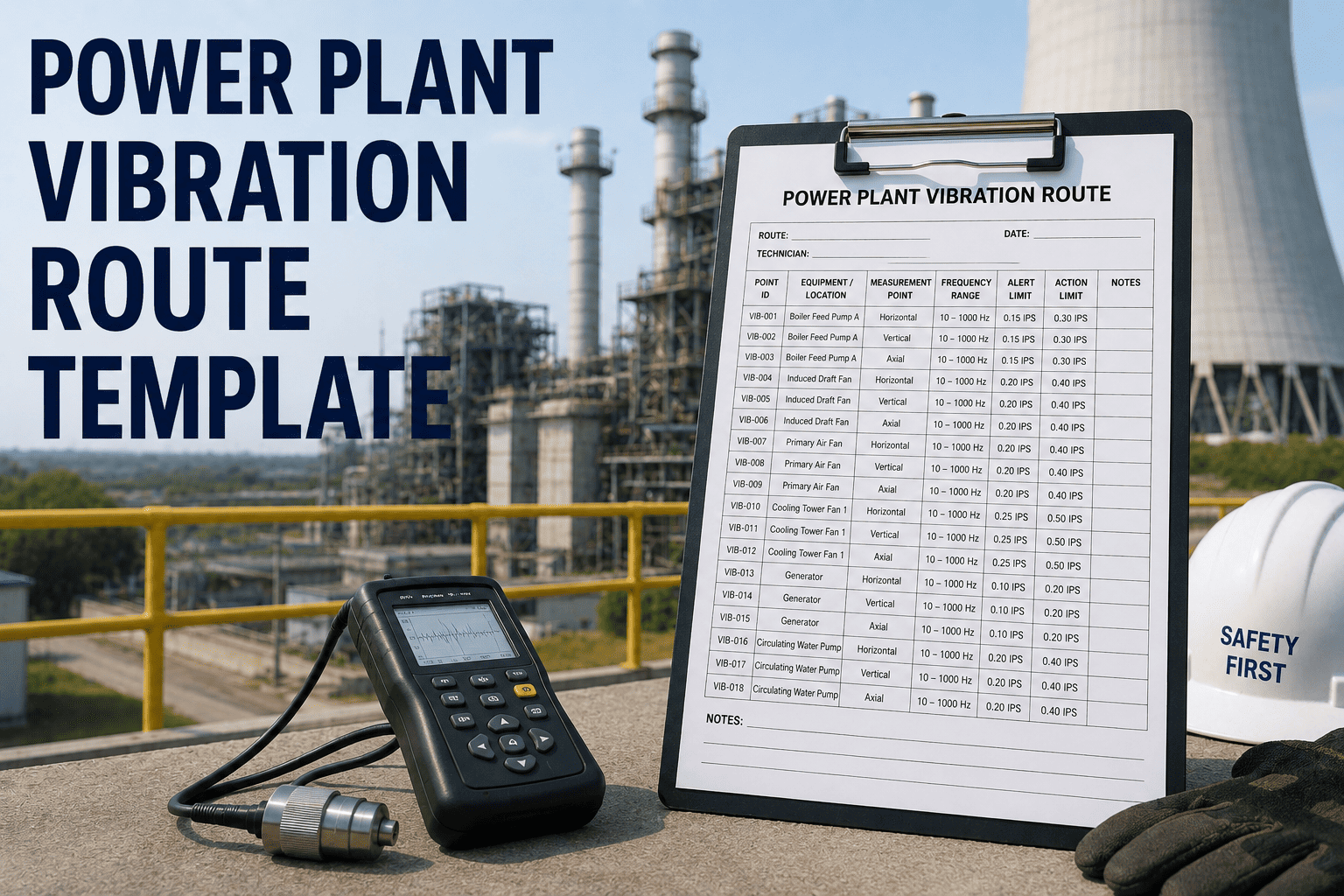
An EHS internal audit at a power plant is not a checklist walk-through — it is a structured, evidence-based review of whether your environmental controls, safety procedures, and management systems actually protect workers and meet regulatory requirements. OSHA 29 CFR 1910.269 governs electrical safety for power generation facilities and mandates documented periodic inspections of LOTO procedures, confined space entry controls, and arc flash protections. EPA 40 CFR requirements cover Clean Air Act permits, SPCC plans, RCRA waste handling, and NPDES stormwater compliance — all with audit evidence requirements that differ from occupational safety documentation. ISO 14001 Clause 9.2 and ISO 45001 Clause 9.2 both require planned, risk-based internal audits with documented findings and closed corrective actions before surveillance visits from registrars. This template gives your EHS team the audit structure, regulatory crosswalk, finding severity classification, and corrective action routing that a power plant internal audit actually requires — including how CMMS-routed corrective actions from OxMaint turn audit findings into closed work orders. For a live walkthrough of how OxMaint manages EHS corrective actions from audit finding to verified closure, book a demo or start a free trial today.
EHS Audit Template · Power Generation · OSHA · EPA · ISO 14001 · ISO 45001
Power Plant EHS Internal Audit Template
OSHA 1910.269, EPA Clean Air Act, ISO 14001/45001 Clause 9.2 — one integrated audit template with finding severity grading and CMMS-routed corrective actions.
OSHA
EPA
ISO 14001
ISO 45001
NFPA 70E
$156K
Maximum OSHA penalty per willful violation — 2026 adjusted rate under 28 USC § 2461
120 days
Lead time required to complete ISO 14001/45001 internal audit before a registrar surveillance visit
9.2
ISO clause number — both ISO 14001 and ISO 45001 require planned, documented internal audits at this clause
40 CFR
EPA regulatory title governing Clean Air Act, SPCC, RCRA, and NPDES — all require documented audit evidence
The Four Regulatory Pillars — What Your Audit Must Cover
A power plant EHS internal audit spans four distinct regulatory frameworks. Each framework has its own audit criteria, evidence requirements, and finding documentation standards. Your audit template must address all four — separately and explicitly — or your internal audit will not satisfy the ISO 9.2 clause requirements and will leave regulatory gaps that external auditors will find.
OSHA
29 CFR 1910.269
Electric Power Generation, Transmission & Distribution
Key Audit Areas
LOTO procedures — documented, current, employee-tested
Confined space permits (1910.146) — particularly boiler drum entry
Arc flash analysis — PPE requirements current per NFPA 70E
Minimum Approach Distance (MAD) documentation
Fall protection at turbine deck and boiler structures
Hot work permit program — boilers, turbine halls
Respiratory protection (1910.134) — boiler confined entries
Evidence: written procedures, completed permits, training records, periodic inspection logs
EPA
40 CFR Compliance
Clean Air Act, SPCC, RCRA, NPDES
Key Audit Areas
Clean Air Act Title V permit — emissions monitoring current (CEMS)
SPCC Plan — current, certified, secondary containment inspected
RCRA hazardous waste — labeling, storage limits, disposal records
NPDES stormwater permit — SWPPP inspections, discharge monitoring
EPCRA Tier II reporting — chemical inventory current
Ash pond management — CCR Rule (40 CFR 257) groundwater monitoring
Evidence: permit files, CEMS data logs, SPCC inspection records, waste manifests, discharge monitoring reports
ISO 14001
Clause 9.2 Internal Audit
Environmental Management System
Key Audit Clauses
6.1 — Environmental aspects and impacts register current
6.2 — Environmental objectives with measurable targets
8.1 — Operational controls for significant aspects
9.1 — Monitoring and measurement records
10.2 — Nonconformities and corrective actions documented
9.3 — Management review conducted and recorded
Evidence: aspect register, objective tracking records, monitoring data, corrective action log, management review minutes
ISO 45001
Clause 9.2 Internal Audit
Occupational Health & Safety Management System
Key Audit Clauses
6.1 — Hazard identification and risk assessment current
7.2 — Competence records — training by task and hazard type
8.1 — OH&S operational controls verified in field
8.2 — Emergency preparedness — drills conducted and recorded
9.1 — Incident investigation records — root cause documented
10.3 — Continual improvement opportunities identified
Evidence: risk register, training matrix, emergency drill records, incident logs, CAPA documentation
OxMaint Routes Audit Findings to Corrective Work Orders — Automatically
Every audit finding that requires a physical corrective action — a LOTO procedure update, a secondary containment repair, a PPE deficiency — becomes a tracked work order in OxMaint. Finding status, assigned technician, due date, and closure evidence in one place.
Finding Severity Classification System
Every EHS audit finding must be classified by severity before corrective action routing. ISO 14001 and ISO 45001 distinguish between major nonconformities, minor nonconformities, and observations — and each requires different response timelines and documentation. OSHA willful, serious, and other-than-serious violations follow a parallel classification with different penalty exposures. Your audit template must apply both systems simultaneously.
ISO: Major Nonconformity
OSHA: Willful or Repeat
Systemic failure of a required control. Immediate worker or environmental harm potential. Certification at risk.
Examples at Power Plants
Active LOTO not applied on energized equipment
Confined space entry without atmospheric testing
No valid Title V permit for stack emissions
SPCC Plan not updated after facility change
Response: Immediate corrective action. Work order P1 within 24 hours. ISO: may require unplanned audit before surveillance.
ISO: Minor Nonconformity
OSHA: Serious Violation
Requirement not fully met. No immediate harm, but regulatory exposure or system gap exists.
Examples at Power Plants
LOTO procedure exists but not reviewed in 12 months
Arc flash labels missing on 3 of 18 panels
CEMS calibration 2 weeks overdue per permit schedule
Waste storage area missing secondary containment label
Response: Corrective action plan within 7 days. Work order P2 within 30 days. ISO: must close before surveillance visit.
ISO: Observation
OSHA: Other-Than-Serious
No nonconformity, but improvement opportunity identified. Good practice gap or documentation weakness.
Examples at Power Plants
Training records in paper format — digital recommended
Incident investigation closed but root cause generic
Environmental objectives tracked in spreadsheet, not system
Hot work permit program lacks pre-task risk score field
Response: Log for management review. Optional work order P3. Address within next audit cycle or 90 days.
Audit Section Structure — 10 Areas Your Template Must Cover
A complete power plant EHS internal audit covers ten distinct audit sections. Each section is linked to one or more regulatory requirements and generates findings that route to specific corrective action types. The table below maps every section to its regulatory reference, evidence requirement, and corrective action pathway.
| Audit Section |
Regulatory Reference |
Key Evidence Required |
CA Route in OxMaint |
| 01 — LOTO & Energy Control |
OSHA 1910.269(d), 1910.147 |
Written procedures per equipment, annual inspection records, employee review documentation |
PM work order — procedure review cycle |
| 02 — Confined Space Entry |
OSHA 1910.146, 1910.269(e) |
Permit log, atmospheric test records, attendant training, boiler drum entry procedures |
Corrective work order — permit program update |
| 03 — Arc Flash & Electrical Safety |
OSHA 1910.269, NFPA 70E |
Arc flash study currency (≤5 years), panel labeling inspection, PPE availability records |
PM work order — arc flash label inspection |
| 04 — Air Emissions Compliance |
EPA 40 CFR 60/63, Clean Air Act Title V |
CEMS calibration logs, permit deviation reports, stack test records |
Corrective work order — CEMS maintenance ticket |
| 05 — Spill Prevention (SPCC) |
EPA 40 CFR 112 |
SPCC Plan (current, PE-certified), secondary containment inspection records, spill response equipment |
PM work order — secondary containment inspection |
| 06 — Hazardous Waste (RCRA) |
EPA 40 CFR 262/265 |
Waste manifests, satellite accumulation inspection, disposal vendor certifications |
Corrective work order — waste area deficiency |
| 07 — Stormwater (NPDES) |
EPA 40 CFR 122, SWPPP |
SWPPP document, quarterly inspection records, discharge monitoring reports |
PM work order — quarterly SWPPP inspection |
| 08 — ISO 14001 System Audit |
ISO 14001:2015 Clause 9.2 |
Aspect register, environmental objectives tracking, Clause 10.2 CAPA log |
Corrective work order — management system gap |
| 09 — ISO 45001 System Audit |
ISO 45001:2018 Clause 9.2 |
Hazard register, training matrix, emergency drill records, incident investigation log |
Corrective work order — OH&S system gap |
| 10 — Management Review Readiness |
ISO 14001/45001 Clause 9.3 |
Prior management review minutes, KPI trend data, open CAPA status report |
Corrective work order — open item from management review |
The Audit-to-Closure Workflow — How Findings Become Fixed
Most EHS audits produce findings that live in a spreadsheet and slowly age out without resolution. The gap between a documented finding and a verified corrective action is where regulatory exposure grows. OxMaint closes that gap by turning every audit finding that requires a physical action into a tracked, assigned, and verified work order.
1
Audit Finding Recorded
Finding documented with section reference, regulatory citation, severity classification, and photographic evidence. Assigned a unique finding ID linked to the asset or location.
→
2
Severity Classified
Critical / Major NC / Observation. Determines response timeline — 24 hours, 7 days, or next audit cycle. ISO clause nonconformity classification applied simultaneously.
→
3
Work Order Created in OxMaint
Physical corrective actions — equipment repair, procedure update, label replacement — become P1/P2/P3 work orders assigned to the correct technician or EHS lead with due date from classification.
→
4
Corrective Action Executed
Technician completes work on mobile app. Photo evidence, completion notes, and parts used captured against the work order. Work order linked back to the source audit finding ID.
→
5
Finding Verified Closed
EHS lead verifies closure evidence in OxMaint. Finding status updates from Open to Verified Closed with timestamp and verifier ID — the audit trail ISO 14001/45001 Clause 10.2 requires.
Frequently Asked Questions
How often must a power plant conduct EHS internal audits under ISO 14001 and ISO 45001?
ISO 14001 and ISO 45001 Clause 9.2 both require internal audits at planned intervals — the standard does not mandate annual frequency, but most power plants conduct full audits annually with targeted section audits quarterly. The audit program must be risk-based: higher-risk areas such as confined space, LOTO, and emissions compliance warrant more frequent review. All internal audit results must be available to the registrar at surveillance visits.
OxMaint tracks audit schedules and finding status to keep you surveillance-ready.
What is the difference between an ISO major nonconformity and an OSHA serious violation?
An ISO major nonconformity means a systematic failure of a required management system element — your certification is at risk and an unplanned follow-up audit may be required. An OSHA serious violation means a workplace condition where substantial probability of death or serious physical harm exists — the 2026 penalty ceiling is $16,550 per violation, with willful violations reaching $156,259. Both can arise from the same finding (e.g., no functional LOTO program) but are assessed independently and documented separately in your audit report.
Book a demo to see how OxMaint handles both classification tracks.
Does OSHA 1910.269 require documented internal audits for power plants?
Yes — 1910.269(d) requires periodic inspections of energy control (LOTO) procedures at least annually, including a review with each authorized employee. Confined space procedures under 1910.146 require documented entry permits that function as inspection records. These are not optional internal audits — they are regulatory requirements with specific documentation evidence standards. Failure to maintain these records is itself an OSHA violation, separate from any underlying safety deficiency.
Can OxMaint track EHS corrective actions from audit findings to verified closure?
Yes — OxMaint links audit findings to corrective work orders, assigns them to specific technicians or EHS leads, tracks completion evidence including photos and notes, and records verifier ID and timestamp at closure. The complete finding-to-closure chain is exportable for ISO registrar review or OSHA inspection response. See this workflow live by
booking a demo with your plant's finding types configured in the demonstration.
What EPA regulations require documented compliance audits at thermal power plants?
The Clean Air Act Title V permit requires documented deviation reporting and continuous compliance monitoring. EPA 40 CFR 112 (SPCC) requires periodic inspections of secondary containment and oil-handling equipment with written records. RCRA 40 CFR 265 requires weekly satellite accumulation inspections. NPDES permits typically require quarterly SWPPP inspections with signed inspection reports. Each of these generates audit-quality compliance records that belong in your EHS audit evidence package.
Start free to see how OxMaint schedules these recurring compliance inspections automatically.
From Audit Finding to Verified Closure — Without the Spreadsheet.
OxMaint routes every EHS audit corrective action to an assigned, tracked work order — OSHA finding, ISO nonconformity, or EPA compliance gap. Your next registrar visit or agency inspection finds closed findings with full evidence trails, not open items aging in a spreadsheet.