Generator stator winding insulation is one of the most valuable and most vulnerable assets in any power plant — a full rewind can cost $480,000 or more, and insulation failure is the cause of roughly 40% of all generator forced outages. The insulation doesn't fail suddenly. It degrades gradually through heat cycles, partial discharge activity, vibration fatigue, and contamination — all of which produce measurable temperature signatures weeks or months before the winding fails. IEC 60034 and IEEE C50 series standards explicitly mandate continuous winding temperature monitoring for generator protection, yet most plant maintenance teams lack a workflow that turns RTD and thermocouple data into actionable maintenance decisions. OxMaint closes that gap with a temperature monitoring workflow that tracks stator slot RTD trends, auto-generates work orders when deviations emerge, and builds the inspection history that justifies condition-based overhaul scheduling. Connect your generator temperature monitoring to OxMaint free and build the maintenance record your next outage planning depends on.
Generator Stator Winding Temperature Monitoring: The Maintenance Workflow That Prevents a $480,000 Rewind
Stator insulation failure costs more than any other generator repair — and it is one of the most preventable. A structured RTD monitoring and escalation workflow in OxMaint gives maintenance teams months of advance warning before insulation degradation becomes a forced outage.
What Stator Slot RTDs Are Actually Telling You — and What Happens When No One Is Listening
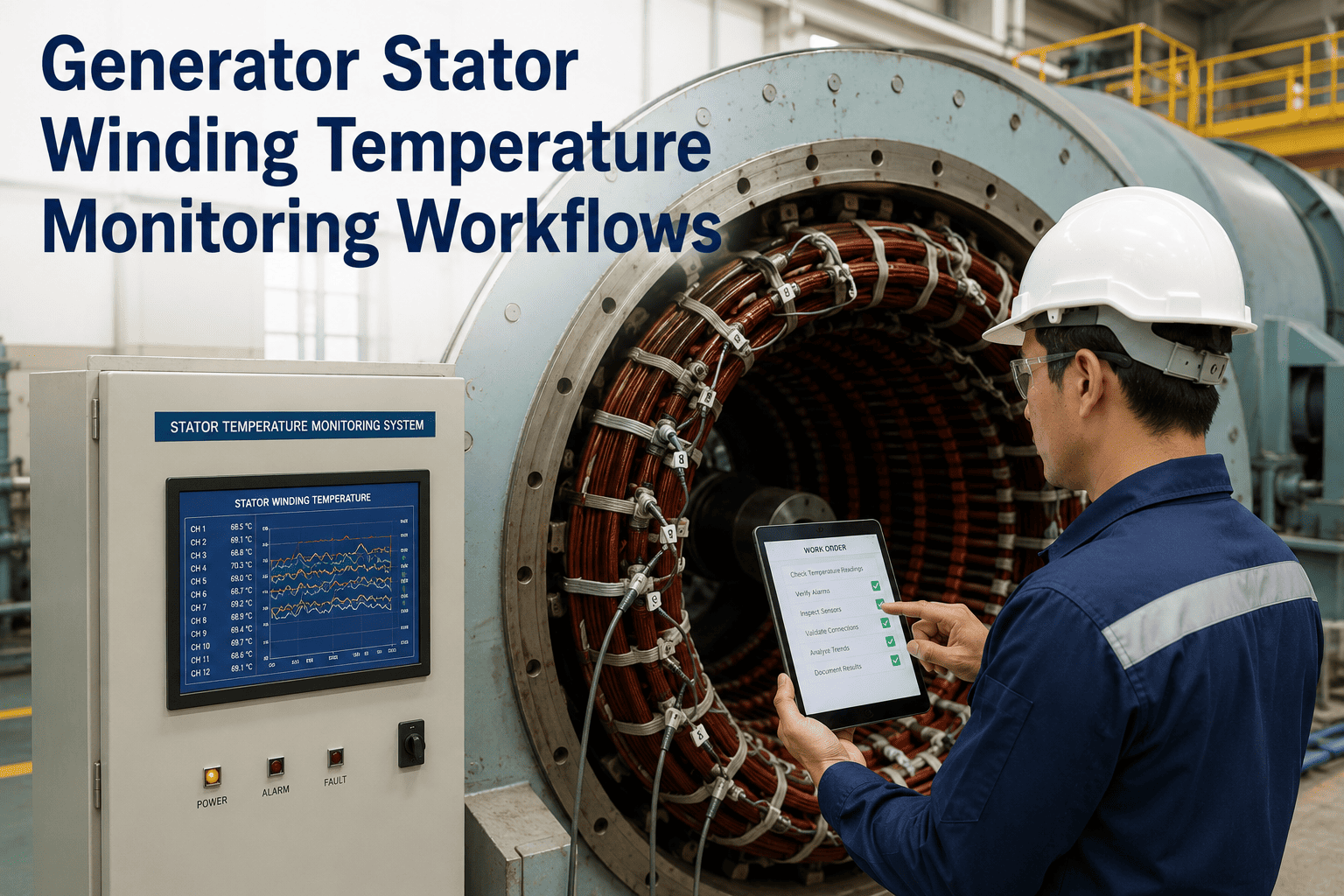
Stator slot RTDs — typically platinum Pt100 or Pt1000 elements — are embedded directly inside generator stator slots to measure the temperature of winding insulation at its hottest point. When insulation begins to degrade through partial discharge erosion, moisture ingress, or overloading, it loses thermal conductivity. The result is a localized temperature rise that shows up in one or several RTD channels days, weeks, or months before an insulation breakdown event.
How RTD Data Becomes a Maintenance Decision in OxMaint
Continuous temperature data is only valuable when it drives action. OxMaint structures the stator temperature monitoring workflow across six stages — from sensor data capture to maintenance record that justifies your next overhaul scope.
Generator Insulation Thermal Classes and What They Mean for Your Monitoring Thresholds
IEC 60034 defines insulation thermal classes that set the maximum operating temperature for generator winding insulation. Operating above class limit accelerates insulation aging exponentially — the Arrhenius rule of thumb holds that insulation life halves for every 10°C of sustained excess. OxMaint threshold configuration should be informed by the installed insulation class.
| Insulation Class | Max Winding Temp | Typical Generator Application | OxMaint Alert Threshold |
|---|---|---|---|
| Class B | 130°C | Older utility generators, some industrial units | Advisory at 120°C, Action at 128°C |
| Class F | 155°C | Most modern power plant generators | Advisory at 145°C, Action at 152°C |
| Class H | 180°C | High-output gas turbine generators, some hydro units | Advisory at 168°C, Action at 177°C |
| Class C | 220°C+ | Specialist high-temperature industrial generators | Per OEM specification — custom threshold |
Connect your generator RTD channels to OxMaint and build your first temperature trend baseline
Our team will configure your stator slot RTD channels, set insulation-class-appropriate thresholds, and show you your first trending dashboard — in a 30-minute demo on your own generator data.
Stator Winding Temperature Monitoring Questions
Your stator winding is already telling you what it needs. Build the workflow to listen.
OxMaint turns RTD trend data into structured maintenance decisions — from first hot spot detection to outage scope justification — so insulation degradation becomes a managed condition, not an emergency rewind.