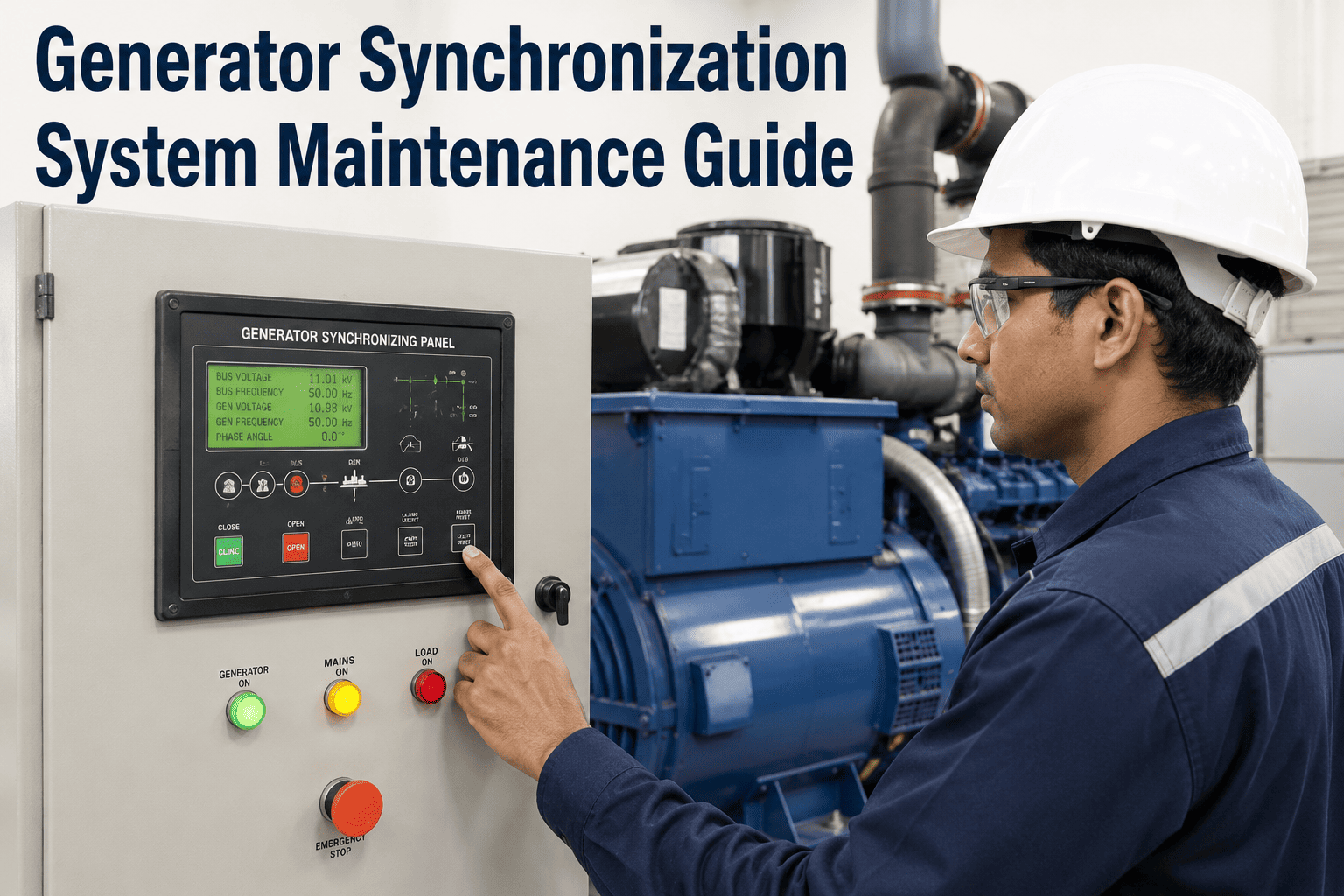
Synchronizing a generator to the grid is a precise dance of matching voltage, frequency, and phase angle within a narrow window before the breaker closes — get it wrong and the result ranges from a nuisance trip to a violent electrical and mechanical shock capable of damaging the generator shaft itself. Synchronization equipment doesn't fail often, but when it does, the consequences scale quickly because the entire purpose of the system is to prevent exactly the kind of out-of-phase connection that causes catastrophic damage. Many plants treat synchronizing relays and auto-synchronizers as "set and forget" equipment, tested only when something else in the electrical system prompts a broader review. OxMaint's preventive maintenance platform for generator controls is built to keep this equipment on a disciplined testing cycle instead.
Generator Synchronization System Maintenance Guide
Synchronization equipment protects the generator from one of the most damaging events a rotating machine can experience — an out-of-phase grid connection. Here is how to keep it tested, calibrated, and trustworthy.
What Synchronization Equipment Actually Protects Against
A synchronization failure escalates in severity depending on how far out of tolerance the connection was at the moment the breaker closed. The ladder below shows why even a "minor" synchronizing relay fault deserves serious attention.
Core Components of the Synchronization System
Synchroscope / Sync Check Relay
Monitors voltage, frequency, and phase angle difference between the generator and the grid, permitting closure only within tolerance.
Automatic Synchronizer
Adjusts governor speed and excitation voltage automatically to bring the generator into tolerance before issuing the close command.
Voltage & Frequency Transducers
Provide the live measurement inputs the synchronizing relay depends on; calibration drift here compromises the entire system.
Breaker Close Circuit
The final permissive path that must only allow closure when the sync check relay confirms conditions are within tolerance.
An Untested Synchronizing Relay Is a Bet You Don't Know You're Making
OxMaint schedules and tracks synchronizing relay calibration and breaker permissive testing so this protection is verified on a fixed interval, not assumed to be working.
Diagnostic Checklist Before Every Synchronization Event
Operations and maintenance teams should be able to answer every item below with confidence before relying on the synchronizer for a grid connection.
Recommended Testing Schedule
| Task | Frequency | Evidence Captured |
|---|---|---|
| Sync check relay calibration test | Annual or per OEM interval | Calibration certificate, tolerance verification |
| Voltage/frequency transducer verification | Annual | Reference comparison reading, deviation log |
| Automatic synchronizer functional test | Each planned outage | Governor/excitation response record |
| Breaker close permissive test | Each planned outage | Pass/fail record with out-of-tolerance block confirmed |
| Manual synchronization procedure review | Annual | Procedure sign-off, operator familiarity confirmation |
KPIs for Synchronization System Reliability
Out-of-Phase Connection Events
Count of grid connections made outside acceptable phase angle tolerance in a rolling 12-month period.
Calibration Test Compliance
Percentage of scheduled sync relay and transducer calibration tests completed on time.
Breaker Permissive Test Pass Rate
Percentage of breaker close permissive tests confirming correct blocking behavior outside tolerance.
Manual Procedure Currency
Percentage of operators confirmed current on manual synchronization procedures as backup coverage.
Frequently Asked Questions
How often should a synchronizing relay actually be calibration-tested?
Most OEMs recommend annual calibration testing for synchronizing relays, though the specific interval should follow the manufacturer's guidance and any applicable grid interconnection requirements. Because this equipment is rarely exercised outside of an actual synchronization event, drift can go undetected for a long time without a scheduled test, which is why treating the interval as a fixed compliance item rather than a discretionary task matters. Book a demo to see how OxMaint schedules and tracks this testing.
What actually happens mechanically when a generator is synchronized out of phase?
When the breaker closes with a phase angle mismatch, the generator and the grid effectively fight to pull into alignment, producing a torque transient on the shaft and coupling proportional to the size of the mismatch. Small mismatches produce a noticeable but survivable shock, while large mismatches can produce forces sufficient to damage the shaft, coupling, or stator windings, and in severe cases cause immediate mechanical failure. This is precisely why the synchronizing relay's permissive function exists as a hard block rather than an advisory alarm.
Can an automatic synchronizer fail in a way that isn't obvious during normal operation?
Yes, an automatic synchronizer can develop calibration drift in its voltage or frequency measurement inputs while still appearing to function normally, since it may still bring the generator close to synchronization conditions even if its tolerance window has shifted from the original setpoint. This is why functional testing against an independent reference, not just observing that the synchronizer completes its sequence, is necessary to catch this type of degradation. Start free in OxMaint to schedule independent verification testing alongside routine functional checks.
Do operators still need manual synchronization skills if the plant has an automatic synchronizer?
Yes, manual synchronization procedures should be maintained as a backup capability in case the automatic synchronizer is out of service for maintenance or has failed, and operators should be periodically refreshed on this procedure rather than relying entirely on automation. A plant that has not exercised manual synchronization in years is at risk of an extended outage if the automatic system needs repair during a period when the unit must reconnect to the grid. Sign in to OxMaint to track manual procedure review and operator sign-off status.
What records should be kept for the breaker close permissive circuit?
Records should include the date and result of each permissive test, confirmation that the circuit correctly blocked closure when conditions were deliberately outside tolerance, and any wiring or relay changes made to the circuit since commissioning. This documentation matters both for internal reliability tracking and because grid interconnection agreements often require evidence that synchronizing protection is periodically verified and functioning as designed.
Synchronization Protection Only Works If It Is Tested. Prove It Is.
OxMaint keeps calibration records, functional test results, and breaker permissive verification for every synchronizing relay in one auditable system.