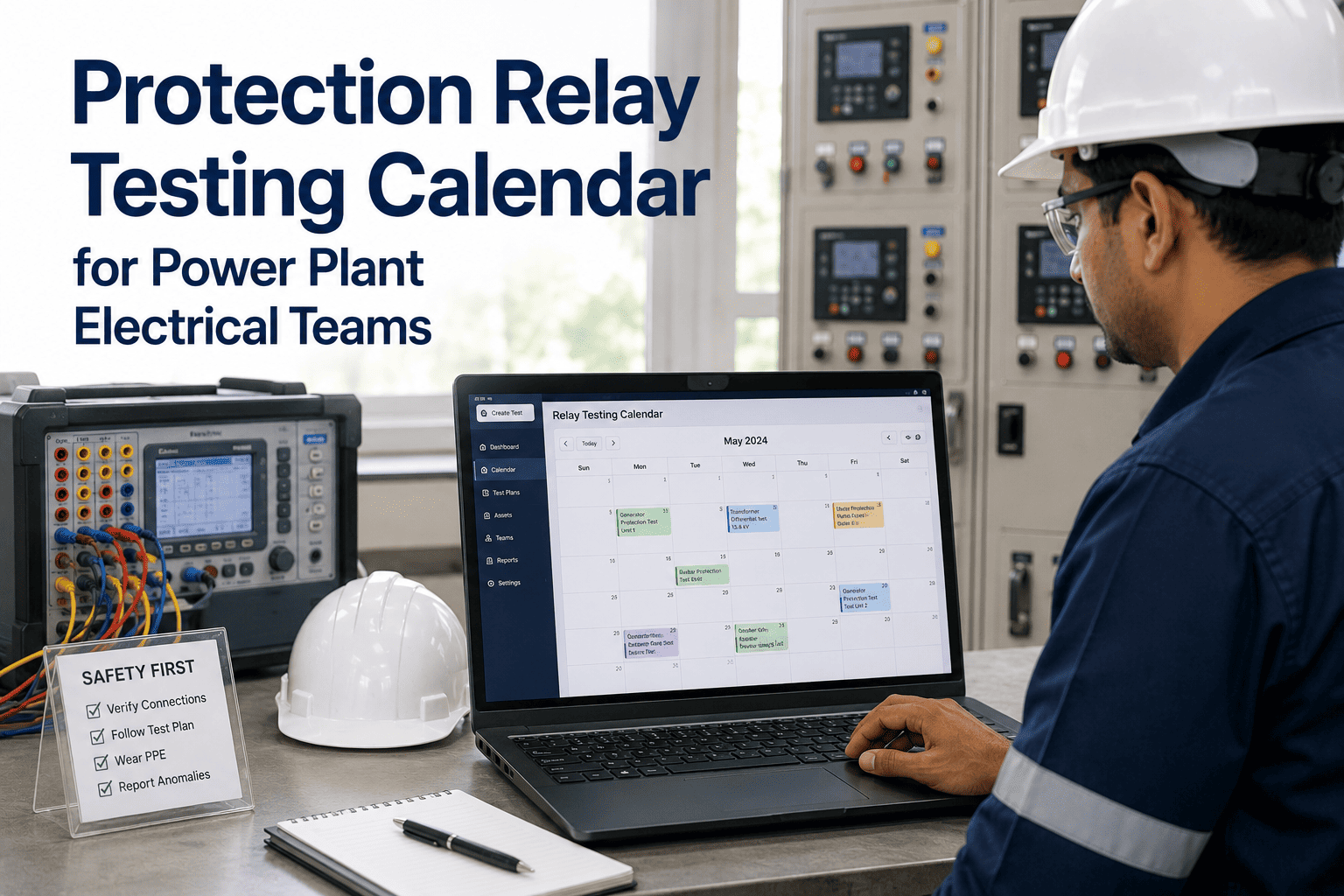
A 132kV feeder protection relay in a state grid substation failed to trip during a fault because its calibration had drifted 9% out of tolerance — undetected since the last manual test eighteen months earlier. The fault propagated upstream, tripping a transformer that should never have seen the disturbance, and triggered a regional load-shed event affecting 40,000 consumers for 95 minutes. The relay itself was healthy. The testing programme was not. Sign up for OxMaint to schedule, track, and document every relay test, calibration, and compliance record from one platform.
Smart Electrical Relay Maintenance and Testing Software
Schedule protection relay testing, track calibration drift, manage compliance documentation, and prevent the slow tolerance creep that turns a healthy relay into a grid liability — all from one CMMS built for utility protection teams.
Why Protection Relay Maintenance Cannot Run on a Fixed Calendar Alone
Most utilities test relays on a fixed interval — annually, or every two years — regardless of relay type, duty cycle, or environmental exposure. This approach misses the relays that drift faster than the schedule assumes, and wastes effort on relays that are stable for far longer than their assigned interval.
Without trend tracking across test cycles, a relay drifting 1–2% per year looks "within tolerance" at every individual test — until the cumulative drift crosses the trip threshold during an actual fault.
A relay with degraded timing coordination can trip out of sequence with upstream or downstream protection, causing a localized fault to cascade into a much larger outage than necessary.
When test records live in disconnected spreadsheets, the same documentation gaps get flagged by regulators year after year, because nobody can see the pattern across substations to fix it structurally.
Without a central record of relay models, firmware versions, and failure history, spare parts planning is guesswork — leading to either expensive overstock or a critical relay sitting in a fault condition awaiting a part.
From Test Due Date to Compliance Record — the OxMaint Relay Testing Workflow
Each relay's test interval is configured by manufacturer recommendation, criticality, and your internal policy — not a single blanket interval applied to the whole substation.
OxMaint sends advance notification to the assigned protection engineer, with the relay's full test history, firmware version, and last calibration values attached — no searching through old folders.
Pickup current, time-delay accuracy, and trip coordination values are entered directly from the test set into the mobile app, with out-of-tolerance values flagged the moment they are recorded.
OxMaint compares this test's results against the relay's full calibration history, surfacing any relay drifting consistently in one direction — even if every individual reading is still technically within tolerance.
A failed or trending-toward-failure relay automatically generates a CMMS work order for recalibration or replacement, routed to the right team with full test data attached.
Every test result, pass or fail, becomes part of the relay's permanent audit trail — exportable by substation, relay type, or date range for regulatory submission in minutes.
Relay Testing Should Never Depend on Someone Remembering a Spreadsheet
OxMaint's onboarding team imports your existing relay inventory, test intervals, and historical calibration records, so your protection team starts with full history on day one — not a blank database.
Protection Relay Types, Test Intervals, and Critical Parameters
| Relay Type | Function | Recommended Test Interval | Key Parameter Verified |
|---|---|---|---|
| Overcurrent Relay | Feeder fault protection | Annual | Pickup current, time dial |
| Differential Relay | Transformer / bus protection | Annual | Restraint slope, bias settings |
| Distance Relay | Transmission line protection | Semi-annual | Zone reach, trip timing |
| Earth Fault Relay | Ground fault detection | Annual | Sensitivity threshold |
| Auto-Reclose Relay | Line restoration sequencing | Semi-annual | Reclose timing, lockout count |
| Synchronizing Relay | Generator paralleling | Quarterly | Phase angle, slip frequency |
What Structured Relay Testing Changes Over a Year
Utilities and industrial power teams that move from spreadsheet-based relay testing to a structured CMMS programme consistently see the same pattern of improvement across these areas.
Automated due-date alerts and escalation to supervisors when a test is overdue eliminate the silent backlog that builds up when tracking depends on memory or a shared spreadsheet.
Trend visibility across test cycles catches relays drifting toward mis-coordination before a fault event exposes the problem in the worst possible way — during an actual trip sequence.
Regulatory and internal audits that once took days of folder searching are completed in minutes, with every test record timestamped, attributed, and exportable by substation or relay class.
Centralized failure and replacement history across all relays gives planners the actual data needed to size spare inventory correctly, instead of relying on rule-of-thumb stocking levels.
Grid Codes and Standards That Shape Relay Testing Requirements
Protection relay testing intervals and documentation requirements are rarely arbitrary — they are usually tied to specific grid code, IEEE, and internal utility protection philosophy requirements that vary by relay function and voltage class.
Transmission-connected protection systems are typically subject to periodic testing mandates from the regional grid code, with documented evidence required during compliance audits and after any protection mis-operation event.
IEEE C37 series standards guide acceptable testing methodology, coordination margins, and documentation practices that most utility protection departments adopt as internal policy baselines.
Most utilities maintain an internal protection coordination philosophy document defining acceptable timing margins and test intervals by relay class, which OxMaint's scheduling engine is configured to follow directly.
Mistakes That Undermine Even a Well-Intentioned Relay Testing Programme
A relay can pass its individual functional test while the overall scheme — including CT/PT accuracy, trip circuit continuity, and breaker operation — has a fault that only an end-to-end test would catch.
Relay firmware version changes can subtly affect timing behavior, yet many test records fail to log the firmware version active at the time of test, making historical trend comparison unreliable.
Adding new feeders or reconfiguring bus arrangements changes fault current distribution, but relay coordination settings are often left unreviewed until the next scheduled test cycle, well after the network change.
Relay Testing and Calibration on OxMaint — Common Questions
Yes. Test intervals are configured per relay, not per substation, based on relay type, manufacturer guidance, criticality classification, and your internal protection policy. A differential relay on a critical transformer can be tested more frequently than a feeder overcurrent relay in the same yard, without any manual schedule juggling. Sign up to configure intervals across your relay fleet.
OxMaint stores every historical test result against the relay's permanent record and calculates the trend across cycles, not just the latest pass or fail status. A relay drifting consistently in one direction is flagged even while still technically within tolerance, giving protection engineers a chance to recalibrate proactively rather than reactively. Book a demo to see drift detection on sample data.
Yes. OxMaint's onboarding team works with your existing relay inventory sheets and historical test reports to populate each relay's record with prior calibration data, so trend analysis starts from your actual history rather than from zero. Most substation relay fleets are fully migrated within the first two weeks of onboarding. Sign up to begin the migration process.
OxMaint exports relay test records as structured PDF reports filterable by substation, relay type, date range, and pass/fail status, formatted to support utility regulatory submissions and internal protection audits. Test attribution includes the technician, test set used, and exact timestamp for every recorded value. Book a demo to see a sample compliance export.
The OxMaint mobile app caches the test checklist and relay history locally before the engineer leaves for a remote substation, allowing full test logging without any connectivity. Results sync automatically once the device reconnects, with original field timestamps preserved exactly as recorded. Sign up to configure offline access for your field teams.
Give Every Relay a Test Record That Actually Tells You Something
OxMaint schedules relay testing, tracks calibration drift across cycles, and builds an audit-ready compliance record automatically — across every substation in your network.