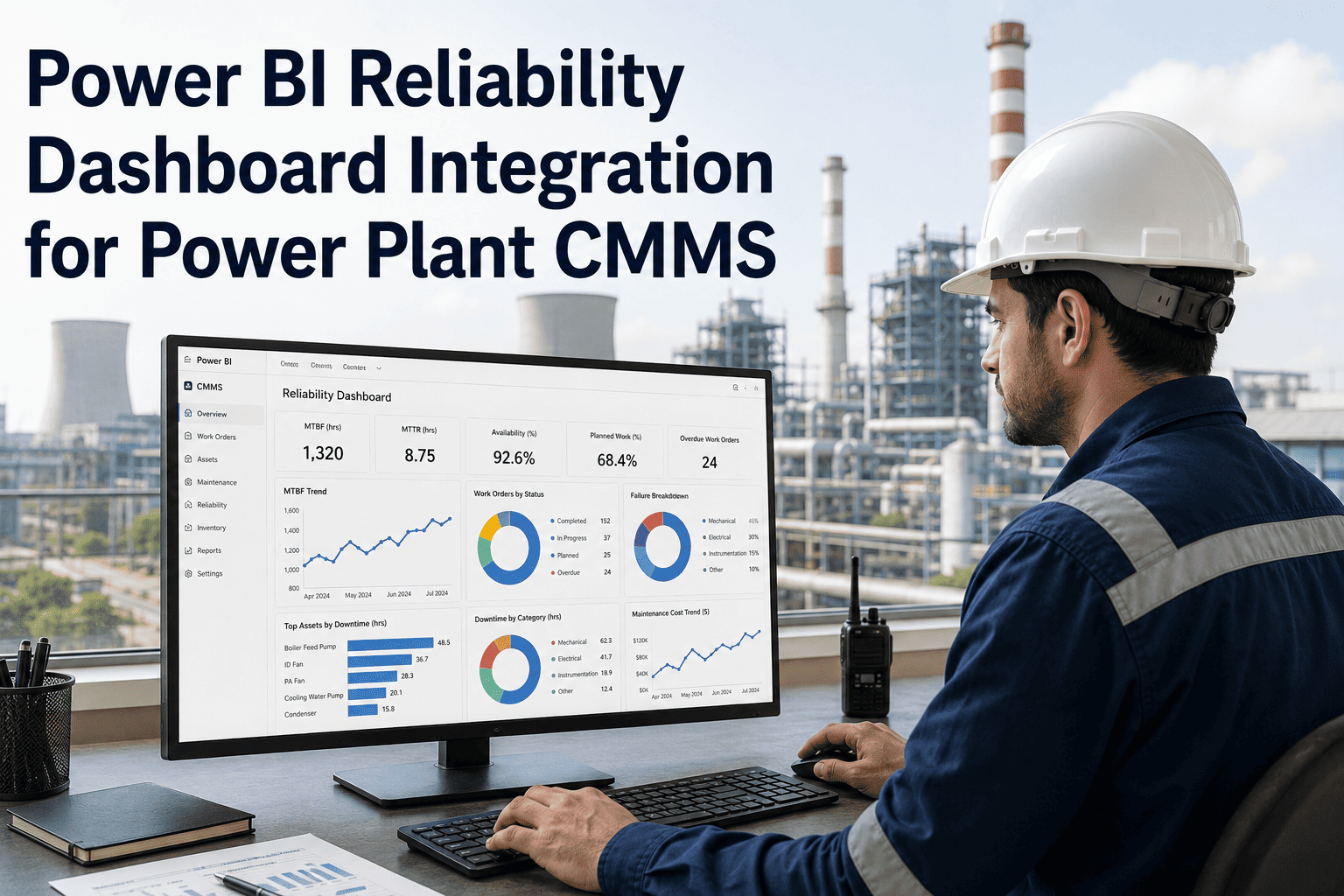
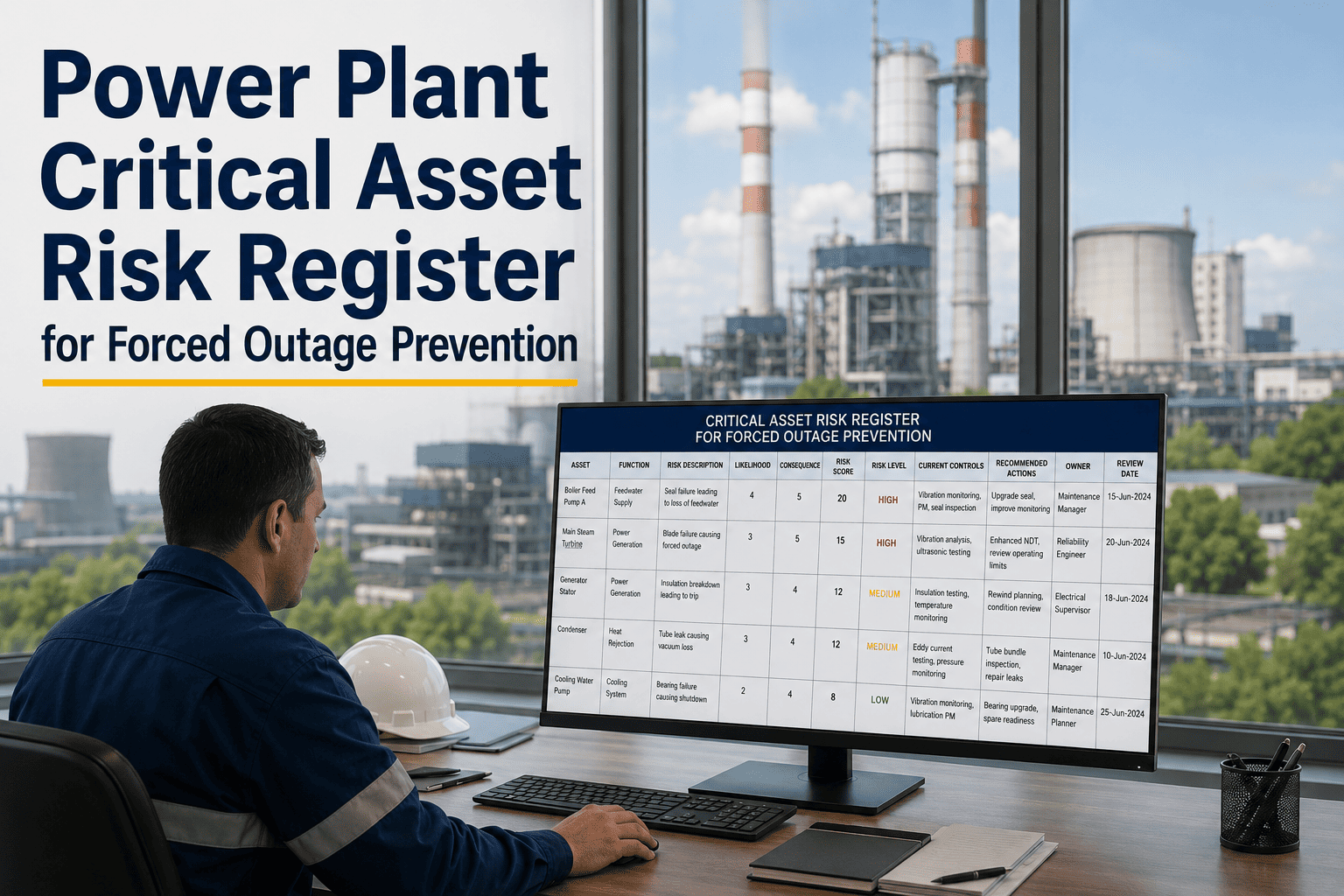
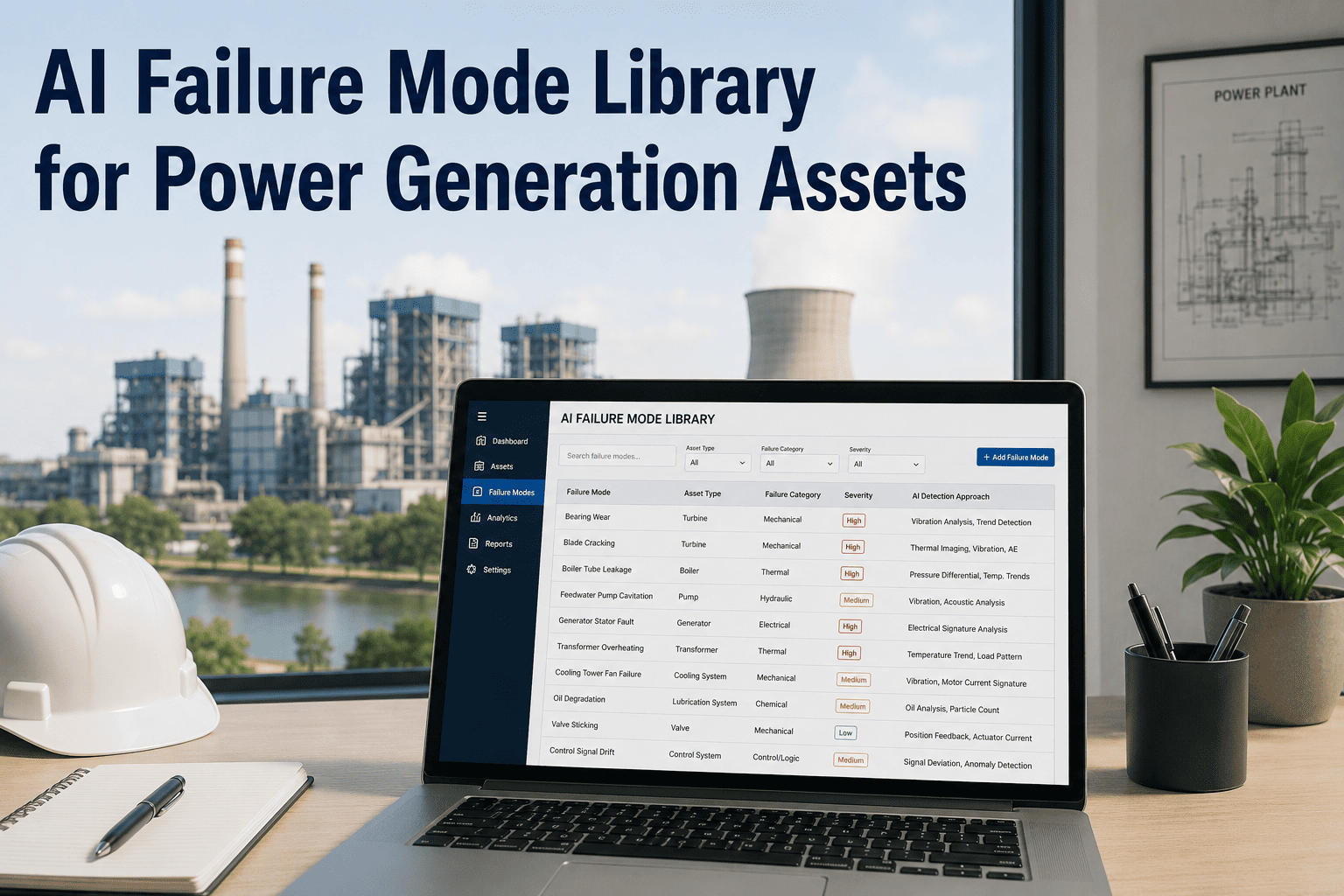
Every unplanned outage at a power plant starts the same way — a failure mode that someone knew about but no one tracked. Boiler tube leaks from untreated water chemistry, turbine blade fatigue from thermal cycling, generator winding insulation breakdown from partial discharge — these are not surprises. They are predictable failure patterns with documented causes, known consequences, and calculable risk scores. Failure Mode and Effects Analysis (FMEA) gives power plant engineers the framework to identify, rank, and act on every one of these risks before they become forced outages costing $500,000 or more per day in lost generation. The problem is not the methodology — it is the execution. FMEA worksheets sit in binders. Risk Priority Numbers get calculated once and never updated. Corrective actions are assigned but never verified. Start your free OxMaint trial to integrate FMEA-driven failure tracking directly into your maintenance workflows — where every failure mode has an owner, every RPN triggers a work order, and every corrective action is verified and closed. Or book a 30-minute demo to see how power plants are turning static risk spreadsheets into live reliability dashboards.
$500K+
average daily cost of an unplanned forced outage at a mid-size thermal plant
70%
of forced outages originate from failure modes already documented in maintenance history
3.2x
higher reliability improvement at plants using CMMS-integrated FMEA vs. spreadsheet-based tracking
1949
year FMEA was developed by the U.S. military — now the global standard for proactive risk analysis
What FMEA Actually Does for Power Plant Reliability
Failure Mode and Effects Analysis is a structured, bottom-up risk assessment method. For every piece of critical equipment in your plant — boilers, turbines, generators, condensers, pumps, transformers — FMEA identifies how each component can fail (failure mode), what happens when it does (effect), and how likely, severe, and detectable that failure is. These three ratings produce a Risk Priority Number (RPN) that tells your maintenance team exactly where to focus resources first.
How Risk Priority Number (RPN) Is Calculated
Critical Failure Modes in Power Plant Equipment
Power plants operate under extreme conditions — high temperatures, high pressures, corrosive environments, and continuous thermal cycling. Each major system has its own set of documented failure modes. The table below maps the most common failure modes across core power plant systems, their typical RPN ranges, and the maintenance strategy each demands.
OxMaint FMEA Integration
Turn Your FMEA Data Into Automated Maintenance Actions
OxMaint connects your failure mode analysis directly to work order generation — so every high-RPN failure mode triggers a scheduled inspection, every corrective action gets assigned an owner and deadline, and every completed task feeds back into your live reliability dashboard.
The 5-Step FMEA Process for Power Plants
Running an effective FMEA in a power plant is not a one-time exercise — it is a continuous reliability cycle that feeds your CMMS with prioritised, risk-ranked maintenance tasks. Here is how leading plants structure the process from start to execution.
01
Asset Criticality Ranking
Rank every plant asset by its impact on safety, generation output, environmental compliance, and repair cost. This determines which equipment gets a full FMEA first. Boilers, turbines, generators, and main transformers are always in the first tier.
02
Failure Mode Identification
For each critical asset, document every way it can fail — using OEM manuals, maintenance history, operator interviews, and industry failure databases. A single boiler system may have 40+ documented failure modes across tubes, headers, burners, fans, and controls.
03
RPN Scoring and Prioritisation
Score each failure mode on Severity (1–10), Occurrence (1–10), and Detection (1–10). Multiply to get the RPN. Failure modes with RPN above 200 typically require immediate preventive or predictive maintenance action. Those above 400 demand engineering controls.
04
Corrective Action Assignment
For every high-priority failure mode, assign a specific corrective action — a new PM task, a condition monitoring programme, an engineering modification, or a spare parts stocking decision. Each action needs an owner, a deadline, and a verification method.
05
CMMS Integration and Continuous Review
Feed all FMEA outputs into your CMMS as scheduled work orders, inspection checklists, and condition monitoring triggers. Every time a failure occurs, update the FMEA — adjust the Occurrence score, reassess the Detection rating, and recalculate the RPN. A living FMEA is a reliability engine; a static FMEA is decoration.
Why Spreadsheet-Based FMEA Fails in Power Plants
Most power plants conduct FMEA during commissioning or after a major failure event. The analysis gets documented in a spreadsheet, shared with the engineering team, and then — nothing. The spreadsheet does not trigger work orders. It does not send alerts when corrective actions are overdue. It does not update itself when new failures occur. Here is where the process breaks down.
RPN scores calculated once — never updated after new failures
Corrective actions listed but not assigned or tracked
No connection to maintenance scheduling or work orders
Failure history in a different system — no cross-reference
Review happens annually at best — usually after an incident
Multiple versions floating across departments
RPN recalculated automatically when new failure data enters the system
Every corrective action becomes a tracked work order with an owner and deadline
High-RPN failure modes auto-generate PM tasks and inspection schedules
Failure history, root cause data, and FMEA linked on the same asset record
Continuous review — every closed work order feeds back into the analysis
Single source of truth accessible to all departments in real time
RPN Risk Zones: What Your Scores Actually Mean
Not all failure modes demand the same response. The RPN score places each failure mode into a risk zone that determines the urgency and type of maintenance intervention required. Power plants operating without clear RPN thresholds end up treating every failure mode the same — which means the critical ones get the same attention as the trivial ones.
RPN 1–80
Low Risk
Monitor through routine inspections. No immediate action required. Review during annual FMEA audit.
RPN 80–200
Moderate Risk
Schedule preventive maintenance tasks. Add to condition monitoring programme. Document in CMMS with next review date.
RPN 200–400
High Risk
Immediate PM task required. Assign corrective action with deadline. Implement predictive monitoring (vibration, oil analysis, thermography).
RPN 400–1000
Critical Risk
Engineering intervention mandatory. Design change, redundancy, or equipment replacement. Escalate to plant management immediately.
Frequently Asked Questions
What is the difference between FMEA and FMECA in power plant maintenance?
FMEA identifies failure modes and their effects. FMECA adds a criticality analysis layer that ranks failures by probability and consequence severity — making it more suitable for high-risk power plant equipment where consequences vary dramatically. OxMaint supports both frameworks within its asset reliability module.
Start your free trial to set up criticality-ranked failure tracking.
How often should power plants update their FMEA?
Every time a failure event occurs, a new asset is commissioned, or an operating condition changes. At minimum, conduct a formal review annually. Plants using CMMS-integrated FMEA update continuously because every closed work order and failure report feeds new data into the RPN calculations automatically.
Book a demo to see continuous FMEA updating in action.
Which power plant equipment should be prioritised for FMEA?
Start with equipment whose failure causes a plant trip or safety hazard — boilers, steam turbines, generators, main transformers, and boiler feed pumps. Then extend to balance-of-plant systems like condensers, cooling water pumps, and fuel handling. OxMaint's asset criticality ranking tool automates this prioritisation.
Sign up free to run your first criticality analysis.
Can OxMaint generate work orders directly from FMEA risk scores?
Yes — OxMaint converts high-RPN failure modes into scheduled preventive maintenance tasks, inspection checklists, and condition monitoring triggers. When an RPN exceeds your configured threshold, the system auto-generates a work order with the corrective action, assigns it to the responsible technician, and tracks completion.
Book a demo to configure your RPN-to-work-order workflow.
What data do we need to start building an FMEA in a CMMS?
You need your asset register, OEM maintenance manuals, historical failure and work order data, and operator input on known problem areas. OxMaint's onboarding workflow guides your team through uploading these records and structuring them into an FMEA-ready format against each asset.
Start your free trial and follow the guided FMEA setup process.
OxMaint for Power Plant Reliability
Your Plant's Failure Modes Are Already Documented Somewhere. Are They Driving Your Maintenance Plan?
80%
reduction in downtime costs with RCM-integrated FMEA programmes
3.2x
faster corrective action closure when FMEA is CMMS-linked vs. spreadsheets
Live
RPN dashboard showing real-time risk status across your entire fleet