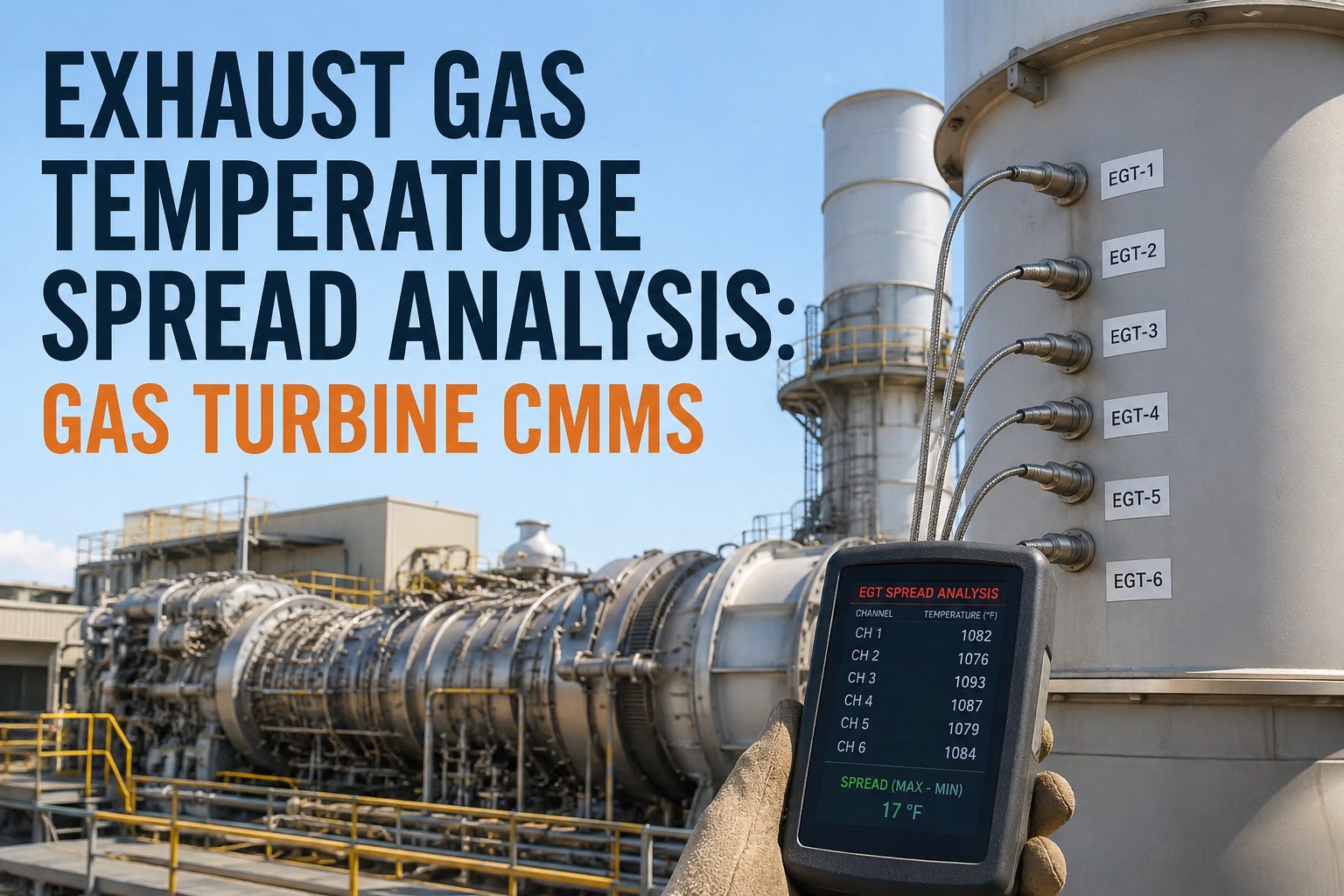
Exhaust gas temperature spread analysis is the single most powerful diagnostic tool for detecting combustion-zone deterioration in gas turbines before it triggers trips, unscheduled outages, or major component damage. A spreading EGT pattern reveals whether the fault lies in a fuel nozzle, combustor liner, transition piece, or turbine inlet guide vane — and interpreting that signature correctly can save a 200 MW unit from a $1.2 M+ forced outage. This guide walks reliability engineers through EGT spread causes, combustor fault signatures, fuel nozzle degradation tracking, and how a CMMS with automated EGT trending turns raw thermocouple data into predictive work orders. Ready to modernize your turbine maintenance program? Start Free Trial and see OxMaint's EGT analytics in action.
Is a widening exhaust gas temperature spread silently degrading your turbine?
An EGT spread exceeding 30–50 °C above baseline is an early warning of combustor distress, fuel nozzle fouling, or transition-piece failure. Manual spreadsheet tracking misses the trend until it becomes a trip. OxMaint's AI-powered CMMS continuously trends every thermocouple, detects deviations in hours — not weeks — and auto-generates corrective work orders before the unit derates.
What is exhaust gas temperature spread and why it matters
Exhaust gas temperature spread is the difference between the highest and lowest readings among the 18–24 thermocouples arranged around the turbine exhaust annulus — and a widening gap is the earliest mechanical distress signal your engine produces.
For a 540 °C average exhaust temp, a spread above 27–54 °C warrants investigation. OEM trip thresholds commonly trigger near 80–110 °C, but by then damage is already progressing.
Common EGT spread causes and combustor fault signatures
Each root cause produces a distinct thermocouple pattern — reading that signature correctly cuts diagnostic time from days to minutes.
| Fault Signature | Typical EGT Pattern | Likely Root Cause | Corrective Action |
|---|---|---|---|
| Single-can hot spot | 1–2 adjacent thermocouples reading 40–80 °C above mean | Fuel nozzle tip erosion or carbon buildup in one combustor can | Borescope + nozzle replacement at next planned outage |
| Single-can cold spot | 1–2 adjacent thermocouples reading 40–60 °C below mean | Clogged fuel nozzle, lean blowout, or combustion liner crack | Immediate borescope; derate unit if spread exceeds OEM limit |
| 180° opposing pair | Two thermocouples 180° apart trending high simultaneously | Transition piece seal degradation or flow-distortion upstream | Schedule transition-piece inspection within 7 days |
| Diffuse multi-point spread | Broad, irregular spread with no single dominant can | Widespread fuel nozzle degradation or compressor fouling distortion | Compressor wash + full nozzle inspection at next window |
| Gradual uniform rise | All thermocouples trending upward together, spread stable | Compressor fouling reducing mass flow, not a combustor fault | Offline compressor wash; trend baseline after recovery |
A 170 MW Frame 7FA gas turbine at a Midwest cogeneration plant showed a 47 °C EGT spread on thermocouples 8–9. The reliability team, tracking EGT on weekly spreadsheet exports, noticed the deviation three weeks after it began. An emergency borescope found a fuel-nozzle tip had eroded by 2.1 mm, damaging the combustor liner. The forced outage lasted 9 days and cost $890,000 in lost steam supply to a downstream chemical plant. With automated CMMS EGT trending, the 15 °C early-warning threshold would have triggered a work order on day one — allowing nozzle replacement during a planned weekend outage at one-tenth the cost.
How EGT spread progresses from first warning to turbine trip
A combustor fault doesn't fail overnight — it follows a predictable 6-month deterioration curve that manual monitoring rarely catches in time.
EGT spread rises 8–12 °C above established baseline. Spread still within OEM alarm band. Invisible to manual weekly checks — detectable only by continuous statistical trending.
Spread reaches 25–35 °C. OEM low-alarm triggers intermittently during peak load. Most teams acknowledge and reset — the underlying nozzle or liner degradation continues undiagnosed.
Spread stabilizes at 50–70 °C. Combustor dynamics shift. NOx emissions may rise 10–15%. Unit requires operational derate to stay within emissions permit — revenue loss begins.
Spread exceeds 80–110 °C. OEM high-high trip logic activates, or combustor liner ruptures. Hot gas path damage may extend to first-stage turbine nozzles and blades — repair scope grows 3–5×.
The window between Month 1 and Month 2 is where predictive maintenance pays for itself. A single avoided gas turbine trip covers a decade of CMMS licensing.
Automated EGT spread tracking and predictive work orders with OxMaint
OxMaint ingests thermocouple data continuously, applies statistical baselining and AI deviation detection, and auto-generates corrective work orders — turning EGT analysis from a forensic exercise into a predictive workflow.
Continuous EGT trending
Every exhaust thermocouple is baselined and trended in real time. AI detects 8 °C+ deviations within hours — not the 2–3 weeks typical of manual spreadsheet exports — and flags the specific combustor can.
Auto-generated work orders
When EGT spread crosses a configured threshold, OxMaint creates a work order pre-filled with fault signature, affected can position, borescope checklist, and required spare parts — routed to the right technician instantly.
Asset & spare-parts linkage
Each turbine's EGT trend is linked to its asset record, maintenance history, and spare-parts inventory. When a nozzle replacement is triggered, OxMaint confirms part availability and reserves it automatically.
Maintenance analytics dashboard
Roll-up dashboards show EGT spread trends across your entire turbine fleet, ranked by risk score. Reliability managers see which units need attention this quarter and which are trending toward a planned outage window.
From spreadsheet tracking to CMMS-powered EGT monitoring
Most reliability teams still track EGT spread on weekly DCS exports pasted into Excel — a process that introduces a 7–14 day blind spot and zero automated alerting.
Connect your turbine data sources
OxMaint integrates with your historian or DCS (OSIsoft PI, GE Cimplicity, Siemens WinCC, Honeywell PHD) via standard OPC-UA or REST API. No manual data export, no copy-paste, no blind spots between readings.
Configure baselines and alarm thresholds
OxMaint's AI establishes a statistical baseline for each thermocouple from 30 days of historical data. Configure multi-tier alerts: 15 °C deviation = advisory work order, 30 °C = inspection required, 50 °C = derate recommendation.
Map fault signatures to work-order templates
Pre-build borescope checklists, nozzle-inspection procedures, and spare-parts kits for each fault-signature pattern. When the AI detects a single-can hot spot, the correct work order generates with zero manual input.
Go live and start catching faults early
Full implementation takes 2–4 weeks for a typical gas turbine fleet. Most OxMaint users detect their first actionable EGT deviation within 30 days of go-live — often a latent fault that manual monitoring had missed for months.
See OxMaint's EGT analytics on your turbine fleet
Book a 30-minute demo and our reliability engineers will walk you through live EGT trending, fault-signature detection, and automated work-order generation on a configured gas turbine asset.
Gas turbine EGT spread analysis — your questions answered
What is an acceptable exhaust gas temperature spread on a gas turbine?
An acceptable EGT spread is typically less than 0.5–1.0% of the average exhaust temperature, which equates to roughly 25–50 °C depending on turbine size and load. Most OEMs set a low alarm near 30–40 °C and a high-high trip near 80–110 °C. However, any sustained increase of more than 10–15 °C above your established baseline warrants investigation, even if it hasn't crossed the OEM alarm threshold. Continuous trending via a CMMS like OxMaint catches these subtle shifts that manual checks miss.
What causes high exhaust gas temperature spread in gas turbines?
The most common causes are fuel nozzle fouling or erosion, combustor liner cracking, transition-piece seal degradation, and compressor fouling that distorts the combustion airflow. Each produces a distinct thermocouple signature — a single-can hot spot usually points to a fuel nozzle issue, while a diffuse spread often indicates widespread nozzle degradation or compressor fouling. Identifying the pattern correctly directs your borescope inspection to the right combustor can. Book a Demo to see how OxMaint's AI automatically classifies these fault signatures.
How often should EGT spread be monitored?
EGT spread should be monitored continuously — not weekly or monthly. A turbine operating at baseload generates a new thermocouple reading every 1–5 seconds, and a combustor fault can progress from baseline deviation to alarm threshold in 2–4 weeks. Manual spreadsheet reviews on a weekly or monthly cadence introduce a blind spot that allows faults to escalate undetected. Continuous CMMS-based trending with automated alerts is the only reliable way to catch deviations early enough for planned corrective action.
Can a CMMS automatically generate work orders from EGT spread deviations?
Yes. OxMaint's CMMS integrates with your historian or DCS to ingest thermocouple data in real time, applies AI-based statistical baselining, and auto-generates a work order when EGT spread crosses a configured threshold. The work order is pre-filled with the fault signature, affected combustor can position, borescope checklist, required spare parts, and assigned technician — eliminating manual diagnostic and administrative work. You can Start Free Trial to configure your first EGT alert template in under an hour.
How much does an undetected EGT spread problem cost?
An undetected EGT spread problem that progresses to a forced gas turbine trip typically costs $500,000 to $2,000,000 per event in lost generation revenue, startup fuel, and repair labor. If the fault damages the hot gas path — extending to first-stage turbine nozzles and blades — repair costs can exceed $5 M and take the unit offline for 4–8 weeks. A CMMS with automated EGT trending typically costs less than 1% of a single avoided trip, making the ROI payback measured in months, not years.
Stop reacting to turbine trips. Start predicting them.
Join the reliability teams using OxMaint to catch combustor faults weeks before they escalate — and turn EGT data into automated, actionable work orders.
Free 14-day trial · No credit card