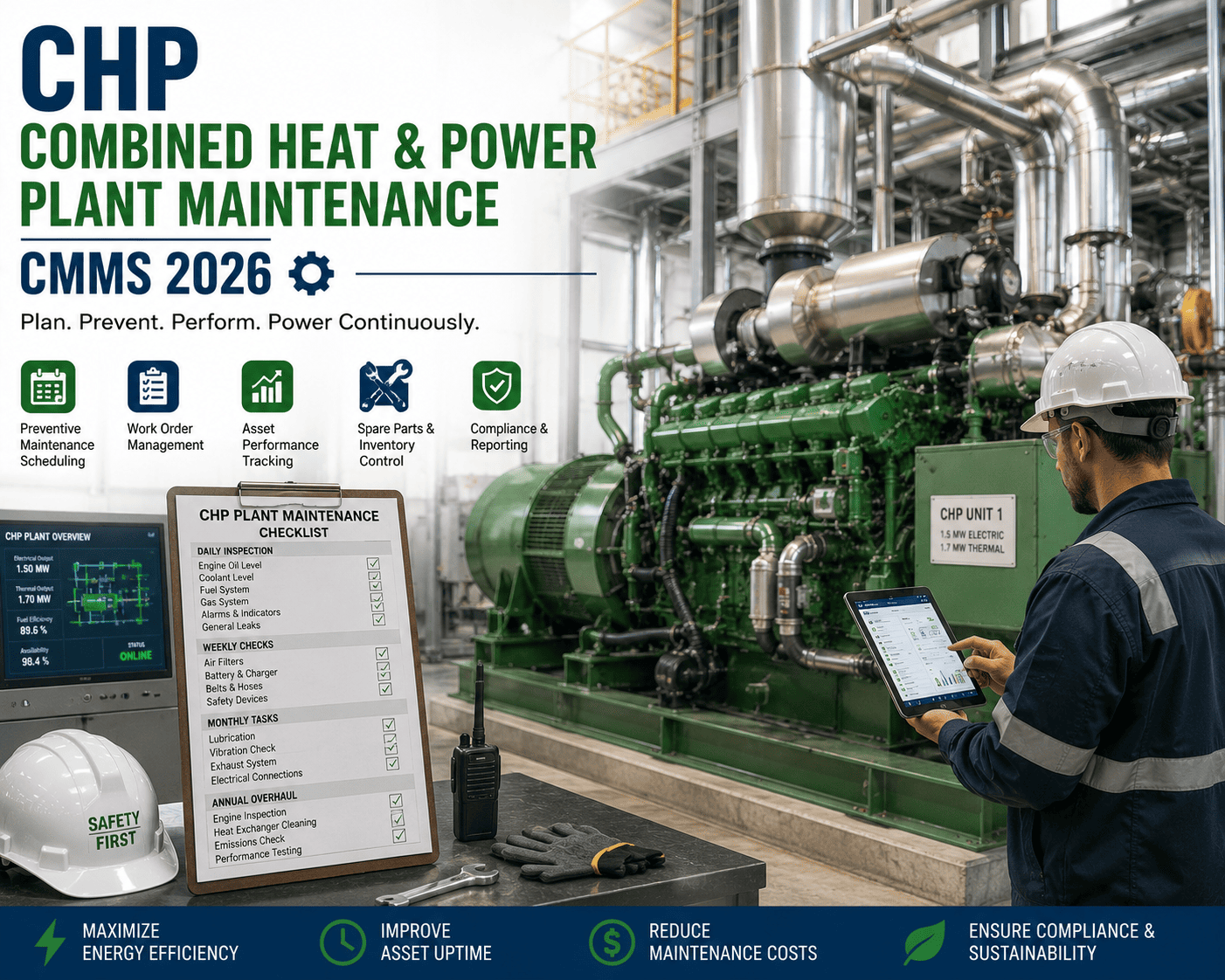
Combined heat and power plant maintenance demands rigorous coordination of gas engines, heat recovery steam generators, and district heating loops — and a purpose-built CHP CMMS is now the standard way to keep those assets available above 95%. This 2026 CHP maintenance guide covers the preventive tasks, inspection intervals, and asset management strategies that separate top-quartile cogeneration plants from reactive, break-down operations. Whether you manage a 2 MW gas engine CHP or a multi-unit district heating facility, moving from spreadsheets to a structured combined heat power CMMS cuts unplanned downtime by 30–50% and extends major overhaul intervals. You can Start Free Trial today or read on for the full framework.
Is your CHP plant losing availability to reactive maintenance?
Top-quartile combined heat and power plants sustain above 95% availability and push major overhaul intervals past 80,000 operating hours. The difference is not luck — it is a disciplined, CMMS-driven maintenance program covering every gas engine, HRSG, and district heating interconnect.
Gas engine CHP maintenance checklist by operating hours
A 2 MW gas engine CHP unit typically consumes 18,000–20,000 operating hours per year in continuous duty. Use this tiered checklist to structure PM triggers — most plants running without a CMMS miss 20–30% of these intervals.
- Oil sample analysis and trend review
- Spark plug inspection and gap verification
- Air filter differential pressure check
- Cylinder exhaust temperature spread log
- Crankcase breather condition inspection
- Valve clearance adjustment (intake & exhaust)
- Ignition system coil and lead resistance test
- Charge air cooler cleaning and pressure test
- Mixture control valve calibration
- Lambda sensor replacement and tuning
- Piston and cylinder head carbon removal
- Connecting rod bearing inspection
- Turbocharger inspection and clearance measurement
- Catalyst element condition and delta-P
- Full control system parameter audit
- HRSG exhaust gas temperature monitoring
- Feedwater chemistry — pH, TDS, oxygen
- Steam drum level control calibration
- Blowdown valve cycling verification
- Stack economizer fouling trend
12-month CHP plant maintenance timeline
A full annual cycle for a combined heat and power plant balances gas engine PM, heat recovery inspections, and district heating integration work. Stagger major overhauls so at least one unit remains online — a CMMS with meter-based triggers ensures no interval slips.
Cost of reactive vs. CMMS-driven CHP plant maintenance
A 180-asset cogeneration plant spending $42K per year on emergency repairs and contractor callouts typically sees payback in under 4 months after deploying a CHP CMMS. The table below breaks down where the savings come from.
| Maintenance Metric | Reactive / Spreadsheet | CMMS-Driven (OxMaint) |
|---|---|---|
| Unplanned downtime per year | 120–180 hours | 30–60 hours |
| PM compliance rate | 55–65% | 92–98% |
| Mean time to repair (MTTR) | 6.5 hours | 3.2 hours |
| Spare-parts stockout rate | 18–22% | 4–6% |
| Annual emergency contractor spend | $42,000 | $11,500 |
| Audit preparation time | 3–5 days | 2–4 hours |
| Gas engine overhaul interval | 40K–50K hrs | 72K–80K hrs |
How much can a CHP plant save with a CMMS?
Use this formula to estimate annual savings when moving from reactive maintenance to OxMaint for combined heat and power maintenance. The numbers below are based on a real 3-unit, 6 MW gas engine CHP facility.
At an annual OxMaint subscription of roughly $9K–$14K for a mid-sized CHP fleet, payback lands between 2.5 and 3.5 months — before counting the avoided cost of a single catastrophic engine failure, which can exceed $180K.
OxMaint: the CHP CMMS built for cogeneration reliability
OxMaint maps directly to the asset hierarchy of a combined heat and power plant — from gas engine modules and HRSG trains to district heating pumps and steam valves. These four capabilities deliver measurable outcomes within the first quarter of deployment.
A 6 MW gas engine CHP plant cut unplanned downtime 41% in 90 days
"We were running three Jenbacher engines on spreadsheets and tribal knowledge. After rolling out OxMaint, our PM compliance went from 60% to 96% in one quarter. The predictive alerts caught a crankshaft bearing trend three weeks before it would have thrown a rod — that alone paid for two years of the platform."
See OxMaint on your CHP assets — book a 30-minute demo
Walk through a live CHP asset hierarchy, meter-based PM schedules, and predictive dashboards configured for your plant. No slides — just your assets in the platform.
CHP maintenance & CMMS — frequently asked questions
CHP maintenance covers both power-generation equipment (gas engines, turbines, generators) and heat-recovery systems (HRSG, steam loops, district heating interconnects) as a single integrated asset base. Standard boiler maintenance addresses only combustion and heat transfer — CHP adds electrical generation, synchronous grid controls, and complex thermodynamic coupling that requires meter-based PM triggers and cross-system analytics. A dedicated CHP CMMS manages both domains in one platform.
Short-cycle service (oil sampling, spark plugs, filter checks) runs every 500 operating hours. Intermediate service — valve adjustments, ignition calibration, charge air cooler cleaning — triggers at 4,000 hours. Major overhauls including piston inspection and turbocharger teardown occur at 20,000-hour intervals. With disciplined PM and a CMMS tracking runtime meters, plants reliably extend major overhauls to 80,000 hours. You can configure all these triggers automatically when you Start Free Trial.
A CHP CMMS automatically generates work orders based on real operating-hour meter readings, tracks spare-parts inventory against asset-level bills of material, and provides predictive analytics on vibration and oil trends. Spreadsheets require manual data entry, cannot trigger alerts, and offer no audit trail — which is why plants using spreadsheets typically achieve only 55–65% PM compliance versus 92–98% with a CMMS.
A typical 3–6 unit CHP plant goes live in OxMaint within 2–4 weeks. The process involves importing your asset hierarchy, configuring meter-based PM schedules, setting min/max parts levels, and training technicians on mobile work orders. OxMaint handles data migration and onboarding — book a 30-minute demo at calendly.com/oxmaintapp/30min to see a tailored timeline.
Yes. AI-driven predictive models analyze vibration spectra, oil analysis trends, exhaust temperature spreads, and combustion knock data to detect bearing wear, valve leakage, and injector fouling 2–4 weeks before catastrophic failure. Plants using OxMaint predictive analytics report 30–50% reductions in unplanned downtime and avoidance of single-event losses exceeding $180K per major engine failure.
Stop managing CHP maintenance on spreadsheets
Join the maintenance teams achieving 96% PM compliance, 41% less downtime, and 80,000-hour overhaul intervals. Deploy OxMaint in weeks — not months.
Free 14-day trial · No credit card