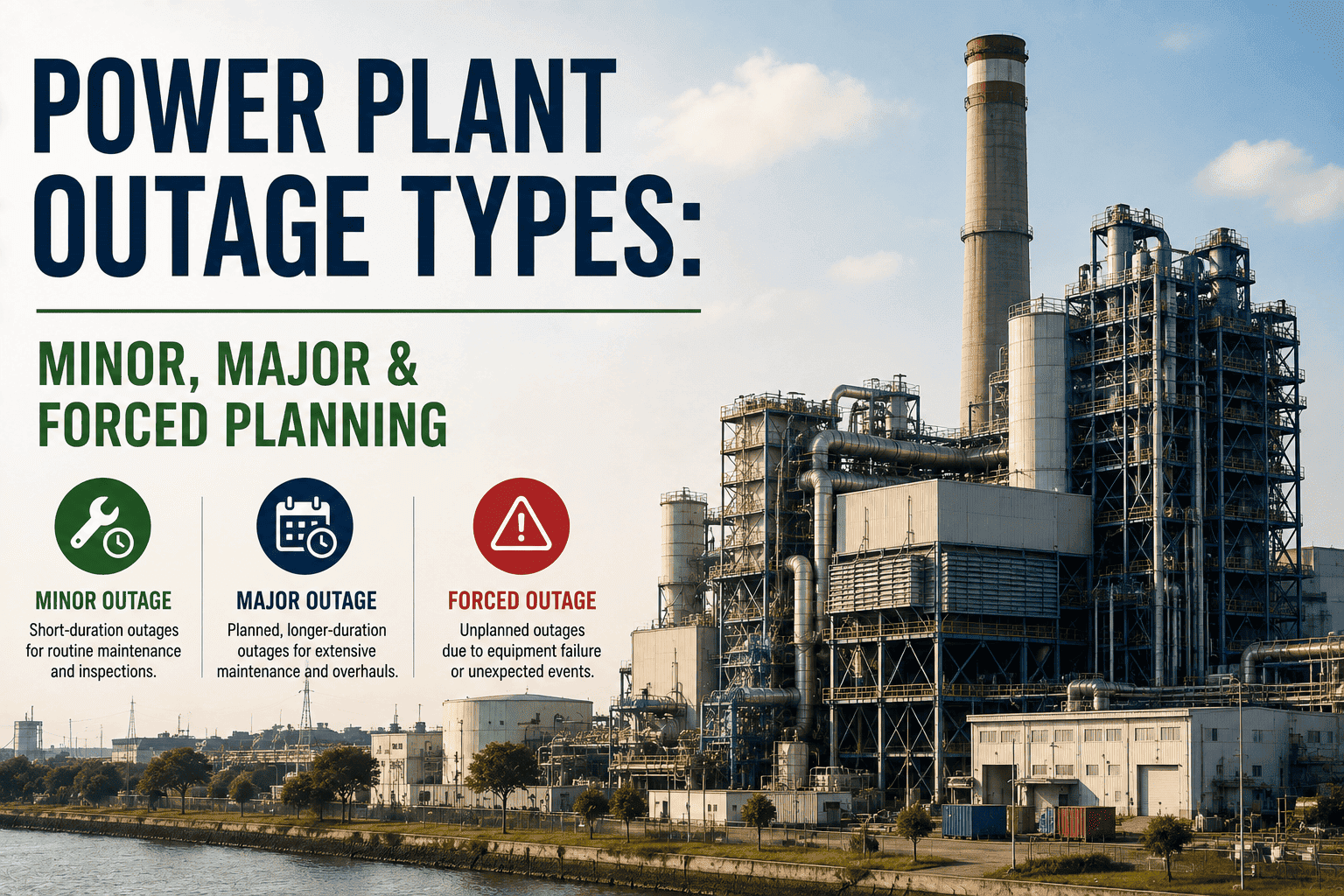
Power plant outage planning is the single highest-stakes maintenance event on a reliability team's calendar — a coal, gas, or nuclear unit outage can cost $500K–$2M per day in lost generation alone, and a single day of schedule slippage on the critical path can erase an entire year's maintenance budget. This complete 2026 guide to outage planning for power plants walks through scope development from condition-based data, critical path method (CPM) scheduling, contractor work-package readiness, and spare-parts staging — and shows how a CMMS built for outage management like OxMaint replaces spreadsheets and tribal knowledge with a single source of truth. Whether you are planning a 14-day minor turbine overhaul or a 45-day major plant turnaround, the framework below will help you cut duration, control costs, and de-risk every milestone. Ready to modernize your outage workflow? Start Free Trial or keep reading.
Power Plant Outage Planning Guide 2026
Is your next plant outage scoped, resourced, and ready — or are you betting $1.5M a day on hope?
A well-planned power plant maintenance outage starts 12–18 months out with condition data, critical path scheduling, and parts readiness. OxMaint gives your reliability team the CMMS backbone to plan, execute, and close out every turnaround — without spreadsheets.
Outage Timeline
Power plant outage planning: a 12-month countdown
A best-in-class power plant turnaround follows a disciplined timeline. Skipping any milestone shifts risk onto the critical path during execution — when every hour costs five figures.
Scope Development & Condition Assessment
Pull 24 months of PM history, work-order failures, vibration trends, and oil-analysis alerts. Identify mandatory turbine inspections (per OEM intervals), regulatory items (e.g., NRC or ASME code requirements), and elective work. OxMaint's asset-history dashboard surfaces top-failure assets automatically.
Critical Path Scheduling
Build the CPM schedule. Turbine disassembly → rotor removal → blade inspection → reassembly → balancing → run-in is the classic critical path. Every parallel task — condenser tube cleaning, generator inspection, boiler reheater welds — must float around it. Lock the duration and define float buffers.
Contractor Packages & Bidding
Issue scoped work packages to turbine OEMs, scaffolding vendors, NDE firms, and welding contractors. Each package should include drawings, safety requirements, QA/QC hold points, and acceptance criteria. OxMaint generates these from work-order templates — no manual document assembly.
Spare Parts Staging
Long-lead items (turbine blades, generator rotor retaining rings, boiler tube sections) may have 20–36 week lead times. Verify inventory, reserve stock, and stage kitted parts in the outage crib. OxMaint's inventory module flags low-stock and long-lead critical spares against the scope list.
Execution Readiness & Lock-In
Finalize shift rosters, permit-to-work procedures, toolbox-talk schedules, and contractor onboarding. Freeze scope — any post-freeze additions go through a formal change-control board with cost and schedule impact analysis. OxMaint tracks every change request with full audit trail.
Scope Intelligence
How to build outage scope from condition data — not guesswork
Scope creep is the #1 cause of outage duration overruns. The antidote is a data-driven scope that ties every planned task to evidence: a failure history, a regulatory mandate, or a condition-monitoring threshold breach.
Outage Scope Equation
Optimal Scope = (Criticality Score × Failure History) + Regulatory Mandates + Predictive Alerts ≥ Threshold
Assets scoring in the top 20% of criticality with a confirmed PdX alert in the last 6 months are mandatory in-scope. Everything else must justify its cost against the daily generation loss.
Worked Example
A 600 MW combined-cycle plant planned a 21-day minor outage. Using OxMaint's asset-criticality matrix and 18 months of work-order history, the reliability team identified 340 candidate tasks, scored each by risk, and challenged 62 low-value items. The trimmed scope saved $185K in contractor labor and parts — and the outage finished on Day 20. Without a CMMS to quantify criticality, those 62 tasks would have stayed in scope by default.
Readiness Assessment
Power plant outage readiness checklist
Run this checklist 30 days before your outage window. Any unchecked item is a critical-path risk that should escalate to the outage manager immediately.
Scope & Planning
- Scope frozen with formal change-control process active
- CPM schedule built with float buffers on non-critical paths
- Every work package linked to a responsible contractor and supervisor
- Pre-outage safety review completed with JHAs for high-risk tasks
Materials & Logistics
- All long-lead spares received, inspected, and staged in outage crib
- Consumables (gaskets, weld wire, grinding discs) kitted by work order
- Scaffolding, rigging, and heavy-lift plan approved
- Tooling calibrated and certification current for all NDE equipment
Execution & Closeout
- Shift rosters, on-call list, and escalation matrix distributed
- Permit-to-work system tested and LOTO procedures verified
- QA/QC hold points and witness points mapped to schedule milestones
- Post-outage performance test plan approved and baselined
Outage CMMS Comparison
Spreadsheets vs. CMMS for outage management: what changes
Many plants still run outages on Excel schedules, shared drives, and radio chatter. The cost of that approach shows up in overruns, missing parts, and lost audit trails — all of which a CMMS eliminates.
| Capability | Spreadsheet / Manual | OxMaint CMMS |
|---|---|---|
| Scope development | Manual export from multiple systems; hours of pivot-table work | Auto-surfaced top-failure assets with 24-month history in one dashboard |
| Work package generation | Copy-paste from prior outages; version-control chaos | Template-driven packages with drawings, QA points, and parts lists auto-populated |
| Spare-parts readiness | Stockout surprises discovered mid-outage | Long-lead alerts 90 days out; kitting staged against work-order scope |
| Schedule tracking | Whiteboard or Excel; updates lag by hours | Real-time work-order completion feeds live critical-path dashboard |
| Permit & LOTO management | Paper permits, manual isolation logs | Digital permit-to-work with isolation verification and electronic sign-off |
| Post-outage closeout | Lessons learned in a binder, rarely referenced | Full audit trail, automated KPI report, recommendations fed to next cycle |
How OxMaint Helps
How OxMaint streamlines power plant outage planning
OxMaint was built for maintenance and reliability teams who cannot afford a 3-day schedule slip. These are the four capabilities that move the needle most during a plant turnaround.
Asset Criticality & History
OxMaint ranks every asset by criticality and aggregates failure history, PM compliance, and PdM alerts — so your scope is evidence-based, not opinion-based. Outcome: 15–25% less scope creep and fewer surprise finds.
Work-Order Templates for Outage Tasks
Pre-built templates for turbine overhauls, valve repacking, boiler tube replacement, and electrical inspections auto-generate scoped work packages with parts, labor estimates, and QA hold points. Outcome: 60% less package-prep time.
Spare-Parts & Kitting Module
OxMaint cross-references the outage scope against real-time inventory, flags long-lead items 90+ days out, and auto-creates kitting requests for the outage crib. Outcome: eliminate parts-driven delays that cause 3+ day slips.
Live Critical-Path Dashboard
Every work-order completion updates the outage dashboard in real time. Outage managers see slip risk on the critical path instantly and reallocate labor before it cascades. Outcome: 30–50% faster decision-making during execution.
See OxMaint on your assets — book a 30-minute demo
We'll walk through a mock outage scope build, work-package generation, and live dashboard — on equipment that looks like yours.
FAQ
Power plant outage planning: frequently asked questions
When should power plant outage planning begin?
Outage planning should begin 12–18 months before the outage window for major turnarounds, and 6–9 months for minor outages. This timeline allows for condition-data gathering, long-lead part procurement (which can take 20–36 weeks for turbine blades or generator components), contractor bidding, and scope freeze at least 3 months before execution. Plants that start later consistently see 15–20% scope growth and schedule overruns. OxMaint's asset-history and inventory modules give you a head start by surfacing failure data and parts status instantly.
What is the critical path in a power plant outage?
The critical path is the longest sequence of dependent tasks that determines the minimum outage duration — typically turbine disassembly, rotor removal, blade inspection, reassembly, balancing, and run-in for a major overhaul. Any delay on a critical-path task extends the entire outage by the same amount. Non-critical tasks (parallel work like condenser cleaning or boiler tube welds) have float and can slip without extending the outage. OxMaint's live dashboard tracks critical-path tasks in real time so managers can reallocate labor before a slip cascades.
How does a CMMS improve outage management for power plants?
A CMMS improves outage management by replacing spreadsheets and tribal knowledge with a single, auditable system. It auto-builds scope from asset-failure history, generates contractor work packages from templates, tracks spare-parts readiness against scope, manages digital permits and LOTO, and provides a real-time execution dashboard. Plants using a CMMS like OxMaint typically cut package-prep time by 60%, reduce scope creep by 15–25%, and eliminate parts-driven delays. You can Start Free Trial to evaluate it on your assets.
How much does a power plant outage cost per day?
A power plant outage typically costs $500K–$2M per day in lost generation revenue, depending on unit size and market price. A 500 MW combined-cycle unit at $40/MWh loses approximately $480K/day; a 1,000 MW coal unit can exceed $1.5M/day. Add contractor labor ($50K–$150K/day for a major outage) and consumables, and the total daily cost can reach $2M+. This is why a single day of critical-path slippage can erase a year's maintenance budget — and why data-driven planning with a CMMS pays for itself many times over.
What is scope freeze in outage planning?
Scope freeze is the point — typically 8–12 weeks before outage start — when the planned work list is locked and any additions must go through a formal change-control board that evaluates cost, schedule, and risk impact. Without scope freeze, last-minute additions accumulate and can extend the outage by days. OxMaint enforces scope freeze digitally: post-freeze work requests require documented justification, cost impact, and schedule analysis with a full audit trail for post-outage review. To see this workflow in action, Book a Demo.
Your next outage starts with the right system
Join the reliability teams using OxMaint to plan sharper scopes, stage parts earlier, and finish outages on time — or ahead of schedule.
Free 14-day trial · No credit card