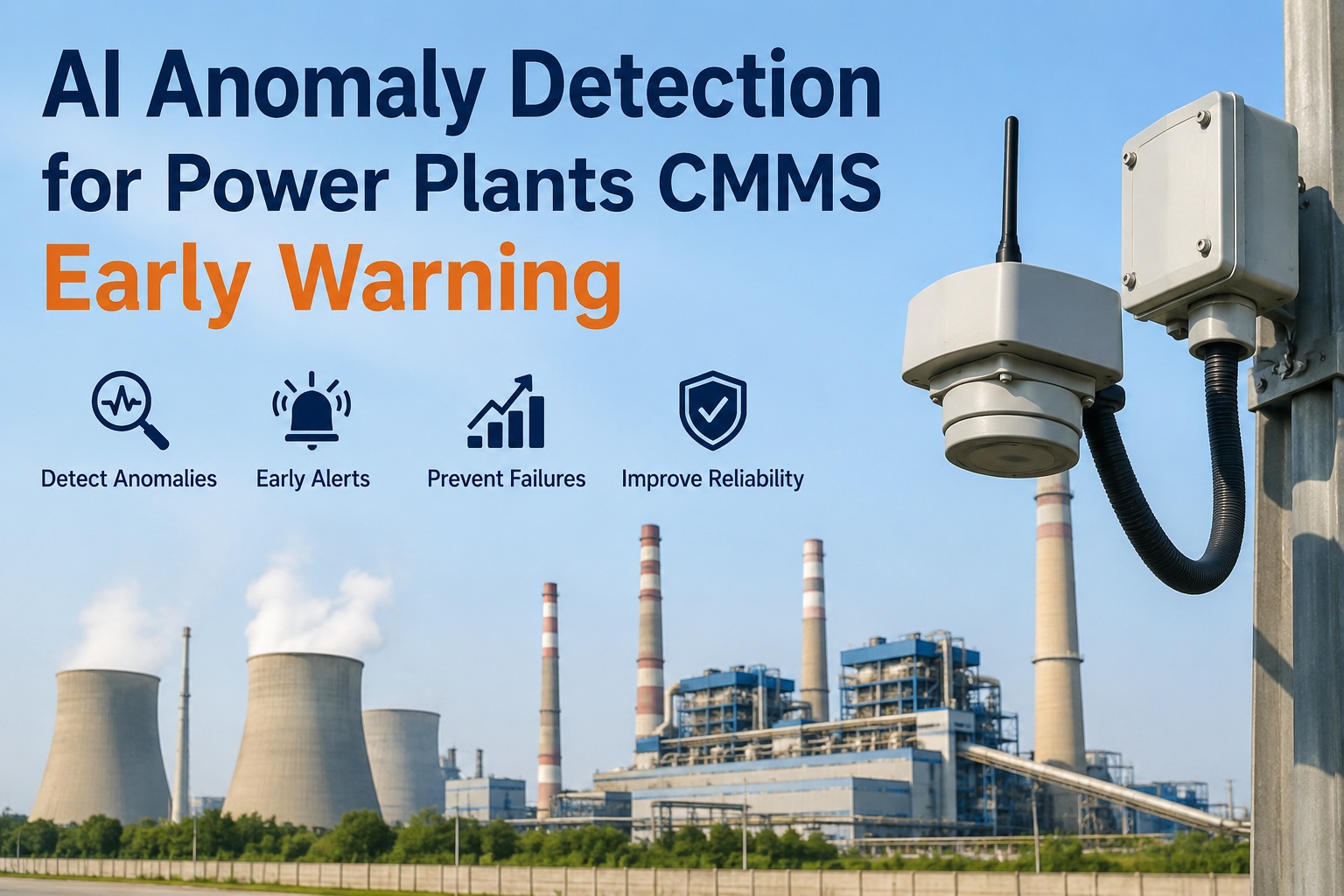
AI anomaly detection for power plants shifts maintenance from time-based routines to condition-driven intervention — catching bearing degradation, vibration drift and thermal excursions days or weeks before they escalate into forced outages. Modern CMMS platforms like OxMaint pair baseline behavioral models with deviation scoring and automated work-order triggers, giving reliability teams real-time early warning across turbines, generators, boilers and balance-of-plant assets. Plants that deploy AI-driven anomaly monitoring typically cut unplanned downtime 25–45% and reduce false alarms by 60% compared to fixed-threshold alarming. Ready to see it on your assets? Start Free Trial or book a personalized walkthrough today.
AI EARLY WARNING FOR POWER GENERATION
Detect turbine and boiler anomalies before they become outages
Baseline behavioral models learn each asset's normal operating envelope, then score deviations in real time — automatically generating prioritized work orders inside your CMMS so crews act with hours or days of lead time, not after the trip.
THE COST OF REACTIVE MAINTENANCE
Why power plants need AI anomaly detection in 2026
A single unplanned gas turbine trip costs $50K–$500K in lost generation, startup fuel and grid penalties — yet 70% of those failures show identifiable deviation signatures 12–72 hours beforehand. AI anomaly detection for power plants captures those signals that SCADA alarms and calendar-based PMs miss.
Forced outages account for 75% of lost MWh — the majority traceable to detectable mechanical or electrical degradation.
A $4K bearing swap becomes a $60K rotor refurbishment plus 3 days of lost generation when it runs to failure.
Plants moving from reactive to predictive regimes routinely recover 3–7 availability points in the first year.
AI baseline models show nearly half of calendar-based overhauls could be safely deferred, freeing crews for higher-value work.
HOW IT WORKS
From sensor data to automated CMMS work orders
AI early warning for power assets isn't a black box — it's a four-stage pipeline that turns raw telemetry into prioritized, actionable maintenance tasks inside your CMMS. Here's how anomaly detection actually works in practice.
Baseline behavioral modeling
OxMaint ingests 30–90 days of historical SCADA, vibration, oil-analysis and DCS data for each asset — turbine, generator, boiler feed pump, cooling tower fan — and trains a baseline model that captures normal behavior across load curves, ambient conditions and operating modes. The model learns that vibration at 70% load differs from vibration at 100% load, eliminating the false positives that plague fixed-threshold systems.
Real-time deviation scoring
Live sensor streams are compared against the baseline every 1–5 minutes. Each deviation receives a composite anomaly score (0–100) combining magnitude, persistence and correlation across sensor pairs — for example, rising bearing temperature coupled with increasing vibration at the same shaft position carries far higher confidence than either signal alone.
False-alarm suppression & validation
Contextual rules filter out sensor faults, calibration drift and known transient events (startups, load ramps, grid frequency events). Multi-sensor confirmation requires agreement from at least two independent channels before escalating — cutting nuisance alarms by 50–70% versus simple threshold logic and preserving operator trust in the alerting system.
Automated CMMS work-order generation
When an anomaly score crosses the confidence threshold, OxMaint automatically creates a prioritized work order — pre-filled with asset ID, deviation description, recommended diagnostic steps, required spare parts and assigned technician. The crew sees a clear, actionable task in their mobile queue instead of a raw alarm they must interpret manually.
THE MATH
Anomaly detection ROI: what a prevented trip is worth
For a 500 MW combined-cycle plant earning $35/MWh margin, a single 24-hour forced outage costs roughly $420,000 in lost generation alone — before repair costs, grid penalties and reputational impact. Here's the payoff calculation.
COST OF ONE UNPREVENTED TRIP
500 MW × 24 h × $35/MWh margin = $420,000
Plus $40K–$120K average repair cost and potential NERC/G-grid reliability penalties.
ANNUAL VALUE OF AI EARLY WARNING
4 prevented trips/yr × $420K = $1.68M
Typical for a mid-size plant catching bearing, lubrication and thermal anomalies 48–72 hours early.
OXMAINT ANNUAL COST
~$18K–$36K/yr depending on asset count
Payback achieved by preventing a single trip — ROI exceeds 4,000% for a 500 MW plant.
| Scenario | Trips/yr | Lost Generation | Repair Cost | Annual Impact |
|---|---|---|---|---|
| Reactive (status quo) | 6 | $2.52M | $480K | -$3.0M |
| Calendar-based PM only | 4 | $1.68M | $300K | -$1.98M |
| AI anomaly detection + OxMaint CMMS | 1 | $420K | $80K | -$500K |
| Net annual savings | — | — | — | +$2.5M |
WORKED EXAMPLE
A 180-asset coal plant in the Midwest was spending $42K/yr on vibration analyst contractors and still experiencing 3–4 bearing failures annually on BFPs and ID fans. After deploying OxMaint's AI anomaly detection, the plant caught 11 degradations in the first 8 months — 7 of which had no visible signature in manual route-based vibration data. The plant reduced forced outages to zero in months 4–8 and reallocated the analyst budget to reliability engineering. Total documented savings: $1.1M in prevented downtime and repair costs, against $24K in OxMaint licensing.
OXMAINT CAPABILITIES
How OxMaint delivers AI anomaly detection for power plants
OxMaint combines predictive AI with a full CMMS and EAM workflow — so anomalies don't just generate alerts, they generate completed work orders, updated PM schedules and closed-loop reliability analytics. Here's what that looks like in practice.
Baseline behavioral models per asset
Each turbine, pump, fan and motor gets its own trained baseline — not a generic OEM threshold. Models retrain continuously as operating conditions and maintenance actions change, maintaining accuracy across seasons and load profiles.
Automated work-order generation
When deviation scores cross confidence thresholds, OxMaint auto-creates prioritized work orders with asset context, diagnostic checklist, required parts and assigned technician — no manual data entry, no alarm-fatigue delays.
Predictive PM optimization
Anomaly data feeds back into the PM scheduler — deferring calendar-based tasks when assets are healthy, accelerating them when deviation trends appear. Your maintenance program becomes condition-driven, not calendar-driven, aligned with ISO 55000 asset-management principles.
Spare-parts inventory synchronization
When an anomaly is detected, OxMaint checks stock levels for likely required parts — bearings, seals, gaskets — and flags shortages before the work order is dispatched. No more discovering the critical spare is on backorder when the turbine is already degraded.
REAL-WORLD IMPACT
What reliability teams say about AI-powered anomaly monitoring
"OxMaint flagged a bearing degradation on our HRSG feed pump 52 hours before vibration route data would have caught it. We scheduled the repair during a planned outage window — saved an estimated $340K in lost generation."
"We cut nuisance alarms by 65% in the first quarter. The multi-sensor confirmation logic actually respects our operators' time — when OxMaint generates an alert, it means something. The automated work orders are the real game-changer."
"The shift from reactive to predictive isn't a technology decision — it's a $2M+ annual margin decision for a mid-size plant. The question isn't whether you can afford AI anomaly detection. It's whether you can afford another year without it."
See OxMaint anomaly detection on your actual assets
Book a 30-minute demo and we'll walk you through baseline modeling, deviation scoring and automated work-order generation using your equipment types and failure modes — not a generic slide deck.
COMMON QUESTIONS
AI anomaly detection for power plants: frequently asked questions
How does AI anomaly detection work in a power plant CMMS?
AI anomaly detection works by training baseline behavioral models on 30–90 days of historical sensor data for each asset — capturing normal vibration, temperature, pressure and performance patterns across operating modes. Live SCADA and DCS data streams are then compared against the baseline every few minutes; deviations receive a composite anomaly score that, when validated by multi-sensor confirmation, automatically triggers a prioritized work order inside the CMMS. Book a demo to see the full pipeline on your asset types.
How much early warning lead time does AI anomaly detection provide?
Typical lead time ranges from 12 to 72 hours for mechanical degradation (bearing wear, shaft misalignment, lubrication breakdown) and 1–7 days for slower-developing thermal or efficiency anomalies. The multi-sensor correlation approach catches degradation signatures that single-parameter threshold alarms miss entirely, often providing actionable warning before vibration route-based inspections would detect the issue.
Can AI anomaly detection reduce false alarms compared to threshold-based monitoring?
Yes — plants typically see a 50–70% reduction in false alarms after deploying behavioral baseline models. Fixed-threshold systems generate nuisance alerts during normal load changes, startups and ambient-condition shifts; AI models recognize these as expected behavior because they've learned the asset's full operating envelope. Multi-sensor confirmation further suppresses single-point sensor faults and calibration drift.
What types of power plant assets benefit most from AI anomaly detection?
The highest-value assets are gas and steam turbines, generator stators and bearings, boiler feed pumps, ID/FD fans, condensate pumps, cooling tower gearboxes and transformers — essentially any rotating or critical static asset with sufficient sensor instrumentation. ROI is strongest on assets where a single failure costs $100K+ in downtime and repair, which covers most primary generation equipment in fossil, nuclear and renewable plants.
How long does it take to deploy AI anomaly detection in an existing CMMS?
For a plant with existing SCADA historians and sensor infrastructure, OxMaint can begin baseline model training within 1–2 weeks of data integration. First actionable anomaly alerts typically appear within 30–45 days as models stabilize, and full automated work-order workflows are live within 60 days. Start a free trial to begin onboarding your assets today — most plants are fully operational within one quarter.
Stop reacting to failures. Start predicting them.
Join the power plants using OxMaint AI anomaly detection to cut unplanned downtime 25–45%, reduce false alarms by 60% and turn maintenance from a cost center into a margin engine.
Free 14-day trial · No credit card required