Manufacturing safety incidents cost U.S. companies $170 billion annually in medical expenses, lost productivity, and compliance penalties — yet 85% of workplace injuries are preventable with proper monitoring and intervention systems. The problem is not awareness or intent; it is visibility. Supervisors cannot physically monitor every worker in real time, and by the time a hazardous condition is reported manually, the incident has often already occurred. Smart safety technology changes this equation entirely — wearable devices detect falls, gas exposure, and heat stress in real time; AI-powered cameras identify unsafe behaviors before they result in injuries; and connected worker platforms aggregate risk data across the facility to identify patterns invisible to human observation. Manufacturing facilities deploying integrated safety technology report 64% reduction in recordable incidents and 78% faster emergency response times, because hazards are detected and addressed at machine speed rather than human reaction speed. The return is measurable: every dollar invested in proactive safety technology yields $4–6 in avoided incident costs, making workplace safety not just a moral imperative but a financially compelling operational upgrade when integrated with OxMaint's safety monitoring and compliance tracking.
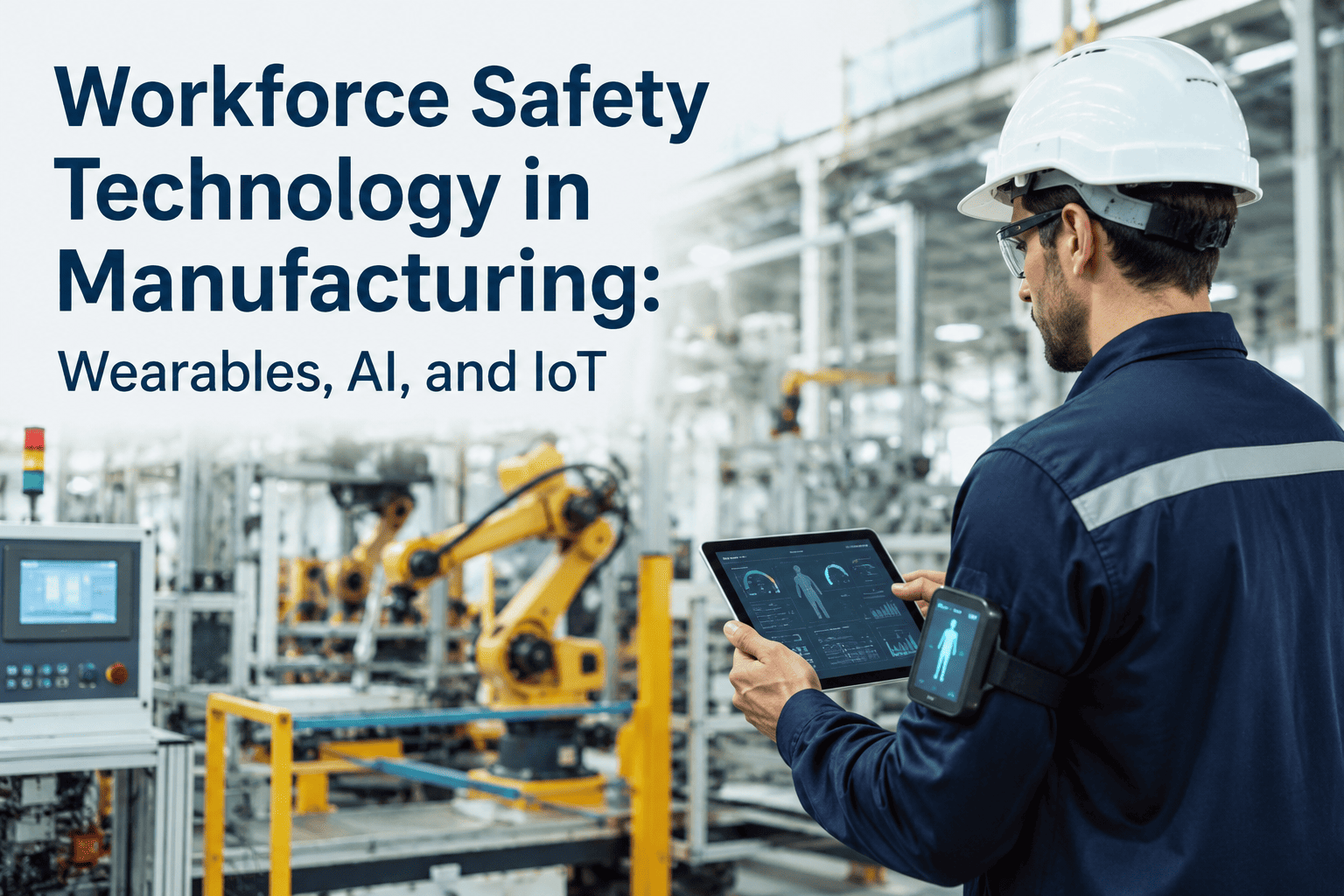
Workforce Safety Technology in Manufacturing: Wearables, AI, and IoT
Smart safety technology transforms manufacturing worker protection — wearables detect hazards in real time, AI cameras identify unsafe behaviors, and connected platforms reduce recordable incidents by 64% through proactive intervention.
4 Technology Types Transforming Manufacturing Safety
Modern safety technology operates on multiple layers — from devices workers wear to environmental sensors embedded in the facility to AI systems that analyze risk patterns across the entire operation.
Smart Wearables and PPE
Connected helmets, vests, watches, and safety glasses equipped with sensors that monitor worker vital signs, detect falls, track location, and measure environmental exposure to gases, heat, and noise in real time.
AI-Powered Safety Cameras
Computer vision systems that monitor manufacturing floors continuously, identifying unsafe behaviors like missing PPE, proximity violations near machinery, blocked emergency exits, and ergonomic risk postures without human oversight.
Environmental IoT Sensors
Fixed sensors placed throughout the facility that continuously measure air quality, temperature, humidity, noise levels, and detect hazardous gas leaks — alerting workers and shutting down equipment automatically when thresholds are exceeded.
Connected Worker Platforms
Integrated software that aggregates data from wearables, cameras, and environmental sensors into a single dashboard — identifying safety trends, predicting high-risk scenarios, and automating compliance reporting for OSHA and ISO 45001.
Measurable Safety Improvements from Technology Deployment
Real-Time Safety Monitoring Workflow
Continuous Data Collection
Wearables, cameras, and environmental sensors collect safety data every second — worker location, vital signs, PPE usage, proximity to hazards, and environmental conditions across the entire facility floor.
AI Risk Analysis
Machine learning algorithms analyze incoming data in real time, comparing current conditions against safety thresholds and historical incident patterns to identify developing hazards before they escalate.
Instant Alert Generation
When a hazard is detected — a worker falls, gas levels spike, or someone enters a restricted zone without PPE — the system triggers immediate alerts to the worker, supervisors, and emergency response teams simultaneously.
Automated Intervention
Connected systems can automatically shut down equipment, activate ventilation, lock out hazardous areas, and dispatch emergency response based on the hazard type — reducing response time from minutes to seconds.
Traditional Safety Methods vs. Smart Safety Technology
| Safety Function | Traditional Method | Technology-Enabled Method | Improvement |
|---|---|---|---|
| PPE compliance monitoring | Supervisor spot checks 2-3 times per shift | AI cameras detect non-compliance in real time | 92% vs. 68% compliance |
| Fall incident response | Worker calls for help or colleague notices | Wearable detects fall, auto-alerts emergency team with location | 78% faster response |
| Gas exposure detection | Fixed area monitors in select locations | Personal wearable badges on every worker | 100% worker coverage |
| Heat stress prevention | Workers self-report symptoms | Wearables monitor heart rate and core temperature, alert before symptoms | Proactive intervention |
| Incident investigation | Interviews and manual reconstruction | Video footage and sensor data provide objective evidence | Accurate root cause analysis |
| Safety training effectiveness | Completion tracking only | Behavioral analysis shows actual practice vs. training | Behavior-based insights |
Integrate Safety Technology with Your CMMS and Maintenance Operations
OxMaint connects safety monitoring systems with equipment maintenance data — correlating worker incidents with machine conditions, tracking safety-related work orders, and ensuring compliance documentation is complete and audit-ready.
Key Factors for Successful Safety Technology Deployment
Worker Privacy and Acceptance
Technology that monitors worker behavior must balance safety benefits with privacy concerns. Successful deployments involve workers in the selection process, clearly communicate what data is collected and how it is used, and focus monitoring on hazard detection rather than productivity surveillance.
Integration with Existing Systems
Safety technology delivers maximum value when integrated with CMMS, ERP, and HR systems. This enables correlation between equipment maintenance schedules and safety incidents, automated compliance reporting, and unified dashboards that connect safety and operational data.
Alert Fatigue Management
Poorly calibrated systems generate excessive false alarms that cause workers and supervisors to ignore legitimate alerts. Effective implementations tune sensitivity thresholds based on actual facility conditions and prioritize alerts by severity to maintain response effectiveness.
Scalability and Pilot Programs
Most successful deployments begin with pilot programs in high-risk areas or with volunteer worker groups. This allows facilities to validate technology effectiveness, refine implementation processes, and build organizational buy-in before full-scale rollout.
Workforce Safety Technology — Common Questions
Connect Safety Monitoring to Maintenance Operations in OxMaint
Track safety-related work orders, correlate incidents with equipment conditions, and maintain audit-ready compliance documentation in one unified maintenance management platform.