Manufacturing equipment purchase decisions that focus exclusively on acquisition cost routinely produce 30–50% higher total expenditure over the asset lifecycle compared to decisions that account for maintenance, downtime, energy consumption, and disposal costs from the outset. A $250,000 machine with low purchase price but high maintenance requirements can cost $180,000 more over 10 years than a $320,000 machine engineered for reliability and efficiency. The problem is visibility: finance teams approve capital expenditures based on upfront price comparisons visible in procurement spreadsheets, while the operational costs that represent 60–75% of true ownership expense remain scattered across maintenance budgets, energy bills, and production loss reports that never feed back into the purchase decision. Total Cost of Ownership frameworks solve this by aggregating every dollar an asset consumes — from initial purchase through maintenance labor, spare parts inventory, energy consumption, unplanned downtime, and eventual disposal — into a single lifecycle metric that enables apples-to-apples comparison between competing equipment options. Manufacturing facilities that adopt TCO analysis for capital equipment decisions report 22% lower total ownership costs and 35% fewer unplanned equipment failures because investment choices prioritize operational reliability over purchase price optimization with data-driven TCO modeling in OxMaint.
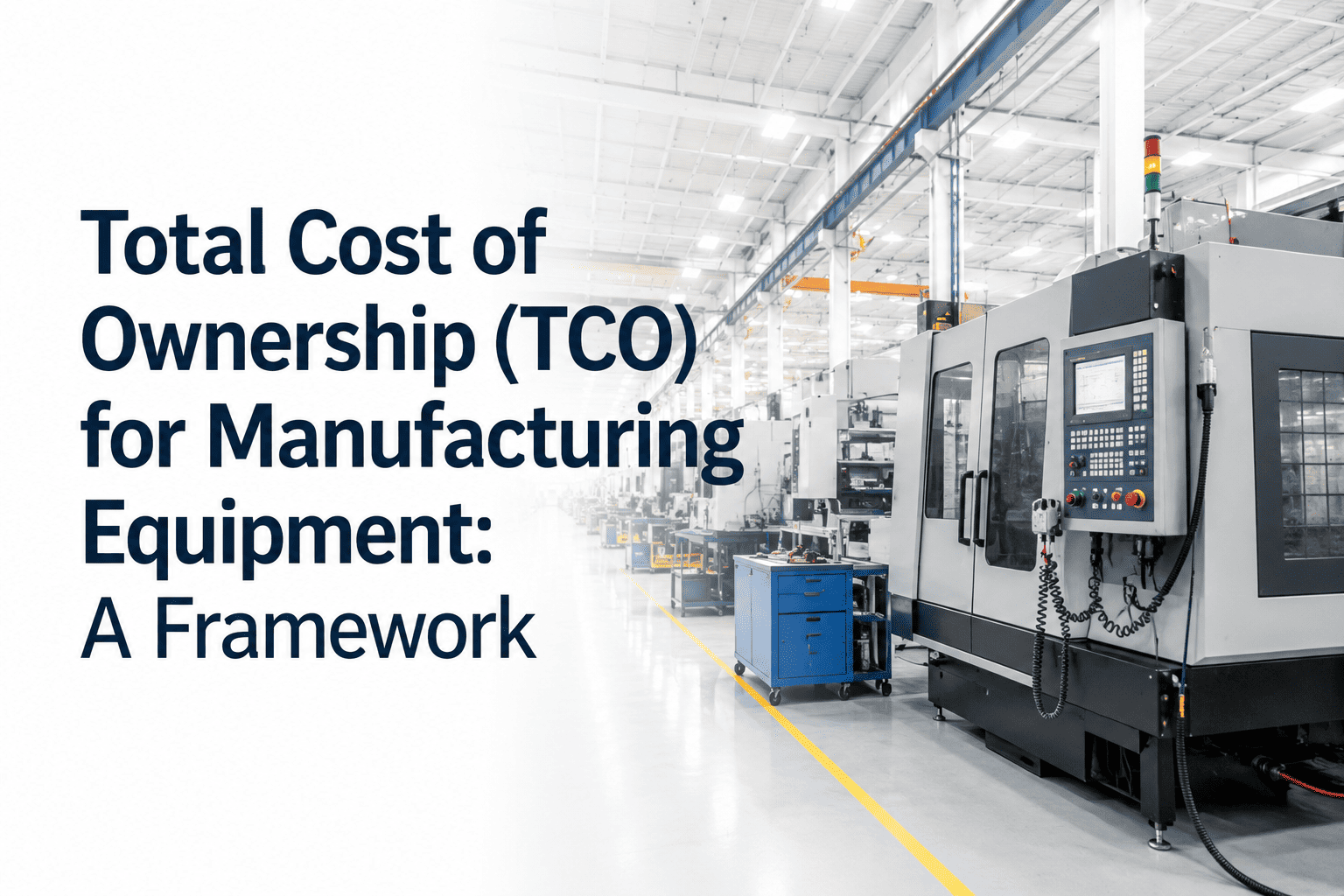
Total Cost of Ownership (TCO) for Manufacturing Equipment: A Framework
TCO analysis reveals the true cost of equipment ownership by aggregating acquisition, maintenance, energy, downtime, and disposal expenses across the asset lifecycle — enabling smarter capital investment decisions that reduce total ownership costs by 22%.
5 Cost Categories That Define Total Cost of Ownership
Total Cost of Ownership encompasses every financial impact an asset has on the organization from purchase to disposal. This framework breaks TCO into five measurable categories that capture both visible and hidden costs.
Acquisition Costs
Purchase price, delivery, installation, training, and commissioning. This is the only cost category most procurement processes consider, yet it typically represents just 25–35% of total lifecycle cost for industrial equipment.
Maintenance and Repair Costs
Preventive maintenance labor, spare parts inventory, consumables, corrective repairs, and technician time. For complex machinery, maintenance represents 30–45% of total lifecycle cost and varies dramatically between equipment models.
Energy and Utility Costs
Electricity, compressed air, water, and other utilities consumed during operation. Energy-efficient equipment may cost 15–25% more upfront but deliver 30–50% lower energy costs annually, creating positive ROI within 2–4 years.
Downtime and Production Loss
Revenue lost when equipment is unavailable for production due to planned maintenance or unplanned failures. For critical production equipment, downtime costs can exceed all other TCO categories combined, making reliability the dominant factor in equipment selection.
Disposal and Decommissioning
End-of-life removal, environmental remediation, scrap value recovery, and replacement transition costs. Often overlooked in TCO analysis, disposal costs for large industrial equipment can reach $50,000–200,000 depending on environmental regulations and site complexity.
Typical TCO Breakdown for Manufacturing Equipment Over 10 Years
Percentages vary by equipment type and industry. For critical production assets with high downtime costs, the downtime category can represent 40–60% of total TCO.
TCO Analysis: Comparing Two CNC Machining Centers
This example demonstrates how TCO analysis changes equipment selection by revealing hidden operational costs that outweigh upfront price differences.
| Cost Category | Machine A (Low Initial Cost) | Machine B (High Reliability) |
|---|---|---|
| Purchase price | $250,000 | $320,000 |
| Installation and commissioning | $18,000 | $22,000 |
| Annual maintenance labor (10 years) | $120,000 | $75,000 |
| Spare parts and consumables (10 years) | $95,000 | $52,000 |
| Energy costs (10 years at $0.12/kWh) | $88,000 | $61,000 |
| Estimated downtime cost (10 years) | $140,000 | $45,000 |
| Disposal and decommissioning | $12,000 | $12,000 |
| Total Cost of Ownership (10 years) | $723,000 | $587,000 |
Analysis Outcome
Machine B costs $70,000 more to purchase but delivers $136,000 in total savings over 10 years — an 18.8% reduction in total ownership cost. Procurement decisions based solely on purchase price would select Machine A, resulting in $136,000 in unnecessary expenditure over the asset lifecycle.
Track Real TCO Data with Integrated Maintenance and Asset Management
OxMaint captures maintenance costs, downtime events, energy consumption, and asset performance data automatically — providing the real-world TCO metrics you need to validate equipment investments and optimize asset replacement decisions.
How to Implement TCO Analysis in Your Equipment Procurement Process
Establish TCO Data Collection
Implement a CMMS that tracks maintenance labor hours, parts costs, and equipment downtime events per asset. Without reliable operational cost data, TCO analysis relies on vendor estimates that may be inaccurate or optimistic.
Define Standard Cost Categories
Create a standardized TCO template that procurement, finance, and maintenance teams all use. Consistency in cost categorization enables valid comparisons between different equipment options and suppliers.
Request Vendor TCO Data
Require equipment suppliers to provide expected maintenance intervals, spare parts pricing, energy consumption specifications, and mean time between failures. Vendors with confidence in their equipment reliability will provide this data readily.
Calculate Downtime Impact
Determine the revenue impact of equipment unavailability for your specific production environment. Downtime costs vary by facility utilization, product margins, and whether backup equipment exists, so generic estimates are unreliable.
Run Sensitivity Analysis
Model how TCO changes if maintenance costs are 20% higher than expected, or if downtime occurs twice as frequently. Sensitivity analysis identifies which cost assumptions most affect the decision and where risk lies.
Review and Refine Annually
Compare actual TCO performance against initial projections for equipment purchased in previous years. Use variance analysis to improve future TCO estimates and identify underperforming assets that should be replaced earlier than planned.
TCO Analysis Pitfalls to Avoid
Underestimating Downtime Costs
Facilities often calculate downtime cost as lost production value only, ignoring overtime labor to recover production, late delivery penalties, and customer relationship damage from unreliable delivery.
Ignoring Energy Cost Escalation
TCO models using current energy prices understate future costs for equipment with 15–20 year lifecycles. Energy costs that rise 3% annually compound to 34% higher expense by year 10.
Using Vendor-Supplied Maintenance Estimates Without Validation
Equipment suppliers provide optimistic maintenance cost estimates to improve their TCO positioning. Validate vendor claims with independent data from facilities operating the same equipment or similar models.
Failing to Account for Learning Curve Costs
New equipment types require technician training, new spare parts inventory, and different maintenance procedures. The productivity loss and increased maintenance time during the learning period adds 15–25% to first-year costs.
Total Cost of Ownership — Common Questions
How accurate do TCO projections need to be to support equipment decisions?
Should TCO analysis use nominal or inflation-adjusted costs?
How do you calculate TCO for used or refurbished equipment?
What discount rate should be used for TCO analysis?
Can TCO analysis be applied retroactively to existing equipment?
Build Data-Driven TCO Models with Real Asset Performance Data
OxMaint automatically tracks maintenance costs, downtime frequency, energy consumption, and asset reliability — providing the operational data foundation that makes TCO analysis accurate and actionable instead of theoretical.