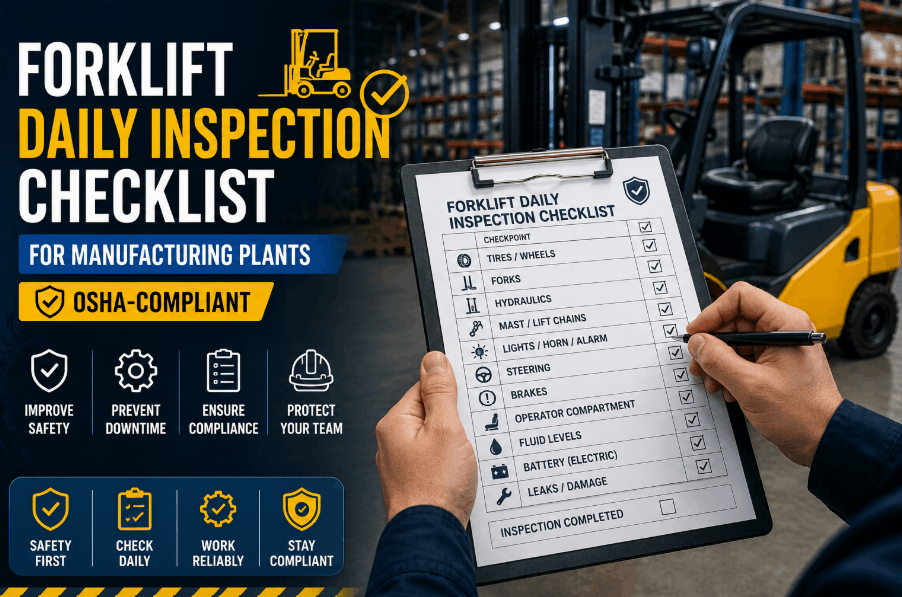
A forklift daily inspection checklist is the single most important document a warehouse manager or EHS officer deploys to prevent OSHA citations, protect operators, and keep powered industrial trucks running safely across every shift. Under OSHA 1910.178(q)(7), forklifts must be inspected at least daily — or before each shift in multi-shift operations — and defects must be documented before the equipment enters service. Skipping this process contributes to the 85 fatal forklift accidents and 34,900 serious injuries reported annually in U.S. workplaces. This forklift daily inspection checklist 2026 covers all critical systems — forks, mast, hydraulics, brakes, tires, lights, and operator controls — giving manufacturing safety teams a repeatable, OSHA-compliant pre-shift inspection framework. Sign Up Free to digitize your forklift pre-shift inspection forms and track compliance across every vehicle on your floor.
Your Forklift Is One Missed Inspection Away From an OSHA Recordable — Are You Covered?
Oxmaint digitizes your forklift daily inspection checklist, assigns tasks to operators, and delivers real-time compliance visibility across your entire powered industrial truck fleet.
Fork and Mast Assembly Pre-Shift Inspection
Fork and mast integrity failures cause the majority of load drop incidents in warehouse environments. Bent blades, worn heel sections, and cracked mast channels create catastrophic drop hazards before each shift. Book a Demo to see how Oxmaint automates fork and mast inspection scheduling across your fleet.
Hydraulic System and Lift Function Inspection
Hydraulic failures cause sudden load drops and uncontrolled mast descents — two of the highest-severity forklift incidents in manufacturing. A thorough hydraulic pre-use inspection catches degraded hoses and low fluid levels before they become recordable incidents. Sign Up Free to digitize hydraulic inspection records and automate replacement scheduling with Oxmaint.
Braking System and Steering Inspection
Brake failures are the leading cause of pedestrian fatalities in powered industrial truck incidents. A forklift with degraded brakes cannot stop reliably on ramps and dock plates where gradient forces compound stopping distances. Book a Demo to see how Oxmaint logs brake test results and auto-escalates service work orders.
Lights, Horns, and Warning Device Inspection
Warning and visibility systems are the primary defense against pedestrian-forklift collisions. Non-functional lights, disabled back-up alarms, and inoperative horns are cited in nearly 40% of pedestrian fatality investigations. Sign Up Free and give supervisors real-time visibility into which forklifts have passed warning device checks at shift start via Oxmaint.
Electric and Propane Forklift Power System Inspection
Power system inspection requirements differ significantly between electric and LP/propane units. Electric battery hazards include hydrogen gas and electrolyte spills; LP units present fuel leak and flame risks. Both are mandatory under OSHA 1910.178(f) and (g). Book a Demo to see how Oxmaint tracks both fuel types with separate configurable checklists per unit.
Operator Controls and Operator Cab Inspection
Operator cab and control defects cause erratic vehicle behavior that endangers operators and surrounding personnel. Worn pedals, non-centering columns, and malfunctioning deadman switches create uncontrolled motion risks that routine pre-use inspection prevents. Sign Up Free to assign unit-specific mobile inspection checklists to operators at shift login with Oxmaint.
Forklift Inspection Frequency and Governing Standard Reference
| System / Component | Inspection Action | Frequency | Governing Standard |
|---|---|---|---|
| Fork Blades & Heel | Crack, bend, and wear inspection | Every shift | OSHA 1910.178 / ASME B56.1 |
| Mast & Lift Chains | Channel check, chain elongation, roller wear | Every shift | ASME B56.1 / ANSI/ITSDF B56.1 |
| Hydraulic System | Fluid level, hose condition, drift test | Every shift | OSHA 1910.178 / ASME B56.1 |
| Brakes & Steering | Pedal firmness, stop distance, parking hold | Every shift | OSHA 1910.178(e) / ANSI B56.1 |
| Lights & Alarms | Headlights, back-up alarm, horn test | Every shift | OSHA 1910.178 / ANSI B56.1 |
| Tires | Wear, pressure, chunk and cut inspection | Every shift | OSHA 1910.178 / ASME B56.1 |
| Battery / LP System | Charge, retention, leak test | Every shift | OSHA 1910.178(f)(g) / NFPA 58 |
| Overhead Guard | Structural integrity and mounting check | Every shift | OSHA 1910.178 / ASME B56.1 |
| Operator Restraint | Seatbelt retractor and latch test | Every shift | OSHA 1910.178 / ANSI/ITSDF B56.1 |
| Hydraulic Hoses & Cylinders | Full hose replacement evaluation | Monthly | ASME B56.1 / OEM service intervals |
Your Forklifts Are Running. Your Inspection Records Should Be Too — Shift After Shift.
Oxmaint puts your forklift operator checklist on any mobile device and delivers instant compliance alerts to supervisors the moment a critical item is skipped or flagged.
Frequently Asked Questions — Forklift Daily Inspection Checklist
Every Forklift. Every Operator. Every Shift — Inspected, Documented, and Verified.
Oxmaint makes OSHA-compliant forklift pre-shift inspection the easiest part of your safety program — not the most overlooked one.
![preventive-maintenance-task-list-template--manufacturing-[download-free]](./manage-post-2k26/uploads/preventive-maintenance-task-list-template--manufacturing-[download-free].png)
![plant-maintenance-budget-template-2026-[excel---google-sheets]](./manage-post-2k26/uploads/plant-maintenance-budget-template-2026-[excel---google-sheets].png)