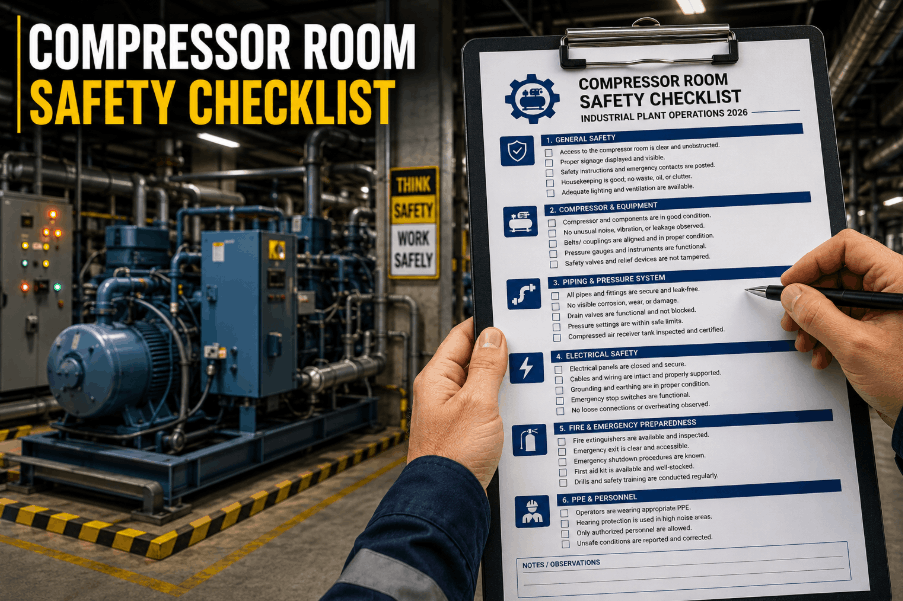
A compressor room safety checklist is the frontline defense against industrial accidents, unplanned downtime, and regulatory violations in any plant operation. Under OSHA 29 CFR 1910.169, ASME Section VIII, and NFPA 70E, compressor rooms housing reciprocating, rotary screw, or centrifugal compressors require structured safety inspections covering pressure containment, ventilation adequacy, electrical hazard control, emergency shutdown readiness, and fire suppression verification. A skipped inspection cycle doesn't just expose your facility to OSHA citation — it removes the only early-warning layer between normal operation and a catastrophic pressure event during peak production. This compressor room safety checklist covers every task plant safety officers and industrial hygienists expect, organized by hazard zone so your team executes what protects people, assets, and compliance standing. Sign Up Free to digitize compressor room safety inspections, auto-assign recurring safety work orders, and maintain a timestamped audit trail for every checklist completed across your plant.
Your Compressor Room Has Dozens of Safety Conditions. Are You Documenting Every One?
Oxmaint auto-schedules compressor room safety inspections by equipment type and hazard zone, routes work orders to certified technicians, and generates timestamped compliance records that satisfy OSHA auditors and insurance reviewers — from a single CMMS platform.
Pressure Relief Valve and Vessel Integrity Safety Checklist
Pressure vessel failures are among the most destructive events in industrial plant operations — a failed relief valve on a reciprocating compressor is a mechanical explosion risk, not a maintenance inconvenience. ASME Section VIII and OSHA 29 CFR 1910.169 require pressure-containing components to be inspected at defined intervals. A PRV that lifts at the wrong setpoint, or not at all, eliminates the only protection layer between overpressure buildup and vessel rupture. Book a Demo to see how Oxmaint tracks PRV inspection intervals, captures test results in the work order, and flags overdue pressure vessel certifications before an OSHA audit finds them first.
Compressor Room Ventilation and Thermal Safety Checklist
Compressor rooms generate substantial heat loads — an unventilated rotary screw compressor room can exceed safe operating temperatures within minutes of door closure during summer operation. Inadequate ventilation also concentrates lubricant vapors and combustion byproducts that create fire and health hazards. NFPA 70E and OSHA 1910.94 require adequate ventilation in rooms housing air-compressing equipment. Sign Up Free to schedule ventilation inspection work orders, log ambient temperature readings at compressor load, and alert maintenance teams when thermal conditions exceed safe thresholds.
Compressor Oil Level, Quality, and Leak Safety Checklist
Lubrication system failures are the leading cause of catastrophic compressor seizure in industrial facilities. Low oil level under load destroys bearings within minutes; degraded oil fails to maintain the film between screw elements, accelerating internal wear at rates that no downstream repair can reverse. Oil leaks in compressor rooms also create slip hazards and fire risks when lubricant contacts hot compressor surfaces. Book a Demo to see how Oxmaint's PM work orders capture oil level readings, oil sample lab results, and leak inspection records linked directly to each compressor asset.
Electrical Safety, Starter, and Belt Drive Inspection Checklist
Electrical hazards in compressor rooms are amplified by the combination of high-voltage motor starters, oil vapor in the air, and condensation from compressed air piping. NFPA 70E arc flash requirements apply to any compressor with motor control panels accessible to maintenance personnel. Belt-driven reciprocating compressors add a mechanical energy hazard from exposed drive components that OSHA 1910.212 requires to be guarded at all times during operation. Sign Up Free to build NFPA 70E electrical inspection tasks into your compressor room safety work orders and track guard installation compliance across every unit.
Emergency Shutdown, Fire Safety, and Egress Inspection Checklist
Emergency response capability in a compressor room degrades silently — E-stop buttons corrode, fire extinguishers expire, and egress paths become storage locations between formal inspections. A compressor room emergency system that fails during a pressure event or fire offers no protection to personnel and no mitigation of equipment damage. OSHA 29 CFR 1910.157, NFPA 10, and local fire codes require fire suppression equipment inspection at defined intervals regardless of whether the equipment has been used. Book a Demo to see how Oxmaint auto-generates emergency system verification work orders on NFPA-required intervals with digital pass/fail capture for every safety device.
Compressor Room Housekeeping and Hazard Zone Compliance Checklist
Compressor room housekeeping failures convert a controlled environment into an active hazard zone — oil-soaked rags near hot exhaust components, unlabeled chemical containers, and compressed air hose assemblies left coiled on walkways are the three most cited housekeeping violations in industrial plant OSHA inspections. Structured housekeeping inspection is not a janitorial exercise; it is a fire, slip, and pressure hazard audit that belongs in every compressor PM work order. Sign Up Free to embed compressor room housekeeping and hazard zone verification directly into recurring Oxmaint inspection templates assigned to the right personnel on the right interval.
Compressor Room Safety Inspection Frequency and Governing Standard Reference
| System / Hazard Zone | Safety Inspection Task | Frequency | Governing Standard |
|---|---|---|---|
| Pressure Relief Valves | Lift test, setpoint verification, gauge calibration | Annual | ASME VIII / OSHA 1910.169 |
| Air Receiver Vessels | External corrosion, drain valve, weld inspection | Annual | ASME VIII / OSHA 1910.169 |
| Ventilation Systems | Ambient temp, CFM verification, louver inspection | Quarterly / Annual | OSHA 1910.94 / NFPA 70E |
| Oil and Lubrication | Level check, leak inspection, oil sample, separator ΔP | Monthly / Annual | OEM Warranty / ISO 8573 |
| Electrical / Motor | Arc flash label, amperage, LOTO verification | Annual | NFPA 70E / OSHA 1910.147 |
| Belt Drives and Guards | Guard installation, belt tension, alignment | Quarterly | OSHA 1910.212 / OEM |
| Emergency Shutdown | E-stop test, safety shutdown setpoint verification | Annual | OEM / OSHA 1910.147 |
| Fire Safety / Egress | Extinguisher inspection, egress path, exit lighting | Monthly / Annual | NFPA 10 / OSHA 1910.157 |
| Housekeeping / Hazard Zone | Floor condition, flammables storage, hose storage | Weekly / Monthly | OSHA 1910.22 / NFPA 30 |
| CMMS Recordkeeping | Inspection records, corrective actions, deferred items | Each Inspection | OSHA / OEM / Insurance |
Stop Managing Compressor Room Safety on Spreadsheets and Paper Forms.
Oxmaint builds OSHA and OEM-aligned compressor room safety checklists into your CMMS, enforces required data capture at every safety checkpoint, and generates timestamped inspection records that satisfy auditors — from a single platform your entire maintenance team can use on mobile in the field.
Frequently Asked Questions — Compressor Room Safety Checklist
Every Compressor Room. Every Safety Checkpoint. Every Record — Documented and Audit-Ready in Oxmaint.
Oxmaint makes compressor room safety inspection the most defensible part of your plant safety program — not the documentation gap that exposes your facility when an OSHA inspector or insurance auditor arrives unannounced.
![preventive-maintenance-task-list-template--manufacturing-[download-free]](./manage-post-2k26/uploads/preventive-maintenance-task-list-template--manufacturing-[download-free].png)

![plant-maintenance-budget-template-2026-[excel---google-sheets]](./manage-post-2k26/uploads/plant-maintenance-budget-template-2026-[excel---google-sheets].png)