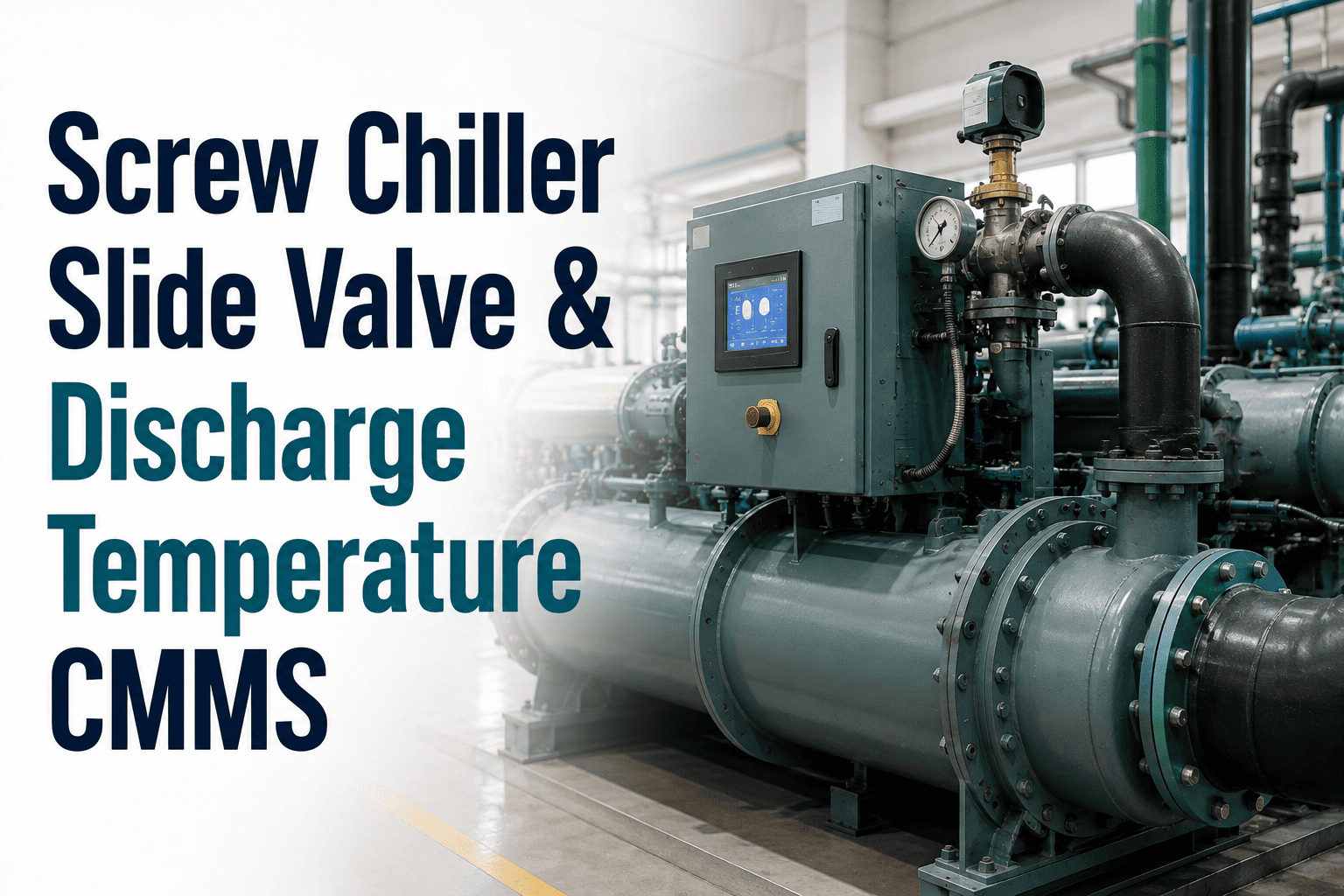
Screw chiller maintenance hinges on two critical parameters: slide valve modulation across the 10–100% capacity range and discharge temperature staying below 220°F. When either drifts out of spec, compressor efficiency collapses, oil degrades, and major overhauls become inevitable. A modern CMMS like OxMaint automates the inspection triggers, temperature-limit alerts, and PM scheduling that keep screw compressors running at peak performance. This guide covers the full screw chiller checklist — slide valve testing, discharge temp monitoring, oil separator PM, and how digital work orders cut unplanned downtime 30–50%. Ready to modernize your maintenance program? Start Free Trial and configure your chiller PM templates today.
Screw Chiller Maintenance Guide
Is your screw chiller's slide valve modulating correctly — or bleeding efficiency every cycle?
A mis calibrated slide valve or a discharge temperature creeping past 220°F can slash compressor efficiency by 18–25% and halve oil life before the next planned overhaul. OxMaint's CMMS tracks every modulation test, temperature reading, and oil separator PM automatically — so failures are predicted, not reacted to.
The cost of one missed slide valve failure
On a 500-ton screw chiller, a slide valve that sticks at 40% capacity during peak load can add $38,000+ in annual energy waste and trigger unplanned compressor teardowns costing $25K–$90K. Continuous discharge temperature monitoring and automated PM triggers are the difference between a $400 oil change and a $90,000 emergency rebuild.
Slide Valve Modulation Testing
How to test slide valve modulation across the 10–100% capacity range
The slide valve on a screw chiller modulates capacity by shortening the compression stroke. If it sticks, surges, or fails to reach full travel, the compressor either short-cycles or runs unloaded — wasting energy and stressing bearings. A structured slide valve chiller test verifies smooth modulation across six setpoints.
Baseline at 100% load — verify full capacity
Command the chiller to 100% capacity. Confirm the slide valve position indicator reads 95–100%, amperage draws within 5% of nameplate FLA, and discharge pressure matches design condensing temperature. Record all three values as the benchmark in OxMaint's asset history.
Step down to 75% — check modulation response time
Reduce the capacity setpoint to 75%. The slide valve should reach the new position within 30–60 seconds. If it overshoots or hunts, the capacity controller or valve actuator needs calibration. Log response time — trending it monthly reveals actuator wear before failure.
Test 50% and 25% — confirm stable part-load operation
At 50% and 25% capacity, the chiller should run smoothly without surge, excessive vibration, or oil carryover. Discharge temperature should not rise more than 8–10°F above the full-load reading. Unstable operation at these setpoints often points to worn slide valve O-rings or guide rails.
Minimum capacity at 10% — verify unload capability
Most screw chillers can unload to 10–15% capacity. If the chiller surges or trips at this setpoint, the slide valve may not be fully retracting, or the minimum load bypass valve is malfunctioning. This is a critical efficiency check for variable-load applications.
Return to 100% — confirm repeatable full travel
Command back to full load and verify the slide valve returns to its original position within tolerance. Hysteresis greater than 3–5% indicates internal wear. OxMaint auto-generates a follow-up work order if readings deviate beyond configured thresholds.
Document and trend — feed data into your CMMS
Every slide valve test reading should be logged against the chiller's asset record. OxMaint's analytics flag negative trends — increasing response times, rising discharge temps at part load — and auto-schedule corrective PM before efficiency drops or failure occurs.
Discharge Temperature Monitoring
Screw chiller discharge temperature limits: why 220°F is the red line
Discharge temperature is the single most predictive indicator of screw compressor health. Refrigerant and lubricant begin breaking down rapidly above 220°F, forming acids that attack motor windings and bearings. Monitoring this metric continuously — not just during quarterly inspections — is what separates proactive teams from reactive ones.
Discharge Temperature Rule of Thumb
Tdischarge ≈ Tevap + Tcond + Compression Heat (≈ 40–60°F)
For R-134a screw chillers: if Tdischarge exceeds 220°F, oil breakdown accelerates exponentially. At 240°F, oil life drops below 2,000 hours. At 260°F, compressor failure is imminent within weeks.
Root Causes of High Discharge Temp
1. Low refrigerant charge → higher compression ratio
2. Fouled condenser tubes → elevated condensing temp
3. Worn slide valve seals → internal recirculation
4. Insufficient oil injection → poor cooling
5. Non-condensables in system → false head pressure
Each 10°F rise above baseline discharge temperature roughly halves oil life and increases bearing wear rate by 15–20%.
Worked Example — 500-Ton R-134a Screw Chiller at a Food Processing Plant
A Midwest food processor's 500-ton screw chiller showed discharge temperatures creeping from 195°F to 218°F over four months. The maintenance team, using spreadsheets, didn't catch the trend until the chiller tripped on high oil temperature. Root cause: a partially fouled condenser combined with a slide valve seal leak. The unplanned outage cost $47,000 in lost production and $18,500 in emergency repairs. With OxMaint's continuous temperature trending and automated threshold alerts, the fouling trend would have triggered a condenser cleaning work order at 205°F — a $2,200 PM that prevents the $65,500 failure.
Screw Chiller PM Checklist
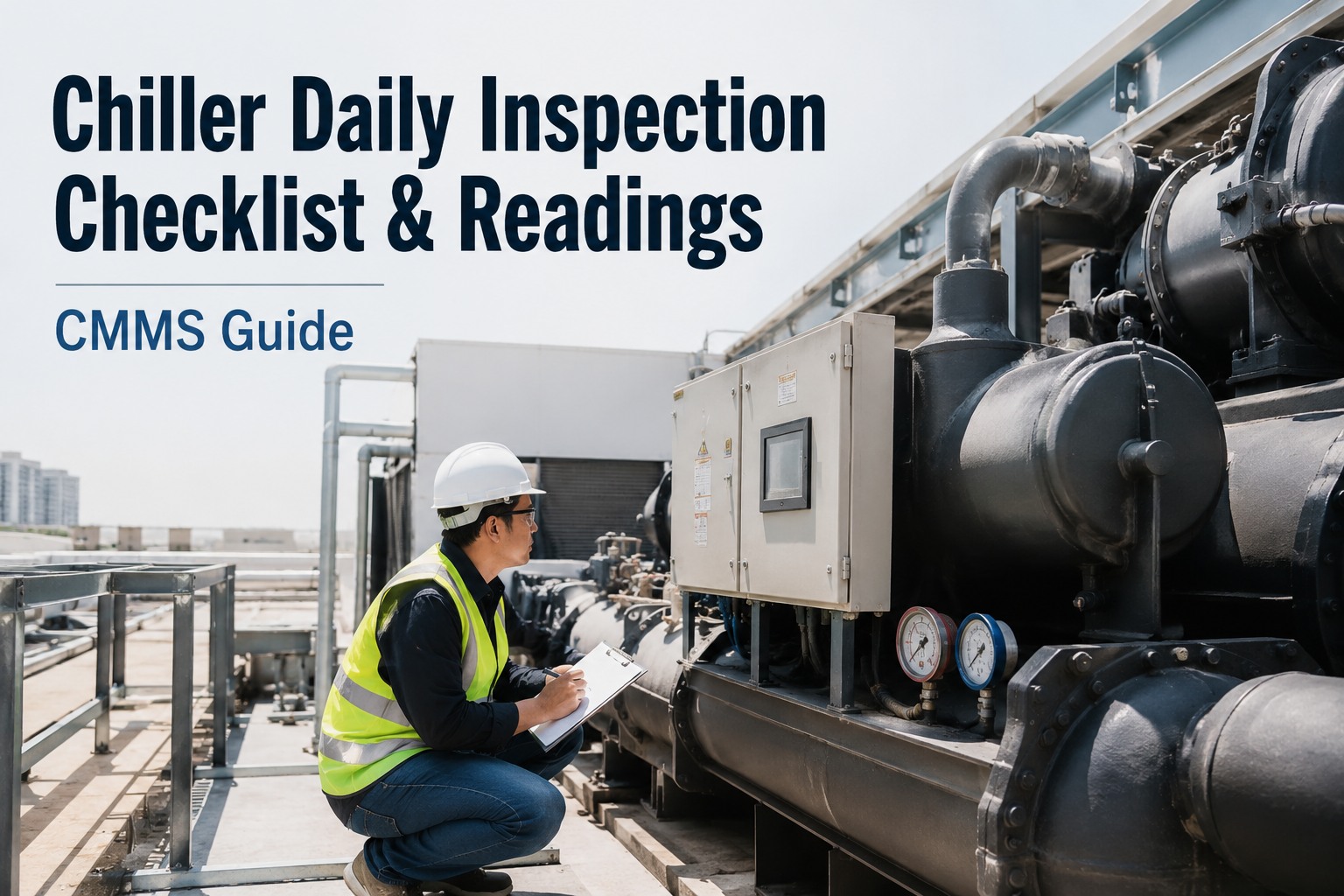
Complete screw chiller preventive maintenance checklist
This tiered screw chiller checklist covers daily, monthly, quarterly, and annual PM tasks for slide valve compressors. Each item maps directly to a work-order template inside OxMaint, so nothing falls through the cracks.
- Log discharge temperature — flag if above 210°F
- Record oil pressure and oil temperature
- Check for unusual vibration or noise during modulation
- Verify chiller status panel shows no active alarms
- Inspect for refrigerant or oil leaks at flanges
- Perform slide valve modulation test (10–100% range)
- Sample compressor oil — check moisture and acidity
- Inspect oil separator for foaming or high oil level
- Clean condenser coil fins and verify water flow rates
- Trend discharge temperature vs. baseline — auto-logged
- Replace or clean oil filter element (every 2,000 hrs)
- Calibrate slide valve position indicator and capacity controller
- Test all safety cutouts — high pressure, low oil, high temp
- Inspect motor winding resistance and megger test
- Perform refrigerant leak survey with electronic detector
- Replace compressor oil and oil filter (mandatory annual)
- Replace refrigerant filter drier cores
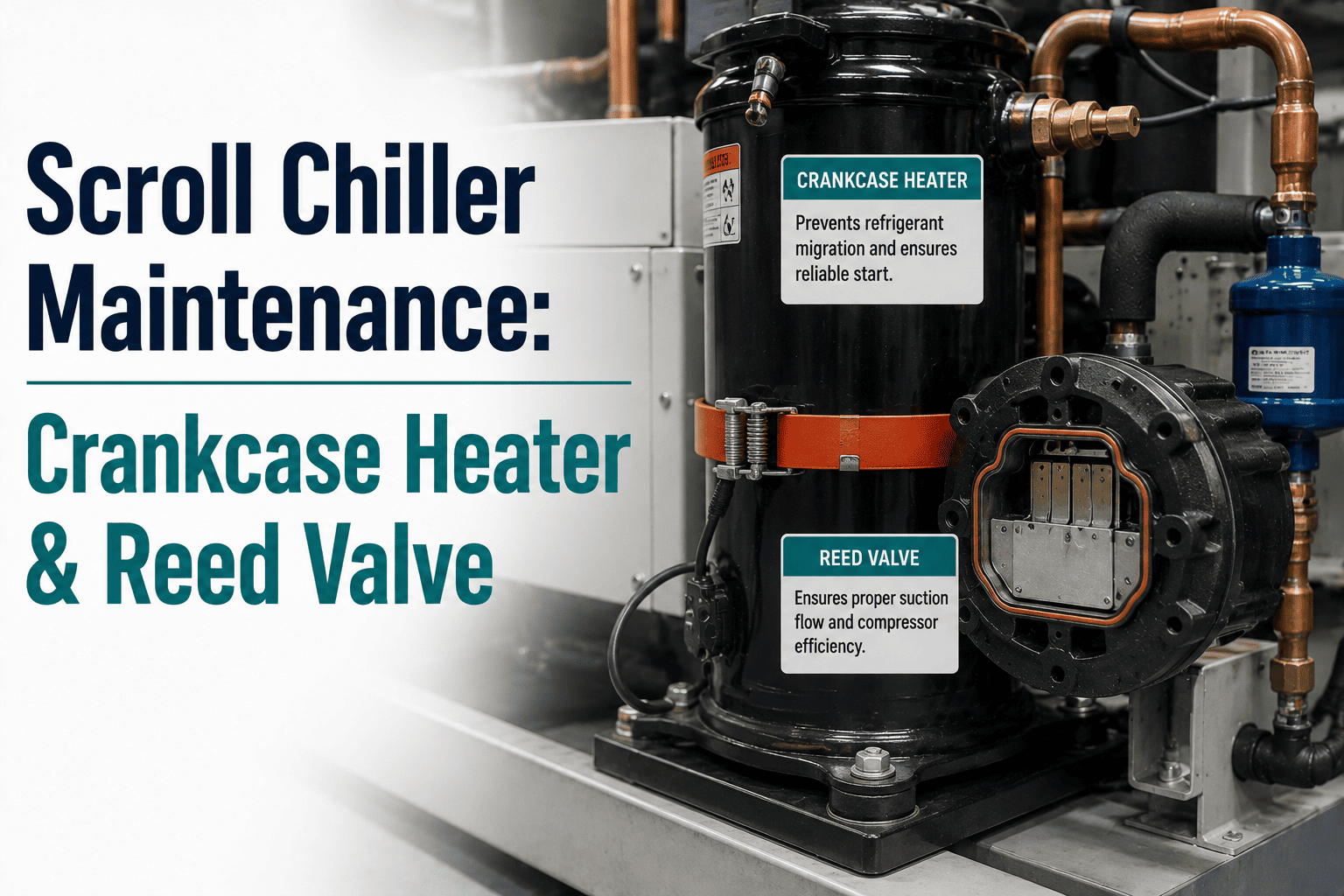
- Inspect slide valve seals, guide rails, and actuator
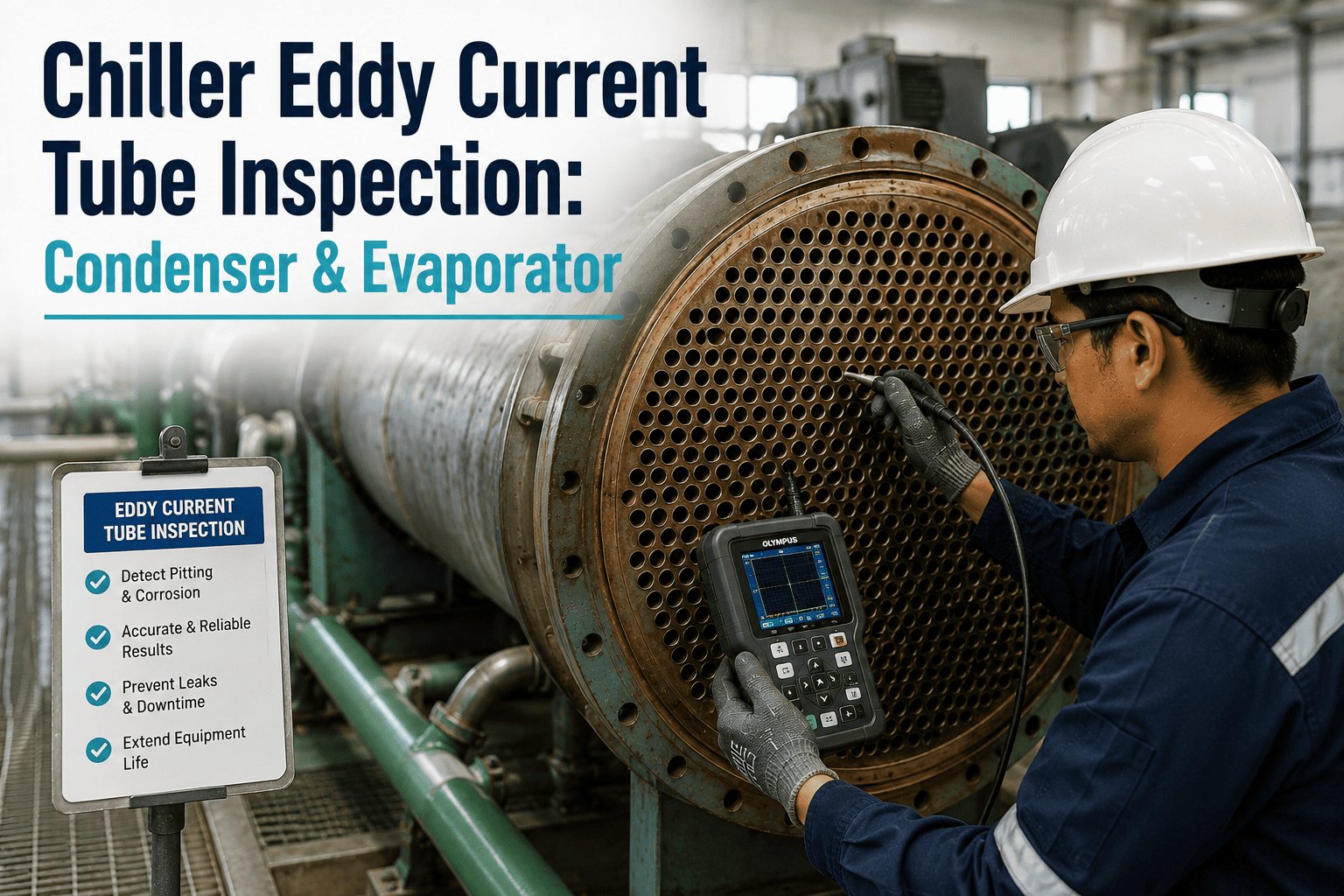
- Perform eddy-current condenser tube inspection
- Calibrate all pressure and temperature sensors
| PM Task | Frequency | Key Threshold | Failure Cost If Skipped |
|---|---|---|---|
| Slide valve modulation test | Monthly | Full travel 10–100%, response < 60s | $25K–$90K compressor rebuild |
| Discharge temperature log | Daily | Below 220°F (alarm at 210°F) | $12K–$20K oil system damage |
| Oil sample and analysis | Monthly | Acidity < 0.05 mg KOH/g | $8K–$15K bearing failure |
| Oil separator inspection | Monthly | No foaming, oil return temp normal | $5K–$10K refrigerant contamination |
| Oil and filter replacement | Annual / 8,000 hrs | Use OEM-specified viscosity grade | $15K–$35K accelerated wear |
| Condenser tube cleaning | Quarterly / as trended | Approach temp < 3°F | $20K+ in lost efficiency / yr |
How OxMaint Helps
How OxMaint's CMMS transforms screw chiller maintenance
Managing screw chiller PM with spreadsheets and clipboard inspections means missed intervals, untracked trends, and reactive scrambles. OxMaint digitizes the entire workflow — from slide valve test checklists to discharge temperature thresholds — with AI-powered failure prediction built in.
Automated PM Scheduling
Pre-built screw chiller PM templates auto-generate work orders for slide valve tests, oil changes, and separator inspections on schedule. Eliminates 95% of missed PM intervals — no chiller task falls through the cracks again.
Outcome: 30–50% reduction in unplanned downtime
Discharge Temp Trending & Alerts
Log daily discharge temperature readings against each chiller's asset record. OxMaint's analytics engine flags upward trends and auto-triggers work orders when temps cross configurable thresholds (e.g., 205°F warning, 210°F critical).
Outcome: Catch oil breakdown 4–8 weeks before failure
Slide Valve Test Checklists
Digital, mobile-friendly checklists guide technicians through the 10–100% modulation test. Every reading — position, response time, amperage — is captured in the asset history with timestamps, enabling trend analysis across months and seasons.
Outcome: 100% PM documentation, audit-ready in seconds
Spare Parts & Inventory Tracking
Track oil filters, refrigerant, slide valve seal kits, and bearing assemblies by chiller asset. OxMaint auto-reorders critical spares when stock hits minimum levels, so the parts you need for a $2K PM are always on hand — preventing a $90K reactive rebuild.
Outcome: Cut parts-related downtime by 70%
See OxMaint on your screw chillers — book a 30-minute demo
We'll load your chiller assets, configure discharge temperature thresholds, and show you how automated slide valve PM checklists work in real time. Most teams go live within 2 weeks.
FAQ
Screw chiller maintenance: frequently asked questions
What is the normal discharge temperature for a screw chiller?
Normal discharge temperature for a screw chiller operating on R-134a typically ranges from 160°F to 200°F. The absolute maximum safe limit is 220°F — above this, lubricant breakdown accelerates rapidly, forming acids that attack motor windings and bearings. OxMaint's CMMS allows you to set warning thresholds at 205°F and critical alerts at 210°F, giving technicians a 4–8 week window to correct the root cause before damage occurs.
How often should slide valve modulation be tested?
Slide valve modulation should be tested monthly by stepping through 100%, 75%, 50%, 25%, and 10% capacity setpoints and recording position, response time, and amperage at each. Quarterly testing is the absolute minimum. Monthly testing catches actuator wear, seal degradation, and capacity controller drift early — each of which can reduce chiller efficiency by 10–25% if left uncorrected. You can schedule and document these tests automatically in OxMaint — Start Free Trial to set up the template.
Why is the oil separator critical in screw chiller maintenance?
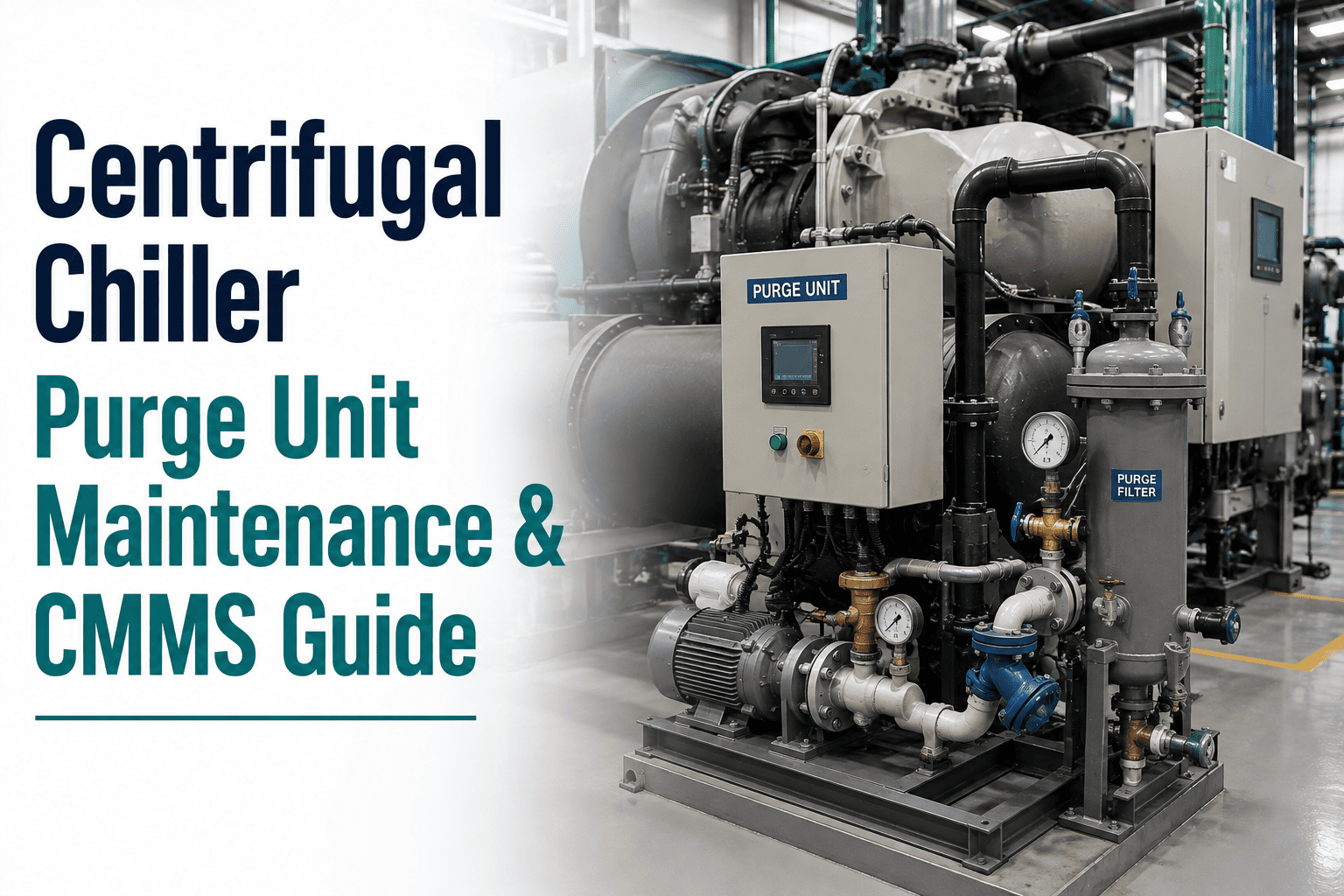
The oil separator removes lubricating oil from the refrigerant stream before it enters the condenser and evaporator. If the separator is inefficient or the coalescing element is fouled, oil carries over into the system, reducing heat exchanger efficiency by 15–30% and starving the compressor of lubrication. Monthly inspection for foaming, oil level changes, and return-line temperature is essential. OxMaint auto-schedules separator element replacement based on run-hours and oil analysis results.
Can a CMMS prevent screw chiller failures?
Yes — a CMMS prevents screw chiller failures by automating PM scheduling, trending critical parameters like discharge temperature and slide valve response time, and triggering corrective work orders before thresholds are breached. Plants using CMMS for chiller maintenance report 30–50% reductions in unplanned downtime and 15–25% lower energy costs. OxMaint adds AI-powered predictive analytics on top, flagging failure patterns humans miss. Book a walkthrough at Book a Demo to see it on your assets.
What are the signs of slide valve failure in a screw chiller?
Common signs include the chiller failing to reach full load capacity (stuck at partial load), surging or hunting at part-load setpoints, abnormally high discharge temperature at reduced capacity, increasing response time when stepping between setpoints, and audible chattering or vibration during modulation. Any of these symptoms warrants immediate slide valve inspection — the seal kit, guide rails, or actuator may need replacement. Waiting typically turns a $3K–$5K repair into a $25K–$90K compressor rebuild.
Stop reacting to screw chiller failures — start preventing them
Join the maintenance teams using OxMaint to automate slide valve testing, monitor discharge temperatures in real time, and cut unplanned chiller downtime by up to 50%. Your first PM template is live in under an hour.
Free 14-day trial · No credit card