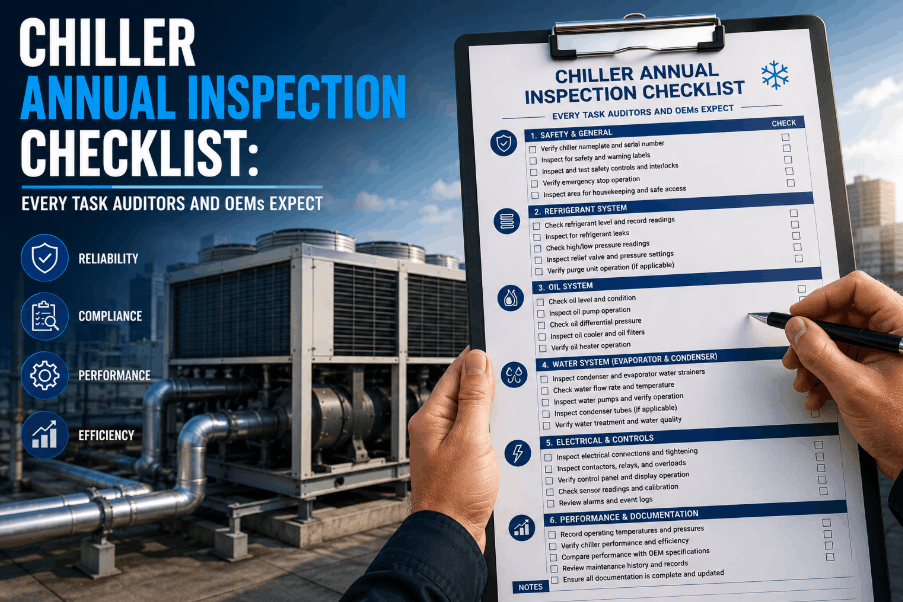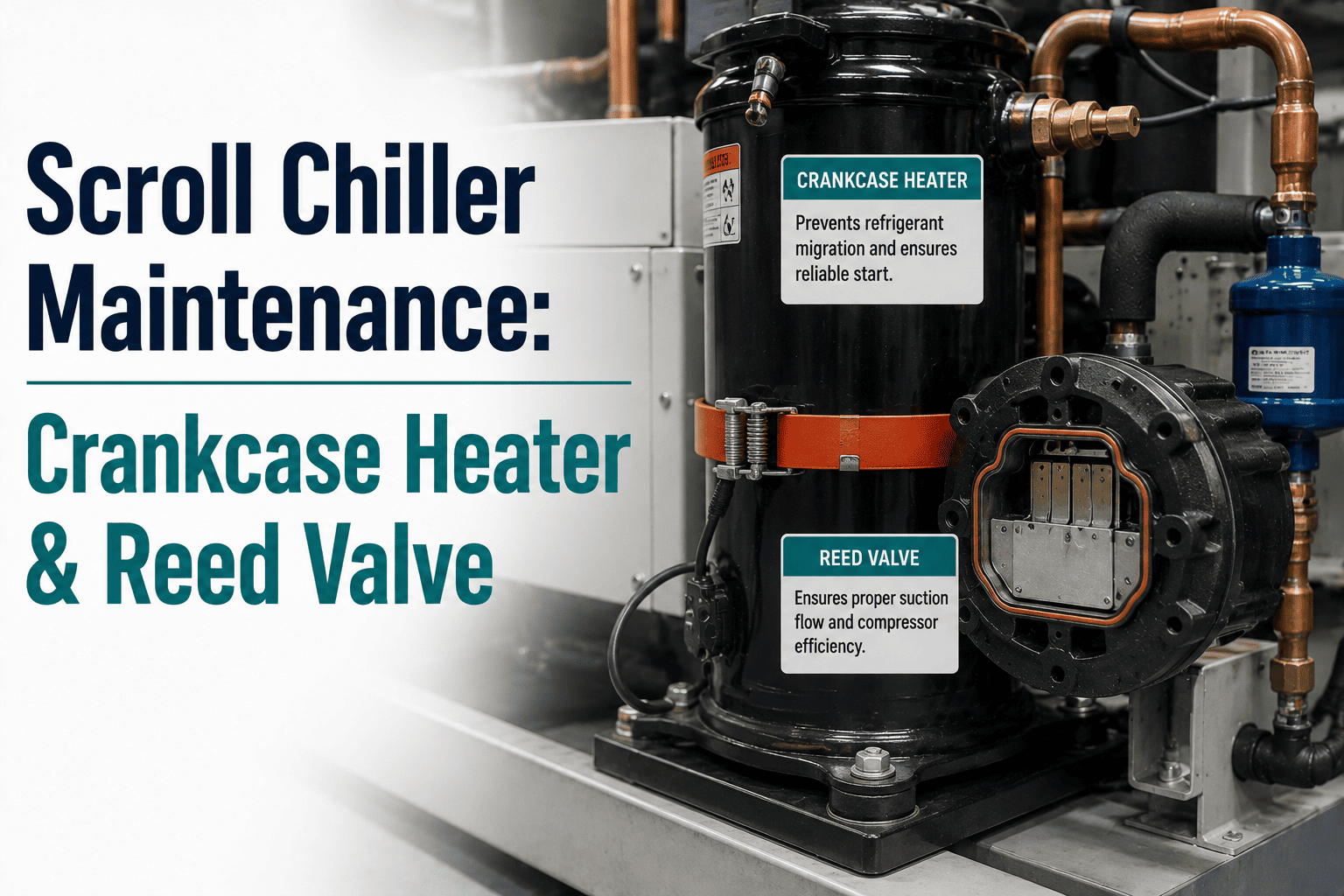
Scroll chiller maintenance hinges on two often-overlooked components: the crankcase heater and the reed valve. When the crankcase heater fails, liquid refrigerant migrates into the oil during the off-cycle, destroying the scroll compressor at startup; when a reed valve flexes fatigues or chips, system capacity drops and discharge temperatures spike. This guide covers off-cycle crankcase heater checks, reed valve inspection during teardown, and refrigerant charge verification to keep your scroll chillers running efficiently. Managing these PM tasks across multiple assets is far easier with a dedicated CMMS—you can Start Free Trial to digitize your entire preventive maintenance workflow today.
Are off-cycle crankcase heater failures costing you compressors?
Over 40% of scroll compressor burnouts trace back to liquid refrigerant migration caused by a failed crankcase heater. Stop Preventive Maintenance blind spots before a $8K+ compressor teardown wipes out your maintenance budget.
The Essential Scroll Chiller PM Checklist
A rigorous scroll chiller PM routine prevents liquid slugging, maintains rated capacity, and extends compressor life beyond the typical 10-year mark. Break these tasks into daily, monthly, and annual intervals.
Off-Cycle & Startup Checks
- Verify crankcase heater is energized when compressor is off (measure amperage)
- Check compressor oil sump temperature (should be 20-30°F above saturation)
- Inspect for liquid refrigerant migration signs (frost on crankcase)
- Listen for abnormal startup rattling indicating reed valve chatter
Running Operations & Charge
- Verify refrigerant charge via subcooling (TXV) or superheat (orifice)
- Monitor discharge temperature (must not exceed 220°F)
- Record compressor amp draw against nameplate RLA
- Log entering/leaving chilled water temperatures for delta-T
Annual Teardown & Inspection
- Perform reed valve inspection for fatigue, carbon tracking, or chipping
- Isolate and megohm-test compressor motor windings
- Calibrate low-pressure and high-pressure safety cutouts
- Pull oil sample for acid/water content analysis
How to Perform a Scroll Chiller Teardown & Valve Inspection
Scroll compressor teardowns require strict documentation. Missing a worn reed valve during inspection can result in a 15-20% efficiency drop before the next service window.
Isolate, Recover & Document Baseline
Isolate electrical feeds and recover the refrigerant charge. Record baseline running pressures and amperage before shutdown. In OxMaint, trigger a digital work order from your phone to log baseline metrics, ensuring no data is lost between the chiller room and the office.
Crankcase Heater & Oil Sump Verification
Remove and test the crankcase heater for continuity and proper ohms. Scale buildup on the heater element drastically reduces heat transfer; replace if heavily scaled. Verify oil sump viscosity and acid content to prevent future bearing wear.
Reed Valve & Scroll Set Inspection
Unbolt the head and discharge muffler. Inspect the reed valves for fatigue breaks or carbon tracking. A failing reed valve allows high-pressure gas to leak back, forcing the scroll to run longer cycles. Check the scroll set for wear lines and measure tip clearance.
Reassembly, Evacuation & Recharge
Replace all gaskets. Pull a deep vacuum to 500 microns to remove non-condensables. Weigh in the exact refrigerant charge per the manufacturer's data plate. Log the final subcooling and superheat values directly into your CMMS asset history.
The Real Cost of Missing a Crankcase Heater Failure
A 180-asset commercial facility running reactive maintenance without a scroll chiller CMMS will experience an average of 3-4 major compressor failures annually. By shifting to predictive PM with OxMaint, that same facility typically reduces catastrophic failures by up to 80%, saving over $50,000 per year in emergency repair costs alone.
Stop losing scroll chillers to missed PM intervals
See how OxMaint automates crankcase heater checks, tracks valve wear, and keeps your refrigerant logs audit-ready.
How OxMaint Solves Scroll Chiller Maintenance
OxMaint is an AI-powered CMMS built to eliminate the spreadsheet chaos that causes missed PMs. Map your scroll chiller maintenance guide directly into automated workflows.
Automated PM Scheduling
Auto-generate off-cycle crankcase heater checks and annual teardown work orders based on runtime hours or calendar days. Eliminate missed intervals and cut unplanned downtime by 30-50%.
Predictive AI Analytics
Feed discharge temperatures, amp draw, and subcooling data into OxMaint's AI to predict reed valve fatigue and compressor degradation before efficiency drops.
Digital Asset Tracking
Maintain a complete digital dossier for every chiller—storing teardown photos, valve inspection logs, and refrigerant charge history in one centralized, audit-ready EAM database.
Spare Parts Inventory
Auto-deduct reed valves, gaskets, and compressors from inventory upon work order completion. Get low-stock alerts so you never delay a teardown waiting for parts.
Refrigerant Charge & Compressor Health Metrics
Tracking the right metrics ensures your scroll chiller guide translates into actual reliability. Compare your current operating data against these industry benchmarks.
| Maintenance Metric | Target Benchmark | Action Required If Out of Range |
|---|---|---|
| Compressor Oil Sump Temp | 20-30°F above sat. temp | Check crankcase heater continuity & contactor |
| Discharge Temperature | 160°F - 200°F | Inspect reed valves for gas blow-by |
| Subcooling (TXV Systems) | 8°F - 12°F | Verify refrigerant charge & condenser flow |
| Superheat (Orifice Systems) | 8°F - 12°F | Adjust charge to prevent liquid flooding |
| Motor Winding Megohm | > 100 Megohms | Acid test oil; plan for motor replacement |
Scroll Chiller Maintenance FAQ
Why does the crankcase heater need to be on during the off-cycle?
The crankcase heater keeps compressor oil warm during off-cycles, preventing liquid refrigerant from migrating into the oil sump and diluting the lubricant. If the heater fails, liquid refrigerant pools in the crankcase and violently washes the oil away during startup (liquid slugging), immediately destroying the scroll set and bearings.
How often should a scroll chiller reed valve be inspected?
Reed valve inspection should occur during every major annual teardown or whenever discharge temperatures exceed 220°F. High discharge temps indicate the valves are leaking high-pressure gas back into the suction side, meaning the compressor is running inefficiently and overheating.
Can a CMMS help prevent scroll compressor failures?
Yes, a CMMS like OxMaint prevents failures by automatically scheduling off-cycle heater checks, logging refrigerant charge data, and tracking runtime hours for predictive teardowns. You can Book a Demo to see how automated PM triggers eliminate the human error that causes missed maintenance.
What is the correct way to verify refrigerant charge on a scroll chiller?
For systems with a thermal expansion valve (TXV), verify charge by measuring subcooling at the condenser outlet (target 8-12°F). For fixed-orifice systems, measure superheat at the evaporator outlet. Never rely solely on suction pressure, as ambient temperature swings distort pressure readings.
What are the signs of a failing reed valve in a scroll compressor?
The primary signs of reed valve failure are abnormally high discharge temperatures, lower-than-normal amp draw (because the compressor isn't doing full work), and a noticeable drop in cooling capacity. You may also hear intermittent chattering or notice the compressor cycling on high-pressure safeties.
Digitize your scroll chiller maintenance program today
Join the maintenance teams using OxMaint to cut downtime, eliminate paper work orders, and predict failures before they happen.
Free 14-day trial · No credit card