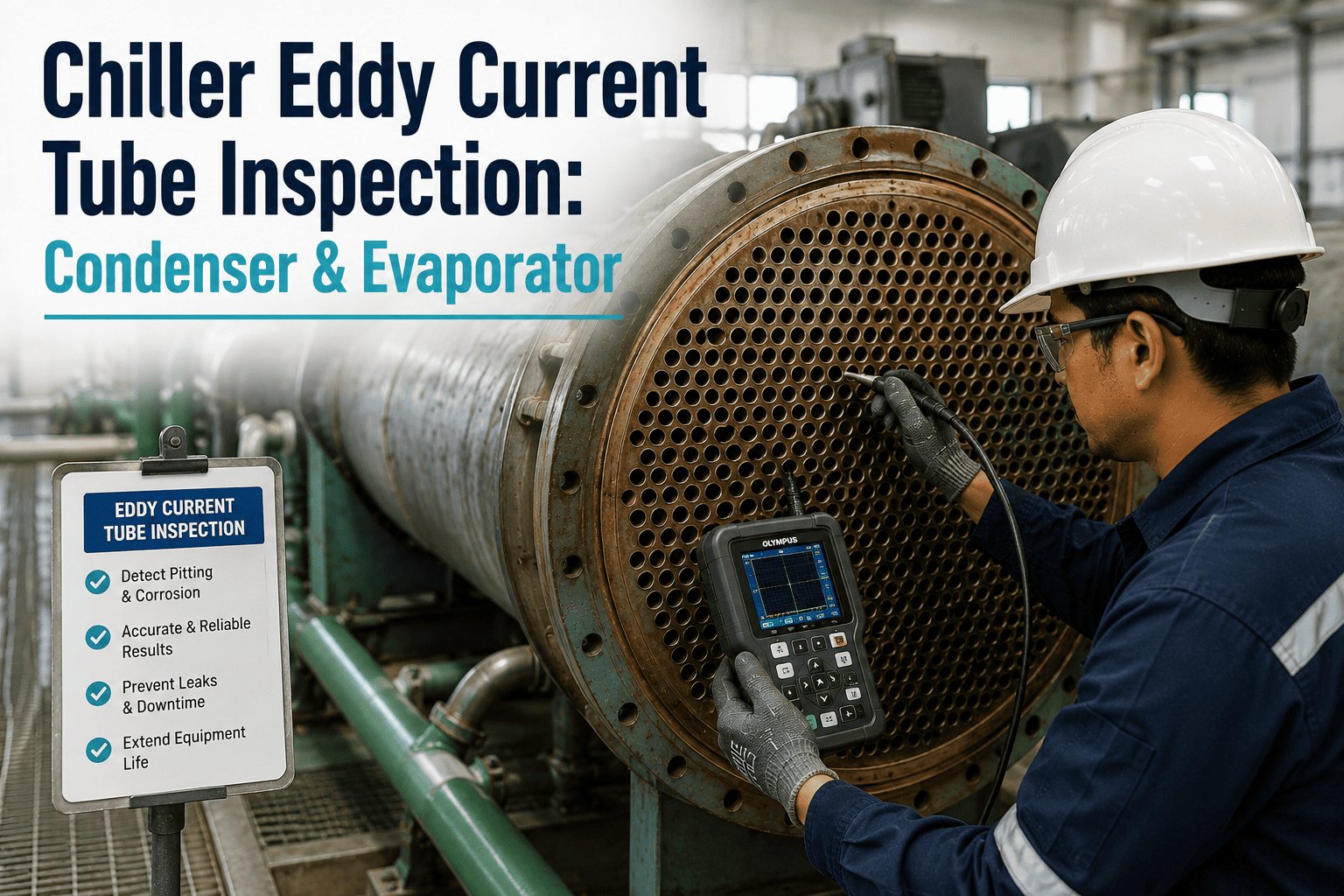
Chiller eddy current tube inspection is the nondestructive examination (NDE) method that maintenance and reliability teams use to detect pitting, cracking, and wall-loss in condenser and evaporator tubes before a catastrophic failure occurs. Industry standards recommend performing eddy current testing on chiller heat exchangers every 3 to 5 years, depending on operating hours, water chemistry, and asset criticality. By identifying tube degradation early, facility managers can avoid unplanned downtime that often exceeds $50,000 per event,and plan retube projects during scheduled outages rather than emergency windows. OxMaint's AI-powered CMMS tracks these inspection intervals automatically, triggering work orders exactly when your chiller tube NDE is due so you never miss a compliance deadline. To digitize your chiller maintenance program and automate inspection scheduling, you can Start Free Trial today.
Chiller Tube NDE Guide
Are Your Chiller Tubes Failing Silently Between Inspections?
Eddy current testing catches pitting and wall loss before a tube rupture takes your 1,000-ton chiller offline. OxMaint automates the 3-to-5-year inspection cycle so you never roll the dice on condenser or evaporator integrity.
for water-cooled chiller condenser and evaporator tubes per ASHRAE and CTI guidelines — tracked automatically in OxMaint.
Inspection Fundamentals
What Is Chiller Eddy Current Tube Inspection?
Eddy current testing (ECT) is a nondestructive electromagnetic technique used to inspect non-ferromagnetic tubes — typically copper, copper-nickel, Admiralty brass, or titanium — found in water-cooled chiller condensers and evaporators. A probe carrying an alternating current is pushed through the tube at 6 to 18 inches per second, inducing eddy currents in the tube wall. When those currents encounter pitting, erosion, stress-corrosion cracking, or wall thinning, the probe detects the impedance shift and generates a real-time signal trace that a certified Level II or Level III analyst interprets.
Eddy current can identify pitting smaller than a pinhead — long before leaks form.
A two-person crew can fully inspect a typical 1,000-ton chiller bundle in one day.
Most retube decisions trigger when 10–20% of tubes show wall loss exceeding 50%.
REAL-WORLD SCENARIO
A 1,200-ton water-cooled chiller at a regional hospital campus was eddy-current tested at year 4. The inspection revealed 38 condenser tubes with pitting exceeding 60% wall loss — caused by microbiologically influenced corrosion (MIC). By plugging the affected tubes and scheduling a targeted retube during a planned outage, the facility avoided an estimated $85,000 in emergency downtime, parts expediting, and after-hours labor. Without the NDE inspection, the chiller would likely have developed tube leaks within 8 to 12 months.
Inspection Checklist
Chiller Condenser & Evaporator Tube Inspection Checklist
A proper eddy current chiller tube test is more than pushing a probe. Use this checklist to ensure your NDE contractor delivers reportable, defensible results that your reliability team can act on.
Pre-Inspection Preparation
- Isolate and lockout-tagout the chiller (LOTO per OSHA 1910.147)
- Drain waterboxes and remove bonnets for tube-sheet access
- Brush-clean tube ends and tube-sheet faces of scale and fouling
- Verify tube material and confirm calibration standard matches
Probe & Calibration Setup
- Calibrate on a tube standard with known artificial defects
- Select differential vs. absolute channel based on defect type
- Set probe push speed (typically 0.3–0.5 m/s for high resolution)
- Map tube sheet layout and assign unique IDs to every tube
Data Collection & Analysis
- Push probe through 100% of accessible condenser/evaporator tubes
- Flag signals exceeding 20% wall-loss on the absolute channel
- Identify defect type: pitting, erosion, cracking, support wear
- Re-inspect suspect tubes at reduced speed for confirmation
Reporting & Action
- Deliver calibrated data file + annotated tube-sheet map
- Rank defects by severity: plug, monitor, or retube
- Upload NDE report to CMMS asset record for audit trail
- Schedule follow-up eddy current test in 3–5 years or per trend
Defect Reference Table
Eddy Current Chiller Tube Defect Quick Reference
Different defect types produce distinct eddy current signal patterns. This table maps the most common chiller tube defects to their causes, signal characteristics, and recommended actions.
| Defect Type | Typical Location | Primary Cause | Signal Characteristic | Recommended Action |
|---|---|---|---|---|
| Pitting | Tube ID, random | Microbiologically influenced corrosion (MIC), chloride | Sharp, localized phase shift on absolute channel | Plug if wall loss > 50%; monitor if < 20% |
| Erosion / Wall Loss | Inlet end, U-bend | High water velocity, entrained particulates | Gradual amplitude increase, smooth trace | Retube section if > 10% of tubes affected |
| Stress Corrosion Cracking | U-bend, tube-sheet expansion | Residual stress + ammonia or amine exposure | Erratic, jagged signal on differential channel | Immediate plug; accelerate retube planning |
| Support-Plate Wear | Baffle / support intersections | Vibration-induced fretting at tube supports | Repeating signal at regular intervals | Install anti-vibration inserts; monitor trend |
| Freeze Damage | Evaporator, bottom rows | Low-temperature excursions, glycol dilution | Bulging signal, multi-plane distortion | Full retube required; inspect for tube-sheet damage |
Retube Decision Criteria
When to Retube vs. Plug: Making the Chiller Retube Decision
Plugging a few defective tubes is standard practice, but as defect counts rise, the thermal performance penalty and leak risk compound. Use these decision criteria to determine when to plug individual tubes versus when to schedule a full or partial retube.
RETUBE THRESHOLD FORMULA
If the result exceeds 5%, begin retube planning. If it exceeds 10%, schedule retube at next planned outage. If it exceeds 15%, treat as urgent — chiller efficiency is measurably degraded and failure risk is high.
Plug & Monitor
Plug defective tubes and re-inspect in 3–5 years. Chiller capacity impact is negligible (typically < 1–2%).
Plan Retube
Begin engineering and budgeting. Order tube bundle materials (8–12 week lead times). Schedule for next planned outage.
Schedule Retube
Capacity loss of 3–6% is likely. Schedule retube within 6–12 months. Increase water-treatment monitoring.
Urgent Retube
High leak probability. Multiple tube failures likely within one cooling season. Execute retube at earliest opportunity.
Month 0
Eddy Current Inspection Completed
NDE report uploaded to OxMaint. Defect data parsed and attached to the chiller asset record.
Month 1–2
Retube Decision & Budgeting
Reliability team reviews defect percentage. If threshold met, capital request is generated from OxMaint work-order data.
Month 2–4
Materials Procurement
Replacement tubes ordered (8–12 week lead). Spare-parts inventory in OxMaint updated with incoming quantities.
Month 4–6
Planned Outage Execution
Retube project executed during scheduled outage. Work-order checklist, contractor sign-off, and photos logged in OxMaint.
Year 3–5 Post-Retube
Next ECT Inspection Auto-Scheduled
OxMaint's PM engine generates the next eddy current inspection work order based on the configured 3–5 year interval.
Don't Guess — Schedule It
See How OxMaint Automates Your Chiller NDE Schedule
Stop tracking eddy current inspection intervals on spreadsheets. Book a 30-minute demo and see how OxMaint auto-triggers chiller tube inspections, stores NDE reports, and predicts retube windows — so you never miss a 5-year deadline again.
How OxMaint Helps
How OxMaint Manages Chiller Tube Inspection & Retube Programs
OxMaint turns eddy current inspection data into action. Instead of filing NDE reports in a binder, OxMaint's AI-powered CMMS connects inspection results to work orders, asset health scores, and predictive retube alerts — so your reliability team always knows which chiller is trending toward failure and which has years of safe service left.
Automated Inspection Scheduling
Configure 3-to-5-year eddy current PM triggers per chiller. OxMaint auto-generates work orders 60 days before the inspection window, assigns the NDE contractor, and attaches the last inspection report — ensuring zero missed intervals and full audit readiness.
Outcome: 100% inspection compliance, zero missed deadlines
Defect Trending & Predictive Retube
Upload NDE data files and OxMaint's AI compares year-over-year defect counts, wall-loss percentages, and pitting growth rates across every chiller in your fleet. When a bundle crosses the 5% retube threshold, OxMaint raises a predictive alert with a recommended action window.
Outcome: Predict retube needs 6–12 months in advance
NDE Report Document Vault
Every eddy current data file, tube-sheet map, and analyst report is stored against the chiller asset record. Search by chiller ID, inspection date, or defect type — and pull a full inspection history in seconds during insurance audits or capital planning reviews.
Outcome: Eliminate 4–6 hours of report-hunting per audit
Spare-Parts & Tube Inventory Tracking
Track replacement tube quantities, plug kits, gasket sets, and o-rings in OxMaint's inventory module. When a retube project is approved, OxMaint auto-generates purchase orders for short-stock items and reserves on-hand quantities for the planned outage.
Outcome: Cut retube project delays 30–50%
"Before OxMaint we missed a 5-year eddy current inspection on a 900-ton chiller and ended up with three tube leaks in one summer. Now OxMaint auto-schedules every NDE window and we haven't missed one in four years. The retube prediction feature alone saved us a $60K emergency repair."
FAQ
Chiller Eddy Current Tube Inspection — Frequently Asked Questions
How often should chiller condenser and evaporator tubes be eddy current tested?
The industry standard is every 3 to 5 years for water-cooled chillers, with the interval determined by water quality, operating hours, and tube material. Chillers with poor water-treatment history, open cooling towers, or copper tubes in aggressive water should be tested at the 3-year mark. First-time inspections on chillers over 10 years old should always use the 3-year baseline. OxMaint's PM engine lets you configure per-asset inspection intervals and auto-generates work orders when each window approaches — Book a Demo to see the scheduling workflow.
What is the difference between condenser tube inspection and evaporator tube inspection?
Condenser tubes carry cooling-tower water (open loop), making them more susceptible to microbiologically influenced corrosion, pitting, and scaling — so they typically require more frequent eddy current testing. Evaporator tubes carry chilled water (closed loop), which is generally treated and less aggressive, but they are still vulnerable to freeze damage, erosion at U-bends, and under-deposit corrosion. Both bundles should be inspected during the same NDE outage, but the defect profiles and trending baselines differ.
Can eddy current testing detect all types of chiller tube defects?
Eddy current testing detects pitting, erosion, wall loss, stress-corrosion cracking, and support-plate wear in non-ferromagnetic tubes (copper, cupronickel, Admiralty brass, titanium). It cannot inspect ferromagnetic tubes (carbon steel) without specialized remote-field eddy current (RFEC) probes. It also cannot detect internal fouling or scale buildup — that requires visual or borescope inspection. For comprehensive chiller tube NDE, combine eddy current testing with visual tube-sheet inspection and water-quality analysis.
How much does chiller eddy current tube inspection cost?
A typical eddy current inspection of a 1,000-ton chiller (both condenser and evaporator bundles, 1,000–1,500 tubes total) costs $6,000 to $12,000 depending on location, accessibility, tube count, and whether tube cleaning is included. This is a fraction of the cost of a single tube-failure event — unplanned chiller downtime in a critical facility can exceed $50,000 per day in lost operations, emergency labor, and expedited parts. OxMaint helps you budget these inspections as planned PM expenses rather than emergency spending.
When should I plug a chiller tube versus schedule a full retube?
Plug individual tubes when fewer than 5% of the bundle shows wall loss exceeding 50%, and the defects are randomly distributed. Begin retube planning when 5–10% of tubes are defective. Schedule a retube at the next planned outage when 10–15% are affected, and treat it as urgent above 15%. Also consider the trend: if defect counts doubled since the last inspection, accelerate the timeline even if the percentage is below 5%. OxMaint's AI analyzes your NDE reports and flags bundles that are trending toward the retube threshold.
Ready to Digitize Your Chiller NDE Program?
Stop Tracking Inspections on Paper. Start Predicting Failures.
Join the maintenance and reliability teams using OxMaint to automate chiller tube inspection scheduling, trend NDE defect data, and predict retube windows before leaks happen. Your 5-year inspection deadline is closer than you think.
Free 14-day trial · No credit card