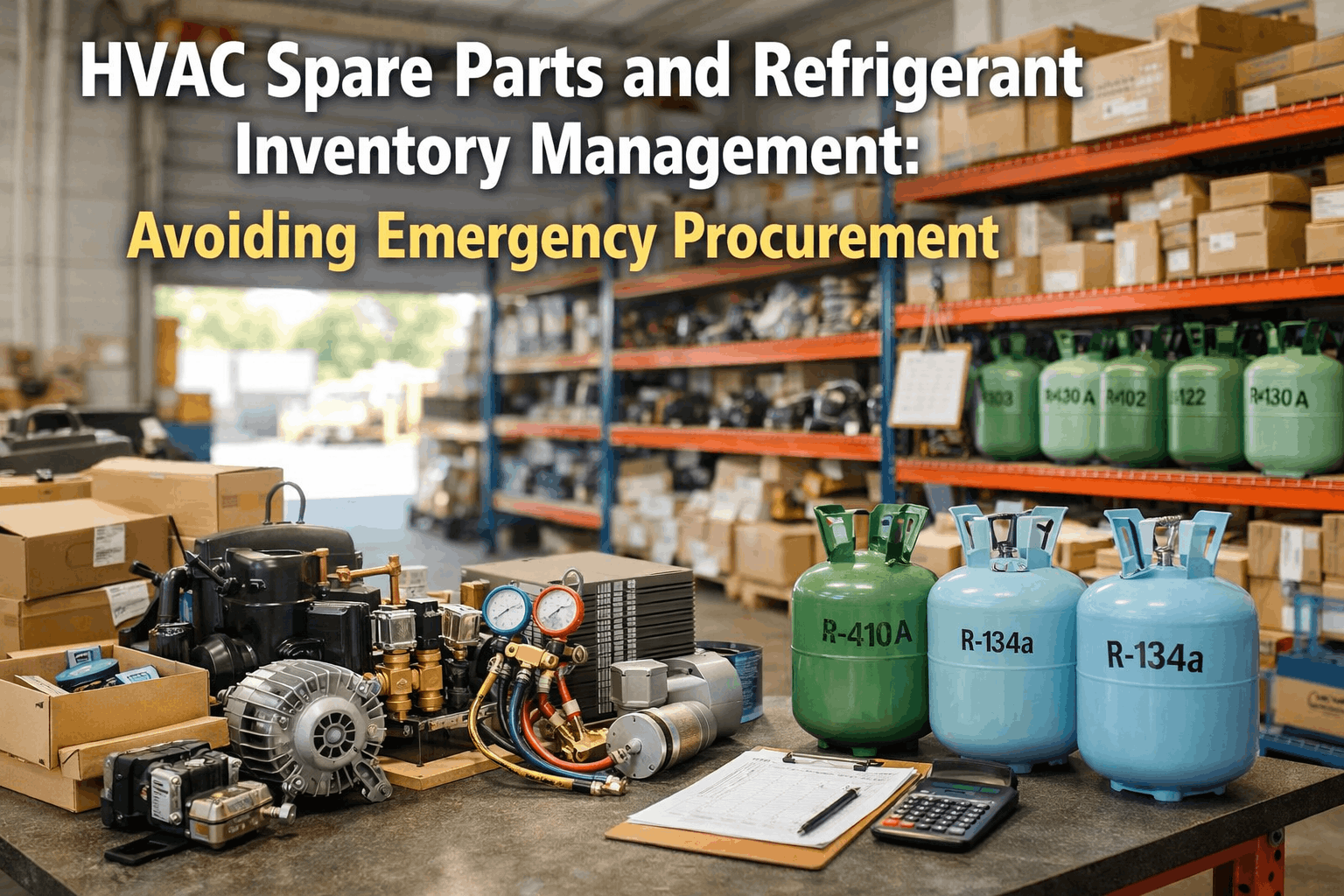
A missing $35 contactor. A capacitor that ran out three days before a technician arrived on-site. These small stockouts do not stay small — they cascade into second truck rolls, angry customers, emergency procurement fees, and technicians standing idle waiting for parts. HVAC companies without a structured inventory system lose 12–18% of their total inventory value every year to carrying costs, write-offs, expediting fees, and stockout-driven lost jobs. This blog breaks down exactly how to prevent that — with criticality-based stocking, CMMS-driven min/max tracking, and automated reordering that keeps your shelves right-sized year round. Start managing HVAC spare parts on Oxmaint — free trial, no credit card.
Blog · HVAC Inventory Management · 2025
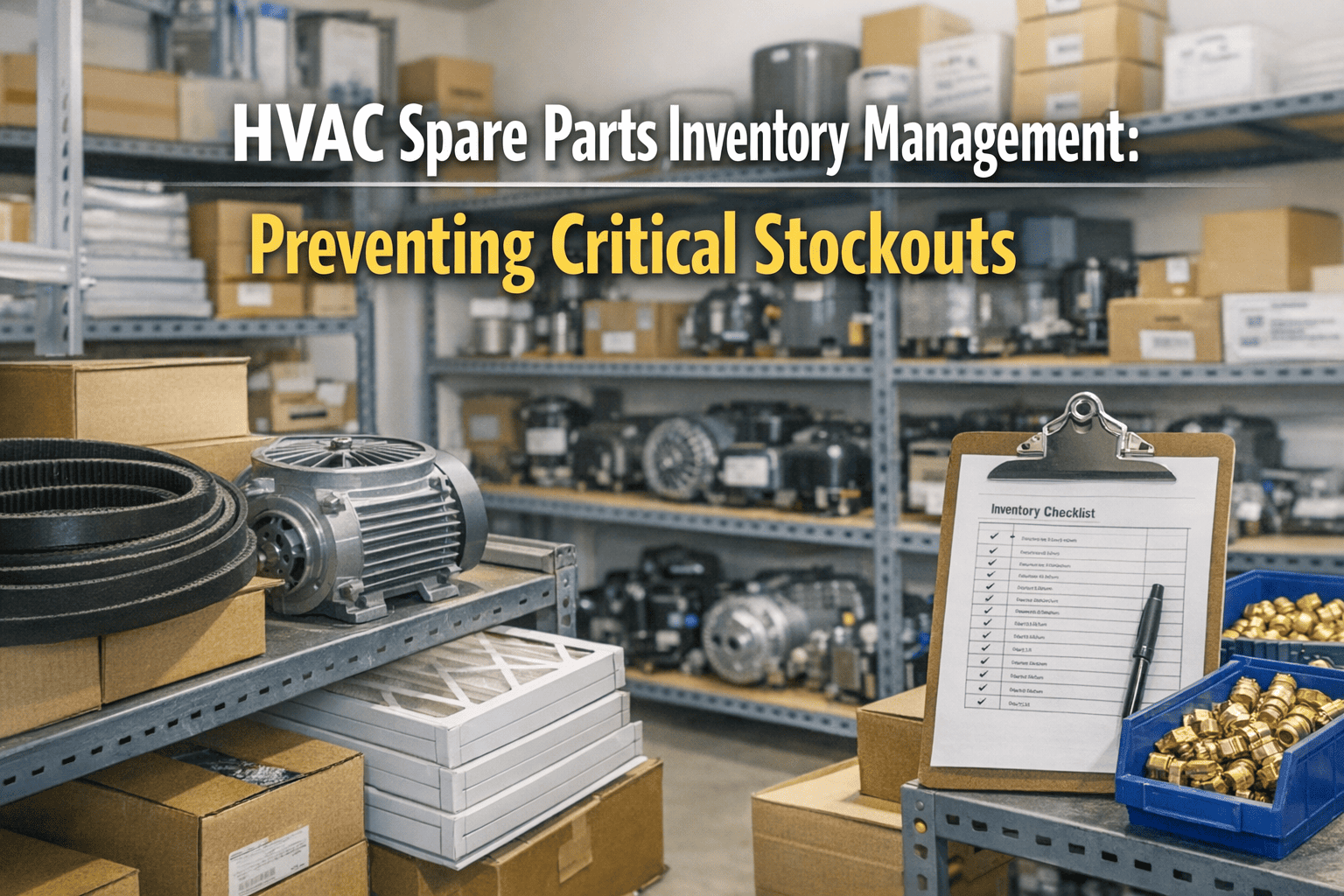
HVAC Spare Parts Inventory Management: How to Prevent Critical Stockouts
Poor stock control costs HVAC operations more than most managers realize. Proper CMMS-driven inventory management reduces emergency orders by up to 85%, lifts first-time fix rates above 90%, and cuts total parts investment by 15–30% — all at the same time.
12–18%
of inventory value lost annually without structured stock control
85%
reduction in emergency orders with automated reorder points
45%
improvement in first-time fix rate with proper parts availability
35%
cost reduction achievable through structured inventory management
The Real Problem
Why HVAC Stockouts Are More Expensive Than They Look
Most HVAC teams track the cost of a missing part as the part price plus expedited shipping. That calculation misses 80% of the actual damage. A single stockout event triggers a cost cascade that connects to every corner of the business — from technician productivity to customer churn.
01
Emergency Procurement
Rush orders carry 40–200% price premiums over standard procurement. A $35 contactor sourced in an emergency can cost $90 delivered next-day — plus the hour of admin time to arrange it.
02
Second Truck Roll
Every return visit costs $150–$300 in truck roll costs alone — fuel, technician time, vehicle wear. A 10-truck fleet averaging one stockout per day burns $375K–$750K annually on avoidable revisits.
03
Idle Technician Time
A technician waiting on parts generates zero revenue. At $60–$90/hour fully loaded, a 2-hour wait on a critical part costs more than most parts themselves — and it happens multiple times per week on poorly stocked fleets.
04
Customer Satisfaction Impact
HVAC companies without CMMS inventory management typically operate at 60–70% first-time fix rates. The industry target is 80%+. Every callback is a dissatisfied customer and a damaged service reputation that compounds over contract renewal time.
!
The average HVAC distributor or service company loses 12–18% of total inventory value annually to carrying costs, write-offs, expediting fees, and stockout-driven productivity losses — without ever realizing the sources are connected.
Criticality-Based Stocking
Not All HVAC Parts Deserve the Same Stock Strategy
Treating every part the same way is how storerooms end up overflowing with parts nobody needs while running out of the ones technicians use every day. The ABC-VED framework separates stocking strategy by financial value and operational criticality — so capital flows to the parts that actually matter.
| Part Category |
Examples |
Stocking Strategy |
Min/Max Approach |
Reorder Type |
| A-Vital (High Value + Critical) |
Compressors, heat exchangers, VFDs |
Vendor-managed or consignment stock |
1–2 units insurance stock |
Manual approval |
| B-Essential (High Use + Moderate Cost) |
Contactors, capacitors, pressure switches |
CMMS-driven min/max with safety stock |
Dynamic, seasonally adjusted |
Auto PO under $300 |
| C-Consumable (High Volume + Low Cost) |
Belts, filters (bulk), refrigerant, fuses |
Bulk seasonal ordering, weekly cycle counts |
High min, weekly replenish |
Fully automated |
| D-Desirable (Low Impact) |
Aesthetic panels, low-priority lighting |
Order on demand only |
No safety stock |
Reactive ordering |
Oxmaint automatically assigns ABC-VED classifications based on equipment criticality and historical consumption, then applies the correct stocking policy per part — no manual spreadsheet work required. Start your free trial to see it in action.
Stop Guessing Stock Levels. Let Data Drive Your Reorders.
Oxmaint CMMS connects your work orders to your parts inventory in real time — every part used on every job automatically updates stock levels, triggers reorder points, and generates purchase orders. No clipboards. No guessing. No stockouts.
Min/Max & Reorder Points
How to Calculate HVAC Reorder Points That Actually Work
A reorder point is not a number you set once and forget. It is a calculated value based on real consumption rates, vendor lead times, and seasonal demand shifts. Set it too high and you tie up capital. Set it too low and your technician arrives on-site without the part they need.
▲
Seasonal Adjustment Is Not Optional. Min/max levels must shift quarterly. In summer, increase stock of refrigerant, contactors, and capacitors. In winter, increase ignitors, heat exchangers, and blower belts. Static thresholds set in January create summer stockouts and winter overstock — both costly in different ways.
High-Velocity Parts List
The HVAC Parts You Cannot Afford to Run Out Of
Start with the top 50 parts by usage volume — they cover 80% of your stockouts. Within that group, these are the highest-frequency items where a stockout has an immediate effect on the job and the customer. Inventory accuracy for these parts must stay above 95% to trust automated reordering.
Critical — Track Weekly
- Contactors (single and double pole)
- Run capacitors (all common MFD ratings)
- Start capacitors
- Pressure switches (high and low)
- Blower motor belts (A, B, C series)
- Refrigerant — R-410A, R-22, R-32
High Use — Track Bi-Weekly
- Air filters (all MERV ratings, bulk)
- Thermostat batteries and fuses
- Transformer modules (24V)
- Drain pan tablets and condensate treatments
- Motor starting relays
- Blower wheel assemblies (common sizes)
Seasonal — Adjust Quarterly
- Ignitors and hot surface ignitors (winter)
- Heat exchanger sections (winter)
- Condenser coil cleaning chemicals (spring)
- TXV valves and metering devices (summer)
- Economizer actuators and linkages
- Fan blade assemblies (seasonal models)
Key Metrics to Track
5 Inventory KPIs Every HVAC Team Should Monitor Monthly
You cannot fix what you do not measure. These five KPIs separate well-run HVAC storerooms from chaos — and each one has a benchmark your operation should be hitting.
Inventory Accuracy Rate
System count matches physical count, measured per SKU
Target: 95%+
Below 90% = systemic process failure. Automated reordering is unreliable at this level.
Stockout Rate per SKU
Requested items unavailable when needed, tracked per part number
Target: <2%
Each stockout cascades to a failed first-time fix. Identify chronic problem parts by SKU.
Inventory Turnover Rate
Cost of goods consumed ÷ average inventory value
Target: 5–8×/year
Below 3× = overstocking. Above 8× = chronic understocking and high stockout risk.
Dead Stock Percentage
Zero-movement inventory (12+ months) ÷ total inventory value
Target: <10%
Above 10% means significant capital is trapped in parts that generate no revenue.
Van Fill Rate
Van replenishment requests filled completely from warehouse stock
Target: 90%+
Below 90% means the warehouse cannot keep up with field demand. Reorder points need adjustment.
Expert Review
What HVAC Maintenance Teams Say After Switching to CMMS Inventory
★★★★★
Our first-time fix rate was stuck at 71% for years. After we implemented usage-based reorder points with automatic purchasing through Oxmaint, emergency orders dropped 78% in the first quarter. First-time fix went to 92%. We cut our total parts investment by 22% while simultaneously increasing availability. We were carrying $180,000 in parts we rarely used and running out of $30 parts we used every day. The data made the problem obvious immediately.
SM
Scott M.
Service Operations Manager, Commercial HVAC Contractor — 12-truck fleet
★★★★★
Seasonal stockouts were our biggest problem — we would consistently run out of contactors and capacitors every July. After setting up seasonal min/max adjustments in Oxmaint with quarterly threshold reviews, we haven't had a critical summer stockout in two seasons. Bulk filter purchasing through the platform also reduced our per-filter cost by 38% versus site-by-site ordering on 22 buildings.
PK
Priya K.
Facilities Director, Multi-Site Commercial Portfolio — 22 buildings
Start With Your Top 50 Parts. Eliminate 80% of Stockouts.
Oxmaint gives your team real-time parts visibility, automated min/max alerts, work-order-linked consumption tracking, and seasonal reorder adjustments — all in one platform that goes live in under 60 minutes. No IT project. No hardware changes.
CMMS Integration
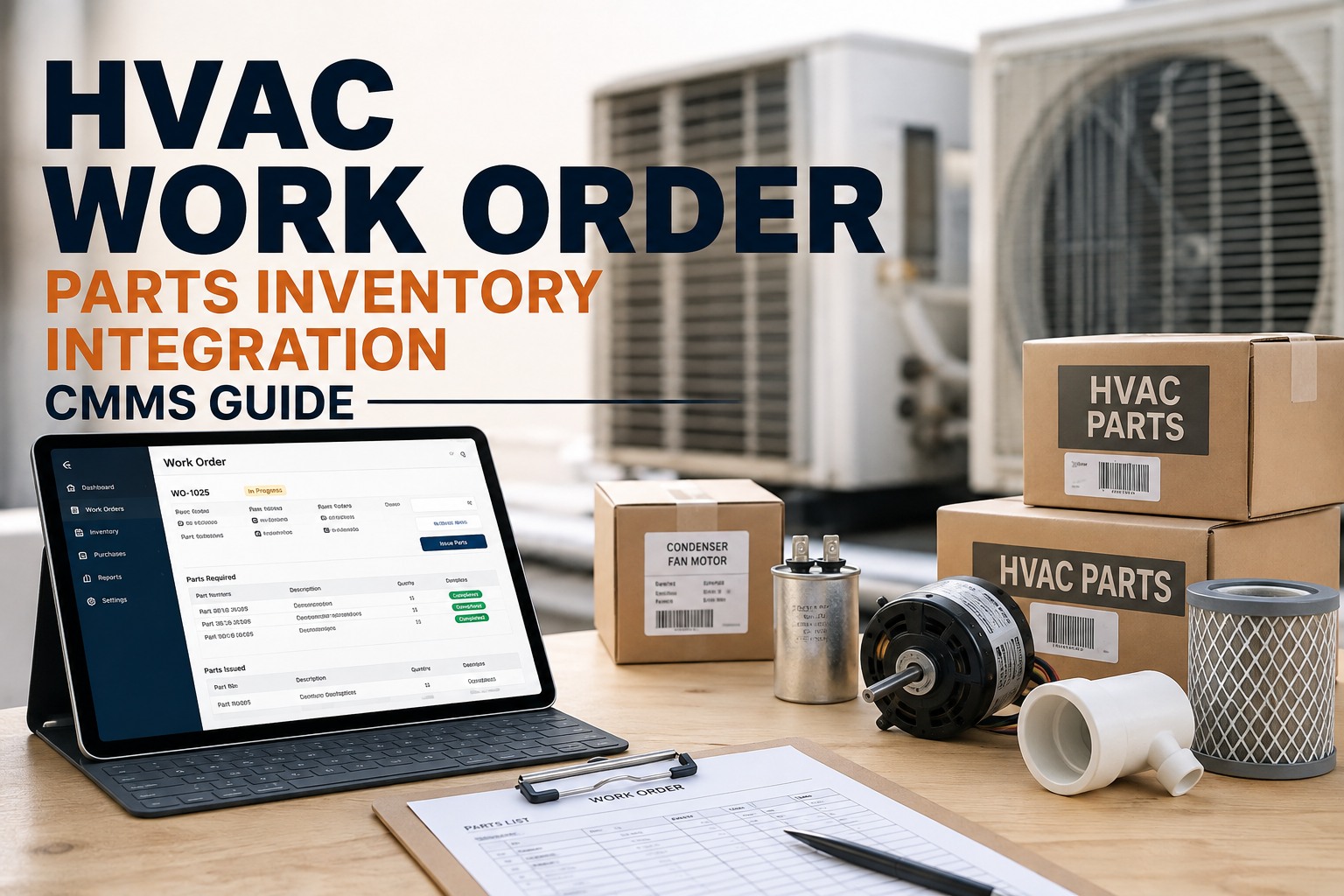
How Oxmaint Connects Inventory to Every Work Order
Manual inventory tracking fails because it depends on human consistency in high-pressure, fast-moving environments. A technician in the field at 7pm is not going to log every part they used. CMMS-driven inventory removes that dependency — parts consumption updates automatically when a work order closes.
1
PM work order generated for belt change on AHU-14
→
2
System reserves belt from stock and confirms availability before tech departs
→
3
Tech completes work order on mobile — part consumption deducted automatically
→
4
Stock hits reorder point — purchase order auto-generated and sent to vendor
95%
Inventory accuracy target
Required to trust automated reordering. Oxmaint cycle count alerts flag discrepancies before they cause stockouts.
Real-time
Stock updates on mobile
Technicians scan parts on the job via mobile app. Stock levels update instantly across warehouse, vans, and job sites.
Auto PO
Automatic purchase orders
When stock hits a reorder point, Oxmaint generates and routes a PO automatically — no procurement staff involvement required for routine replenishments.
Common Questions
HVAC Inventory Management FAQs
How do I set min/max levels when I don't have 12 months of historical data?
Start with industry benchmarks segmented by part category and fleet size, then refine within 60–90 days as real consumption data accumulates. For a 5–10 truck fleet, initial benchmarks for contactors are 15–25 units minimum; capacitors 20–40 units; belts 10–20 per common size. Connect to Oxmaint from day one so the system builds your consumption history automatically — it adjusts reorder points dynamically as real data replaces estimates.
Start free to begin building your usage history today.
Do our technicians need to scan every part they use for CMMS inventory to work?
Yes — technician adoption is the single biggest failure point in CMMS inventory programs. The fix is making mobile scanning faster than not doing it: require part scanning for work order closure, use barcode or QR scanning that takes under 10 seconds, and make the mobile app accessible offline in basements and rooftop locations. Inventory accuracy must stay above 95% for automated reordering to be reliable. Below 90%, the system generates incorrect purchase orders.
Book a demo to see Oxmaint's mobile scanning workflow.
How often should HVAC inventory min/max levels be reviewed and adjusted?
Quarterly reviews are the minimum standard — aligned to seasonal demand shifts between summer cooling and winter heating loads. High-velocity items like contactors, capacitors, and refrigerant need summer min levels 30–50% higher than winter baselines. CMMS platforms like Oxmaint track seasonal consumption patterns automatically and flag items where current thresholds are misaligned with actual usage trends, so reviews become targeted rather than a full manual audit.
See how Oxmaint seasonal analytics work — start free.
What is the fastest way to reduce dead stock in an HVAC storeroom?
Run a zero-movement report covering all parts with no consumption in the past 12 months. Any item above 10% of total inventory value is a priority. Cross-reference against active equipment assets — if the equipment the part serves has been decommissioned or replaced with a different model, the part is obsolete. Oxmaint's inventory module generates this report on demand, links parts to equipment asset records, and flags probable obsoletes automatically. Liquidate or return obsoletes to vendor to free shelf space and capital for parts you actually consume.
Book a demo to see the dead stock report in Oxmaint.
Can a small HVAC company with 3–5 technicians benefit from CMMS inventory management?
Smaller operations are often where the ROI is fastest — because every avoided stockout and every eliminated return trip is proportionally larger against total revenue. A 3-truck fleet preventing just 3 emergency procurements per month at $200 average premium saves $7,200 annually, which typically covers the full CMMS subscription. Oxmaint requires no hardware changes, no IT infrastructure, and goes live in under 60 minutes.
Start your free trial — no credit card required.
HVAC Inventory Management · CMMS-Driven · Free to Start
Your Storeroom Is Costing You More Than You Think. Fix It This Week.
Oxmaint gives HVAC teams real-time parts visibility, automated min/max alerts, work-order-linked consumption tracking, and seasonal demand adjustments — so your technicians always arrive with the right parts, and stockouts stop draining your margins.