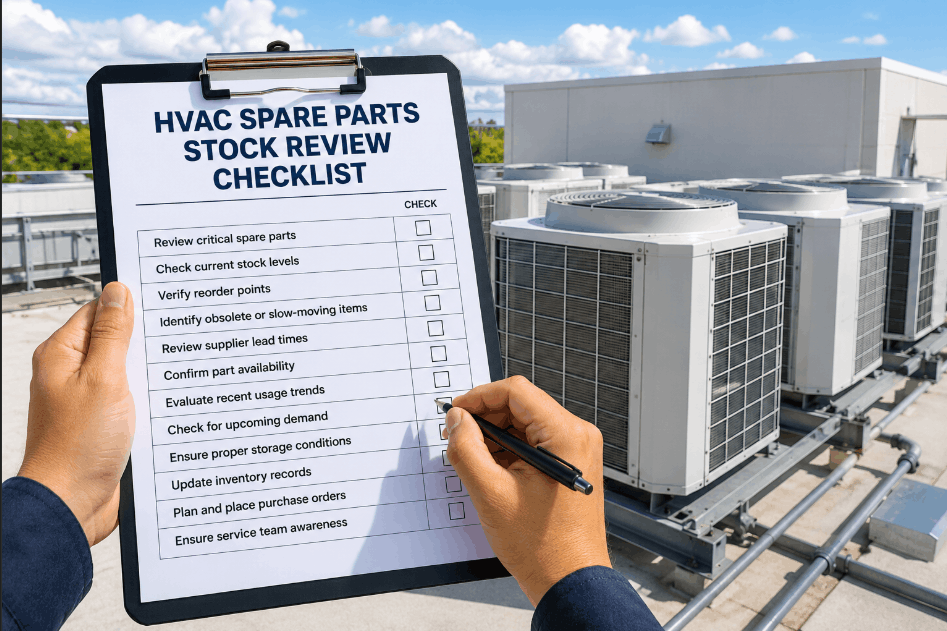
When an HVAC system fails after hours, the difference between a one-hour fix and a three-day outage usually comes down to one thing: whether the right part was already on the shelf. A critical spares list maps high-impact components to the assets they serve, so technicians responding to an emergency call know exactly what to grab instead of waiting on a supplier. Sign Up Free with Oxmaint to connect your HVAC asset records, parts inventory, and work order history in one place so emergency response time stops depending on guesswork.
Why Critical Spares Planning Determines HVAC Emergency Response Time
A spares list built on guesswork tends to either overstock low-risk parts or leave high-impact components unavailable when they matter most. Book a Demo to see how Oxmaint's parts and inventory module ties stocking decisions to asset criticality and failure history instead of generic vendor catalogs.
Four Factors That Shape a Reliable Critical Spares List
Facilities that stock parts without weighing these variables end up with shelves full of the wrong inventory. Sign Up Free to build asset-linked spares profiles in Oxmaint that account for criticality, lead time, and failure history together.
Chillers, boilers, and main air handlers serving life-safety or revenue-critical spaces warrant higher spares investment than secondary units. Criticality tiers should be set per asset, not per equipment type, since duplicate units can carry very different operational importance.
Components with multi-week supplier lead times deserve priority stocking even when failure probability is low, since the cost of waiting far exceeds the cost of carrying the part. Fast-shipping components can usually be left to standard reorder cycles.
Work order history reveals which parts actually fail on which assets, replacing assumptions with data. Parts tied to recurring failure codes should move up the stocking priority list regardless of unit cost.
Every spare on the shelf ties up capital and storage space. The goal is matching investment to downtime risk, not maximizing stock levels, so low-impact parts should stay on lean reorder rules instead of permanent inventory.
Critical Spares Evaluation Framework for HVAC Portfolios
Deciding what belongs on a critical spares list requires comparing stocking priority against measurable risk, not just unit price. Book a Demo to see how Oxmaint pairs parts data with PM schedules and work order history to support these decisions.
| Evaluation Factor | High Priority Spares | Low Priority Spares | Key Metric to Track | Monitoring Approach |
|---|---|---|---|---|
| Asset Criticality | Chillers, boilers, main AHUs | Secondary or redundant units | Criticality score per asset | Asset register tagging |
| Supplier Lead Time | Compressors, control boards | Filters, belts, gaskets | Average days to fulfillment | Vendor lead time logging |
| Failure Frequency | Parts tied to recurring WO codes | Parts with no failure history | Failures per part per year | Work order history review |
| Seasonal Demand | Compressors, capacitors before peak season | Components with steady year-round demand | Stock level vs. seasonal forecast | Seasonal reorder point review |
| Storage and Cost | High-downtime-impact, moderate cost parts | Low-impact, high-cost parts | Carrying cost vs. downtime risk | Inventory valuation reporting |
Common Critical Spares Failures in HVAC Emergency Response
Implementing Critical Spares Management with Oxmaint
A critical spares list only stays useful if it is connected to live asset and work order data instead of a static spreadsheet. Book a Demo to see how Oxmaint ties spares records to asset criticality, lead times, and automated reorder rules.
- Register chillers, boilers, AHUs, and rooftop units in Oxmaint with criticality tiers based on space served
- Document failure history and parts used per asset from existing work order records
- Flag life-safety and revenue-critical equipment for elevated spares priority
- Link each stocked part to the specific asset and model it fits in the parts and inventory module
- Record supplier lead times so reorder points reflect real delivery risk, not assumptions
- Tag long-lead-time components for pre-stocking regardless of unit cost
- Set automatic reorder triggers tied to stock thresholds for tiered critical parts
- Route stockout alerts to facility managers with vendor and lead-time context attached
- Reserve spares against open emergency work orders to prevent cross-site allocation conflicts
- Monitor mean time to repair for emergency work orders against parts availability data
- Review which spares went unused versus which caused delays to refine the stocking list
- Report spares program performance to facility leadership on a recurring cycle
Critical Spares KPIs for HVAC Facility Teams
Tracking spares performance requires metrics that connect inventory decisions to actual emergency response outcomes. Book a Demo to see how Oxmaint's reporting tools turn parts data into measurable response improvements.
Percentage of emergency calls delayed by missing critical parts. Any stockout on a tier 1 asset signals a gap in the stocking list that needs immediate review.
Time between emergency dispatch and part availability. Rising fulfillment times point to lead-time assumptions that no longer match supplier performance.
Percentage of critical assets with a defined, current spares mapping. Gaps here mean technicians are guessing instead of working from a verified parts list.
How closely reorder triggers match actual supplier delivery performance. Drift here causes either stockouts or unnecessary overstocking.
Change in supplier delivery times against the assumptions used to set stocking levels. Significant variance should trigger a stocking policy update.
Mean time to repair for emergency HVAC work orders. A well-tuned spares list should show steady improvement in this number across quarters.