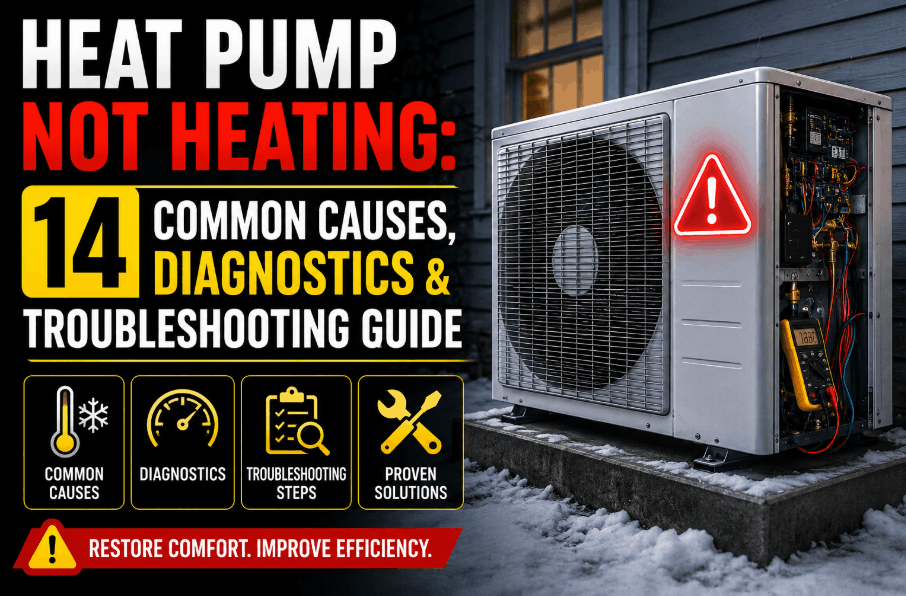
When a commercial heat pump stops heating, the ripple effects reach far beyond discomfort — occupant complaints, regulatory pressure, emergency contractor fees, and unplanned asset downtime all compound fast. Facility managers operating without a structured HVAC maintenance program often discover failures only after systems have already failed. Oxmaint's AI-native CMMS platform helps operations teams Sign Up Free and move from reactive breakdown response to predictive HVAC asset management — catching reversing valve degradation, refrigerant anomalies, and compressor stress weeks before a no-heat call. This guide walks through 14 proven diagnostic causes for heat pump heating failures and shows how structured work order management, preventive scheduling, and sensor-driven alerts through a purpose-built platform like Oxmaint reduce HVAC downtime by 30% or more. If your facility's HVAC program still runs on spreadsheets and service calls, Book a Demo to see how automated maintenance workflows close diagnostic gaps before they become failures.
Ready to Stop Reacting to Heat Pump Failures?
Oxmaint helps facility teams schedule preventive HVAC maintenance, track asset health, and get predictive alerts — before heating failures become emergencies.
Why Commercial Heat Pumps Fail to Heat: The Root Cause Map
Before dispatching a technician, understanding the failure category narrows diagnostic time significantly. Heat pump heating failures split into four root cause zones — each with distinct symptoms, indicators, and maintenance responses.
Refrigerant Circuit Failures
Low refrigerant charge, refrigerant leaks, and metering device blockages that prevent the system from transferring heat energy effectively through the vapor compression cycle.
Electromechanical Component Failures
Reversing valve stuck in cooling mode, failed compressor, defrost board faults, and auxiliary heat lockout failures that disable the system's heating pathway entirely.
Airflow & Heat Transfer Failures
Clogged filters, frozen outdoor coils, dirty indoor coils, and restricted ductwork that prevent proper heat exchange between the refrigerant circuit and conditioned air.
Controls & Sensing Failures
Thermostat miscalibration, faulty outdoor temperature sensors, incorrect mode settings, and defrost termination sensor failures that cause the system to operate in the wrong mode.
14 Common Heat Pump Heating Failures: Causes, Symptoms & Diagnostics
Each failure mode below includes the trigger condition, field-observable symptoms, and the maintenance action required. Linking these findings to asset records in Oxmaint creates a searchable failure history that improves future diagnostics across your entire HVAC fleet.
System runs continuously but blows cool or ambient-temperature air in heating mode. Suction and discharge pressures appear reversed relative to heating cycle norms.
Confirm mode setting, check 24V signal to reversing valve solenoid, measure refrigerant pressures in heating and cooling mode. Listen for the valve's audible "click" on mode change.
Energize solenoid manually to free stuck slide. Replace valve if mechanically failed. Log findings as an asset failure event in your CMMS for pattern tracking.
Insufficient heating output, ice formation on outdoor coil, low suction pressure on gauges, high superheat readings, longer-than-normal run cycles.
Attach manifold gauges, compare suction/discharge pressures to manufacturer spec for ambient temperature. Perform electronic leak detection across all joints, coils, and valve connections.
Locate and repair leak, pressure-test, evacuate, recharge to spec weight. Sign Up Free on Oxmaint to schedule recurring refrigerant charge inspections automatically.
Visible ice buildup on outdoor unit, dramatically reduced heating capacity, outdoor fan running but blocked by ice, increasing suction pressure drop.
Check defrost board timer settings and defrost termination sensor resistance. Verify reversing valve shifts to defrost mode. Inspect outdoor coil sensor placement and contact.
Replace defrost control board or termination sensor. Verify defrost cycle runs to completion. Clear ice manually if immediately required, then resolve root control fault.
System runs but produces minimal heating. Compressor draws high amperage or trips on thermal overload. Suction and discharge pressures equalize at rest faster than normal.
Measure compressor amp draw against nameplate RLA. Perform compression ratio check with gauges. Megohm test windings. Check crankcase heater operation to rule out oil dilution failure.
Replace compressor. Before replacement, diagnose root cause of failure (liquid slugging, refrigerant overcharge, oil failure) to prevent recurrence and update asset failure record.
Heat pump runs but cannot maintain setpoint in cold weather. No response from electric resistance backup strips. High-limit safety may be tripped.
Verify thermostat is calling for auxiliary heat. Check sequencer operation and resistance element continuity. Inspect high-limit switch condition and auto-reset status.
Replace failed sequencer, heating element, or high-limit switch. Investigate root cause of high-limit trip — often restricted airflow or control board failure.
Weak airflow at supply registers, system running constantly without reaching setpoint, indoor coil freezing over, high static pressure across the air handler.
Physically inspect filter media. Measure static pressure drop across filter section — should not exceed manufacturer spec (typically 0.1–0.15" WC for standard media filters).
Replace filter immediately. Book a Demo to see how Oxmaint automates filter change schedules based on runtime hours or calendar intervals across your HVAC asset fleet.
System does not respond to setpoint changes, operates in cooling when heating is selected, or cycles off before reaching setpoint. Often occurs after thermostat battery replacement or programming reset.
Confirm O/B wire configuration for heat pump operation. Verify thermostat type (heat pump vs conventional) matches system. Compare thermostat reading against calibrated thermometer.
Reconfigure O/B terminal setting, update thermostat programming, or replace if sensor is drifted beyond acceptable tolerance. Document calibration records in CMMS asset log.
Reduced heating capacity, elevated compressor discharge temperature, longer runtime to maintain setpoint, increased refrigerant head pressure.
Visually inspect coil fins for debris, cottonwood, or bio-fouling. Measure outdoor airflow volume. Compare subcooling and superheat readings against clean-coil baseline values.
Clean coil fins with approved coil cleaner, rinse from inside out. Schedule bi-annual outdoor coil cleaning on preventive maintenance calendar in Oxmaint to avoid recurrence.
Extreme superheat variation, compressor running hot, frost on suction line upstream of valve, very low suction pressure with high discharge pressure.
Measure superheat at evaporator outlet — TXV systems should maintain 8–12°F superheat. Ice the sensing bulb to verify valve response. Check for moisture in system causing ice blockage at valve orifice.
Replace TXV or EEV driver board. Install filter drier if moisture contamination is detected. Verify bulb contact and insulation on replacement valve.
Outdoor unit runs but no fan movement, high discharge pressure trip, system short-cycles on high-pressure safety, outdoor unit making unusual electrical hum.
Check fan capacitor microfarad value against nameplate spec. Measure motor winding resistance. Verify correct voltage supply. Attempt manual spin — seized bearing is a common cause.
Replace capacitor or motor assembly. Oxmaint's asset health tracking records motor replacement dates and runtime hours so teams know exactly when next replacement risk window opens.
Random lockouts, failure to energize reversing valve, defrost cycle never initiating or not terminating, erratic relay behavior, error codes on communicating systems.
Pull fault codes from communicating thermostat or control board LED indicators. Check for burnt relay contacts, cracked solder joints, or evidence of moisture intrusion on the board surface.
Replace control board or defrost timer board with OEM equivalent. Book a Demo to see how Oxmaint work orders capture error codes as searchable asset failure events for pattern analysis.
High discharge pressure, liquid flooding back to compressor, elevated suction pressure, reduced subcooling values, possible high-pressure safety cutout activation.
Compare suction, discharge, and subcooling readings against manufacturer charging charts for current ambient temperature. Overcharge typically shows subcooling well above 10–15°F target.
Recover excess refrigerant to manufacturer-specified weight charge. Recalibrate gauges and scales before future charging. Record charge weight in asset record for future reference.
Certain zones receive no heat while system appears operational. Unaccounted heat loss in unconditioned spaces (attic, crawlspace). System runs long cycles with little temperature rise.
Duct blaster test for leakage percentage. Inspect accessible ductwork connections at air handler, flex duct connections at registers, and plenums for separation or disconnection.
Seal joints with mastic compound and foil tape. Reattach disconnected flex duct. Include duct inspection as a scheduled preventive task in CMMS PM program.
System operates but cannot meet heating setpoint during extreme cold events. Auxiliary heat runs constantly. Standard air-source units lose capacity rapidly below 35°F ambient.
Compare system operating ambient range in equipment specifications to current outdoor temperature. Verify auxiliary heat lockout temperature setting on thermostat or outdoor thermostat.
Adjust auxiliary lockout setpoint. For chronic cold-climate underperformance, evaluate cold-climate heat pump upgrade. Sign Up Free to track seasonal performance baselines across your HVAC asset portfolio.
How Structured HVAC Maintenance Programs Prevent Heat Pump Failures
The majority of the 14 failure modes above are preventable with consistent, documented preventive maintenance. Oxmaint's CMMS platform enables facility teams to build and execute HVAC PM programs that reduce emergency repair spend and extend equipment life.
Filter & Airflow Inspection
Auto-scheduled work orders for filter inspection, static pressure checks, and indoor coil visual inspection. Oxmaint sends mobile push alerts to technicians when tasks are due — no manual follow-up required.
Refrigerant & Electrical Checks
Scheduled work orders for refrigerant pressure readings, superheat and subcooling verification, capacitor testing, and control board visual inspection — all captured with technician sign-off in Oxmaint.
Coil Cleaning & Defrost Validation
Outdoor and indoor coil cleaning tasks with photographic completion evidence. Defrost cycle verification before heating season. Full findings logged to equipment asset record for lifecycle tracking.
Full System Diagnostic & Compliance
Comprehensive inspection checklists with pass/fail criteria for every major component — reversing valve, compressor, controls, ductwork, and auxiliary heat. Oxmaint generates audit-ready compliance reports automatically.
Moving Beyond Scheduled PM: Predictive HVAC Monitoring with Oxmaint
Scheduled maintenance catches planned degradation — but sensor-driven predictive monitoring catches the anomalies between service visits that cause unplanned failures. Oxmaint integrates vibration, temperature, and electrical sensors to deliver real-time HVAC asset health data.
Vibration Monitoring
Wireless accelerometers on compressor and fan motor assemblies detect bearing wear, mechanical imbalance, and mounting looseness — triggering maintenance alerts 2–6 weeks before audible failure symptoms appear.
Thermal Imaging Integration
Oxmaint's AI Vision Camera detects abnormal heat signatures at electrical panels, contactors, and terminal blocks during routine walkthroughs — flagging faults invisible to standard visual inspection.
Runtime & Performance Analytics
OEE analytics and runtime tracking in Oxmaint establish baseline performance signatures for each heat pump unit. Deviations in runtime-per-degree-day signal refrigerant loss, coil fouling, or compressor degradation before failure.
Track Every Heat Pump, Every PM, Every Failure — In One Platform
Oxmaint gives HVAC facility teams mobile work orders, automated PM scheduling, sensor-driven alerts, and compliance-ready reporting — purpose-built for operations managing complex mechanical assets.
Frequently Asked Questions: Heat Pump Troubleshooting & HVAC Maintenance
Give Your HVAC Team the Tools to Stop Failures Before They Happen
Oxmaint delivers automated PM scheduling, mobile work orders, asset health tracking, and predictive alerts — everything a facility operations team needs to eliminate reactive heat pump repairs for good.


-not-cooling-18-common-causes,-diagnostics-&-troubleshooting-guide.png)