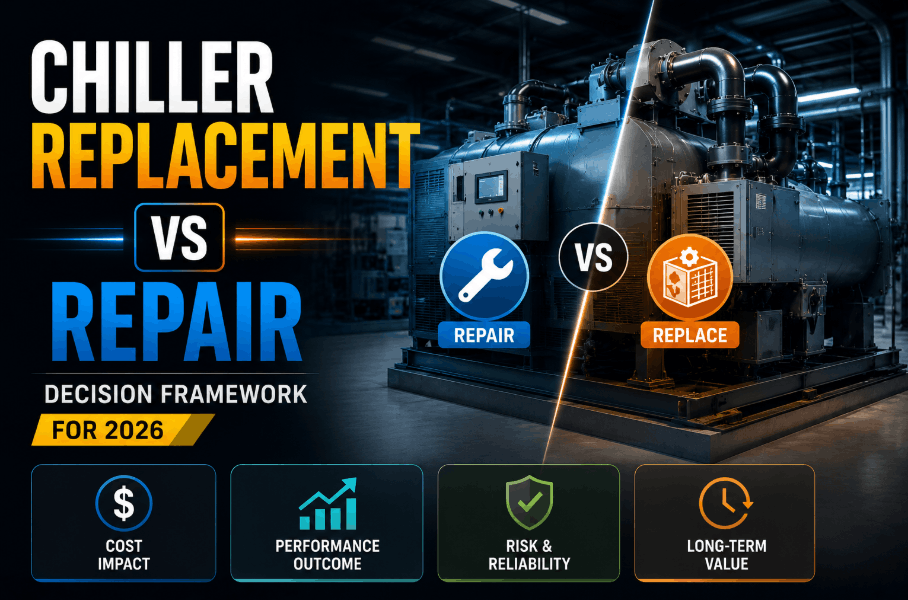
A commercial chiller running at 68% of its rated capacity while consuming 94% of its design energy budget is not aging gracefully — it is transferring capital from your operations budget to your utility provider every hour it stays online. The repair-versus-replace decision is the highest-stakes capital call a facility team makes in an HVAC lifecycle, and in 2026, rising refrigerant costs, tightening efficiency mandates, and compressed equipment lead times mean the window for a well-timed decision is narrower than ever. Sign Up Free to see how OxMaint's CMMS tracks chiller performance trends, maintenance history, and total cost of ownership — so your next capital decision is built on data, not assumptions. Facility managers who delay this analysis by even one budget cycle typically absorb one to two unplanned compressor events, each costing $18,000–$65,000 in emergency parts and labor before the replacement conversation begins. Book a Demo to review how OxMaint structures chiller asset records for capital planning. The 2026 decision framework below gives engineering and operations teams a structured methodology to evaluate TCO, ROI, and risk across replacement, major repair, and continued-run-to-failure scenarios. Sign Up Free and connect your chiller data to OxMaint's asset management platform before your next budget cycle closes.
Your Chiller's Cost History Is Your Best Capital Argument
OxMaint tracks every repair event, PM cost, energy deviation, and downtime hour — giving facility teams the documented asset history needed to justify replacement or defend continued operation to finance teams.
The 2026 Cost Landscape — What Replacement and Repair Actually Cost
Chiller Replacement
$120,000 – $900,000+
Installed cost · 50–500 ton range
Air-cooled, 50–150 ton: $120K–$280K installed
Water-cooled centrifugal, 200–500 ton: $350K–$900K installed
Refrigerant transition surcharge (R-22 → A2L): $15K–$40K additional
Commissioning, controls integration: $8K–$25K
Lead times 2026: 28–52 weeks for centrifugal units
Major Repair / Rebuild
$18,000 – $160,000
Compressor overhaul · Heat exchanger · Controls
Compressor remanufacture or replacement: $22K–$85K
Tube bundle replacement (evaporator/condenser): $18K–$55K
Controls and VFD upgrade: $12K–$35K
Refrigerant recharge (R-22 recovery + replacement): $6K–$22K
Expected life extension post-overhaul: 6–12 years
Annual Operating Delta
$14,000 – $68,000/yr
Energy savings · New vs aged unit
Modern VFD centrifugal: 0.48–0.55 kW/ton IPLV
Aged unit (15+ years, degraded): 0.72–0.95 kW/ton actual
Energy delta on 250-ton unit at $0.11/kWh: $26K–$54K/yr
Maintenance cost delta (new vs aged): $8K–$18K/yr
Downtime risk premium (aged unit): $12K–$35K/yr modeled
TCO Decision Matrix — Repair vs Replace Across Asset Age
| Chiller Age |
Repair Viability |
Replacement ROI Payback |
OxMaint Decision Signal |
Recommended Action |
| 0–7 Years |
High — parts available, efficiency near design |
12–18 years (poor ROI) |
PM compliance below 85% triggers alert |
Repair and optimize PM schedule |
| 8–12 Years |
Moderate — evaluate specific failure mode |
8–12 years |
Efficiency trend >10% below baseline |
Repair if <40% of replacement cost |
| 13–17 Years |
Low — compressor and controls near EOL |
5–8 years |
Cumulative repair cost >60% of replacement |
Plan replacement within 24 months |
| 18–20 Years |
Very Low — refrigerant phase-out risk |
3–6 years |
Any major repair event triggers capital review |
Budget replacement immediately |
| 20+ Years |
Not recommended — parts scarcity, R-22 cost |
2–4 years |
Run-to-failure risk modeled as imminent |
Emergency replacement planning |
6 Financial Indicators That Signal Replacement Over Repair
01
Cumulative Repair Cost Exceeds 50% of Replacement Value
When the documented 3-year repair spend on a unit approaches half its current replacement cost, the financial case for continued repair collapses. OxMaint's asset cost tracking aggregates every work order, parts invoice, and emergency call-out against the asset record — producing this ratio automatically.
02
Energy Intensity Has Risen More Than 18% Above Nameplate
A chiller consuming 0.90 kW/ton when its nameplate rates it at 0.55 kW/ton is burning $30,000–$55,000 in excess energy annually on a 250-ton unit. This efficiency gap, tracked continuously in OxMaint, converts directly to replacement payback period — often under 5 years at current utility rates.
03
Refrigerant Type Is Being Phased Out or Priced Prohibitively
R-22 refrigerant in 2026 costs $35–$65 per pound versus $4–$8 for modern HFO blends. A 200-ton R-22 unit requiring a 180-pound recharge represents $6,300–$11,700 in refrigerant cost alone — recurring. OxMaint tracks refrigerant type, charge history, and leak rate per asset.
04
Compressor Has Reached Its Second Major Overhaul
A compressor undergoing its second rebuild on a unit over 15 years old is statistically within 3–5 years of a non-repairable failure. The second overhaul cost — typically $45,000–$85,000 — invested in a 15-year-old unit rarely recovers through energy savings before another major event occurs.
05
Controls and VFD Obsolescence Creates Parts Scarcity
Legacy chiller controls from pre-2010 installations often rely on discontinued PCBs, proprietary sensors, and VFDs no longer in production. When a controls failure triggers a 6–14 week parts lead time, the operational risk premium of continued operation frequently exceeds the annualized cost of replacement financing.
06
Utility Incentive Windows Are Open and Won't Repeat
In 2026, utility demand-side management programs and IRA Section 179D deductions offer $15,000–$90,000 in combined incentives for high-efficiency chiller replacement in commercial buildings. These windows are budget-cycle-specific —
Book a Demo to model your incentive-adjusted payback in OxMaint before the current program cycle closes.
How OxMaint Structures Chiller Capital Decision Support
Asset Cost Accumulation
Every repair work order, PM cost, emergency callout, and parts purchase is logged against the chiller asset record. OxMaint produces a running 3-year cost curve that gives finance teams the documented history required for capital approval — no manual spreadsheet reconstruction.
Efficiency Trend Monitoring
OxMaint tracks kW/ton performance against the asset's nameplate rating over time. When actual energy intensity deviates more than 10% from baseline, an alert is generated — connecting performance degradation directly to the cost consequence in the asset record.
Predictive PM Compliance
Runtime-triggered PM schedules ensure compressor oil analysis, tube bundle inspections, and refrigerant leak checks occur at the correct operating-hour intervals — not on a fixed calendar that over- or under-services the unit depending on seasonal load variation.
Replacement Planning Workflow
When OxMaint's decision triggers flag a unit for capital review, a structured replacement planning workflow activates — tracking specification development, contractor quotes, lead time monitoring, and commissioning milestones in the same platform as the asset's operational history.
OxMaint Turns Chiller Data Into Capital Decisions
Connect your chiller asset history, PM compliance, and energy performance to OxMaint's CMMS — and arrive at every budget meeting with documented TCO analysis, not gut feel.
Sign Up Free or
Book a Demo to see the chiller capital decision workflow in action.
ROI Comparison — Repair, Overhaul, and Full Replacement Scenarios
Scenario A — Continue and Repair
250-ton water-cooled centrifugal · 16 years old · R-22
Annual energy cost (0.82 kW/ton)$134,000
Annual maintenance spend$28,000
Modeled unplanned downtime risk$22,000
Total annual cost$184,000/yr
R-22 recharge risk adds $8K–$18K exposure per leak event. No energy improvement trajectory.
Scenario B — Compressor Overhaul
Same unit · $72,000 overhaul · 6-year life extension modeled
Overhaul capital (amortized 6 yr)$12,000/yr
Annual energy cost (0.75 kW/ton post-overhaul)$122,000
Annual maintenance (reduced near-term)$18,000
Total annual cost$152,000/yr
$32,000/yr saving vs continue-and-repair. Risk: refrigerant compliance, controls obsolescence persist.
Scenario C — Full Replacement
High-efficiency centrifugal · 0.52 kW/ton IPLV · $420,000 installed
Capital (financed, 10 yr at 5.8%)$54,600/yr
Annual energy cost (0.52 kW/ton)$85,000
Annual maintenance (new unit PM)$8,000
Total annual cost$147,600/yr
Simple payback vs continue-and-repair: 6.8 years. Utility incentives reduce to 5.1 years. Zero refrigerant risk.
Chiller Lifecycle Monitoring — OxMaint KPI Framework
| KPI |
Target (Healthy Unit) |
Capital Review Trigger |
OxMaint Tracking Method |
| Energy Intensity (kW/ton) |
Within 8% of nameplate IPLV |
More than 18% above nameplate |
Monthly energy trend vs baseline |
| 3-Year Cumulative Repair Cost |
Below 30% of replacement value |
Above 50% of replacement value |
Asset cost accumulation ledger |
| Compressor Runtime Hours |
Per manufacturer lifecycle spec |
Second overhaul milestone reached |
Runtime-triggered PM counter |
| Refrigerant Leak Rate |
Below 5% annual charge loss |
Above 15% or R-22 unit |
Refrigerant log per work order |
| Tube Bundle Fouling Factor |
Below 0.00015 hr·ft²·°F/BTU |
Approach temperature rising >3°F/yr |
Monthly approach temperature trend |
| PM Compliance Rate |
Above 92% |
Below 78% over 6-month period |
Work order completion tracking |
| Unplanned Downtime Events |
Zero per cooling season |
Two or more in 12-month period |
Asset failure log and downtime hours |
Regulatory and Refrigerant Pressures Reshaping the 2026 Decision
AIM Act Phase-Down
HFC production quotas reduced 40% from 2024 baseline by 2028
R-410A equipment banned from new installations in most states from 2025
R-22 service refrigerant cost expected to reach $80–$120/lb by 2027
OxMaint tracks refrigerant type and charge cost per asset for compliance reporting
ASHRAE 90.1 Efficiency Minimums
2025 edition raises minimum chiller IPLV to 0.60 kW/ton for water-cooled units
Units below minimum on replacement or major renovation triggers compliance requirement
Many aged chillers operating at 0.75–0.95 kW/ton fail 2025 minimums by wide margin
OxMaint energy intensity tracking identifies compliance-at-risk assets proactively
IRA Section 179D Deductions
Up to $5.00/sq ft deduction for HVAC upgrades exceeding 50% energy reduction
Commercial buildings replacing <0.55 kW/ton chillers with <0.40 kW/ton qualify
Prevailing wage compliance required —
Book a Demo for incentive modeling
OxMaint documents pre- and post-replacement performance for deduction substantiation
Local Law 97 — NYC and Expanding
Carbon intensity penalties: $268/ton CO₂ over building cap from 2025
Inefficient aging chillers are largest single contributor to excess carbon intensity
Similar legislation active or pending in Boston, Chicago, Denver, and Washington DC
OxMaint energy tracking integrates with carbon reporting frameworks for compliance audit
"
The repair-versus-replace decision fails when it is made reactively — after an unplanned compressor failure with a 35-week lead time on the replacement unit. Facility teams that win this decision make it 18 to 24 months in advance, with documented asset cost history, energy trend data, and a replacement specification already drafted. OxMaint gives engineering teams the asset intelligence to make that case to finance before the emergency forces the issue. I have reviewed portfolios where 60% of replacement decisions were driven by emergency failure rather than planned capital cycles — and in every case, the documented cost consequence of that reactive posture exceeded what a structured monitoring and planning program would have cost over five years. The payback is in the planning, not the equipment.
Dr. Priya Ramachandran, PE, CEM
Director of Mechanical Systems Engineering — 21 Years Commercial HVAC Capital Planning · Certified Energy Manager · Specialist in chiller lifecycle economics, CMMS-driven asset management, and HVAC capital program development across healthcare, Class A commercial, and higher education portfolios
Frequently Asked Questions
What is the average chiller replacement cost in 2026 for a commercial building?
For air-cooled units from 50–150 tons, installed costs typically run $120,000–$280,000. Water-cooled centrifugal units from 200–500 tons range from $350,000–$900,000 installed, including commissioning and controls integration. Lead times for centrifugal units are currently 28–52 weeks.
Sign Up Free to track your asset's documented cost history in OxMaint before requesting replacement quotes.
How does OxMaint support the chiller repair vs replace decision?
OxMaint accumulates every work order cost, PM event, and unplanned failure against the chiller asset record — producing the 3-year cumulative repair cost ratio that is the primary financial trigger for replacement review. Energy intensity trends are tracked against nameplate IPLV, and alert thresholds flag units when the financial case for replacement begins to outperform continued repair.
What repair-to-replacement cost ratio should trigger a capital review?
Industry-standard guidance places the trigger at 50% of current replacement value in cumulative 3-year repair spend. For units over 15 years old, many facility managers apply a 40% threshold given higher residual risk. OxMaint calculates this ratio automatically from the asset cost ledger.
How does refrigerant phase-down affect the repair vs replace decision in 2026?
Units operating on R-22 face $35–$65/lb refrigerant costs versus $4–$8/lb for modern HFO blends. Any recharge event on a legacy unit now carries a significant cost premium that, when added to the repair cost, frequently pushes the cumulative spend past the replacement trigger threshold. OxMaint tracks refrigerant type and charge events per asset for this analysis.
What financial incentives are available for chiller replacement in 2026?
IRA Section 179D deductions offer up to $5.00/sq ft for qualifying HVAC upgrades. Utility DSM programs provide $15,000–$60,000 for high-efficiency chiller replacements in most major markets.
Book a Demo to see how OxMaint documents pre- and post-replacement performance for incentive substantiation.
Build Your Chiller Capital Case Before the Next Budget Cycle
OxMaint tracks chiller asset cost history, energy intensity trends, PM compliance, and refrigerant spend — giving facility teams the documented TCO analysis that finance teams require before approving capital replacement.