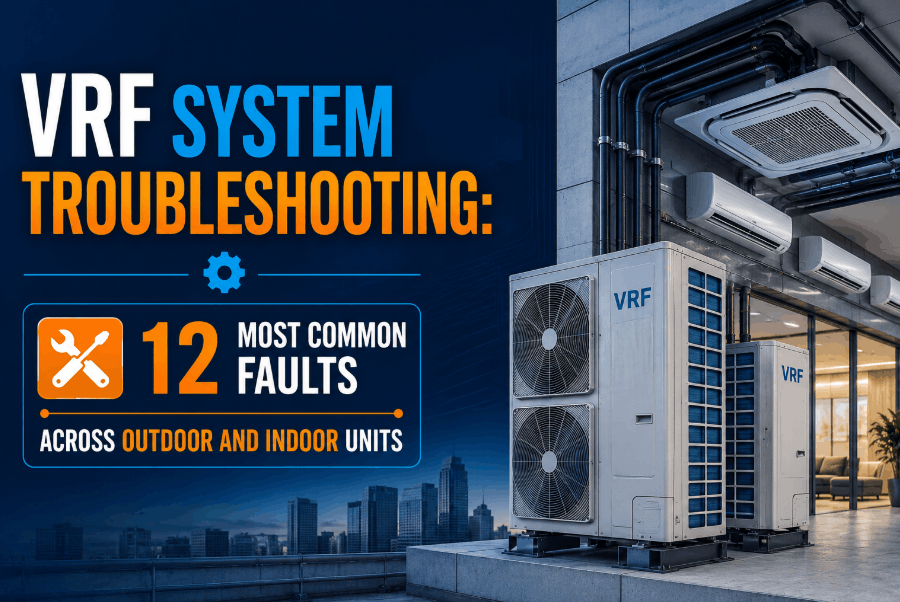
VRF system troubleshooting demands a fundamentally different diagnostic approach than conventional HVAC — because variable refrigerant flow systems distribute faults across interconnected indoor and outdoor units in ways that make the root cause invisible until a complete zone failure forces emergency service. This guide covers the 12 most common VRF faults, the specific fault codes that signal each failure mode across Mitsubishi, Daikin, LG, and Carrier platforms, and the systematic diagnostic sequence that resolves each fault before it cascades into a compressor or refrigerant circuit replacement. Sign Up Free to centralize your VRF fault history and service records from day one.
Why VRF System Faults Are Harder to Diagnose Than Conventional HVAC
Variable refrigerant flow systems use a single refrigerant circuit to serve multiple indoor units simultaneously — which means a fault in one component can manifest as comfort complaints across an entire building floor while the actual failure point sits undetected in the outdoor unit or branch circuit controller. Unlike a split system where each indoor unit has its own isolated refrigerant circuit, a VRF system's shared refrigerant circuit creates diagnostic interdependencies that require technicians to understand the full system architecture before interpreting fault codes.
The other complexity that drives VRF troubleshooting difficulty is proprietary fault code systems. Mitsubishi Electric VRF troubleshooting codes, Daikin VRF fault codes, and LG Multi V fault codes each use different numeric or alphanumeric schemes that map to different underlying failure modes — and the same symptom (one indoor unit not cooling) can carry six different fault codes depending on the manufacturer and system generation. Book a Demo to see how OxMaint standardizes VRF fault tracking across mixed-manufacturer building portfolios.
Always retrieve fault history from the outdoor unit controller before clearing codes or beginning component-level diagnostics. VRF systems store fault sequences that reveal whether a current fault is the root cause or a downstream consequence of an earlier failure — clearing codes first destroys the most valuable diagnostic information available.
The 12 Most Common VRF Fault Codes: Root Causes and Diagnostic Sequences
The following fault categories represent the highest-frequency VRF system problems across commercial building applications. Each entry covers the triggering condition, the system components involved, and the diagnostic steps. Sign Up Free with OxMaint to document fault-to-resolution sequences and build a searchable knowledge base for your VRF fleet.
- Dirty condenser coil blocking heat rejection
- Failed condenser fan motor
- Refrigerant overcharge or non-condensables
- Blocked airflow around outdoor unit
- Check fault history for trip frequency
- Measure discharge pressure vs. saturation curve
- Inspect condenser coil for fouling
- Verify all condenser fans are running
- Refrigerant undercharge from slow leak
- Restricted or clogged expansion device
- Clogged indoor unit air filters
- Partial liquid line blockage
- Measure suction pressure at outdoor unit port
- Inspect all indoor unit air filters
- Perform leak detection at flare connections
- Check expansion valve via coil temperatures
- Refrigerant undercharge reducing motor cooling
- Low supply voltage causing high amperage
- Failed inverter overdriving compressor
- Liquid slugging in heat pump mode
- Measure supply voltage under full load
- Check compressor winding resistance
- Retrieve inverter drive fault log
- Measure discharge line temperature
- Broken or miswired communication cable
- Duplicate unit address assignment
- Interference from adjacent power wiring
- Failed indoor unit PCB comm circuit
- Verify all unit addresses match config map
- Inspect wiring for damage and correct polarity
- Measure bus voltage (typically 12–24VDC)
- Isolate fault by disconnecting units one by one
- Actual leak at flare connection or indoor coil
- Contaminated refrigerant detection sensor
- Charge imbalance between operating modes
- Slow refrigerant migration in circuit
- Never assume false positive — verify physically
- Electronic leak check at all flare connections
- Verify charge using manufacturer weight method
- Inspect indoor coils with UV dye if applicable
- Failed reversing valve solenoid
- Reversing valve stuck in cooling position
- Low outdoor ambient locking out heat pump
- Defrost cycle stuck, blocking heating mode
- Verify outdoor temp is above heating floor
- Command mode change, listen for valve click
- Check pressure change within 30 sec of switch
- Measure reversing valve solenoid resistance
- Blocked refrigerant flow through BC controller
- Electronic valve failure in BC controller
- Communication loss to outdoor unit
- Power supply issue to BC control board
- Map offline units to their shared BC controller
- Read BC controller fault codes directly
- Check refrigerant temps at BC liquid/gas ports
- Inspect board for moisture ingress or damage
- Inverter power module failure from heat cycling
- DC bus voltage fault from power quality issues
- Phase imbalance on three-phase supply
- Inverter cooling fan failure causing overheating
- Read inverter sub-code from controller display
- Measure phase imbalance (must be under 2%)
- Test compressor winding insulation (megohmmeter)
- Inspect inverter fins for dust blockage
- Condensate pump failure or float switch fault
- Blocked drain line from algae or debris
- Unit installed without adequate drain pitch
- Coil icing overloading drain pan capacity
- Check for condensate pump fault code first
- Pour water in pan — verify pump activates
- Flush drain line with nitrogen or water
- Inspect coil for frost indicating low charge
- Defrost sensor failure triggering early initiation
- Dirty outdoor coil accelerating frost buildup
- Refrigerant undercharge lowering evap temperature
- Defrost termination sensor fault
- Time defrost cycle (normal = 3–10 minutes)
- Cycles over 12 min indicate termination fault
- Check defrost sensor clip contact on coil
- Clean coil and verify charge before replacing parts
- DC fan motor failure (bearing or open winding)
- Fan motor controller fault on inverter systems
- Fan blade obstruction from debris
- Motor harness damage from UV or rodents
- Verify correct control voltage reaches motor
- Rotate blade manually — check for binding
- Measure DC motor winding resistance
- Use fault sub-index to identify which fan failed
- Heat pump VRF receiving conflicting mode commands
- Incorrect BC controller config for heat recovery
- BAS sending opposing signals to zone units
- Heat recovery BC controllers not installed
- Confirm: heat pump or heat recovery system?
- Verify BC controllers are heat recovery type
- Review BAS points for conflicting commands
- Rebalance zone groupings within system capability
VRF Fault Code Reference: Mitsubishi, Daikin, LG, and Carrier Systems
VRF fault codes are manufacturer-specific, but the underlying failure categories are consistent across platforms. The table below maps common fault code patterns to failure categories and diagnostic priorities across the four major VRF platforms in the North American commercial market. Always cross-reference with the applicable installation and service manual for the specific model. Book a Demo to see how OxMaint stores equipment-specific fault code libraries for technician reference in the field.
| Fault Category | Mitsubishi City Multi | Daikin VRV | LG Multi V | Carrier VRF | Priority |
|---|---|---|---|---|---|
| High Discharge Pressure | P1 / 1302 | A3 / E3 | CH 02 | HP High Press | Critical |
| Low Suction Pressure | P2 / 1303 | A5 / E1 | CH 03 | LP Low Press | Critical |
| Compressor Overload | E6 / 6600 | H3 / UC | CH 38 | Comp OL | Critical |
| Communication Fault | E4 / 6600 | U4 / UF | CH 10 | Comm Err | High |
| Inverter Drive Fault | P8 / 6700 | UC / U0 | CH 21 | Inv Fault | Critical |
| Condensate Overflow | E3 / 5100 | C4 / CF | CH 53 | Drain Float | Medium |
| Defrost Abnormal | E9 / 1500 | J6 / J3 | CH 67 | Defrost Err | Medium |
| Fan Motor Fault | P9 / 2500 | F6 / FA | CH 05 | Fan OL | High |
VRF Preventive Maintenance Schedule: Preventing Faults Before They Occur
The most effective VRF troubleshooting strategy is a preventive maintenance program that intercepts the conditions that generate fault codes before a system lockout disrupts building operations. VRF systems operating under structured PM programs exhibit fault rates 60 to 70 percent lower than systems receiving reactive-only service. Sign Up Free with OxMaint to automate VRF PM scheduling and track completion across every unit in your portfolio.
Dirty filters are the most common upstream cause of low suction pressure faults, evaporator icing, and condensate overflow events. Filter replacement on schedule eliminates this fault chain entirely.
Flush condensate lines and test pump operation at each indoor cassette unit. Biological blockage develops within 90 to 120 days in humid climates and is the primary cause of water damage events.
Inspect field communication wiring at all connection points for corrosion, damage, and secure termination. Communication faults are almost entirely preventable with routine connection maintenance.
Annual coil cleaning prevents high discharge pressure faults and compressor overloads. A clean condenser coil reduces peak discharge pressure by 50 to 100 PSI under design conditions.
Charge verification using superheat and subcooling, combined with electronic leak detection at all flare connections, prevents the majority of low-pressure and compressor overload fault cascades.
Measure supply voltage, phase balance, and harmonic distortion at the outdoor unit disconnect. Inverter drive failures are disproportionately triggered by marginal power quality conditions.
-not-cooling-18-common-causes,-diagnostics-&-troubleshooting-guide.png)