Chiller plant sequencing optimization is the process of intelligently staging multiple chillers to match real-time cooling load, typically cutting annual energy use by 15–30% and extending equipment life by thousands of operating hours. This chiller plant guide for 2026 covers multi-chiller load staging, primary-secondary pumping efficiency, and how a CMMS with sequencing automation turns scattered BMS data into actionable work orders. Reliability teams managing large HVAC portfolios can Start Free Trial to immediately integrate asset tracking with energy analytics.
CHILLER PLANT GUIDE 2026
Are Your Chillers Cycling On and Off Because Your Sequencing Logic Is Stale?
Most multi-chiller plants waste 20–30% of their energy budget on short-cycling, poor load matching, and decoupled primary-secondary pumping loops. OxMaint connects your chiller plant performance data to automated maintenance triggers—so every staging decision is backed by real-time condition monitoring and predictive analytics.
Average Energy Waste
25%
of chiller plant energy is lost to poor sequencing, short-cycling, and unoptimized staging logic in legacy BMS setups.
ENERGY & COST IMPACT
Why Chiller Plant Sequencing Optimization Matters in 2026
A typical 2,000-ton chiller plant running 3,500 hours per year consumes over 2.1 million kWh annually. Without chiller sequencing optimization, most of these plants operate 15–25% below their optimal efficiency curve. The problem is rarely the chillers themselves—it is the staging logic. Legacy building management systems (BMS) often sequence chillers based on fixed leaving-water-temperature setpoints or simple lead-lag timers, ignoring real-time load conditions, entering condenser water temperatures, and equipment degradation curves.
Achievable with optimized multi-chiller staging vs. fixed setpoint logic
For a 1,500-ton plant at $0.12/kWh after sequencing upgrades
For CMMS-integrated sequencing optimization projects
REAL-WORLD SCENARIO
A 180-asset pharmaceutical plant spending $42K/yr on chiller energy was cycling two 500-ton chillers every 12 minutes during partial-load mornings. After implementing CMMS-driven chiller load staging with primary-secondary pumping optimization, short-cycling dropped to near zero, annual energy fell by 22%, and chiller compressor overhauls were extended from 4 to 6 years—saving $14K in parts and labor annually.
STEP-BY-STEP GUIDE
How to Optimize Multi-Chiller Staging & Load Distribution
Effective chiller staging optimization follows a structured sequence of data collection, analysis, and control logic refinement. The goal is to stage chillers so that each operating machine runs within its highest-efficiency envelope (typically 40–85% load) while avoiding short-cycling penalties that accelerate compressor wear.
Benchmark Current Plant Performance
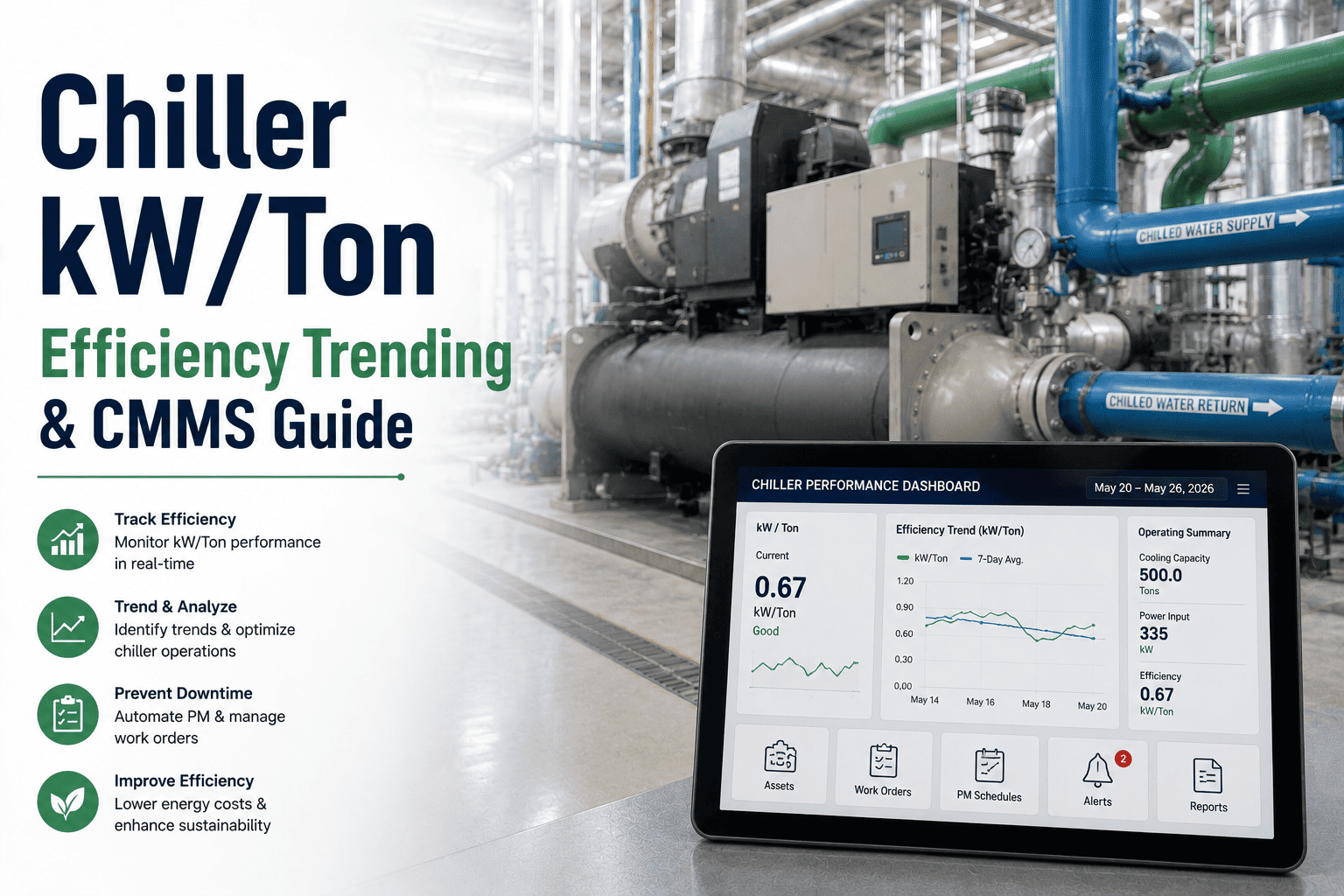
Log kW/ton at 25%, 50%, 75%, and 100% load for each chiller. Record entering/leaving CHW temps, condenser water temps, and flow rates. A CMMS captures these readings against asset records automatically, establishing a kW/ton baseline for ISO 50001 compliance tracking.
Map the Cooling Load Profile
Analyze 12 months of BMS trend data to identify load duration curves. Most plants find that chillers operate below 40% load 60–70% of the time—exactly where sequencing inefficiency is highest. Prioritize optimization efforts for these partial-load hours.
Rewrite Chiller Load Staging Sequences
Replace fixed-temperature staging with kW/ton-based logic. Stage the next chiller on when marginal efficiency of the running machine drops below the predicted combined efficiency of two machines. Set minimum run timers (20–30 min) and anti-short-cycle locks to protect compressors.
Tune Primary-Secondary Pumping Efficiency
In decoupled systems, optimize secondary pump VFD curves to match actual ∆P loads. Eliminate blending flow in the bypass line—every gallon of blending flow wastes pumping energy and degrades chiller efficiency. Target a bypass flow of zero during normal operation.
Automate Performance Tracking with CMMS
Feed real-time kW/ton, flow, and temperature data into your CMMS. Set automated alerts when efficiency degrades beyond 5% of baseline, and trigger preventive maintenance work orders automatically—closing the loop between energy performance and maintenance action.
SAVINGS & FORMULAS
Chiller Plant Efficiency: Calculating Sequencing Savings
Quantifying chiller plant efficiency improvements requires measuring the plant's integrated kW/ton before and after sequencing changes. The formula below isolates the energy impact of staging logic from weather and load variations, giving reliability teams a defensible ROI number for capital requests.
ANNUAL SEQUENCING SAVINGS FORMULA
Savings ($) = (kW/tonbefore − kW/tonafter) × Tonsavg × Hoursannual × $/kWh
Example: A 1,000-ton plant improves from 0.72 to 0.58 kW/ton, runs 3,200 hrs/yr, at $0.11/kWh.
Savings = (0.72 − 0.58) × 1,000 × 3,200 × 0.11 = $49,280/year
| Optimization Measure | Energy Savings | Maintenance Impact | Typical Implementation |
|---|---|---|---|
| Adaptive chiller load staging | 10–18% | 50% fewer compressor starts | 2–4 weeks |
| Primary-secondary pumping tuning | 5–12% | Extended pump seal life | 1–3 weeks |
| Condenser water reset | 4–8% | Reduced tube fouling | 1–2 weeks |
| CHW temperature reset | 3–7% | Lower coil corrosion rate | 1 week |
| CMMS-driven predictive triggers | 5–10% | 30–50% fewer unplanned outages | 2–6 weeks |
PRODUCT FIT
How OxMaint CMMS Solves Chiller Plant Sequencing Challenges
OxMaint bridges the gap between your BMS/SCADA energy data and your maintenance workflow. Instead of manually tracking chiller efficiency in spreadsheets, OxMaint automatically ingests performance metrics, detects degradation patterns, and triggers work orders before efficiency drops—or equipment fails.
Real-Time Efficiency Monitoring
Track kW/ton, ∆T, and flow for every chiller against baseline curves. Auto-trigger work orders when efficiency deviates beyond 5%—cutting unplanned downtime 30–50% and keeping sequencing logic honest.
Predictive Maintenance Triggers
AI-driven analytics predict compressor, tube, and pump failures 2–6 weeks before they happen. Automatically schedule tube cleaning, oil analysis, and overhaul work orders—eliminating reactive firefighting.
Automated PM Scheduling
Link chiller run-hours and cycle counts to preventive maintenance templates. OxMaint auto-generates work orders for filter changes, oil sampling, and condenser tube cleaning at the right interval—every time.
Asset & Spare Parts Tracking
Full asset hierarchy from plant → chiller → compressor → bearing. Track spare parts inventory for each chiller model so repairs happen in hours, not days. Reduce parts stockout downtime by 40%.
See OxMaint Optimize Your Chiller Plant—Book a 30-Min Demo
Watch how OxMaint connects BMS data to work orders, predicts failures, and cuts chiller plant energy 15–30%. Bring your plant specs—we'll show you the ROI on your assets.
FREQUENTLY ASKED QUESTIONS
Chiller Plant Sequencing Optimization FAQs
What is chiller plant sequencing optimization?
Chiller plant sequencing optimization is the practice of using real-time load data, equipment efficiency curves, and smart staging logic to determine exactly when to add or remove chillers from service. Instead of fixed setpoints, an optimized sequence calculates the marginal kW/ton of each chiller and stages machines so the combined plant operates at the lowest possible energy consumption. A CMMS like OxMaint enhances this by tying efficiency degradation directly to maintenance work orders, ensuring staging decisions are always based on actual equipment condition.
How much energy does chiller staging optimization save?
Most plants achieve 10–30% energy savings after implementing optimized multi-chiller staging, depending on baseline efficiency, load profile, and plant age. The largest gains come during partial-load operation (below 50% load), where legacy lead-lag logic is least efficient. For a 1,000-ton plant running 3,500 hours per year, a 20% reduction typically saves $40K–$70K annually. You can Start Free Trial to baseline your plant and quantify your specific savings opportunity.
How does primary-secondary pumping affect chiller plant efficiency?
In a primary-secondary system, the decoupler bypass line should see zero flow during normal operation. When secondary pump speeds are mismatched to actual load, blending flow occurs—chilled water bypasses the chillers and dilutes the supply temperature, forcing chillers to work harder. Tuning secondary pump VFD curves and eliminating blending flow can recover 5–12% in pumping and chiller energy, while reducing pump seal wear and extending motor life.
Can a CMMS integrate with my BMS for chiller sequencing?
Yes. OxMaint CMMS integrates with BMS/SCADA via API or BACnet/IP connectors to pull real-time chiller performance data—kW, tons, ∆T, flow, run-hours, and cycle counts. When efficiency drops below threshold or a predictive model flags degradation, OxMaint automatically generates a work order, assigns it to the right technician, and tracks resolution—closing the loop between energy performance and maintenance action.
What is the typical payback period for chiller plant optimization?
The payback period for chiller plant sequencing optimization ranges from 12 to 24 months. Software-led approaches using CMMS-driven monitoring and automated PM triggers tend to pay back faster (10–18 months) because they require no major capital equipment and immediately reduce both energy and unplanned downtime costs. Plants that pair sequencing logic with predictive maintenance see compounded savings of 25–40% on total cost of ownership over 5 years.
Stop Wasting 25% of Your Chiller Plant Energy Budget
Join reliability teams using OxMaint to automate chiller plant performance tracking, trigger predictive maintenance, and cut energy costs 15–30%. Start your free trial or book a personalized demo today.
Free 14-day trial · No credit card