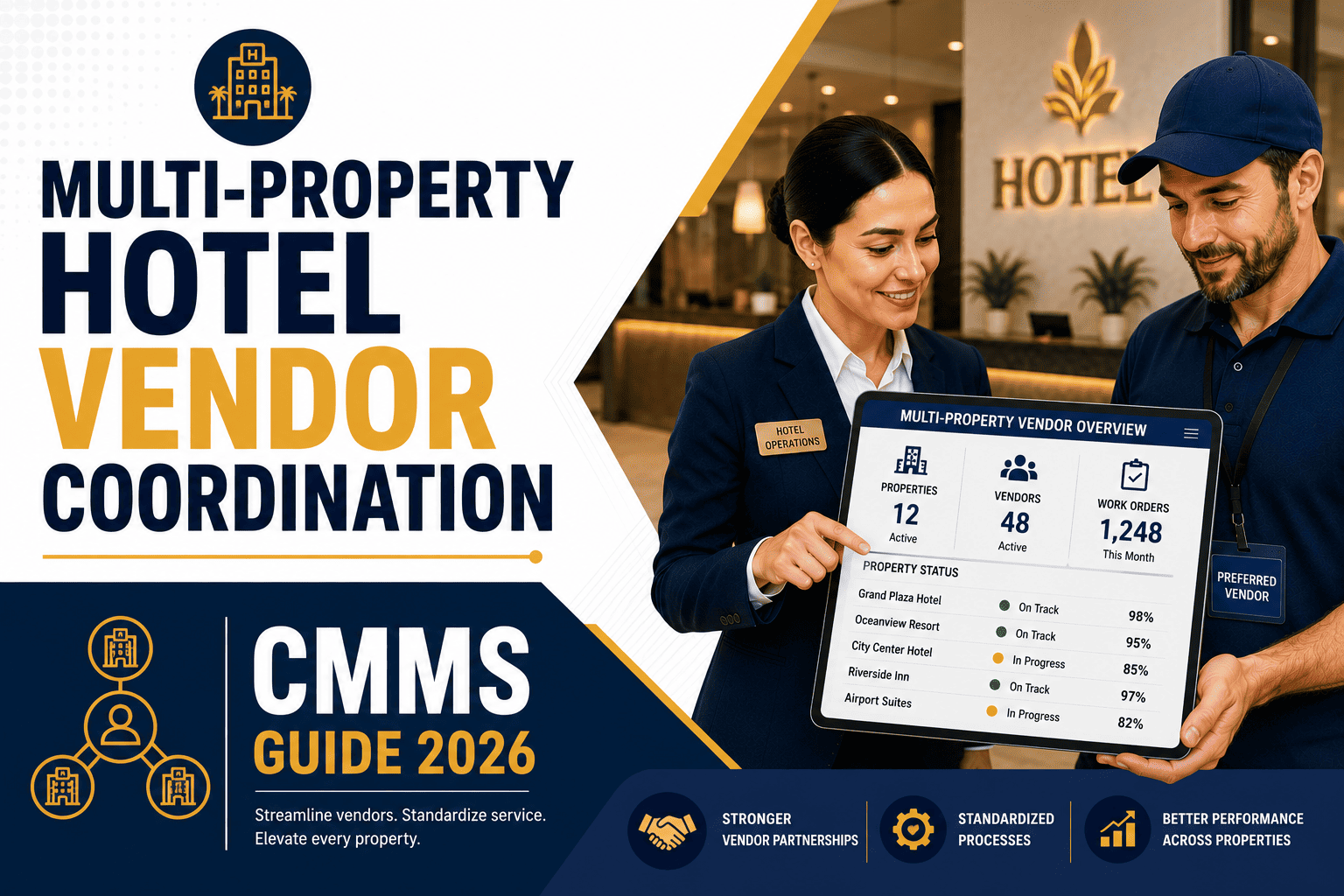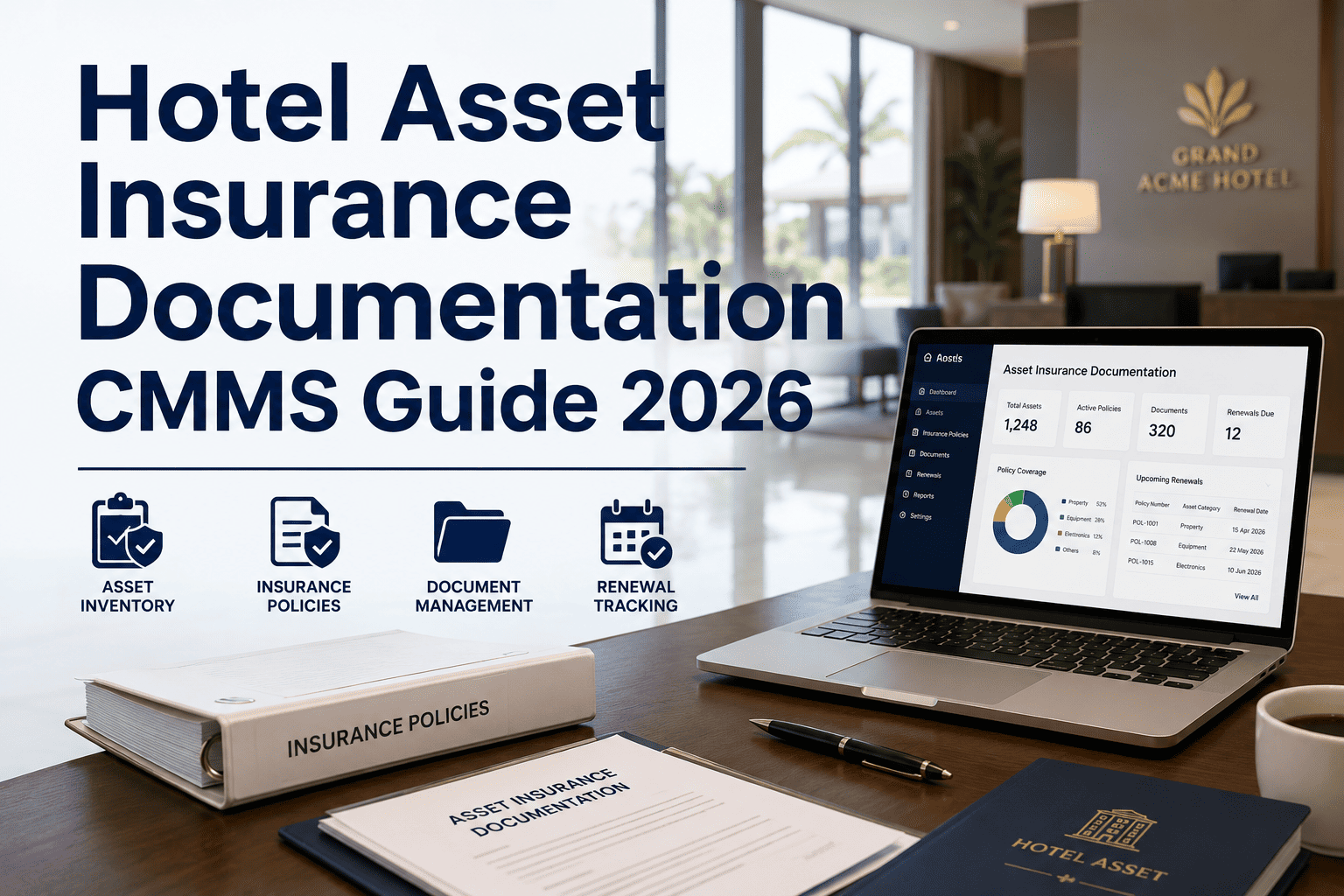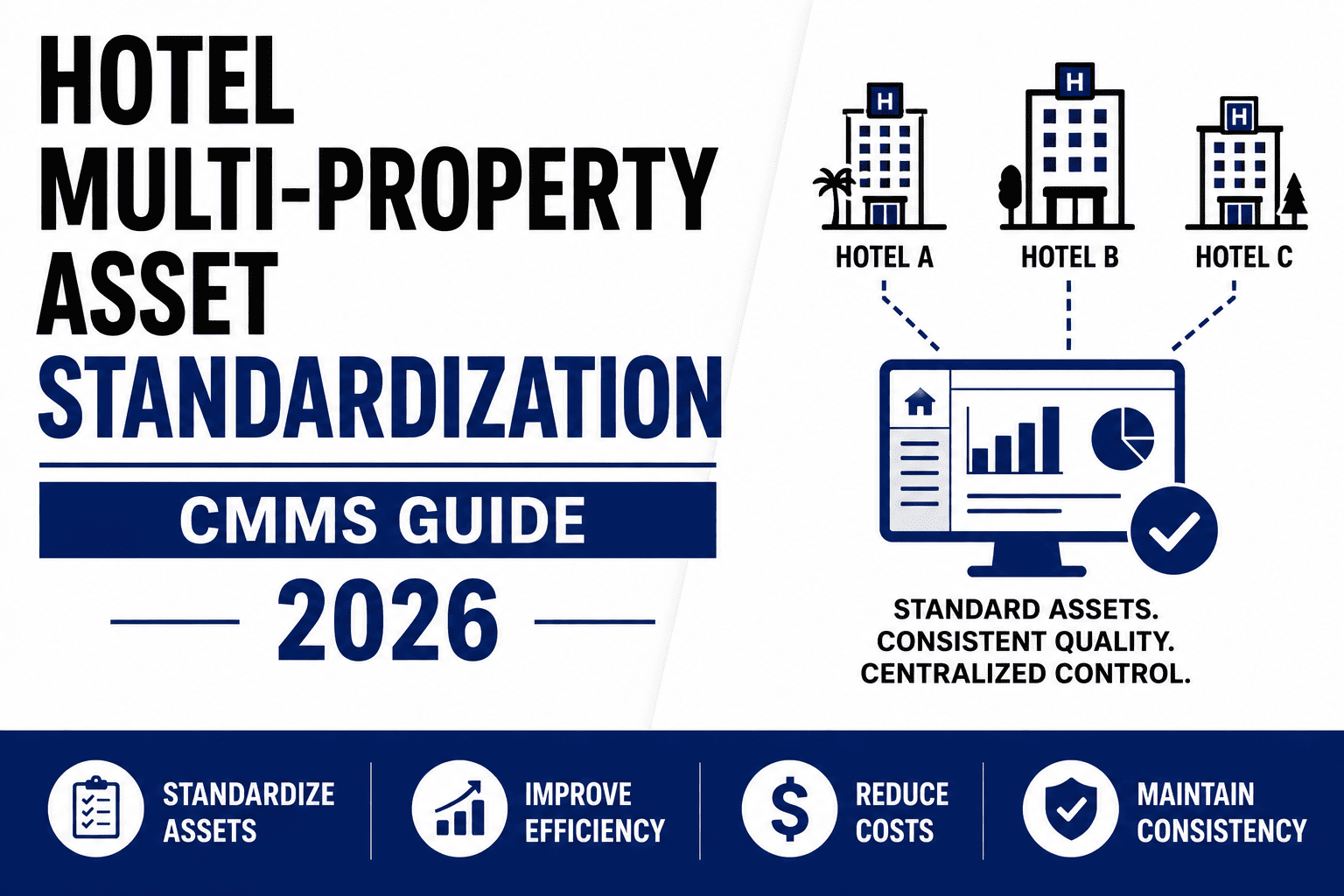
Hotel multi-property asset standardization is the discipline that turns portfolio purchasing power into portfolio operational power — the same preventive maintenance plans, the same spare parts, and the same technician playbooks can support any property in the chain. This CMMS hotel multi-property asset guide covers how to build a standardized asset catalog, replicate PM libraries across properties, enforce parts commonality, and run the corporate program that delivers the buying and operational efficiency portfolios are supposed to achieve. For chains still managing assets in spreadsheets or siloed property-level systems, the cost of inconsistency is measured in inflated inventory, duplicated labor, and untraceable downtime. OxMaint brings every property into a single AI-powered CMMS so standardization becomes executable, not aspirational — you can Start Free Trial today or book a demo to see it mapped to your portfolio.
Can a technician walk into any property in your portfolio and service the same asset without retraining?
When asset naming, PM schedules, and parts lists differ by property, portfolio efficiency collapses. Standardization through a CMMS changes that — one catalog, one playbook, every property.
The hidden cost of property-level asset inconsistency
A 12-property hotel chain typically carries 180–240 duplicate asset names, 15–30 variant PM schedules for the same boiler model, and 3–5 different part numbers for an identical filter — all because no central authority enforces the hierarchy.
Without a CMMS hotel standardized asset framework, corporate engineers spend weeks reconciling spreadsheets every time a new property is acquired or a franchise converts. The result is reactive maintenance by default — assets fail before PMs catch them, guest complaints spike, and capital expenditure replaces equipment that should have lasted another three years. Property asset consistency is not an administrative nicety; it is the structural prerequisite for any predictive maintenance or analytics program to function across a portfolio.
Four pillars of hotel multi-property asset standardization
Building a CMMS hotel portfolio asset program that scales requires four interconnected layers — each one compounds the value of the previous.
Standardized Asset Catalog
Every asset type — HVAC RTU, laundry ozone generator, boiler, guest-room mini-fridge — follows one naming convention and one hierarchy: Property → Building → Floor → Space → System → Asset. A "Carrier 48TC-09 rooftop unit" is identically categorized, tagged, and described whether it sits on a rooftop in Miami or Seattle.
Standard PM Library
One preventive maintenance template per asset model, replicated across every property with property-specific trigger dates. Filter changes, belt inspections, and combustion analyses fire on the same interval whether the asset serves 80 rooms or 400. Corporate engineering updates the library once; every property inherits the change.
Parts Commonality
A single approved parts list per asset model eliminates the 3–5 variant part numbers that bloat inventory. When a property manager orders a replacement air filter, the CMMS surfaces the standardized SKU — enabling vendor consolidation, volume discounts, and inter-property transfers during stockouts.
Corporate Governance Program
A defined approval workflow ensures no property can create a new asset type, PM variation, or part number without corporate review. Quarterly audits confirm compliance, and the CMMS flags deviations automatically — turning standardization from a one-time project into a living, enforceable program.
How to implement multi-property CMMS standardization in 6 months
A phased rollout prevents disruption and builds buy-in property by property. Here is the timeline a 10-property chain can follow to achieve full asset standardization by Q3.
Asset Audit & Hierarchy Design
Survey every property's asset register. Identify duplicates, naming variants, and orphaned records. Define the master hierarchy and naming convention in the CMMS. Target: 100% of critical assets mapped to the new schema.
PM Library Consolidation
Collapse 15–30 variant PM schedules per asset model into one standard template. Configure triggers (runtime hours, calendar days, condition thresholds) and push to all properties. Decommission legacy PMs in the same sprint.
Parts Standardization & Vendor Alignment
Map every part number to the approved standard SKU. Negotiate portfolio-wide vendor contracts for the top 20% of parts by spend. Load safety-stock min/max levels per property based on criticality, not guesswork.
Pilot Rollout at 2 Properties
Go live with two representative properties — one full-service, one limited-service. Train technicians on the CMMS mobile app. Run standard PMs, issue work orders, and validate parts flows. Capture feedback and refine before full rollout.
Portfolio-Wide Go-Live
Deploy to all remaining properties in waves of 3–4. Corporate engineering monitors compliance dashboards daily for the first 30 days, then weekly. By end of Month 6, every property runs on the same standard catalog, PM library, and parts list.
A 12-property portfolio: before and after CMMS standardization
Consider a 12-property hotel portfolio (1,800 total rooms) spending $1.4M annually on maintenance. Before standardization, each property ran its own spreadsheet-based PM schedule and ordered parts independently. Here is what changed.
| Metric | Before Standardization | After OxMaint CMMS | Impact |
|---|---|---|---|
| Asset naming variants | 210 duplicate names across portfolio | Single standardized catalog | 100% consistency |
| PM schedule variants per boiler model | 9 different PM templates | 1 corporate-standard PM | 88% reduction |
| Spare parts SKUs (top 100) | 340 SKUs (3.4 variants per part) | 100 approved SKUs | $52K/yr inventory savings |
| Unplanned downtime hours/yr | 1,840 hours across portfolio | 920 hours | 50% reduction |
| Guest complaints (maintenance-related) | 340 per quarter | 185 per quarter | 46% reduction |
| Technician onboarding time | 14 days per new hire per property | 4 days (standardized procedures) | 71% faster |
The portfolio recouped its CMMS investment in under 5 months. The combination of volume purchasing, reduced inventory carrying cost, and downtime avoidance delivered $312K in annualized savings — a 22% reduction in total maintenance spend.
How OxMaint delivers multi-property asset consistency
OxMaint is built for portfolios, not single sites. Its AI-powered CMMS and EAM platform enforces standardization at the data layer so every property, technician, and vendor operates from the same source of truth.
Portfolio-Wide Asset Hierarchy
Define your master hierarchy once. Every property inherits the same asset categorization, naming conventions, and criticality ratings. New acquisitions onboard in days, not weeks — with zero naming drift.
Centralized PM Library with AI Optimization
Maintain one preventive maintenance template per asset model. OxMaint's AI analyzes failure patterns across all properties and recommends interval adjustments — you approve once, every property updates automatically.
Standardized Spare-Parts Inventory
One approved parts list per asset model with property-level min/max levels driven by usage analytics. Inter-property transfer requests surface automatically during stockouts, eliminating emergency orders and expediting fees.
Cross-Portfolio Maintenance Analytics
Compare asset performance, PM compliance, and cost-per-room across properties in real time. Identify which properties are outliers, which asset models underperform, and where capital reinvestment delivers the highest return.
What hotel portfolio standardization pays back — and how fast
For a 10-property portfolio with $1.2M annual maintenance spend, the math is straightforward. Here is the savings formula and a line-by-line payback breakdown.
| Savings Category | Annual Amount | How Standardization Drives It |
|---|---|---|
| Inventory carrying cost reduction | $52,000 | Eliminate duplicate SKUs, right-size safety stock per property |
| Unplanned downtime avoidance | $98,000 | Standard PMs catch failures early; AI predicts remaining useful life |
| Labor efficiency gains | $64,000 | Technicians follow one playbook; 71% faster onboarding; mobile CMMS app |
| Vendor consolidation & volume discounts | $41,000 | Portfolio-wide contracts on standardized parts; fewer emergency orders |
| Guest complaint revenue recovery | $28,000 | Fewer maintenance-related complaints preserve ADR and repeat bookings |
| Total Annual Savings | $283,000 | Payback period: 4.3 months on CMMS investment |
What hotel maintenance leaders say about OxMaint
"We rolled OxMaint out across 8 properties in 6 weeks. For the first time, corporate engineering can see PM compliance at every hotel in real time. Our parts spend dropped 28% in the first quarter alone because we finally had one approved parts list."
"The standardized asset catalog was the unlock. When we acquired two new properties, they were fully onboarded into our CMMS in 4 days — same PMs, same parts, same reporting. That used to take a month of spreadsheet reconciliation."
See OxMaint standardize your portfolio — book a 30-minute demo
We will map your asset hierarchy, PM library, and parts list across every property and show you exactly what your payback looks like.
Hotel multi-property asset standardization CMMS — your questions answered
What is hotel multi-property asset standardization in a CMMS?
It is the practice of maintaining a single, corporate-approved asset catalog, preventive maintenance library, and spare-parts list across every property in a hotel portfolio. A CMMS like OxMaint enforces this standard at the data layer so that a rooftop unit in one hotel is categorized, maintained, and repaired identically to the same unit in another — eliminating naming variants, duplicate PMs, and inconsistent parts ordering.
How long does it take to implement multi-property CMMS standardization?
A typical 10-property hotel portfolio achieves full standardization in 4–6 months using a phased rollout: asset audit and hierarchy design in Months 1–2, PM library consolidation in Month 3, parts standardization in Month 4, pilot at two properties in Month 5, and portfolio-wide go-live in Month 6. OxMaint's onboarding team accelerates this by importing existing asset data and auto-mapping it to your standard hierarchy — you can book a demo to see a tailored timeline for your portfolio.
How much can a hotel portfolio save with asset standardization?
Hotel portfolios typically see 18–25% reductions in total maintenance spend within the first 12 months. The savings come from four sources: inventory carrying cost reduction (20–35% less duplicate stock), downtime avoidance (30–50% fewer unplanned failures), labor efficiency (71% faster technician onboarding), and vendor consolidation through portfolio-wide parts contracts. A 10-property chain spending $1.2M annually can expect $180K–$340K in annualized savings.
Can OxMaint handle different property types within the same portfolio?
Yes. OxMaint's hierarchy supports mixed portfolios — full-service, limited-service, extended-stay, and resort properties — under one standardized catalog. Each property type uses the same asset naming and PM templates, but property-level configurations (room counts, system complexity, climate zones) adjust trigger intervals and safety-stock levels automatically. Corporate engineering maintains governance while property teams retain operational flexibility.
What happens to existing asset data when switching to OxMaint?
OxMaint imports your existing asset registers, PM schedules, and parts lists from spreadsheets, legacy CMMS, or property management systems. The onboarding team maps your current data to the standard hierarchy, flags duplicates and naming variants for review, and cleanses the records before go-live. Most portfolios are fully migrated within 2–3 weeks, and you can Start Free Trial to explore the import tools immediately.
Standardize every property. Start today.
Join hotel portfolios that cut maintenance spend 20%+ with OxMaint's AI-powered CMMS — one asset catalog, one PM library, one parts list, every property.
Free 14-day trial · No credit card