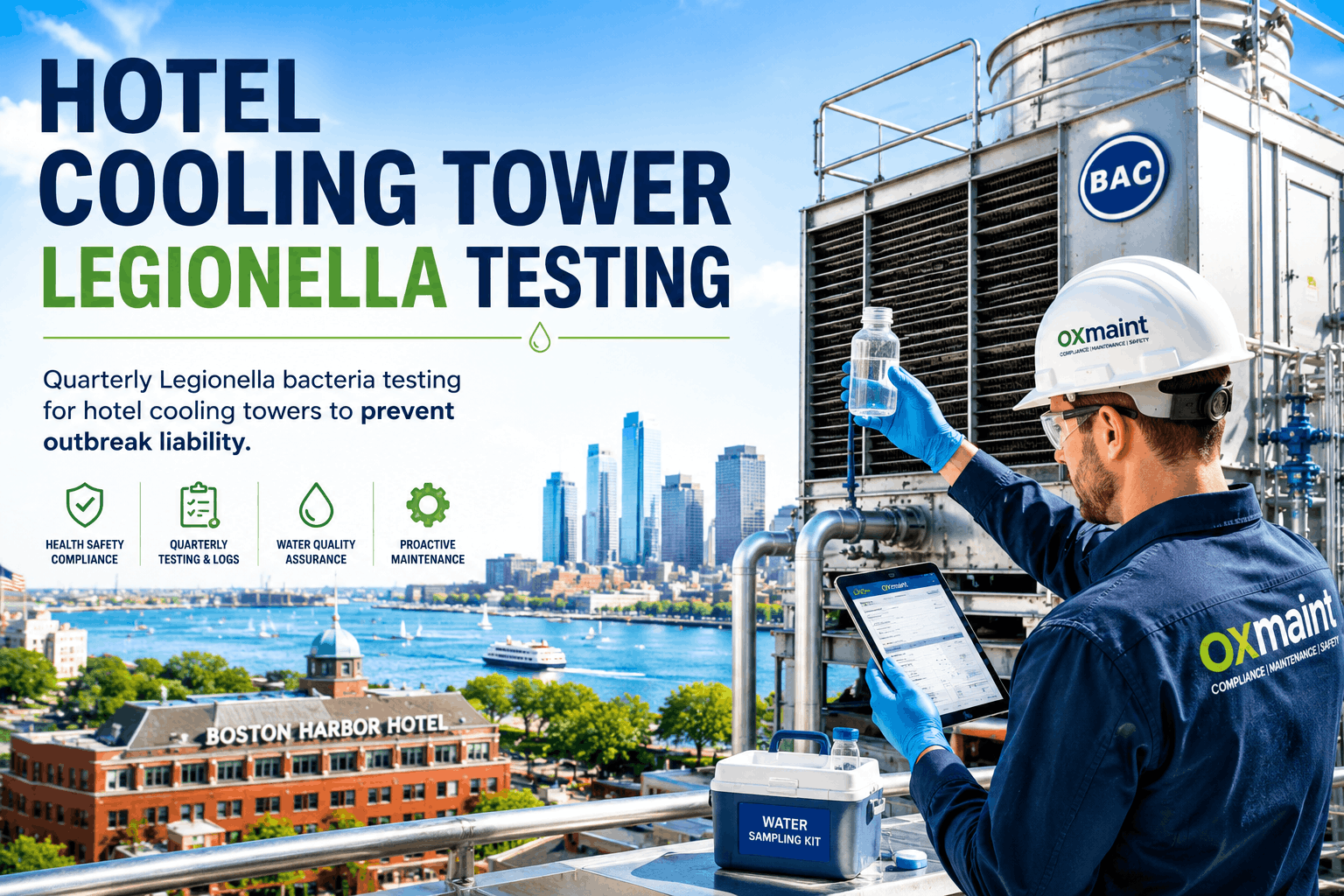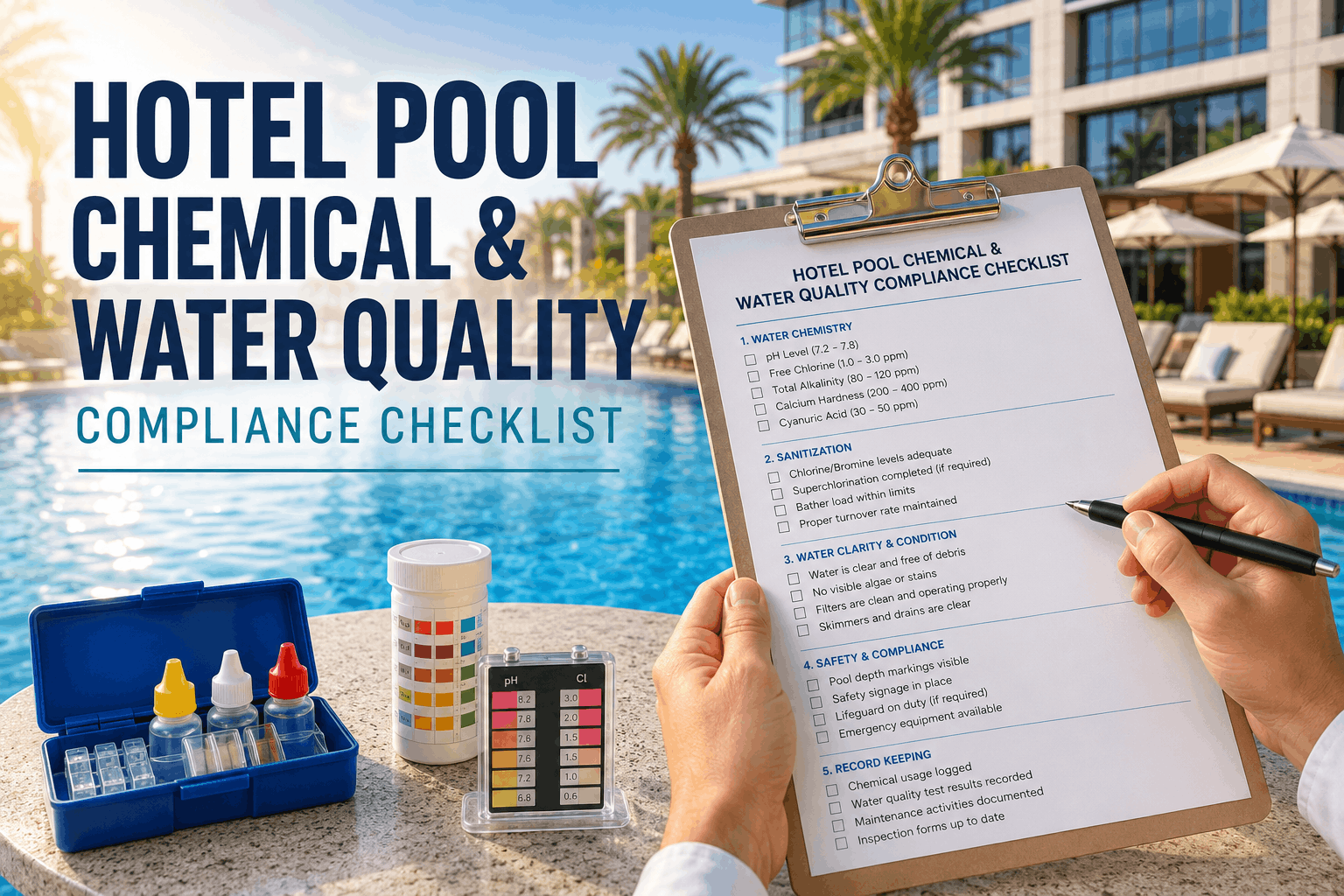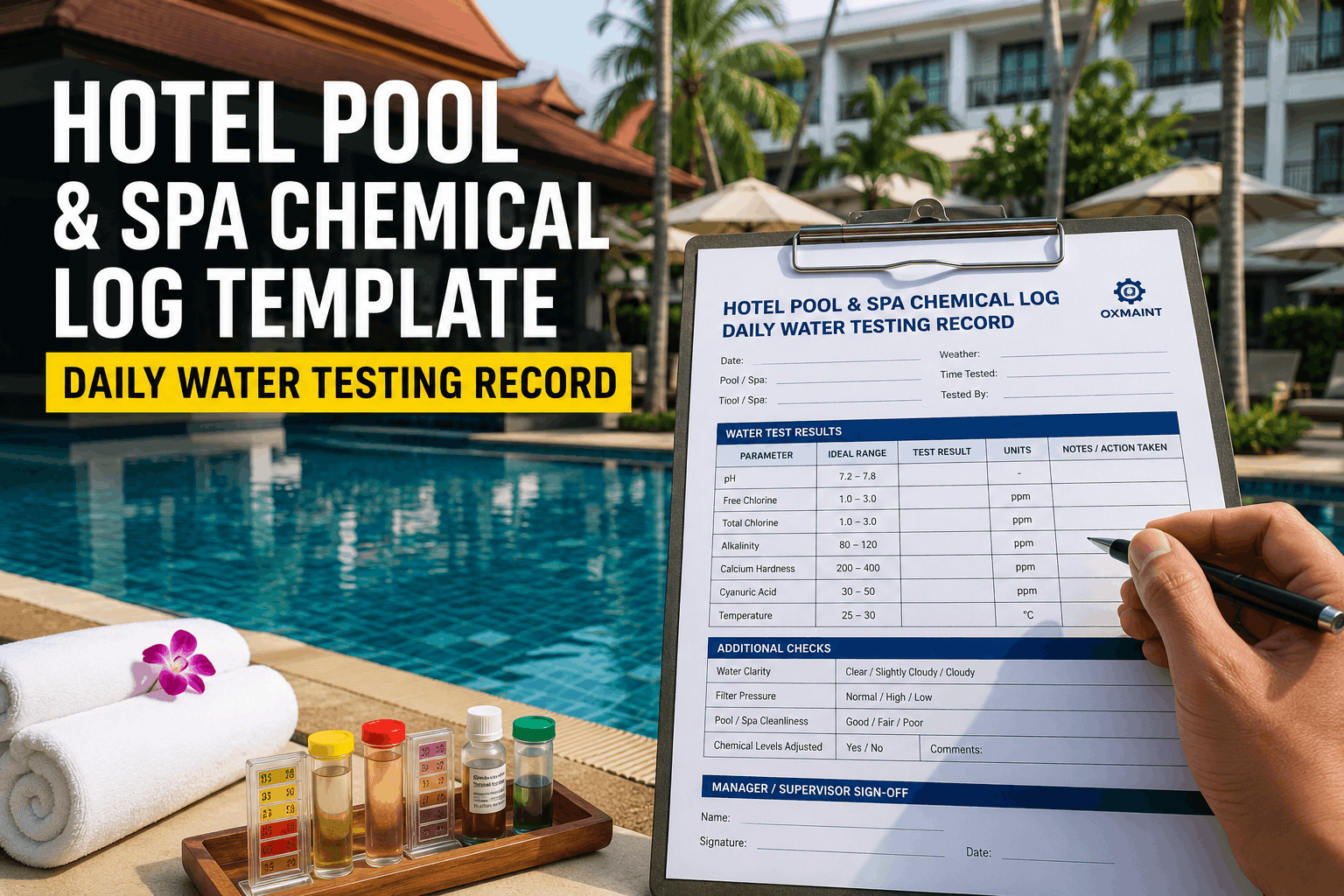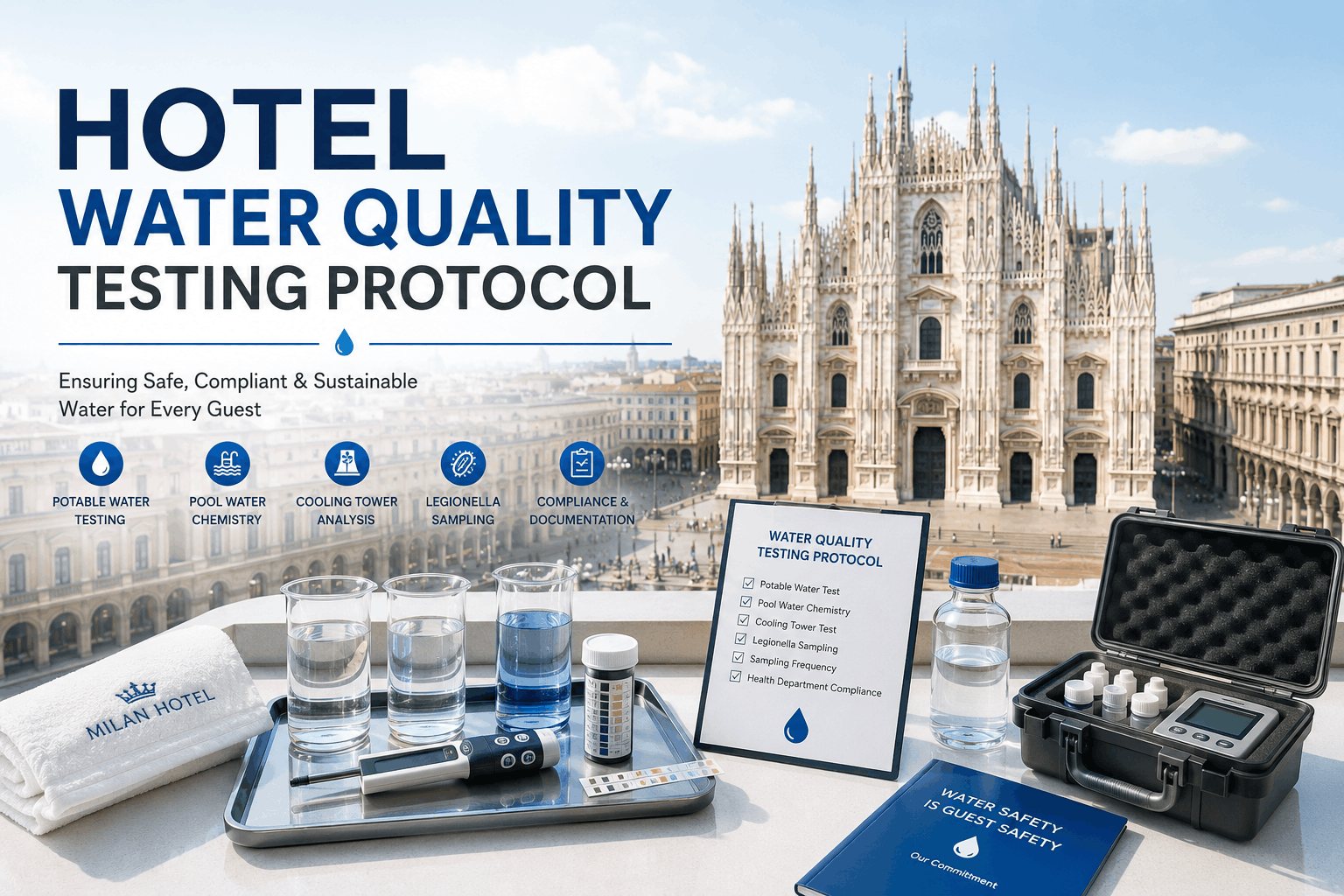
Hotel water systems—potable water lines, cooling towers, hot water storage tanks, pools, spas, ice machines, and decorative fountains—are complex, multi-zone networks spanning thousands of linear feet of piping distributing water to hundreds of guest rooms and facilities. Each zone presents distinct water quality risks and testing requirements. Hotels manage six distinct water system zones simultaneously: (1) domestic hot water (highest Legionella risk due to temperature stagnation), (2) cooling towers (where Legionella thrives in warm, biofilm-rich environments), (3) swimming pools (requiring chlorine residual and pH control for guest safety), (4) decorative fountains (aerosol-generating devices creating Legionella inhalation risk), (5) hot tubs and spas (intensive use and temperature create perfect conditions for pathogenic growth), (6) cold water supply (requiring periodic sampling for microbial contamination). Without a structured water management program based on ASHRAE 188 compliance, hotels operate blind to water quality risks. Legionella bacteria grow silently in warm, stagnant water—invisible without laboratory culture testing. When Legionella detection occurs, it's typically after guest illness, requiring emergency remediation, regulatory investigation, litigation, and reputation damage that costs hundreds of thousands of dollars and occupancy suppression lasting months. Oxmaint's water management system automates testing schedules per zone, logs all chemistry readings and Legionella culture results, flags exceedances for immediate corrective action, and maintains audit-ready compliance documentation for health department inspections and litigation support.
Water Quality and Legionella Risk: Why Hotel Water Systems Require Comprehensive, Zone-Specific Testing Protocols
Legionella pneumophila is a gram-negative bacterium that grows in warm water between 77°F and 113°F—a temperature range found in almost every hotel water system. Legionella doesn't survive in cold water below 68°F or in hot water above 122°F, but the transition zones in between are ideal breeding grounds. Unlike bacteria like E. coli that require ingestion to cause illness, Legionella is inhaled as fine aerosol droplets—a guest taking a shower with Legionella-contaminated water inhales bacterial aerosols with every breath. Legionnaires' disease causes severe pneumonia with 10-15% mortality rate in hospitalized patients; even survivors often require weeks of hospitalization and can suffer permanent lung damage. Pontiac fever (a milder Legionella manifestation) causes flu-like symptoms in exposed populations. CDC statistics show that 9 in 10 Legionella outbreaks are preventable through effective water management programs—meaning nearly all confirmed cases represent management failures, not inevitable accidents. ASHRAE Standard 188-2018 establishes a comprehensive water management framework requiring hotels to: (1) conduct baseline Legionella testing of all high-risk zones before beginning monitoring, (2) maintain control limits for temperature, biocide level, and water chemistry in each zone, (3) monitor compliance continuously with defined test frequency per zone, (4) execute immediate corrective actions when control limits are exceeded, (5) maintain complete documentation of every test, corrective action, and system modification. Many hotels implement partial programs (maybe testing the cooling tower but ignoring domestic hot water), creating false confidence while critical zones remain unmonitored. Comprehensive water management requires simultaneous attention to all six zones per ASHRAE 188 framework.
Six Water System Zones and Zone-Specific Testing Requirements: ASHRAE 188 Compliance Framework
ASHRAE 188 organizes hotel water systems into six distinct zones, each with different risk profiles, control measures, and testing frequencies. A hotel implementing only partial water testing (e.g., cooling tower only, ignoring domestic hot water) leaves critical gaps where Legionella growth goes undetected. The six zones are: Domestic Hot Water (DHW) system, Cooling Tower, Swimming Pool, Decorative Fountain, Spa/Hot Tub, and Cold Water Supply. Each zone requires different chemistry parameters, test frequencies, and corrective action thresholds. Complete water management means treating all six zones as an integrated system with automated scheduling, consistent documentation, and immediate notification when control limits are exceeded.
Storage tanks, recirculation loops, distribution piping to all guest rooms. Risk: water stagnation in unused guest room lines, temperature setback creating cool zones ideal for Legionella. Control: maintain 120°F minimum at all return lines, monitor temperature in sleeping guest rooms. Test: quarterly temperature spot checks per ASHRAE, annual Legionella culture of return line.
Chiller condenser cooling loop, highest Legionella risk from warm, biofilm-rich basin water. Control: maintain biocide residual (10-20 ppm typical), pH 6.5-8.5, conductivity within limits. Test: weekly water chemistry (on-site), semi-annual Legionella culture by certified lab (start/end of season, after 7+ day shutdown).
Large volume of warm water, continuous guest use, heavy aerosol generation. Control: maintain free chlorine 1.0-3.0 ppm, pH 7.2-7.6, turbidity <1.0 NTU. Test: daily chlorine/pH testing on-site, weekly professional lab analysis of samples. Less Legionella risk than hot water due to continuous chlorination, but guest safety depends on chemistry compliance.
Recirculating loop with aeration (splash feature), warm water, biofilm formation in basin. Control: maintain biocide residual, temperature below 68°F if possible (difficult due to sun heating), drain and refill monthly. Test: weekly biocide and pH testing, monthly Legionella culture of basin water.
Heated to 104°F+, intensive guest use, high biofilm risk. Control: maintain free chlorine 2.0-5.0 ppm (higher than pool due to heat stress), pH 7.2-7.6, temperature 104°F max, drain and refill per manufacturer (typically 3-7 days). Test: daily chlorine/pH/temperature, weekly lab analysis, monthly Legionella culture.
Incoming municipal water, distribution piping to cold outlets, ice machines. Lower Legionella risk but potential for other waterborne pathogens (Giardia, Cryptosporidium). Control: maintain temperature below 68°F, monitor pressure and flow. Test: monthly bacteriological sampling (standard plate count, coliforms), Legionella culture quarterly.
Water Quality Testing Procedures: Chemistry Measurement, Legionella Sampling, and Laboratory Analysis
Water quality testing combines two distinct approaches: field chemistry testing (on-site measurement of chlorine, pH, temperature, conductivity) and laboratory Legionella culture (requiring certified lab analysis of water samples). Field tests provide immediate feedback enabling same-day corrective action; Legionella culture requires 5-7 days for results, making it a compliance verification tool rather than immediate response mechanism. Hotels must implement both simultaneously—field testing ensures control limits are maintained daily, Legionella culture confirms that control measures are preventing colonization. A hotel measuring chlorine perfectly but ignoring Legionella culture has a false confidence that control is effective. A hotel growing Legionella is evidence that field testing alone is insufficient.
| Test Type | Zone(s) | Parameters Measured | Frequency | Equipment & Method |
|---|---|---|---|---|
| Field Chemistry: Chlorine (Free & Total) | Pool, Spa, Fountain, sometimes DHW (if chloramination used) | Free chlorine residual (ppm), total chlorine (ppm), chlorine type (hypochlorite vs. chlorine gas) | Pool/Spa: daily (morning before opening). Fountain: 3x weekly minimum. DHW: weekly if chemical treatment used. | Test kit with colorimetric indicator (compare sample color to reference chart) or digital chlorine meter (more accurate, require calibration). Record reading and time in CMMS. |
| Field Chemistry: pH | Pool, Spa, Fountain, DHW (return line temperature), Cooling Tower | pH value (0-14 scale); for water systems, target typically 6.5-8.5 range | Daily for pool/spa. Weekly for fountain, cooling tower, DHW return temperature. pH affects chlorine effectiveness (chlorine is most effective at pH 6.5-7.0). | Digital pH meter or test strips. Meter requires calibration with 4.0 and 7.0 buffer solutions at start of measurement day. Record pH and temperature (pH is temperature-dependent). |
| Field Chemistry: Temperature (Thermal Monitoring) | DHW (outbound and return), Spa, Fountain, Cooling Tower | Water temperature at measurement point, recorded in Fahrenheit and Celsius | DHW: daily temperature spot checks in 3-5 guest room shower lines (selected randomly). Spa: continuous monitoring via built-in thermometer. Cooling Tower: daily. Fountain: daily or continuous if sensor present. Temperature drift triggers corrective action protocols. | Infrared thermometer (non-contact, useful for pipe surface temperature) or digital probe thermometer (accurate within ±1°F). DHW compliance requires 120°F minimum at return; guest room outlets require flushing to confirm hot water arrives within 30 seconds. |
| Field Chemistry: Biocide Residual (for towers, fountains) | Cooling Tower, Decorative Fountain, sometimes DHW | Active biocide concentration (ppm); type depends on biocide used (oxidizing, non-oxidizing, or combination) | Cooling Tower: 2-3x weekly. Fountain: weekly. Controls Legionella and other microorganisms. Target typically 10-20 ppm for oxidizing biocides. | Test kit matching biocide type (e.g., chlorine residual kit for hypochlorite, color indicator kit for bromide). Requires sample preparation (cooling if hot). Record concentration and biocide type in CMMS. If residual drops below minimum, increase biocide dosing and retest within 24 hours. |
| Field Chemistry: Conductivity (mineral content proxy) | Cooling Tower primarily; sometimes DHW | Electrical conductivity (µmho/cm or mS/cm); correlates to total dissolved solids (TDS) | Cooling tower: weekly. Used to track mineral accumulation and guide blowdown frequency. Target range depends on water hardness and treatment program. | Conductivity meter (requires calibration with standard solution). Higher conductivity indicates mineral buildup; triggers tower blowdown to prevent scaling on heat exchanger surfaces. |
| Laboratory Legionella Culture Testing | DHW (return line), Cooling Tower, Spa, Fountain, cold water (quarterly) | Legionella pneumophila count (CFU/mL); reported as "Legionella detected" or "not detected" or quantified as concentration | DHW: annual minimum (semi-annual recommended). Cooling tower: semi-annual (start and end of season, plus after 7+ day shutdown). Spa: monthly (higher risk). Fountain: monthly. Cold water: quarterly. Results arrive 5-7 days after sample collection. | Collect 1-liter sterile sample from each testing location. Use chain-of-custody form. Ship on ice to certified laboratory within 24 hours. Laboratory culture on specialized media (BMPA or similar), incubation at 35-37°C for 10-14 days. Results reported as positive/negative or concentration. Any positive result triggers immediate remediation (temperature increase, biocide shock treatment, system disinfection). |
| Laboratory Bacteriological Analysis (Cold Water) | Cold water supply, potable water outlets | Standard Plate Count (SPC), Coliform bacteria, E. coli, other indicator organisms | Monthly for municipal supply compliance verification. Quarterly if system modifications made. More frequent if contamination suspected. | Collect sterile samples from cold outlets. Test for indicator organisms (presence of coliforms = evidence of contamination). Results arrive 24-48 hours. Any positive coliform result requires immediate system flushing and resampling. |
Implementing a Comprehensive Water Management Program: ASHRAE 188 Compliance, Baseline Testing, and Ongoing Monitoring
Hotels establishing a water management program from scratch typically begin with baseline Legionella testing of all high-risk zones, then implement ongoing monitoring protocols. Baseline testing establishes the starting condition—if a zone already harbors Legionella colonization, baseline testing reveals it so remediation can begin before monitoring starts. Many hotels make the mistake of skipping baseline testing and assuming their systems are clean; this is false confidence. If baseline testing reveals colonization, immediate thermal or chemical remediation protocols must be executed (heating domestic hot water to 160°F for one hour, or high-dose biocide shock treatment) before normal monitoring protocols resume. Oxmaint automates the entire process: scheduling baseline tests, logging all laboratory results, triggering corrective action protocols when colonization is detected, and maintaining complete audit-ready documentation for health department inspections.
- Identify and sample all six water zones: DHW return line (high-risk), cooling tower basin, pool, decorative fountain, spa, cold water supply
- Collect 1-liter sterile samples from each zone using chain-of-custody documentation. Maintain cold chain (ship on ice) and deliver to certified laboratory within 24 hours.
- Include detailed sampling notes: location, temperature at time of sampling, recent system changes, known water chemistry issues
- Results arrive 5-7 days. Any positive Legionella result (even low concentrations) triggers immediate remediation before regular monitoring begins
- DHW: if Legionella detected, increase setpoint to 160°F and circulate through all branch lines for minimum one hour. Retest 48 hours later.
- Cooling Tower: if Legionella detected, dose with high-concentration biocide (50+ ppm if using oxidizing biocide), operate circulation for 2+ hours, drain and refill basin, retest 7 days post-treatment
- Pool/Spa: shock with high chlorine dose (10-20 ppm), maintain for 12+ hours, then normalize to operating levels. Drain and refill if contamination is heavy.
- Fountain: drain, clean basin mechanically, refill with fresh water, increase biocide residual. Retest after 7 days of operation.
- Document all remediation actions in Oxmaint with timestamps, chemicals used, dosages, duration. Remediation must be completed and documented before regular monitoring schedule begins.
- In Oxmaint, create recurring daily work orders for field chemistry testing (DHW temperature, pool chlorine/pH, spa chlorine/pH/temperature, cooling tower biocide, fountain biocide)
- Schedule monthly and quarterly Legionella culture sampling with certified laboratory. Pre-schedule sample collection technician or assign to engineering staff trained in sterile sampling technique
- Configure Oxmaint alerts: if any field test result exceeds control limit (e.g., chlorine below 1.0 ppm in pool, DHW temperature below 120°F, tower biocide below 10 ppm), immediate notification to chief engineer with corrective action guidance
- For Legionella culture results: results are logged in CMMS automatically if using lab integration, or manually entered. Any positive result triggers automatic escalation and remediation protocol execution.
- Monthly: run Oxmaint compliance report showing all field tests completed (percentage completion target >95%), all Legionella culture results received, and any control limit exceedances with remediation actions taken
- Quarterly: review with chief engineer and environmental health/safety coordinator; identify any pattern issues (repeated chlorine failures in pool, persistent temperature issues in DHW return line) requiring corrective actions
- Before health department inspection: generate complete water management report from Oxmaint covering last 12 months: all baseline tests, ongoing field test results, Legionella culture results, remediation history. Include photos of water system, equipment certifications, and staff training records.
- Health department examiners will scrutinize: (1) completeness of testing (all zones covered), (2) test frequency compliance with ASHRAE 188, (3) control limit documentation and corrective action response, (4) Legionella results and follow-up actions, (5) treatment documentation (biocide refill logs, maintenance records).
Water Quality Compliance KPIs: Testing Completion, Control Limit Exceedances, and Outbreak Prevention Metrics
Hotels tracking water quality KPIs connect daily testing discipline to guest safety and regulatory compliance. Oxmaint's water management dashboard shows testing completion status, control limit violations, Legionella results, and remediation timeliness in real time. Start a free trial and measure your water system's compliance and safety today.
Percentage of scheduled daily field tests (chlorine, pH, temperature, biocide) completed and logged per week. Below 85% creates compliance gap and allows control limits to be exceeded undetected.
Count of instances where field test results fall outside control limits (e.g., chlorine <1.0 ppm, pH >8.0, DHW <120°F). Frequent exceedances signal dosing problems, equipment failures, or operator training gaps.
Percentage of Legionella culture samples returning "not detected" status. Any positive result requires immediate remediation and increased monitoring. Zero positive results = proof of effective water management.
Hours elapsed from detection of exceedance (e.g., low chlorine) to completion of corrective action (e.g., biocide refill, chemical dosing, equipment repair). Delays increase risk window for pathogenic growth.
Percentage of all six water zones that have undergone baseline Legionella testing. Incomplete baseline testing leaves zones without colonization status documentation.
Count of water system violations cited by health department. Oxmaint documentation eliminates these violations by proving comprehensive testing, control limit compliance, and corrective action documentation.