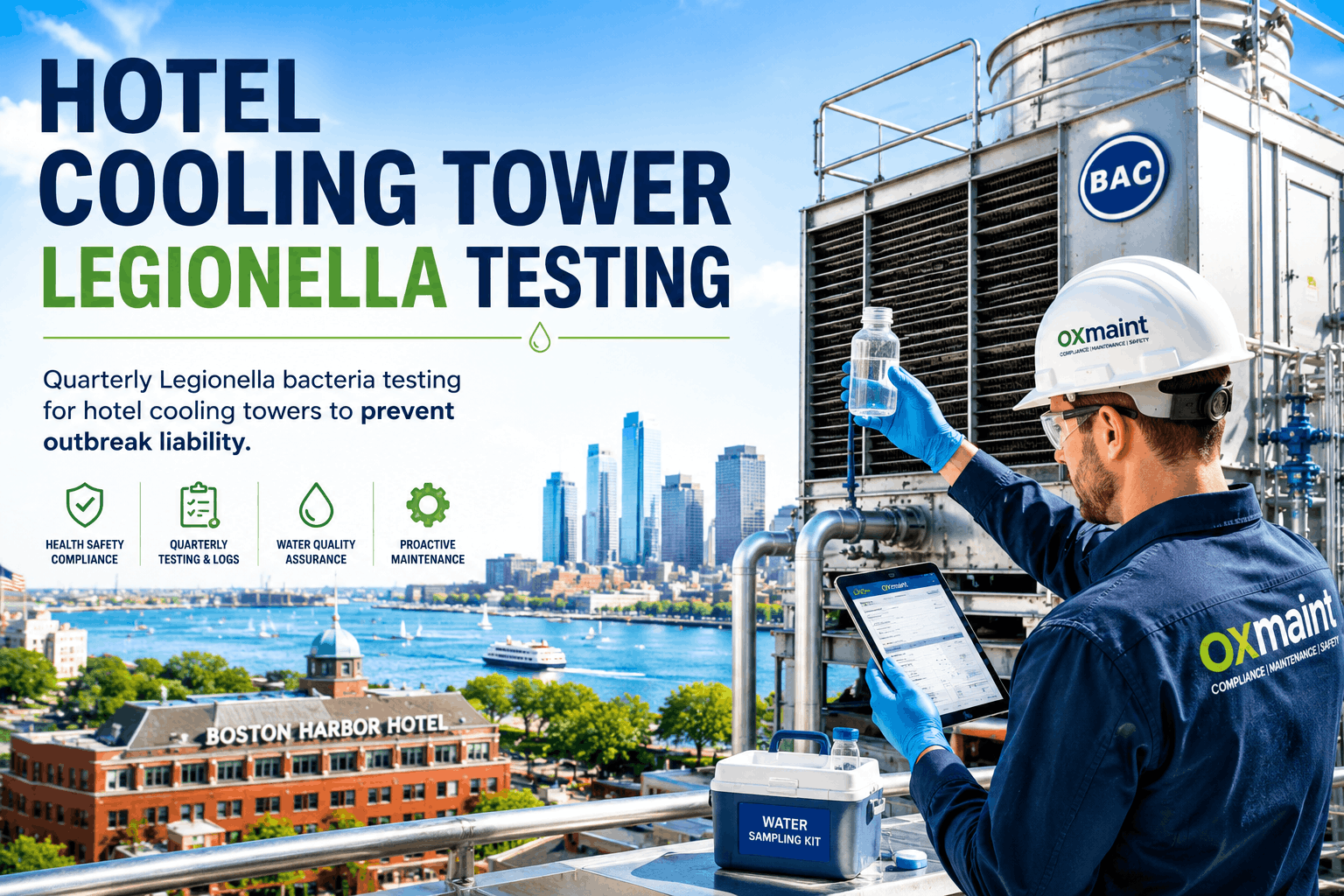
A 320-room resort in Orlando discovered Legionella pneumophila in its cooling tower water system after two guests were hospitalized with Legionnaires' disease resulting in a $3.8M lawsuit settlement, 45-day partial closureand permanent reputation damage across review platforms. The bacteria had been growing undetected for months in dead-leg piping sections where water temperatures sat between 77°F and 108°F—the ideal Legionella breeding range. Quarterly water testing had returned "compliant" results because samples were drawn from high-flow outlets, missing the stagnant zones entirely. A continuous IoT water quality monitoring system measuring temperature, pH, chlorine residual, turbidity, and flow rates across every branch of the distribution system would have flagged the temperature anomaly within hours of the dead-leg forming, triggered an automatic thermal flush protocol, and generated a maintenance work order before bacterial colonization reached dangerous levels. Hotels managing complex water systems across guest rooms, kitchens, pools, spas, cooling towers, and decorative fountains face an invisible compliance challenge: the water leaving treatment looks safe, but what reaches the guest can be dangerously different.
68%
Of Hotels Fail Comprehensive Water Quality Audits
Industry studies reveal that 68% of hospitality properties have at least one water system zone operating outside safe parameters at any given time—from low disinfectant residual in far-end guest room fixtures to elevated lead levels from aging pipe infrastructure. Periodic grab-sample testing catches only 2-4% of these excursions because problems develop between sampling events. Continuous IoT monitoring closes the gap between what quarterly tests show and what guests actually encounter.
IoT water quality monitoring replaces periodic laboratory testing with continuous, real-time sensor networks measuring temperature, pH, chlorine/chloramine residual, turbidity, dissolved oxygen, conductivity, and flow velocity across every critical point in the hotel water distribution system—from municipal supply entry through treatment, storage tanks, distribution risers, guest room fixtures, kitchen lines, cooling towers, pool systems, and decorative water features. When any parameter drifts outside safe ranges, alerts reach engineering staff instantly. Hotels that implement structured water system equipment maintenance tracking alongside IoT water monitoring create the complete water safety management system that prevents contamination, documents compliance, and protects guests from waterborne health risks.
The Real Cost of Water Quality Failures
What Hotels Risk Without Continuous Water Monitoring
$3.8M+
Average Legionnaires' disease lawsuit settlement—single incidents have exceeded $10M with wrongful death claims
$85K-$250K
Cost per water system remediation event—including emergency disinfection, pipe replacement, retesting, and operational disruption
34%
Revenue decline at properties with publicized water contamination—booking recovery takes 8-18 months after remediation
8,640 hrs
Annual blind hours between quarterly water tests—the window where Legionella colonizes, biofilm builds, and disinfectant depletes undetected
6 Core Components of IoT Water Quality Monitoring
Modern IoT water monitoring systems integrate multi-parameter sensing, automated disinfection control, flow analytics, and compliance documentation into a unified platform that covers every water system in the property. Hotels using OXmaint's asset management platform for water system equipment maintenance create the complete water safety ecosystem that passes every health department inspection and prevents contamination before it reaches a single guest fixture.
IoT Water Quality Monitoring Architecture
1. Multi-Parameter Sensor Arrays
Continuous measurement of temperature, pH, free chlorine residual, turbidity, conductivity, dissolved oxygen, and ORP at supply entry, storage tanks, distribution risers, and far-end fixtures every 60 seconds.
2. Automated Disinfection Control
Real-time chlorine/chloramine dosing adjustment based on sensor feedback—maintaining 0.2-2.0 ppm free chlorine throughout distribution without manual chemical testing or guesswork.
3. Legionella Risk Detection
Continuous temperature monitoring across hot and cold water systems—flagging any zone sitting in the 77°F-108°F danger range and detecting dead-leg stagnation through flow velocity analysis.
Automatic timestamped logging of every reading creates EPA, state health department, ASHRAE 188, and brand-standard-ready records—replacing manual logbooks that inspectors increasingly reject.
6. Pipe & Infrastructure Health
Tracks flow rate changes, pressure anomalies, and conductivity shifts that indicate pipe corrosion, scale buildup, biofilm formation, or leak development before visible water quality degradation occurs.
Setting Up IoT Water Quality Monitoring
Implementation Sequence
Follow these steps to deploy continuous water quality monitoring
01
Water System Inventory & Risk Assessment
Map all water systems including potable distribution, hot water recirculation loops, cooling towers, pool/spa circuits, kitchen lines, fire suppression connections, and decorative features with pipe materials, ages, and dead-leg locations.
02
Sensor Deployment at Critical Control Points
Install water quality sensors at municipal supply entry, after treatment systems, storage tank outlets, distribution riser bases, far-end guest room fixtures, cooling tower basins, and pool returns. Add flow sensors to detect stagnation zones.
03
Threshold & Alert Configuration
Set compliance ranges per EPA/ASHRAE 188/state codes: free chlorine 0.2-2.0 ppm, pH 6.5-8.5, turbidity below 1 NTU, hot water above 120°F at return, cold water below 68°F. Configure escalation routing by severity.
04
CMMS Integration & Work Order Automation
Connect IoT alerts to your maintenance platform to auto-generate work orders for thermal flushes, chemical treatment adjustments, valve exercising, sensor calibration, and quarterly Legionella culture sampling coordination.
05
Water Management Plan & Staff Training
Develop ASHRAE 188-compliant Water Management Program documentation, train engineering staff on dashboard interpretation, alert response protocols, and emergency remediation procedures. Validate with parallel manual/IoT testing for 2 weeks.
Preventive Maintenance Schedule
IoT-Enhanced Water System Equipment PM Matrix
Equipment
Daily (IoT)
Weekly
Monthly
Annually
Water Quality Sensors
Auto-read every 60s
Calibration verification
Probe cleaning & inspect
Full sensor replacement
Hot Water System
Return temp monitoring
Recirculation pump check
Mixing valve inspection
Full system flush & service
Chemical Treatment
Chlorine residual tracking
Dosing pump calibration
Chemical inventory review
Treatment system overhaul
Cooling Towers
pH & conductivity monitoring
Blowdown valve & biocide check
Basin cleaning & inspect
Full teardown & service
Storage Tanks
Level & temp monitoring
Overflow & vent check
Sediment inspection
Interior cleaning & coating
Distribution Piping
Flow velocity & pressure
Dead-leg flush rotation
Valve exercising program
Pipe condition assessment
OXmaint automatically generates work orders for each PM task, tracks completion rates, flags overdue items, and maintains the digital compliance trail that health inspectors and brand auditors require.
Compliance & Safety Framework
Water Quality Compliance Requirements IoT Monitoring Satisfies
Regulatory Standards
EPA Safe Drinking Water Act
ASHRAE Standard 188 (Legionella)
State health department codes
CDC cooling tower guidelines
Pool/spa disinfection requirements
24/7
continuous IoT monitoring vs. quarterly grab samples
Brand & Liability Protection
Timestamped digital water quality logs
Legionella risk management records
Thermal flush documentation
Chemical treatment verification
Insurance & litigation defense data
100%
audit-ready documentation at all times
Protect Guests From Waterborne Health Risks
OXmaint tracks all water system equipment maintenance, sensor calibration, chemical treatment schedules, thermal flush protocols, cooling tower service, and compliance documentation—creating the maintenance backbone your water management program requires.
Based on water system management benchmarks and published hospitality data
85%
Reduction in Legionella risk through continuous temperature monitoring
60%
Lower chemical costs through optimized automated dosing control
70%
Fewer water-related guest complaints with real-time quality control
90%
Reduction in emergency remediation events through predictive alerts
"Water safety is the single largest liability exposure in hospitality—bigger than fire, bigger than food safety, bigger than slip-and-fall combined. A single Legionella case can generate eight-figure legal exposure, shut down floors for weeks, and destroy a brand reputation that took decades to build. The hotels that survive are the ones monitoring continuously, not the ones testing quarterly and hoping for the best. IoT water monitoring isn't an upgrade—it's insurance you can actually verify."
— VP of Risk Management, National Hotel Management Company
Implementation Timeline
Typical IoT Water Quality Monitoring Deployment Roadmap
Week 1-2
Assessment
Water system mapping • Risk assessment • Dead-leg identification • Baseline sampling • Code review
OXmaint brings structure to water system maintenance—automated PM scheduling, chemical treatment tracking, thermal flush reminders, sensor calibration, Legionella risk documentation, work order management, and inspection-ready compliance records that protect your property from violations, lawsuits, and guest harm.
What does IoT water quality monitoring measure in hotels?
IoT water quality systems continuously monitor temperature (both hot and cold distribution), pH levels, free chlorine or chloramine residual, turbidity (water clarity), conductivity (dissolved solids indicator), dissolved oxygen, and oxidation-reduction potential (ORP). Advanced systems also track flow velocity to detect stagnation zones, pressure differentials to identify pipe degradation, and specific contaminants like lead, copper, and total coliform bacteria through integrated sampling modules. Readings are taken every 60 seconds at each monitoring point and transmitted to a cloud dashboard with instant alerts when any parameter breaches safe thresholds set by EPA, ASHRAE 188, or state health codes.
How does IoT monitoring prevent Legionella in hotel water systems?
Legionella pneumophila thrives in water between 77°F and 108°F with low disinfectant residual and stagnant flow conditions. IoT monitoring prevents colonization through three mechanisms: continuous temperature tracking across every distribution branch to ensure hot water stays above 120°F and cold water below 68°F at all points, real-time chlorine residual monitoring to verify disinfectant levels remain effective throughout the system (not just at treatment), and flow velocity sensors that detect dead-leg stagnation zones where bacteria accumulate. When any condition enters the risk zone, the system triggers immediate alerts and can auto-generate thermal flush work orders through CMMS integration—addressing the problem in hours rather than discovering it during the next quarterly test.
What is ASHRAE Standard 188 and how does IoT help hotels comply?
ASHRAE Standard 188 requires buildings with complex water systems—including virtually all hotels—to develop and maintain a Water Management Program (WMP) that identifies Legionella risk points, establishes control measures, monitors effectiveness, and documents corrective actions. IoT water monitoring satisfies the standard's monitoring requirements by providing continuous temperature and disinfectant data at every critical control point identified in the WMP, automatically documenting all readings with timestamps for audit purposes, triggering corrective actions when parameters drift outside safe ranges, and maintaining the digital compliance trail that demonstrates due diligence. Properties relying on manual quarterly testing cannot demonstrate the continuous verification ASHRAE 188 envisions.
How much does hotel water quality monitoring cost?
IoT water quality sensor nodes range from $300-$1,200 per unit depending on parameters monitored. A 200-room hotel typically requires 15-30 sensors across supply entry, storage, distribution risers, far-end fixtures, cooling towers, and pool systems—totaling $8,000-$25,000 for hardware. Gateway infrastructure adds $1,500-$4,000. Cloud platform subscriptions range $400-$1,500 monthly. Most properties recover the investment within 4-8 months through avoided remediation events (one incident costs $85K-$250K), reduced chemical waste from optimized dosing (saving 40-60%), and eliminated manual testing labor. The liability protection alone—considering average Legionella settlements exceed $3.8M—makes ROI effectively infinite.