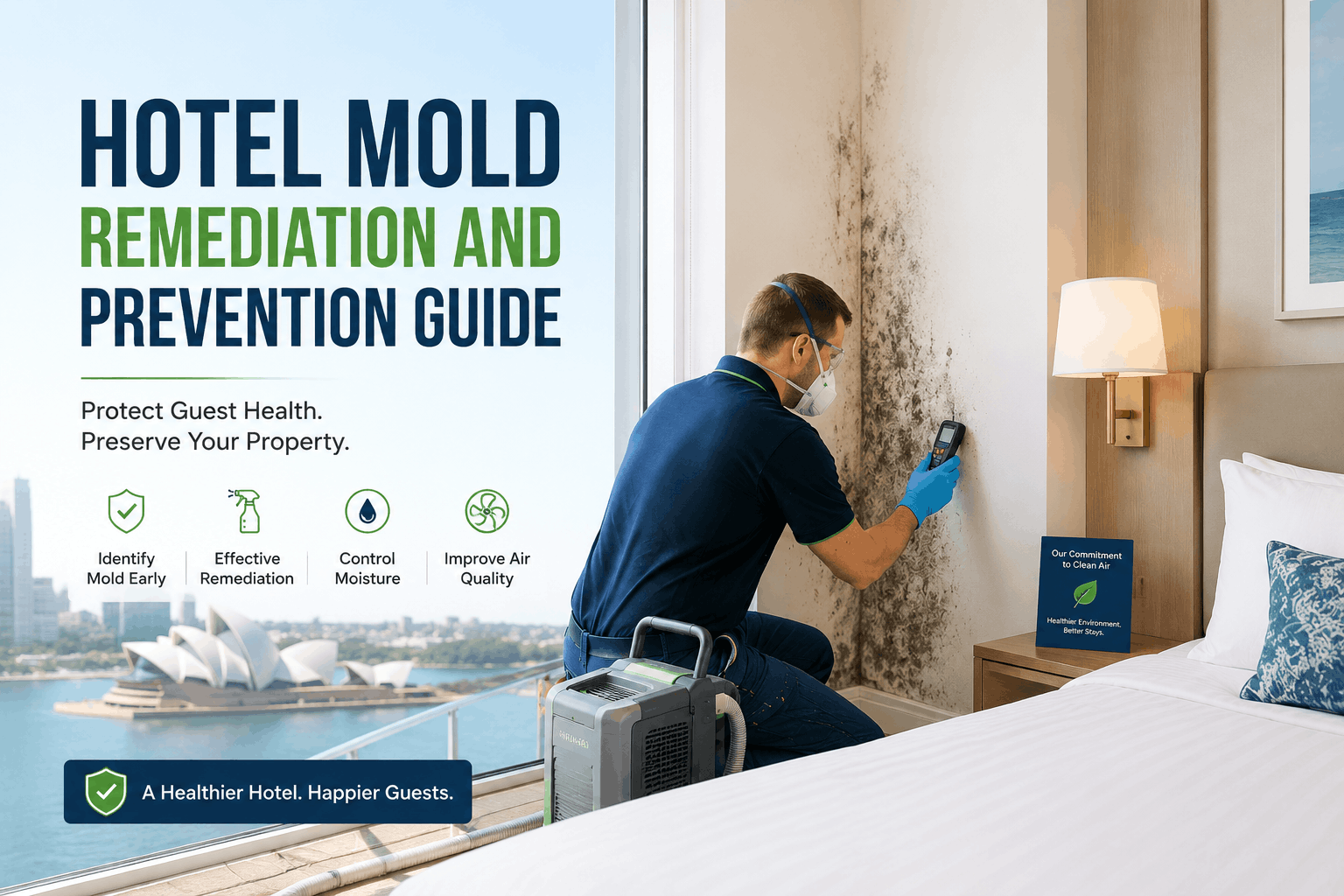
Mold in a hotel is not just a maintenance issue — it is a guest health liability, a brand reputation destroyer, and a property value eroder. A single guest complaint about "musty smell" or "visible mold in bathroom" can trigger negative TripAdvisor reviews, health department inspections, and in extreme cases, litigation that costs $50,000–500,000 per incident. Yet most hotels treat mold as an isolated cleaning issue rather than a systematic moisture management problem. OxMaint's water management and HVAC modules help engineering teams track moisture sources, schedule preventive inspections, and document remediation actions — turning mold management from a reactive crisis into a preventive safety program. This guide gives hotel engineers and property managers a practical framework to identify, remediate, and prevent mold — moisture source identification, HVAC cleaning protocols, water damage response, building envelope inspection, and dehumidification strategies — so guest health and property value are protected systematically.
HOTEL SAFETY · MOLD PREVENTION · 2026
Hotel Mold Remediation and Prevention Guide: Protecting Guest Health and Property Value
Moisture source identification, HVAC cleaning protocols, water damage response, building envelope inspection, dehumidification strategies, and remediation documentation — the complete guide to mold management for hotel engineering teams.
$50K–500KTypical cost of a guest mold-related liability claim
48–72 hrsCritical window to dry water intrusion before mold establishes
85%Of mold issues originate from unaddressed moisture sources
60%Reduction in mold-related guest complaints with systematic moisture monitoring
Where Mold Grows in Hotels — The 6 High-Risk Zones
Mold requires three conditions to grow: moisture, a food source (organic material), and time. Hotels provide all three in abundance. The six high-risk zones below represent the most common mold growth locations in hotel properties — and the moisture sources that feed them. OxMaint's mold risk assessment module helps engineering teams prioritize inspection and remediation efforts based on moisture risk scores per zone.
Guest Bathrooms
Moisture: Showers, humidity, leaks
High Risk Grout failure, missing caulk, inadequate exhaust fans, and steam condensation create ideal mold conditions. Most common mold location in hotels.
HVAC Systems
Moisture: Condensation, drain pan overflow
PM Critical PTAC units, AHUs, and ductwork with clogged drains, dirty coils, or inadequate insulation become mold reservoirs that distribute spores throughout the building.
Plumbing Chases & Walls
Moisture: Hidden leaks, condensation
Hidden Risk Leaking pipes within walls, poor insulation causing condensation, and failed waterproofing create hidden mold that grows undetected until visible damage appears.
Building Envelope
Moisture: Rain intrusion, condensation
Structural Roof leaks, window condensation, failed flashing, and poor exterior waterproofing allow moisture to enter wall cavities — often going undetected for years.
Carpet & Flooring
Moisture: Spills, high humidity, leaks
Common Carpet near entry doors, under windows, and in high-traffic areas traps moisture. Spills not properly dried create mold growth beneath the surface.
Kitchens & Laundry
Moisture: Steam, humidity, spills
High Humidity Commercial kitchens and laundries generate continuous moisture. Inadequate ventilation and extractor maintenance create persistent high-humidity environments.
Mold Prevention — The 5 Essential Moisture Control Strategies
Mold prevention is moisture control. If you control moisture, you eliminate the primary condition mold needs to grow. The five strategies below represent the highest-ROI moisture control measures for hotel properties. OxMaint's moisture control module schedules and tracks each of these strategies across your property — ensuring no moisture source goes unaddressed.
Mold Prevention — 5 Essential Moisture Control Strategies
Measured impact on mold risk reduction
1
HVAC System Maintenance
Clean coils, unclog drain pans, replace filters regularly, and ensure proper drainage. Dirty coils and clogged drains are the #1 source of HVAC-related mold. Quarterly PM reduces mold risk by 60%.
2
Building Envelope Integrity
Inspect roofs, windows, doors, and flashing annually. Repair leaks within 48 hours. Properly sealed building envelope prevents water intrusion — the primary moisture source for hidden wall mold.
3
Bathroom Exhaust Systems
Verify bathroom exhaust fans are operational and properly vented to exterior. Minimum 50 CFM per fixture. Clean fan grilles quarterly. Inadequate exhaust causes 40% of bathroom mold cases.
4
Humidity Monitoring & Control
Maintain indoor relative humidity between 30–50%. Use dehumidifiers in high-humidity zones (pool areas, basements, laundry). Continuous monitoring prevents mold-favorable conditions.
5
Rapid Water Damage Response
Respond to all water leaks within 2 hours. Dry affected areas within 48 hours. Document all water damage with photos and moisture readings. Speed of response determines mold growth.
Mold Remediation — The 6-Step Process
When mold is discovered, remediation must follow a structured process to ensure complete removal and prevent recurrence. The six-step process below follows industry standards (EPA, IICRC) for mold remediation in commercial buildings. OxMaint's remediation module documents each step with photos, moisture readings, and sign-off — creating the compliance record required for liability protection.
Step 1: Identify Source
Find the moisture source
Identify and eliminate the water source. Mold cannot be permanently removed without addressing the moisture that caused it.
Step 2: Containment
Prevent spore spread
Isolate affected area with plastic sheeting and negative air pressure. Prevents spores from contaminating other areas during removal.
Step 3: Removal
Remove contaminated materials
Remove and dispose of mold-contaminated porous materials (drywall, carpet, insulation). Non-porous surfaces can be cleaned.
Step 4: Cleaning
Clean all affected surfaces
Clean non-porous surfaces with antimicrobial solutions. HEPA vacuum all remaining surfaces. Verify cleanliness with visual inspection.
Step 5: Drying
Dry affected area completely
Dry all materials to <15% moisture content. Use dehumidifiers and air movers. Monitor moisture levels daily until dry.
Step 6: Verification
Post-remediation testing
Visual inspection, moisture readings, and air sampling (if required). Document clearance before reoccupying area.
Before vs. After: Mold Management Transformation
Mold Management Metric
Before (Reactive)
After (Proactive)
Mold-related guest complaints
12–18 per year
3–5 per year — 60–75% reduction
Water damage response time
24–72 hours (reactive)
2–4 hours (automated alerts)
HVAC mold inspections
Reactive — only when complaint
Quarterly — 100% coverage
Mold remediation cost per event
$5,000–15,000 (emergency)
$1,000–3,000 (planned)
Liability exposure
High — undocumented remediation
Low — documented compliance
"
We had four guest complaints about mold odors in one year — each one generated a negative review and required expensive emergency remediation. We realized we were responding to mold instead of preventing it. After implementing systematic moisture monitoring and quarterly HVAC inspections through OxMaint, we caught two roof leaks and three clogged PTAC drains before they caused mold growth. Mold complaints dropped from 14 in year one to 3 in year two. The prevention program paid for itself in avoided remediation costs and guest compensation alone.
Director of Engineering — 400-room Full-Service Hotel, US Southeast
Frequently Asked Questions — Hotel Mold Remediation and Prevention
What are the health risks of mold in hotels?
Mold exposure can cause respiratory issues, allergic reactions, asthma exacerbation, and in susceptible individuals, more severe health effects. Guests with pre-existing conditions are most vulnerable. Health department investigations typically require air sampling and may result in operational restrictions if elevated mold levels are found. Proactive prevention is less expensive than reactive response.
What moisture level prevents mold growth?
Maintain indoor relative humidity below 50% (30–50% recommended). Surface moisture readings should be below 15% on wood and drywall. Areas with persistent humidity above 60% require dehumidification or ventilation improvements. Continuous humidity monitoring provides early warning before mold-favorable conditions develop.
How quickly does mold grow after water exposure?
Mold can begin growing within 24–48 hours of water exposure. The critical window for drying is 48–72 hours — after that, visible mold growth is likely. This is why rapid water damage response is the most effective mold prevention strategy. Every water incident requires immediate attention and documentation.
How does a CMMS help with mold prevention?
A CMMS like OxMaint provides three mold prevention advantages: (1) Moisture tracking — schedules and logs humidity readings, water damage responses, and drying progress, (2) HVAC maintenance — ensures filters, coils, and drain pans are inspected and cleaned on schedule, (3) Documentation — creates a complete record of all moisture-related maintenance for liability defense and insurance claims.
Protect Guest Health and Property Value — Start Managing Moisture Today
OxMaint's mold prevention module tracks moisture sources, schedules HVAC inspections, and documents remediation actions — turning mold management from reactive crisis to proactive safety. Free to start.